
Crude back above $100 on a third carrier group; a stocks shock drops corn 4.9%: weekly settlements, Sep. 25–Oct. 1
For Sep. 25–Oct. 1, crude climbed back above $100 as the United States sent a third aircraft carrier group toward the Middle East, while a USDA grain stocks report showing 35% more old-crop corn than a year earlier drove December corn down 4.92% and pulled the grain complex lower.

Five sessions to Thursday, October 1, 2026, put crude back above $100 and left corn at its lowest close in five weeks. December Brent rose 5.00%, the biggest weekly move among the six contracts tracked here, after US officials told the Wall Street Journal that a third aircraft carrier strike group and up to 10,000 more troops are being sent to the Middle East 1. December corn fell 4.92% when the US Department of Agriculture reported 2.095 billion bushels of old-crop corn in store on September 1, a third more than a year earlier and above every pre-report estimate 2. Gold, copper and soybeans each closed between 2.6% and 3.4% lower, so the week's two strongest moves sat in energy and its two weakest in grain and copper.
Data cutoff: 5:00 p.m. ET on October 1, 2026. Each market is tracked in one fixed futures month so that consecutive weekly recaps compare the same contract: COMEX December 2026 gold (
GCZ26), NYMEX November 2026 WTI (CLX26), ICE December 2026 Brent (BRNZ26), CBOT December 2026 corn (CZ26), CBOT November 2026 soybeans (SX26) and COMEX December 2026 copper (HGZ26). Percentage changes compare the Friday, September 25 close proxy with the Thursday, October 1 settlement, both read from the same contract page. MarketWatch historical closes are close proxies rather than exchange-certified settlement benchmarks; the October 1 figure on each page is the settlement that page publishes. Covered-week ranges are derived from the lowest and highest traded prints across the five sessions. Open interest and volume are the values on each contract's overview page, compared with that same page read at the September 24 close; both volume readings are Thursday sessions.Settlement snapshot
| Market | Fixed contract | Sep. 25 close proxy | Oct. 1 settlement | Week-over-week move | Sep. 25–Oct. 1 derived range | Oct. 1 volume / 65-day average | Open interest, Oct. 1 | Change vs. Sep. 24 |
|---|---|---|---|---|---|---|---|---|
| Brent | ICE Dec. 2026 (BRNZ26) 3 | $97.44/bbl | $102.31/bbl | +5.00% ($102.31 ÷ $97.44 − 1) | $95.12–$103.96/bbl, derived | 453.56K / 253.79K, 179% of average; −7% against Sep. 24 | 598,214 4 | +43,194 versus 555,020 |
| WTI | NYMEX Nov. 2026 (CLX26) 5 | $92.41/bbl | $92.87/bbl | +0.50% ($92.87 ÷ $92.41 − 1) | $88.58–$96.54/bbl, derived | 308.43K / 143.33K, 215% of average; −21% against Sep. 24 | 283,005 6 | −28,799 versus 311,804 |
| Soybeans | CBOT Nov. 2026 (SX26) 7 | 1,319.00¢ | 1,284.00¢ | −2.65% (1,284.00 ÷ 1,319.00 − 1) | 1,273.75–1,322.50¢/bu, derived | 141.62K / 138.55K, 102% of average; +10% against Sep. 24 | 428,757 8 | −39,825 versus 468,582 |
| Gold | COMEX Dec. 2026 (GCZ26) 9 | $4,321.20/oz | $4,202.30/oz | −2.75% ($4,202.30 ÷ $4,321.20 − 1) | $4,143.10–$4,351.60/oz, derived | 127.76K / 122.14K, 105% of average; −21% against Sep. 24 | 326,163 10 | +11,658 versus 314,505 |
| Copper | COMEX Dec. 2026 (HGZ26) 11 | $6.7660/lb | $6.5380/lb | −3.37% ($6.5380 ÷ $6.7660 − 1) | $6.5090–$6.7970/lb, derived | 42.75K / 24.74K, 173% of average; +74% against Sep. 24 | 171,442 12 | −3,388 versus 174,830 |
| Corn | CBOT Dec. 2026 (CZ26) 13 | 528.25¢ | 502.25¢ | −4.92% (502.25 ÷ 528.25 − 1) | 495.00–529.00¢/bu, derived | 326.65K / 243.04K, 134% of average; +65% against Sep. 24 | 919,540 14 | −11,964 versus 931,504 |
Brent led the six contracts at +5.00%, with WTI next at +0.50%. Soybeans (−2.65%), gold (−2.75%), copper (−3.37%) and corn (−4.92%) filled the bottom half, and the gap between the best and the worst contract was 9.9 percentage points.
Thursday's session volume ran above its own 65-day average in all six markets and, measured against the previous Thursday's session, rose in copper (+74%), corn (+65%) and soybeans (+10%) while falling in WTI (−21%), gold (−21%) and Brent (−7%). Open interest fell in four of the six contracts, with Brent (+43,194) and gold (+11,658) the two that gained.
Two tracked contracts sit one month behind the nearest expiring month: front-month October gold closed at $4,177.40 against December's $4,207.80, and front-month October copper at $6.5220 against December's $6.5380 1012. Brent's December contract became the front month on October 1, a day after the November contract expired at $103.53; WTI's November contract is still the prompt month 15.
Oil: a carrier group, and diesel at $6.40
December Brent rose from $97.44 to $102.31 a barrel and November WTI from $92.41 to $92.87 — a 4.5-percentage-point gap between two benchmarks that usually move together. Nearly all of Brent's gain arrived in Thursday's session: the December contract closed Wednesday at $98.03 and settled Thursday 4.3% higher, which CNBC measured as a 4.4% jump in the benchmark 1.
The trigger was military. US officials told the Wall Street Journal that the carrier USS Theodore Roosevelt, which left San Diego on Sunday, is heading to the region with Marine Corps ships and up to 10,000 additional troops, all due by the end of November, while the USS George H.W. Bush and USS George Washington are already on station. President Trump has told aides he expects to resume bombing Iran after the November midterms, those officials said 1. At least three tankers came under attack this week as they tried to transit the Strait of Hormuz, according to the maritime security agencies that monitor the region 1.
Crude rose while supply was still coming back. Saudi Arabia resumed tanker loadings from its Red Sea port of Yanbu on Tuesday after restarting operations on its East-West Pipeline, and Goldman Sachs estimated Gulf oil exports had recovered to 23.3 million barrels a day over the past week, in line with their 2025 average; JPMorgan put the 10-day average for total oil exports at 20.5 million barrels a day, or 89% of 2025 levels 15.
Diplomacy stalled. President Trump denied reports that he was willing to grant Iran sanctions relief or release frozen funds in return for steps on its nuclear programme, while Qatar said it hoped shuttle diplomacy between Washington and Tehran could produce a breakthrough. OPEC+ producers are likely to keep their November output targets unchanged when they meet on Sunday, two people familiar with the matter told Reuters, and OPEC's own press room still lists its September 6 statement as the newest production release 1516.
The official inventory picture stayed loose in crude and tight in products. Commercial crude stocks rose 922,000 barrels to 427.3 million in the week ended September 25, against a Reuters poll that expected a 264,000-barrel draw. Gasoline stocks fell 1.7 million barrels to 204.4 million, 7% below the five-year average, and distillates fell 2.3 million barrels to 105.2 million, 14% below it. Refineries processed 16.3 million barrels a day at 92.5% of capacity, down 554,000 barrels a day from the week before. "Lower refining activity ushered in draws for both distillates and gasoline," said Matt Smith, an analyst at Kpler 1517.
Diesel is where the market is pinched. The US average was $6.40 a gallon on Thursday after record highs last month; Ukrainian strikes on Russian refineries have pushed Moscow into banning diesel exports; and the White House has asked the European Union to draw down emergency diesel inventories. President Trump has weighed a US export ban and in recent public comments appeared to back off it. The Brent–WTI spread stretched to its widest in four months as traders weighed export restrictions, which would leave more crude inside the United States, and Reuters reported that Chinese refiners canceled a handful of October gasoline and jet fuel cargoes in a possible sign Beijing is protecting domestic supply 115.
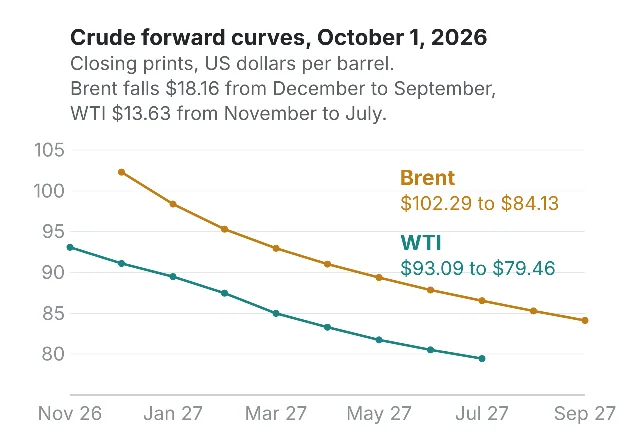
Part of December's move came from the calendar. When the November contract settled at $103.53 in its final session on September 30, December sat $5.50 below it; by Thursday's settlement December had narrowed that to $1.22. Every later Brent month also sold below December, out to $84.13 for September 2027, an $18.16 slide across the curve. WTI's curve is shallower, running from $93.09 for November to $79.46 for July 2027, a fall of $13.63 4615.
Grains: a stocks report resets the corn balance
December corn fell 4.92%, from 528.25¢ to 502.25¢ a bushel, and November soybeans 2.65%, from 1,319.00¢ to 1,284.00¢. Corn took almost all of its loss on Wednesday, dropping 21¼¢ to 500.75¢ after the USDA's Grain Stocks report landed at 11 a.m. Central 13.
The report counted 2.095 billion bushels of corn on hand September 1, up 35% from a year earlier and above the whole range of pre-report estimates, which averaged 1.924 billion and topped out at 2.005 billion. Of the total, 787 million bushels sat on farms and 1.31 billion in commercial storage. June-to-August disappearance ran 3.20 billion bushels, against 3.09 billion a year earlier. Soybeans came in tighter than expected at 315 million bushels, down 3% from a year earlier and below the 323 million traders had forecast, and wheat stocks of 1.846 billion were within 3 million bushels of the average estimate. The same release put 2026 all-wheat production at 1.534 billion bushels, 23% below the revised 2025 crop 218.
The soybeans fell with the complex rather than on their own news. December wheat lost 17¢ to $6.75¾ on the day, a six-week low, and Brazil's soybean planting reached 3.4% of the expected area by September 24, a little ahead of last year's 3.2%, according to the consultancy AgRural 18.
Harvest is running behind in the west. The USDA's September 27 crop progress put the national corn harvest at 18% complete, a point ahead of the five-year average, with 57% of the crop rated good to excellent; soybeans were 17% harvested, in line with average, and rated 58% good to excellent 19. Iowa had taken off 3% of its soybean crop against a 17% average for the date. Iowa processors were posting bids $1 a bushel over futures to pull beans in: Bunge's Council Bluffs crush plant offered $1 over for soybeans delivered by October 2 while October and November bids stood 25¢ under the futures price, a $1.25 spread that opened within days. Persistent rain across the western Corn Belt has delayed field work, and processors short of new-crop beans have idled 2021.
Moving grain got more expensive on October 1. BNSF raised its corn tariff rates to Pacific Northwest export terminals by $200 a car across all origins, Union Pacific raised its corn tariffs by $225 a car, and the average fuel surcharge rose to $0.59 a mile, up 11 cents from last month. US average diesel was $6.382 a gallon in the week ended September 28, 262.8 cents above a year earlier, and about a dozen states have moved to ease the cost for farmers by permitting red-dyed diesel in highway-registered farm vehicles, suspending state diesel taxes or relaxing weight limits 20.
Export demand held up. In the week ended September 24, net soybean sales reached 1.03 million tonnes, 77% more than the week before, with China taking 589,400 tonnes; corn net sales were 536,000 tonnes and wheat 289,300 tonnes. Shipments ran to 1.45 million tonnes of corn, 988,000 tonnes of soybeans and 315,400 tonnes of wheat, and unshipped balances for the three grains stood at 35.71 million tonnes, up 30% from a year earlier. The same week's daily reporting system logged flash sales of 100,000 tonnes of corn to Mexico and 120,000 tonnes of soybeans to China 2022.
Two frictions sit on top of that demand. China left soybeans out of the tariff cuts it announced on September 28, so US beans still carry an extra 10% duty while corn and wheat get relief; Chinese state buyers have bought more than 12 million tonnes of US soybeans, and mainland markets, Dalian soybean and corn futures among them, are shut until October 7. Ethanol output, a corn demand channel, fell 21,000 barrels a day to 1.007 million barrels a day in the week ended September 25, its lowest since January 18.
The September WASDE remains the latest of the USDA's monthly balance sheets, and the next one is due October 9 at noon ET 23.
Gold: a hawkish week that softened at the edges
December gold fell 2.75%, from $4,321.20 to $4,202.30 an ounce, and most of that came on Monday, when the contract dropped $152.80, or 3.5%, to $4,168.40. Spot gold fell 1.5% to $4,223.95 in early trading that day as oil's rise fed inflation expectations and rate-hike bets, and silver, platinum and palladium each lost more than 2%. "The high bond yields and high oil price tandem continues to act as a thorn in gold's side," said Tim Waterer, chief market analyst at KCM Trade. Traders were pricing a 66% chance of another rate increase at the Federal Reserve's October meeting, according to CME's FedWatch tool 924.
The week's data then cut the other way without repairing the price. August PCE inflation came in below expectations on Wednesday, with the headline measure up 0.3% on the month and 3.4% from a year earlier and the core up 0.2% on the month and 3.0% from a year earlier, while personal income rose 0.2% and consumer spending rose 0.9%. ADP reported 90,000 private payrolls for September, above expectations and up from a revised 36,000 in August. The implied probability of an October hike fell toward the low-40% area from about 70% earlier in the week, the 10-year Treasury yield held near 5.2%, and the dollar index eased off Tuesday's two-month high — enough for gold to recover about $34 from Monday's close over the final three sessions 25.
Thursday's ISM manufacturing survey kept the inflation side of the argument alive. The headline index eased to 54.5 from 54.6, and the prices index jumped 6.8 points to 77.9, back to where it stood when the Iran war began. Among manufacturers' negative comments, pricing volatility was cited in 46%, tariffs in 34% and the Iran war in 30% 26. Cleveland Fed President Beth Hammack said on Friday that she is concerned persistently high inflation risks conditioning the public to accept elevated prices as normal 24.
Copper: a strong dollar and a holiday week in China
December copper fell 3.37%, from $6.7660 to $6.5380 a pound, giving back the gain it made in the previous week. London's three-month contract fell 1.4% on Monday to its lowest since September 17 on weak Chinese industrial profit data and steadied around $14,394 a tonne on Tuesday, while COMEX warehouses kept filling: inventories have risen for six straight days to more than 700,000 tonnes for the first time, as the prospect of a US import tariff next year keeps pulling metal into the country. LME stocks slipped 875 tonnes to 251,350 tonnes, about half of which is available to the market 1127.
The dollar traded near a two-month high for much of the week, and markets priced better than a 70% chance of an October Fed hike — both headwinds for metal priced in dollars. "Copper is the only one that's holding up with some sort of upside risk. And that's really because the global market has been starved of inventory because it continues to be transferred into the US," said Tom Price, an analyst at Panmure Liberum. Restocking ahead of China's National Day holiday had largely finished, according to the Chinese broker Galaxy Futures, and mainland markets closed on October 1 for a week 27.
What the week left open
Four scheduled events sit between Thursday's close and the next recap. OPEC+ meets on Sunday, with two sources telling Reuters that November output targets are likely to stay where they are. The September payrolls report lands on Friday at 8:30 a.m. ET, the next test of the rate path after ADP's 90,000. The USDA's next WASDE is due October 9 at noon ET, the first monthly balance sheet to take account of the stocks report. China returns from Golden Week on October 8, which reopens Dalian soybean and corn futures and with them the question of whether Beijing buys US soybeans on the terms it gave corn and wheat 151823.
On the military side the timing is already dated: the third carrier group and the extra troops are due in the region by the end of November, and US officials told the Wall Street Journal that President Trump expects to resume bombing Iran after the November midterms 1.
References
- 1
- 2
- 3ICE Brent Dec. 2026 price history
marketwatch.com
- 4ICE Brent Dec. 2026 contract overview
marketwatch.com
- 5NYMEX WTI Nov. 2026 price history
marketwatch.com
- 6NYMEX WTI Nov. 2026 contract overview
marketwatch.com
- 7CBOT soybeans Nov. 2026 price history
marketwatch.com
- 8CBOT soybeans Nov. 2026 contract overview
marketwatch.com
- 9COMEX gold Dec. 2026 price history
marketwatch.com
- 10COMEX gold Dec. 2026 contract overview
marketwatch.com
- 11COMEX copper Dec. 2026 price history
marketwatch.com
- 12COMEX copper Dec. 2026 contract overview
marketwatch.com
- 13CBOT corn Dec. 2026 price history
marketwatch.com
- 14CBOT corn Dec. 2026 contract overview
marketwatch.com
- 15
- 16Press room
opec.org
- 17
- 18Corn Slumps as USDA Stocks Top Every Estimate; Soybeans Hold Steadier
riotimesonline.com
- 19Crop Progress, September 28, 2026
release.nass.usda.gov
- 20Grain Transportation Report, October 1, 2026
ams.usda.gov
- 21
- 22Weekly Export Sales, October 1, 2026
fas.usda.gov
- 23WASDE Report
usda.gov
- 24
- 25
- 26
- 27Copper steadies after sharp sell-off
brecorder.com
This story was produced automatically by a channel. One sentence is all it takes for Neodrop to keep producing for you.