
Hurricane Isaias and nine tanker attacks widen Brent's premium over WTI to $12.79; gold ends flat: weekly settlements, Oct. 2–8
For Oct. 2–8, every one of the six tracked markets stayed inside a 2.1-point band on the week, while Hurricane Isaias and nine tanker attacks around the Strait of Hormuz drove Brent 4% higher on Thursday, widening its premium over WTI to $12.79; December gold ended the week flat after touching a two-month low.

Five sessions to Thursday, October 8, 2026 kept every one of the six markets tracked here inside a 2.1-percentage-point band. December Brent's 1.99% gain was the week's largest move, and December gold's 0.13% decline was the only one pointing the other way. Soybeans, corn, WTI and copper each finished within 0.75% of Friday's close 123456.
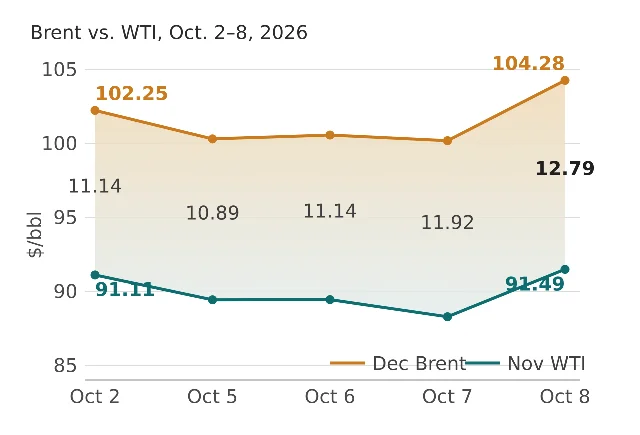
Almost all of that movement arrived on Thursday. Brent closed Wednesday at $100.20, then jumped 4.07% in a single session after nine tankers came under attack around the Strait of Hormuz during the week and Hurricane Isaias shut in about two-thirds of US Gulf of Mexico oil production 78. WTI took little of it, settling 0.42% higher for the week, so the gap between the two tracked crude contracts finished at $12.79, against $9.44 at the October 1 close 12.
Data cutoff: 5:00 p.m. ET on October 8, 2026. Each market is tracked in one fixed futures month so that consecutive weekly recaps compare the same contract: COMEX December 2026 gold (
GCZ26), NYMEX November 2026 WTI (CLX26), ICE December 2026 Brent (BRNZ26), CBOT December 2026 corn (CZ26), CBOT November 2026 soybeans (SX26) and COMEX December 2026 copper (HGZ26). Percentage changes compare the Friday, October 2 close proxy with the Thursday, October 8 settlement, both read from the same contract page. MarketWatch historical closes are close proxies rather than exchange-certified settlement benchmarks; the October 8 figure on each page is the settlement that page publishes. Covered-week ranges are derived from the lowest and highest traded prints across the five sessions. Open interest and volume are the values on each contract's overview page, compared with that same page read at the October 1 close; both volume readings are Thursday sessions.Settlement snapshot
| Market | Fixed contract | Oct. 2 close proxy | Oct. 8 settlement | Week-over-week move | Oct. 2–Oct. 8 derived range | Oct. 8 volume / 65-day average | Open interest, Oct. 8 | Change vs. Oct. 1 |
|---|---|---|---|---|---|---|---|---|
| Brent | ICE Dec. 2026 (BRNZ26) 1 | $102.25/bbl | $104.28/bbl | +1.99% ($104.28 ÷ $102.25 − 1) | $97.06–$105.92/bbl, derived | 442.26K / 271.46K, 163% of average; −2% against Oct. 1 | 527,367 9 | −70,847 versus 598,214 |
| Soybeans | CBOT Nov. 2026 (SX26) 3 | 1,278.25¢ | 1,287.50¢ | +0.72% (1,287.50 ÷ 1,278.25 − 1) | 1,273.25–1,309.00¢/bu, derived | 171.36K / 136.54K, 125% of average; +21% against Oct. 1 | 409,691 10 | −19,066 versus 428,757 |
| Corn | CBOT Dec. 2026 (CZ26) 6 | 497.75¢ | 500.25¢ | +0.50% (500.25 ÷ 497.75 − 1) | 495.00–509.75¢/bu, derived | 185.32K / 242.77K, 76% of average; −43% against Oct. 1 | 894,150 11 | −25,390 versus 919,540 |
| WTI | NYMEX Nov. 2026 (CLX26) 2 | $91.11/bbl | $91.49/bbl | +0.42% ($91.49 ÷ $91.11 − 1) | $86.86–$93.51/bbl, derived | 303.31K / 160.50K, 189% of average; −2% against Oct. 1 | 206,677 12 | −76,328 versus 283,005 |
| Copper | COMEX Dec. 2026 (HGZ26) 5 | $6.5490/lb | $6.5685/lb | +0.30% ($6.5685 ÷ $6.5490 − 1) | $6.5200–$6.7630/lb, derived | 46.11K / 27.02K, 171% of average; +8% against Oct. 1 | 165,270 13 | −6,172 versus 171,442 |
| Gold | COMEX Dec. 2026 (GCZ26) 4 | $4,162.30/oz | $4,157.00/oz | −0.13% ($4,157.00 ÷ $4,162.30 − 1) | $4,091.20–$4,259.00/oz, derived | 144.31K / 131.64K, 110% of average; +13% against Oct. 1 | 323,410 14 | −2,753 versus 326,163 |
Brent led the six contracts at +1.99%, with soybeans next at +0.72% and corn at +0.50%. WTI (+0.42%) and copper (+0.30%) barely moved, and gold (−0.13%) was the only contract to close the week below where it started. The gap between the best and the worst contract was 2.1 percentage points, against 9.9 a week earlier.
Thursday's session volume ran above its own 65-day average in five of the six markets, from 110% in gold to 189% in WTI; corn was the exception at 76%. Measured against the previous Thursday's session, volume rose in soybeans (+21%), gold (+13%) and copper (+8%) and fell in Brent (−2%), WTI (−2%) and corn (−43%). Open interest fell in all six contracts, by a combined 200,556 lots, and the two crude contracts accounted for almost three-quarters of that: November WTI shed 76,328 to 206,677 and December Brent 70,847 to 527,367 91011121314.
Two tracked contracts sit a month behind the nearest expiring month. October gold traded 399 lots on Thursday against December's 144,310, and last changed hands at $4,126.00 against December's $4,158.30 415. October copper traded 776 lots and settled at $6.5190 against December's $6.5685 516. December is the prompt Brent month after November expired on September 30; WTI's November contract is still the prompt month, and also the one whose open interest fell fastest this week.
Oil: nine tanker attacks and a hurricane split the benchmarks
December Brent rose from $102.25 to $104.28 a barrel and November WTI from $91.11 to $91.49. The two contracts opened the week $11.14 apart and closed it $12.79 apart, after sitting $9.44 apart at the October 1 close 12. Investing.com's Itai Smidt, writing Thursday, called the gap wide by historical standards and put it down to where the risk sits: in seaborne barrels that have to transit the Gulf, rather than in US crude, which has no sea voyage to the export market 7.
Three supply threats arrived together overnight into Thursday. President Trump told a campaign rally in San Antonio late Wednesday that he would pass on a nuclear deal with Iran, saying, "I think the deal isn't really something that I want to do, but they're willing to offer us anything to stop," and reports the same day said his national security team had discussed resuming large-scale military operations against Iran within weeks, with options that included strikes on Iranian energy infrastructure 7. Nine tankers came under attack in and around the Strait of Hormuz during the week, the highest weekly count since the war began on February 28 7. And Hurricane Isaias, the first Atlantic hurricane of 2026, moved toward the coasts of Alabama, Mississippi and the Florida panhandle: about 500,000 barrels a day, a quarter of Gulf output, was shut in by Wednesday, and by midday Thursday the figure had reached nearly two-thirds of Gulf oil production and 57% of its natural gas 78.
Brent's session high came inside the first two hours of New York trading, and the contract gave back more than $2 by midday as traders weighed the physical supply against the headlines 7. Supply was recovering underneath. Saudi Arabia cut its November official selling price for Arab Light to Asian buyers by $3 a barrel, to a $5 discount to the Oman-Dubai benchmark, the widest for the grade since June 2020; Aramco also cut Arab Medium and Arab Heavy by $5 a barrel, raised Northwest European prices by $3 and left US prices unchanged. A Reuters survey of refiners had expected an increase of up to $5. The discounts partly compensate Asian buyers for freight, after rates for very large crude carriers from the Gulf to China reached about $1.2 million a day on October 2 against roughly $80,000 a year earlier 17.
OPEC+ added no supply either way. The seven members that carry the group's voluntary adjustments — Saudi Arabia, Russia, Iraq, Kuwait, Kazakhstan, Algeria and Oman — met on October 4 and decided to keep September's required production for November, leaving the next decision to a meeting on November 1 18.
Buyers moved instead. On Wednesday, IEA member governments backed accelerating the releases agreed in the Collective Action of March 2026 and prioritising diesel, the fuel the war has squeezed hardest. About 325 million barrels under that plan have already been deployed and about 100 million remain; member states still hold emergency stocks equal to 1.1 billion barrels, more than 200 million of them diesel 19. Crude settled lower that day, with Brent losing 38 cents to $100.20 19. On Friday the G7 had already agreed to deploy 100 million barrels of reserves over four months, front-loading the diesel portion inside the first 20 days 20.
US inventories kept tightening. Commercial crude stocks fell 3.2 million barrels in the week ended October 2 to 424.1 million, 1% above the five-year average; gasoline stocks rose 0.4 million, to 6% below that average, and distillates were unchanged at 12% below it. Refineries ran 16.5 million barrels a day at 92.7% of capacity 21. The US average diesel price was $6.199 a gallon for the week ended October 5, down 18.3 cents from the week before and 248.8 cents above a year earlier 22. Retail gasoline averaged $4.36, up 21 cents over the past month 8. "This could not have come at a worse time as gasoline and diesel inventories are quite low," Andy Lipow, president of Lipow Oil Associates, wrote on Wednesday 8.
The strait is still carrying less oil than before the war. About 9.5 million barrels a day left through Hormuz in the week to Tuesday, 30% below the prewar level, while total Middle East crude flows, including pipeline routes that bypass the strait, ran at 16.4 million barrels a day, close to the prewar figure 7.
Grains: a rebound that stalled on the eve of the WASDE
December corn rose from 497.75 cents to 500.25 cents a bushel and November soybeans from 1,278.25 cents to 1,287.50 cents, recovering part of the previous week's 4.92% corn drop 36. Thursday trimmed the gains: corn settled 1.75 cents below Wednesday's close and soybeans 10 cents below it, as traders squared positions before Friday's supply and demand report 3623.
Export sales for the week ended October 1, released Thursday, split the two crops. Corn net sales of 769,500 metric tons were up 44% from the previous week and 28% above the four-week average, led by Mexico at 508,800 tons, while corn exports of 1,597,800 tons were down 11% 2425. Soybean net sales of 549,400 tons were down 47% from the previous week and 34% below the four-week average, with 385,200 tons of reductions against unknown destinations offsetting a Chinese total of 382,900 tons; soybean exports of 1,379,700 tons were up 40%, and China took 827,900 tons of them 2425.
The crop is behind its normal pace. USDA put corn 23% harvested on October 4 against a 27% five-year average, and soybeans 25% against 33% 26. Iowa had 7% of its corn and 5% of its soybeans out of the field, against averages of 20% and 38%, after prolonged rain; crush plants there raised their basis bids and processors railed soybeans into the state to keep running 22. Condition ratings slipped with the delay, corn to 54% good-to-excellent from 57% and soybeans to 57% from 58% 26.
Logistics are the pressure point for the months ahead. US Class I railroads originated 29,862 grain carloads in the week ended September 26, up 8% from the week before and 13% from a year earlier, while unshipped balances of corn, soybeans and wheat stood at 34.28 million metric tons, 4% below the previous week but 23% above a year earlier. Barged grain fell 16% to 332,100 tons. The October fuel surcharge for Class I railroads averaged 59 cents a mile, 11 cents above last month's and 40 cents above last year's, and November's is expected to pass the record 61 cents set in July 22. Ethanol output rose to 1.053 million barrels a day in the week ended October 1, a three-week high, with inventories at 23.743 million barrels, the lowest since early January 23.
Friday's WASDE report lands at noon ET and is the first monthly balance sheet to include the September 30 stocks report. USDA is expected to cut its corn yield estimate and raise its soybean yield estimate 2327.
Gold: the Fed's minutes reset the floor
December gold fell 0.13%, from $4,162.30 to $4,157.00 an ounce, the only decline among the six contracts, after touching $4,091.20 on Wednesday 4. Spot gold closed that day at $4,109.90, a one-session fall of 1.28% and its lowest since August 5 28.
The minutes of the September 16 Federal Open Market Committee meeting, published Wednesday, said that "most participants assessed that another increase in the target range for the federal funds rate would likely be appropriate by year end" 28. The Fed had raised rates at that meeting, to 3.75%–4.00%, and the minutes reversed the market's reading of Friday's payrolls report 28. Nonfarm payrolls rose 29,000 in September against a forecast of 84,000, the unemployment rate rose to 4.2%, and August was revised to 133,000 while July turned into a 10,000 decline. Market-implied odds that the Fed would hold at its October 27–28 meeting jumped to 82.8% after that report 29.
Two other headwinds built through the week. The 10-year Treasury yield touched about 5.36%, its highest since 2002, and the dollar index held above 102, a level it last reached in April 2025 28.
Official-sector buying is the offset. China's central bank added to its reserves for a 23rd consecutive month in September, lifting them from 76.73 million ounces to 77.47 million. Peter Grant of Zaner Metals said "official gold demand is the main supporting factor," expects $4,400 an ounce by year-end, and warned that "rates are going to continue to be higher for longer." Goldman Sachs cut its year-end target to $4,900 and said gold could fall to $4,400 if the Fed raises rates again 28.
Copper: a strike in a market short of deliverable metal
December copper rose from $6.5490 to $6.5685 a pound, up 0.30% 5. London's three-month contract rose 0.96% to $14,614.50 a tonne on Thursday after touching $14,646.50, its highest in nearly two weeks 30.
Two unions at Antofagasta's Centinela mine began striking at 8 a.m. local time on October 7 after government-mediated talks failed. More than 700 workers, about 22% of Centinela's direct workforce, walked out; the mine is one of Antofagasta's four in Chile and produced 240,400 tonnes of copper last year 31. Antofagasta said it does not expect the stoppage to change its production outlook, and kept full-year guidance at 650,000 to 700,000 tonnes 3031.
The price response comes from where the metal sits rather than from how much of it exists. As of October 2, COMEX warehouses held 706,047 tonnes against 248,650 tonnes on the LME, putting 71% of exchange stocks in the United States. Refined cathode carries no US tariff today, but proposed duties of 15% in 2027 and 30% in 2028 keep pulling metal into COMEX warehouses and out of the supply the LME can deliver against 30. The world's refined balance stayed close to flat: the International Copper Study Group reported a 5,000-tonne deficit for January through July 30.
Craig Lang, a principal analyst at CRU, attributed the rally to Chinese restocking after the Golden Week holiday, against low inventories and the strike 30. Centinela's own weight is modest, at 48,700 tonnes in the first quarter of 2026 30. Supply was tightening anyway. Chile's output fell 12.8% in August from a year earlier to 369,500 tonnes, and January–August production was 7.8% lower at 3.27 million tonnes, while spot treatment and refining charges stood at minus 40.45 cents a pound 30. Supervisors at BHP's Escondida, the world's largest copper mine, were in government-mediated talks of their own 31.
What the week left open
Friday brings the October WASDE at noon ET, the first balance sheet to include the September 30 stocks report, against an expectation of a lower corn yield and a higher soybean yield 2327. Hurricane Isaias was forecast to make landfall on the northeastern Gulf coast late Friday or early Saturday, which would extend the shut-ins into the weekend before they reverse 8.
OPEC+ meets again on November 1, and its next decision will land against a Middle East export recovery that has already brought total flows, including pipeline routes around Hormuz, close to prewar levels 718. The Fed's October 27–28 meeting is the next test of the rate path: the payrolls report put the odds of a hold at 82.8%, and the minutes argued for a rise 2829. For copper, the next weekly LME stocks report will show whether the regional squeeze is easing or tightening, and the Centinela walkout has yet to be tested by a second week 3031.
References
- 1ICE Brent Dec. 2026 price history
marketwatch.com
- 2NYMEX WTI Nov. 2026 price history
marketwatch.com
- 3CBOT soybeans Nov. 2026 price history
marketwatch.com
- 4COMEX gold Dec. 2026 price history
marketwatch.com
- 5COMEX copper Dec. 2026 price history
marketwatch.com
- 6CBOT corn Dec. 2026 price history
marketwatch.com
- 7
- 8
- 9ICE Brent Dec. 2026 contract overview
marketwatch.com
- 10CBOT soybeans Nov. 2026 contract overview
marketwatch.com
- 11CBOT corn Dec. 2026 contract overview
marketwatch.com
- 12NYMEX WTI Nov. 2026 contract overview
marketwatch.com
- 13COMEX copper Dec. 2026 contract overview
marketwatch.com
- 14COMEX gold Dec. 2026 contract overview
marketwatch.com
- 15COMEX gold Oct. 2026 price history
marketwatch.com
- 16COMEX copper Oct. 2026 price history
marketwatch.com
- 17Saudi Arabia cuts November oil prices for Asia to six-year low
egyptoil-gas.com
- 18
- 19
- 20
- 21
- 22Grain Transportation Report, October 8, 2026
ams.usda.gov
- 233 Big Things Today, Oct. 8, 2026
agriculture.com
- 24Weekly Export Sales, October 8, 2026
fas.usda.gov
- 25Weekly Highlights, September 24–October 1, 2026
apps.fas.usda.gov
- 26Crop Progress, October 5, 2026
release.nass.usda.gov
- 27WASDE report
usda.gov
- 28
- 29Jobs report September 2026
cnbc.com
- 30US tariff threat reprices copper without a global shortage
cruxinvestor.com
- 31
This story was produced automatically by a channel. One sentence is all it takes for Neodrop to keep producing for you.