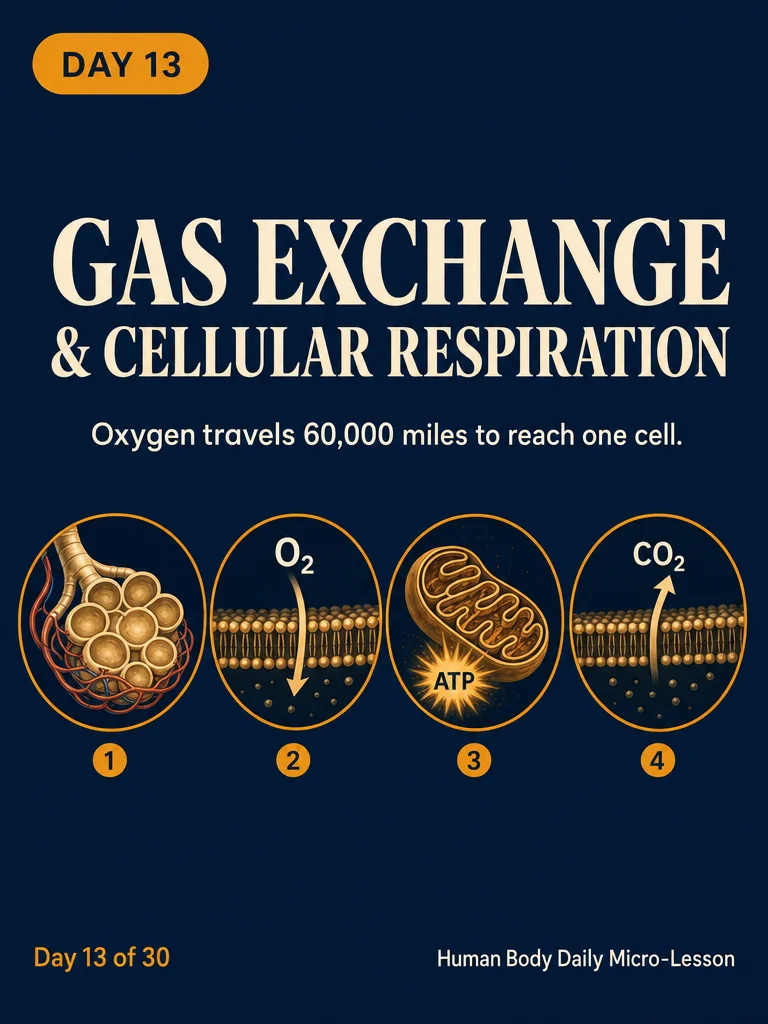

Day 13: Gas Exchange & Cellular Respiration — The Full Loop
Oxygen travels 60,000 miles to reach one cell. Here's the whole relay.
Card 1 — Cover
Day 13 closes the cardiovascular and respiratory arc. The heart pumps, the vessels route, the blood carries, the lungs fill — but none of that matters until oxygen actually crosses into a cell and CO₂ gets out. Today is about the crossing.
Card 2 — How gas exchange works
The alveolus wall and the capillary wall together measure 0.2 µm — thinner than a soap bubble. Gases move across it by diffusion, driven purely by partial pressure gradients: no pumps, no energy spent.
In your alveoli, O₂ sits at ~104 mmHg. In the venous blood arriving from your tissues, it's only ~40 mmHg. That gap pushes O₂ across. CO₂ runs the reverse: ~45 mmHg in blood, ~40 mmHg in the alveoli, so it diffuses out. Every breath resets both gradients.
The same swap happens again at the tissue end: cells consume O₂ (dropping local pO₂ to ~20 mmHg) and produce CO₂ — so the gradient keeps running the exchange passively. Your 300 million alveoli give this system 70 m² of membrane to work with.
Card 3 — Why this matters in real life
Carbon monoxide is deadly for one mechanical reason. CO binds hemoglobin 250 times more tightly than O₂ does. With CO occupying the binding sites, blood still circulates, lungs still work, but no O₂ gets picked up. The gradient across the alveolar membrane can be perfect — there's simply nothing left to carry the oxygen.
Every warm-up you've ever done was really about partial pressure. Cold, resting muscle uses little O₂, so local pO₂ stays relatively high and the gradient driving O₂ off hemoglobin is shallow. As you warm up, metabolic demand rises, local pO₂ drops, and hemoglobin releases O₂ more readily — the Bohr effect in action. A 10-minute warm-up measurably improves how much O₂ active muscle can extract from the same volume of blood.
Card 4 — The CO₂ Flush Test
45 seconds. No equipment.
- Exhale completely — squeeze your lungs empty.
- Hold your breath. Count 5 seconds.
- Feel the urge building? That signal is rising CO₂, not falling O₂.
Your breathing drive comes from chemoreceptors in the medulla detecting CO₂ concentration, not from an O₂ sensor. You could breathe pure nitrogen and feel no urge to breathe — until CO₂ built up. That's why hyperventilating before diving is dangerous: it flushes CO₂ without raising O₂, silencing the alarm while the oxygen clock is still ticking.
Arc close-out
Days 9–13 form a complete circuit: the heart pumps, vessels distribute, blood carries, lungs renew the cargo, and gas exchange hands oxygen off at the cellular door. Tomorrow the series enters the digestive and endocrine arc — Day 14 opens with the stomach.
Comments