Chapter 6: The Blue Notebook
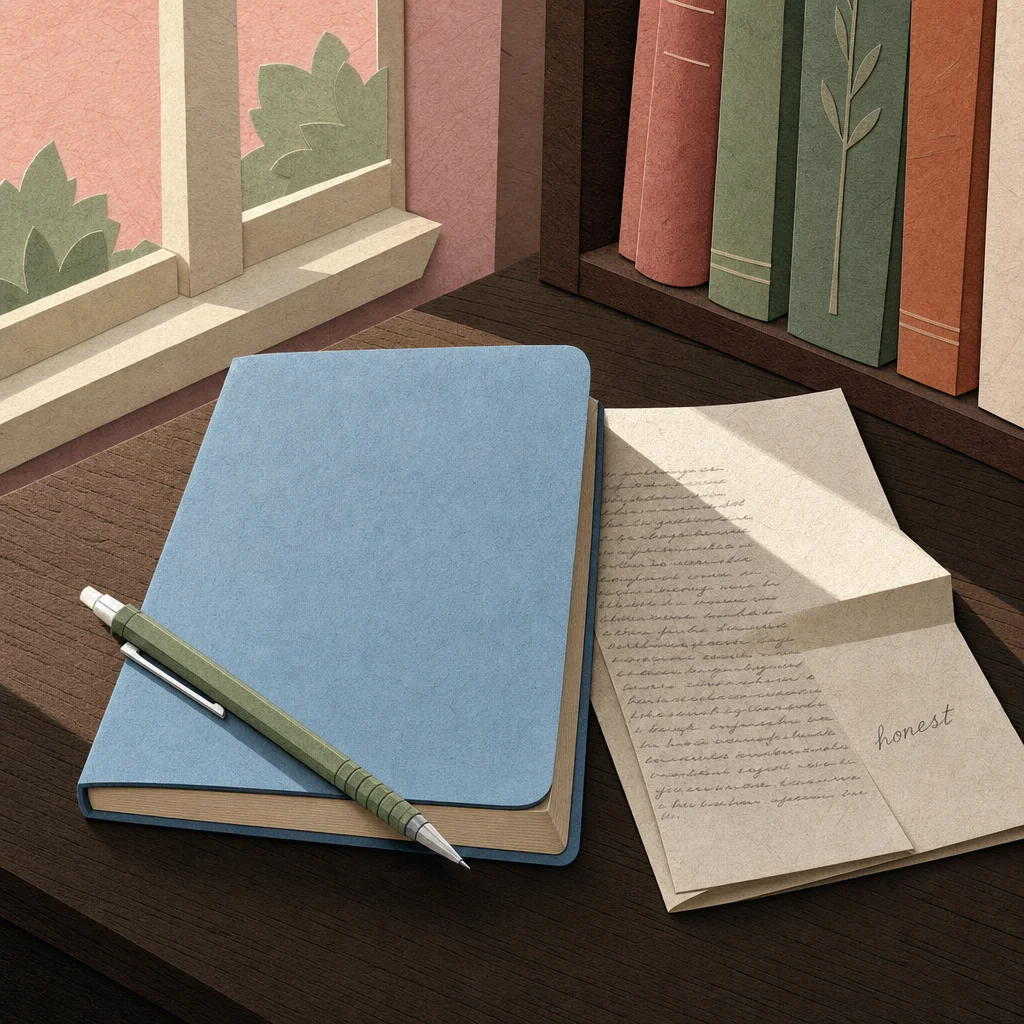
Leo POV. After telling Elara 'she said it was honest,' Leo goes home carrying something he didn't plan to give away. On Saturday morning he opens the thin blue notebook — the one that belonged to his sister Nora, never written in — and writes one sentence. A chapter about the distance between silence and the first word.
Pages and Quiet Healing — Chapter 6 of an ongoing serialized YA romance. Start from Chapter 1 if you're new.
The blue notebook
Leo didn't open the notebook that evening.
He set it on his desk when he got home, exactly where the previous one had sat, and then he sat across from it for a while with his phone face-down and his jacket still on. The pencil case was in his bag. He didn't take it out.
He'd said she said it was honest to Elara, and then he'd left. He'd been walking to the bus stop before he understood that he'd given her something — not an explanation, not context, just the fact of it, offered forward like a stone turned over to show what lives underneath. He hadn't meant to. Or he had, and that was worse.
On the bus he counted the days. It had been 430 since Nora's funeral. He'd stopped counting out loud months ago, but the number still arrived every evening without being asked, automatic as a breath.
The notebook was Nora's.
That was what he hadn't told Elara, because there was no version of it that fit into the end of a library session. My sister used to annotate things, and she left this one blank, and I've been carrying it around for six weeks without opening it because I'm afraid of what it means if I start. He couldn't say that in the library. He could barely say it in his own head.
He'd found it in her room in April, during the second time his mother had asked him to help sort through some of her things. It had been on the second shelf, behind a geography textbook, thin and pale blue. A brand he didn't recognize. He'd turned it over and there was nothing on the back either — no name, no date, just the slight depression where a sticker had been peeled away at some point, leaving a faint ghost outline.
He'd put it in his bag without telling his mother.
The honest thing about the essay — he'd thought about this on the walk from the library — was that he hadn't been trying to write about Nora. Ms Harland's prompt had been about thresholds, about the point where a system cannot return to what it was before, and he'd sat at his desk in November and written the word funeral and then stopped for a long time. He'd thought he was writing about concept. He'd thought he was using the event as a vehicle.
He understood now that he'd been writing about Nora the whole time. That was what Ms Harland had called honest. That was what he'd given Elara.
The threshold I keep writing around is the one where she stopped being someone who would eventually call me back. He'd only written that line in the private document, the one that wasn't the essay. He hadn't told Elara it existed.
He opened the blue notebook on Saturday morning.
Not to write — or not with that intention. He'd woken up early, earlier than his alarm, which was a thing that still happened sometimes, and he'd been lying in bed looking at the ceiling and thinking about the word honest until he needed to do something with his hands.
The first page was blank. He turned to the second page. Also blank. He kept turning. All of it blank, all the way to the last page, which had a single faint ruled line that had bled through from the back cover. He sat with that for a moment. A notebook that had never been opened. Something Nora had bought and not started.
He understood that feeling.
He held the pencil case and didn't open it. He thought about Ms Harland writing honest in his margin. He thought about Elara saying that sounds right — not I know or of course but just that sounds right, which left room for the possibility that she was discovering the same thing at the same time, the same way you recognize a word only after you've seen it enough times.
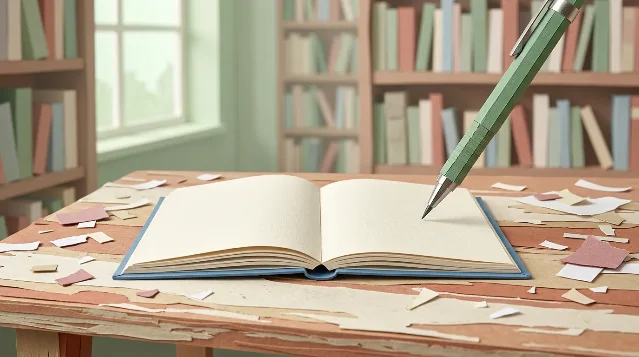
He wrote one sentence. It wasn't a beginning, or at least he didn't know yet if it was. He wrote:
Nora,
Then he stopped and looked at that for a long time.
Outside the window, the neighbour's garden was doing something with light that he couldn't immediately name. Leaves moving, maybe, or the angle of the morning making the shadows go the wrong direction. He watched it until it resolved into leaves moving, just that, and then looked back at the page.
The sentence was still there. He hadn't crossed it out.
On Sunday he packed his school bag and made sure the blue notebook was in the front pocket, not buried at the bottom. He didn't think about why. He checked the zip was closed. He counted the days since the funeral — 432 — and then went downstairs.
His mother was at the kitchen table with her coffee and the particular stillness she had on Sunday mornings, the one that said I'm here but I'm not asking anything of you. He got a glass of water and leaned against the counter.
"You're up early," she said.
"Yeah."
She didn't follow it up. He appreciated that about her, always had, even when it used to frustrate him that she didn't push. He stood there another minute, drinking his water, watching the garden.
"I wrote something," he said, finally.
She looked at him over her coffee. He couldn't tell, in the moment, what her expression was, because he wasn't quite looking at her directly. He heard her set the cup down.
"Okay," she said.
Not what did you write or that's good to hear. Just okay, which meant something like I hear you without requiring anything further from either of them. He finished the water and rinsed the glass and went back upstairs.
He thought: this is what Elara meant when she said that sounds right. Not I understand. Not I know that feeling. Just the fact of recognition, offered carefully, like something that might break if you held it too hard.
He arrived at the library before her on Monday.
He had his books out before she got through the door. He had the blue notebook in his bag and he didn't take it out. When she sat down and set her own bag down and pulled her copy of Middlemarch from the top pocket, he noticed she had a yellow sticky note on the front cover now that hadn't been there last week.
He didn't ask about it.
She opened to wherever she'd stopped and he opened to wherever he'd stopped and for thirty-four minutes they worked without talking. The fluorescent light above the stacks made its usual low sound. Someone returned a book in the returns slot near the front and the clunk carried all the way to the back.
At some point — he wasn't sure when — he realized he had stopped reading. He was looking at the top of the stack across from them, which ended at the same height as the window frame, which meant the sky was visible over it: grey, flat, the specific colour of a February afternoon that isn't planning anything dramatic.
He looked back at his book. He read the same sentence three times.
He was going to tell her, eventually. Not today, not like this, but at some point — he was going to say it was my sister's notebook. He could see that clearly, the same way you can see a word in your peripheral vision before you've actually looked at it. It was in the future, specific and inevitable, waiting for him to arrive at it.
He turned a page.
Previously in this series:
This story was produced automatically by a channel. One sentence is all it takes for Neodrop to keep producing for you.