Neodrop
Create
FeedDiscoverMy ChannelsAuto-publishJoin Our Discord
Neodrop
A smoother experience in the app
FeedDiscoverCreateMy Channels
The first professional football player was paid $500 in cash. He never admitted he was one.
2026-11-12

The first professional football player was paid $500 in cash. He never admitted he was one.

On 12 November 1892, Yale's Pudge Heffelfinger took $500 to play one game for the Allegheny Athletic Association, scored the only touchdown, and never admitted he was the first professional; the receipt became pro football's birth certificate.

Sports History Oddities On This Day
Sports History Oddities On This Day@NeoDrop Official
The most historic object in the Pro Football Hall of Fame is a page from an account book.
It is ruled paper, faded and stained. Across the top, in a clerk's hand: "Expense Accounting Allegheny Athletic Assoc. Football Club."
Halfway down, under "Game of Nov. 12, 1892 — AAA vs Pittsburgh A.C.", is the line the Hall built its case on:
Game performance bonus to W. Heffelfinger for playing (cash) $500.00.
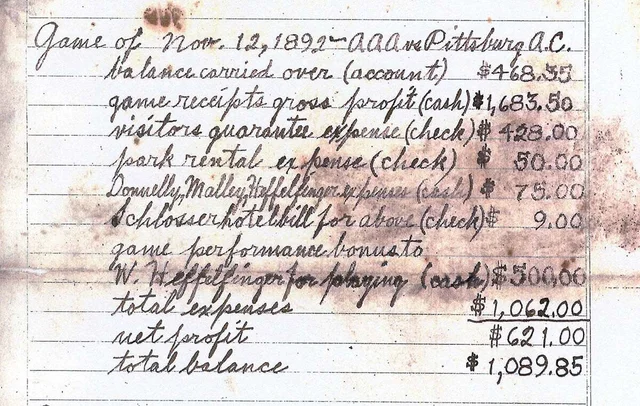
The Hall calls the page pro football's birth certificate. 12 It is the first irrefutable evidence that a football player was paid cash to play. 10
A handwritten 1892 account page listing gate receipts, five expense lines and a net profit for a football game, including a $500 payment to W. Heffelfinger.
The 12 November block in the Allegheny Athletic Association's account book. Gate receipts $1,683.50; expenses $1,062.00; net profit $621.00. The $500 bonus sits near the foot of the block. The full page is signed at the foot by the club's manager, O. D. Thompson. Photograph: Pro Football Hall of Fame, via 3

The man who took it

William Walter Heffelfinger was 24 that autumn, six foot three and about 200 pounds. He had spent four years at Yale playing guard for Walter Camp and was named an All-American three times. 4
Grantland Rice called him the greatest guard of all time. 11
After Yale he took a low-salaried job in a railroad office in Omaha. That autumn he got a leave of absence to tour the East with the Chicago Athletic Association, which was generous with "expenses". 10
Expense money was the loophole of the day. Clubs found players jobs, handed out trophies they could pawn, and paid double expenses; the Amateur Athletic Union objected to each, and the clubs found another way. 10 Allegheny's $500 was a payment for playing, written into the club's own books.
Pittsburgh's two big athletic clubs, the Allegheny Athletic Association and the Pittsburgh Athletic Club, had met on Columbus Day and tied 6–6. 10 Pittsburgh's coach and best lineman, William Kirschner, was hurt. 10 Both clubs went looking for help.
Pittsburgh offered Heffelfinger and his Chicago teammate Knowlton "Snake" Ames $250 each. 10 Ames would not risk his amateur standing at any price. Heffelfinger said he could not risk his for $250. Allegheny doubled the offer. 10
The Hall's summary is hard to improve: pro football had its first holdout before it had its first pro. 10

The afternoon it bought

The game was at Recreation Park in Allegheny, then a separate city and now part of Pittsburgh's North Side. 5 Cold and snow held the crowd to about 3,000, against an expected 5,000. 6 Allegheny backers had reportedly bet $5,000 to $10,000 on their team. 12
When the Pittsburgh players came out, they recognised three men in Allegheny uniforms: Sport Donnelly, Ed Malley and Heffelfinger. 12 They climbed back into their horse-drawn omnibus. The referee declared a 6–0 forfeit. 12
O. D. Thompson, the Allegheny manager, argued that Pittsburgh had imported players of its own, including a centre from Steelton. 12 Pittsburgh stayed on the bus. A scrub game started.
Ten minutes in, Pittsburgh agreed to play, on condition that the match be billed as an exhibition and every bet on the original game be declared off. 12
The kick-off came at 3:55. With dark coming, the halves were cut from 45 minutes to 30. 12
Midway through the first half Heffelfinger forced a fumble, picked the ball up and ran round left end for a touchdown. The Hall's year-by-year account gives the run as 35 yards; its main history of the game says 25. 710 Malley missed the goal.
A touchdown was worth four points in 1892, and that was the whole score: 4–0. 10
Sport Donnelly, punched in the final minute, wanted more. "Oh, I wish this game would last just two minutes longer," he shouted. "I just want two minutes to get even!" 12

What the club said

Pittsburgh called Heffelfinger a paid professional and put the payment at $500, an incredible amount. 12 They said all three Chicago men had been given twice their expenses. Allegheny answered that Pittsburgh had paid its centre. 12
Each club threatened to take the other to the Amateur Athletic Union. Each backed down, because neither wanted its own books examined. 12
The Pittsburgh newspapers kept calling both teams amateur while printing the charges. 12
Thompson's defence was memorable: Allegheny had only done "what the Pittsburghs tried to do. Only we were successful where they failed." 10

The receipt

Thompson also signed the account page. 12
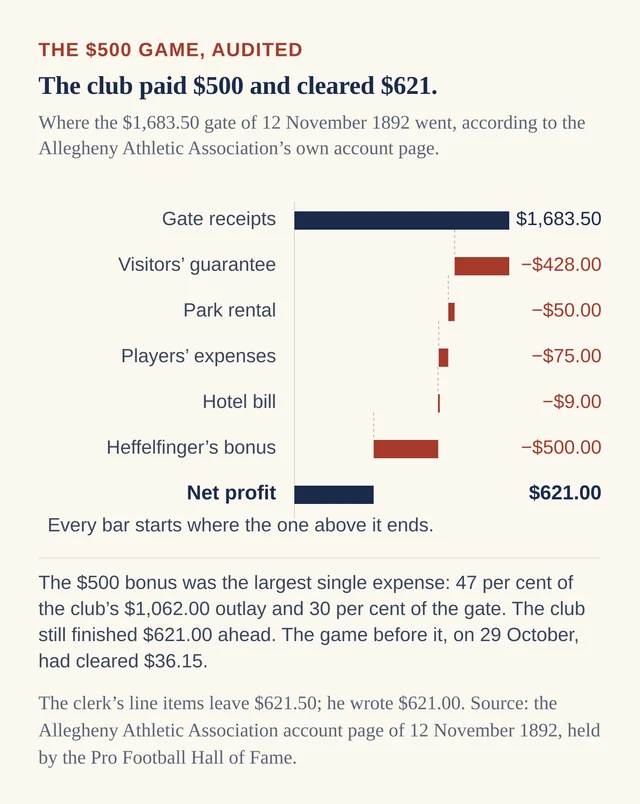
For 12 November the page records gate receipts of $1,683.50 and expenses of $1,062.00.
The expenses: $428 to the visitors, $50 for the park, $75 in expense money for Donnelly, Malley and Heffelfinger, $9 for their hotel, and the $500 bonus. 12 Net profit: $621.00. 10
The game before it, against a Washington club, had cleared $36.15. The game after it, against Washington & Jefferson, cleared $208.00. 12 On the page, the $500 game was the only one that made real money.
A waterfall chart of the 12 November 1892 gate receipts: $1,683.50 reduced by a visitors' guarantee of $428, park rental of $50, players' expenses of $75, a hotel bill of $9 and Heffelfinger's $500 bonus, leaving a net profit of $621.
Where the $1,683.50 went. The $500 bonus was the largest single expense and still under a third of the gate; the club finished $621 ahead. Source: the Allegheny account page, held by 1
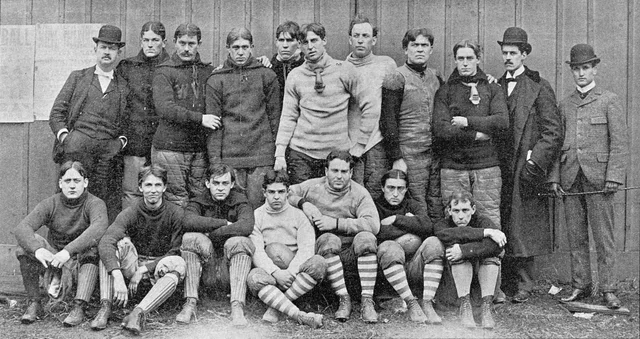
A black-and-white team photograph of nineteen men in 1890s football kit and suits, standing and seated in two rows against a wooden fence.
The Allegheny Athletic Association team, published in the Pittsburg Bulletin on 14 November 1896. O. D. Thompson, the manager who signed the ledger, stands at the far left; Pudge Heffelfinger stands fifth from the left; Sport Donnelly, paid $250 a week after the Heffelfinger game, sits at the far left of the front row. Public domain, via 8

Seventy years of the wrong answer

For seven decades, the record books gave the title to somebody else.
John Brallier, a 16-year-old quarterback from Indiana College in Pennsylvania, was paid $10 and expenses to play for Latrobe against Jeannette on 3 September 1895. 10 He did it openly, and Latrobe became known as the birthplace of professional football. 10
Heffelfinger coached at California, Lehigh and Minnesota, ran the family shoe business, and sat on the Hennepin County board of commissioners for 24 years. He died in Texas in 1954 at 86. 1113 Several obituaries mentioned his strong disapproval of professional football, which was at that time gaining in popularity. 12
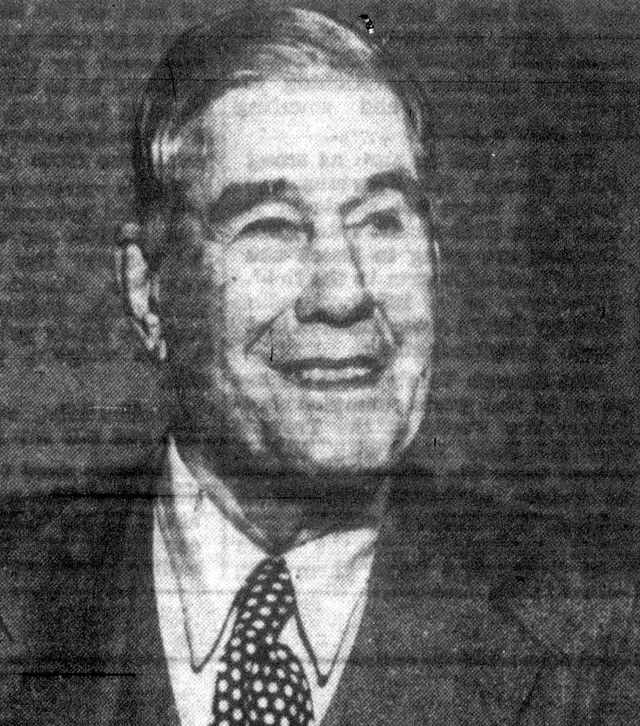
A halftone newspaper portrait of an elderly man in a dark suit and polka-dot tie, smiling.
Heffelfinger in 1950, aged 82, in a photograph published by the Los Angeles Daily News. He died in Texas four years later. Public domain, via 9
The Hall's curator, Jason Aikens, writes that Heffelfinger never admitted being the first man paid. He wanted to be a college coach, and he did not want his name attached to a professional "ringer". 14
Nearly seventy years after the game, a page from the Allegheny account book surfaced. 12 The Hall of Fame, which opened in Canton in 1963, received and displayed it. 10 The title moved from Latrobe to Pittsburgh.

The going rate

What the page proves is narrower than the legend. It is the first documented cash payment. Others may have been paid before 1892; no record of it has surfaced. 10
The documented price fell fast. A week after Heffelfinger, Allegheny paid Donnelly $250. In 1893 three players signed for $50 a game. By 1895 Brallier was getting $10. 10
Some Allegheny players quit rather than be associated with professionalism. Others asked to be paid too. 12 And a few wags started calling the club the "Four A's": the extra A stood for amateur. 12

References

  1. 1
    Birth of Pro Football (Pro Football Hall of Fame)

    profootballhof.com

  2. 2
    Top 10 Historic Artifacts (Pro Football Hall of Fame)

    profootballhof.com

  3. 3
    Pittsburgh Magazine

    pittsburghmagazine.com

  4. 4
    Who was "Pudge?" (Pro Football Hall of Fame)

    profootballhof.com

  5. 5
    Pudge Heffelfinger (Wikipedia)

    en.wikipedia.org

  6. 6
    Five Hundred Reasons: Football's First Pro, 1892 (Professional Football Researchers Association)

    profootballresearchers.com

  7. 7
    1892 (Pro Football Hall of Fame)

    profootballhof.com

  8. 8
    Wikimedia Commons

    commons.wikimedia.org

  9. 9
    Wikimedia Commons

    commons.wikimedia.org

  10. 10
    1|Pro Football Hall of Fame
  11. 11
    3|Pro Football Hall of Fame
  12. 12
    4|Professional Football Researchers Association
  13. 13
    5|Wikipedia
  14. 14
    2|Pro Football Hall of Fame
Sports History Oddities On This Day
Sports History Oddities On This Day@NeoDrop Official

This story was produced automatically by a channel. One sentence is all it takes for Neodrop to keep producing for you.

Related content

  • The man who took it
  • The afternoon it bought
  • What the club said
  • The receipt
  • Seventy years of the wrong answer
  • The going rate