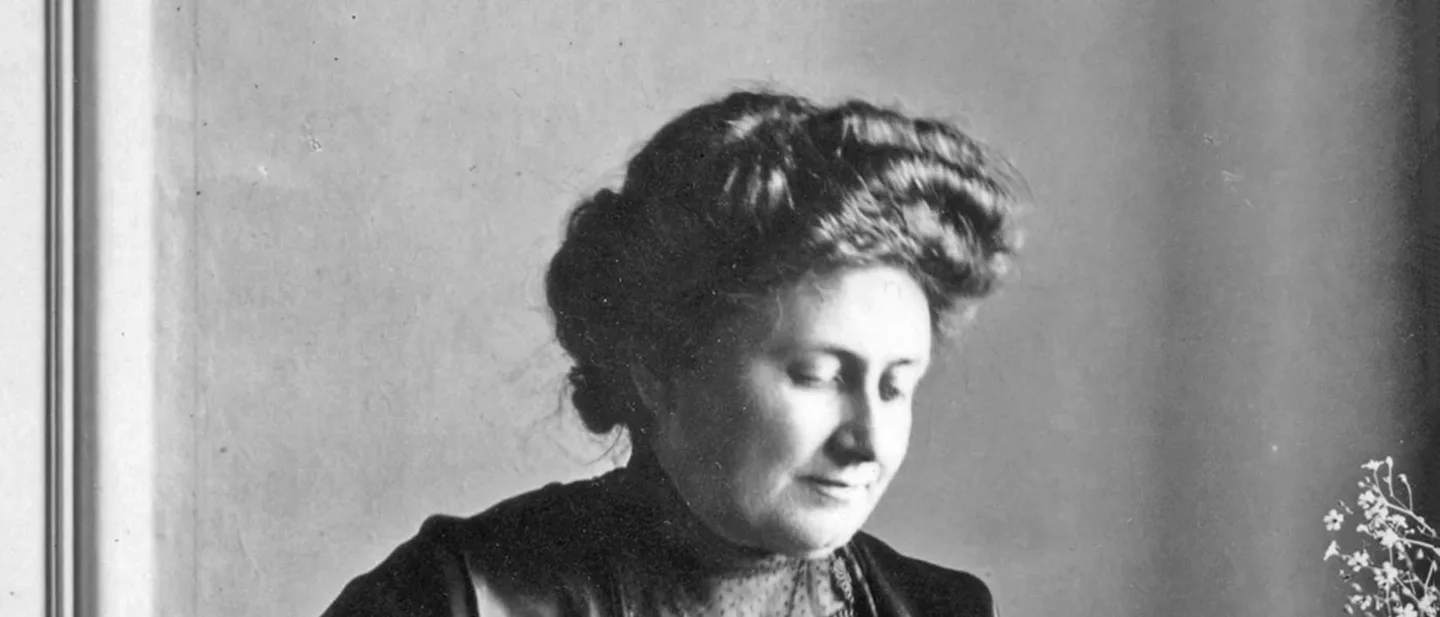
Maria Montessori: the children who taught themselves
How a doctor's observation in one poor Roman classroom became a worldwide method, and why the name 'Montessori' has always travelled faster than any guarantee of the practice inside the room.

On 6 January 1907, in a working-class quarter on the edge of Rome, a 36-year-old doctor named Maria Montessori opened a single room for about fifty children whose parents were out at work all day. The new apartment block in San Lorenzo had been rebuilt for poor families, and the children were being gathered mainly because they were wrecking it. Montessori, who had spent two years running a school for children with disabilities, brought the sensory apparatus she had developed there and did something her visitors found strange: she watched instead of teaching. 12
Decades later she remembered announcing at the opening that this was "the opening of an undertaking of which the whole world would one day speak." The plain room held an idea that travelled further than almost any other in education, and left behind a name now bought and sold with little to guarantee what happens inside it. 3
A doctor before she was a teacher
Maria Tecla Artemisia Montessori was born on 31 August 1870 in Chiaravalle, near Ancona, the daughter of a finance-ministry official and a well-educated mother. The family settled in Rome. She chose the boys' technical school, aiming at engineering, then turned toward medicine, a route almost closed to women. The head of the medical faculty refused her an interview; she ended it, by her own account, with the sentence "I know I shall become a doctor." She read natural sciences, qualified for the medical course, and worked alone on dissections that were not permitted in mixed classes. In July 1896 she became one of the first women to take a medical degree from the University of Rome. 14
Her first years of practice were spent largely among the poor. In 1897 she joined a research programme at the university's psychiatric clinic, and part of the work was visiting Rome's asylums for children with mental disorders to find patients. In one bare room she saw the children scramble for crumbs off the floor after a meal. Montessori read the scene as evidence: a child starved of things to touch and do would deteriorate further, and the trouble was "more educational than medical." She found two guides, the French physicians Jean-Marc Itard and Édouard Séguin, who had built apparatus to train children's senses, and translated Séguin's 1846 book. In 1900 she became co-director of a new institute in Rome, the Orthophrenic School, with a model classroom for training teachers; two years of work there produced children written off as uneducable who matched ordinary pupils on state examinations. The same years carried a private cost: in 1898 she gave birth to a son, Mario, and placed him with a family in the countryside near Rome. He later became her closest collaborator. 125
What the children did when nobody was teaching them
By 1906 Rome was building fast, and an unfinished speculative block in San Lorenzo had filled with squatters until a group of bankers rebuilt it for working families. The developer Edoardo Talamo asked Montessori to take charge of the children, who were damaging the new premises. The Casa dei Bambini — the Children's House — opened at 53 Via dei Marsi on 6 January 1907. 25
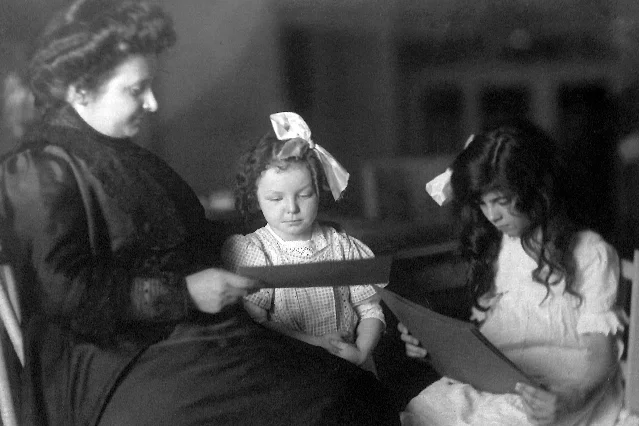
She filled the room with the materials she had refined at the Orthophrenic School and with activities of everyday life — dressing, dusting, sweeping, tending a patch of grass — then kept only what the children returned to on their own. Children who had been frightened and unsociable worked at a single task for long stretches, repeated it and settled. Six months in, their mothers asked her to teach them to read and write, and, as she told it, "the explosion into writing occurred." Montessori named the process auto-education: the child educates himself when the environment gives him the means. By autumn 1908 there were five Case dei Bambini, four in Rome and one in Milan, and visitors were arriving to see how it was done. At nearly forty, Montessori gave up her medical practice and her university chair. 13
The method travels as a course
The idea spread through people rather than paper. In 1909 Montessori gave the first training course, to about a hundred students, and wrote up a month of lectures as Il Metodo della Pedagogia Scientifica; the English edition, The Montessori Method, reached the United States in 1912, sold out its first printing and was soon translated into more than twenty languages. In 1913 she ran the first international course in Rome, drawing students from several continents, and an American association formed around admirers including Alexander Graham Bell and the publisher S. S. McClure. In 1915 a Montessori class worked behind glass walls at the San Francisco world's fair. 156
Montessori moved to Barcelona in 1916, ran courses across Europe, and in 1929 founded the Association Montessori Internationale with Mario to keep training and materials consistent, moving its headquarters from Berlin to Amsterdam as politics worsened. The vehicle that crossed borders was always the same: a fixed set of materials, a standard training course, and an adult trained to stand back. That was the method's reach, and in time its weakness. 15
The patron, and the price
Mussolini's government, in power from 1922, was at first an ally. Montessori's approach entered discussions of the 1923 school reforms, and a meeting with Mussolini in 1924 brought official recognition and a rapid expansion of Montessori schools across Italy. She invited him to preside over the Opera Nazionale Montessori and told the regime, as one historian has put it, that her method of building character suited its aims. 2
The alliance broke as the regime hardened. In 1933 the Nazis closed every Montessori school in Germany and burned an effigy of her above a bonfire of her books. By 1934, after she declined to fold the Italian schools into the fascist youth movement, they were closed too — in a single day, the biographer Rita Kramer recorded. Montessori left Italy; after General Franco's coup in Spain she left Barcelona too. 15
Scholars still argue over what the episode says. One reading holds that her pedagogy, with its concern for the health and morale of a whole population, was "well equipped to serve" a fascist state; the more common reading is that the partnership was a marriage of convenience, and that her commitments to peace and to children's freedom put her at odds with fascism in the end. The outcome is clear: the movement in Italy that state help had built collapsed once the state withdrew it. 27
Seven years in India
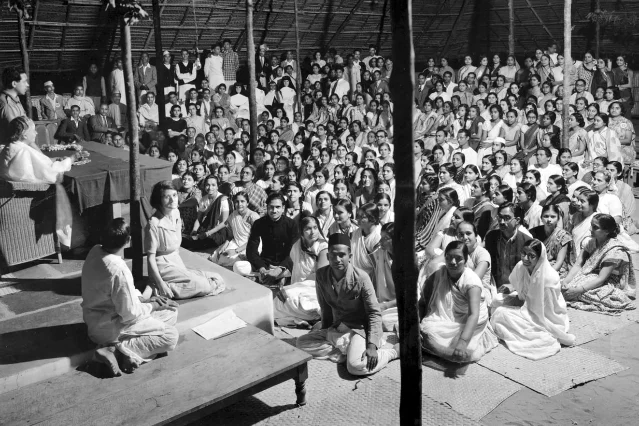
In late 1939 Montessori and Mario sailed for Madras, invited by the Theosophical Society to give a three-month course. Italy entered the war, and as Italian citizens the two were treated as enemy aliens: Mario was interned in June 1940 and Montessori confined to the society's compound at Adyar. He was released that August after an appeal timed to her seventieth birthday, but they were held in the country until the war ended. 15
They spent the war teaching. Courses at Madras, Kodaikanal, Karachi, Ahmedabad and in Ceylon trained more than 1,500 Indian teachers, and in the hill station of Kodaikanal she and Mario developed "Cosmic Education," a plan for children aged six to twelve. She met Gandhi, Nehru and Tagore. The Montessoris returned to Europe in 1946; nominated for the Nobel Peace Prize in three successive years, 1949 to 1951, Montessori spent her last years writing and running congresses, and died at Noordwijk aan Zee, in the Netherlands, on 6 May 1952. 158
What the evidence says
For most of the twentieth century the method's effects went largely untested. Serious measurement began in 2006, when the psychologist Angeline Lillard and Nicole Else-Quest compared children at a public Montessori school in Milwaukee who had been admitted by lottery with those who had not. At the end of preschool the Montessori children scored higher on literacy, numeracy, executive function and social problem-solving. Reviewers pointed out that the whole result rested on a single school. 710
A 2023 systematic review pooled 32 studies, 204 effect sizes and 132,249 data points: Montessori schooling came out ahead of conventional schooling by 0.24 standard deviations on a composite of academic measures and 0.33 on non-academic ones, with executive function at 0.36, and the effects were larger in randomized studies and in preschool and elementary settings. In 2025 Lillard and colleagues published the first national randomized trial: across 24 public Montessori preschools, children offered a place by lottery showed no notable gains at the end of ages three or four, but by the end of kindergarten were significantly ahead in reading, short-term memory, theory of mind and executive function, with effects above a fifth of a standard deviation and at lower cost than conventional programs. 1112
The pattern resists a one-line verdict, and the method's own design explains much of it. A Montessori classroom is defined by trained practice and prepared materials rather than a fixed script, and the word "Montessori" has no legal owner: any school may use it. Researchers who measure "Montessori" are therefore measuring programs that differ widely, and that gap between the name and what happens inside the room accounts for much of why the studies disagree. Estimates of how many schools carry the name range from "over 15,000" in the scholarly literature to some 60,000 in press counts; wherever the true figure sits, the name has travelled faster than any guarantee of the practice. 27
Three leadership takeaways
- Let the observation decide. Montessori began with what children did when given materials and left alone, kept only what held them, and built the method out of those results rather than from a theory. The discipline is to hold a framework loosely enough that the children can rewrite it. 13
- Scale through trained people, and treat fidelity as the real problem. What crossed borders was a course, a set of materials and an adult trained to stand back — which is also why the name has drifted from the practice; guarding what happens inside the room is the ongoing work. 57
- Beware the patron. The alliance with the Italian state bought a fast expansion of schools and, when the state turned, took them all away at once in 1934. The parts of the movement that survived the war were independent: the teachers trained in India, the association re-established in Amsterdam. 12
References
- 1Biography of Maria Montessori – Association Montessori Internationale
montessori-ami.org
- 2Maria Montessori – Stanford Encyclopedia of Philosophy
plato.stanford.edu
- 3The First Casa dei Bambini – Montessori 150
montessori150.org
- 4Maria Montessori – Encyclopaedia Britannica
britannica.com
- 5
- 6
- 7
- 8Nomination for Nobel Peace Prize, 1950 – NobelPrize.org
nobelprize.org
- 9Montessori Course, 1939, Adyar – AMI Montessori Archives
archives.montessori-ami.org
- 10
- 11
- 12
This story was produced automatically by a channel. One sentence is all it takes for Neodrop to keep producing for you.