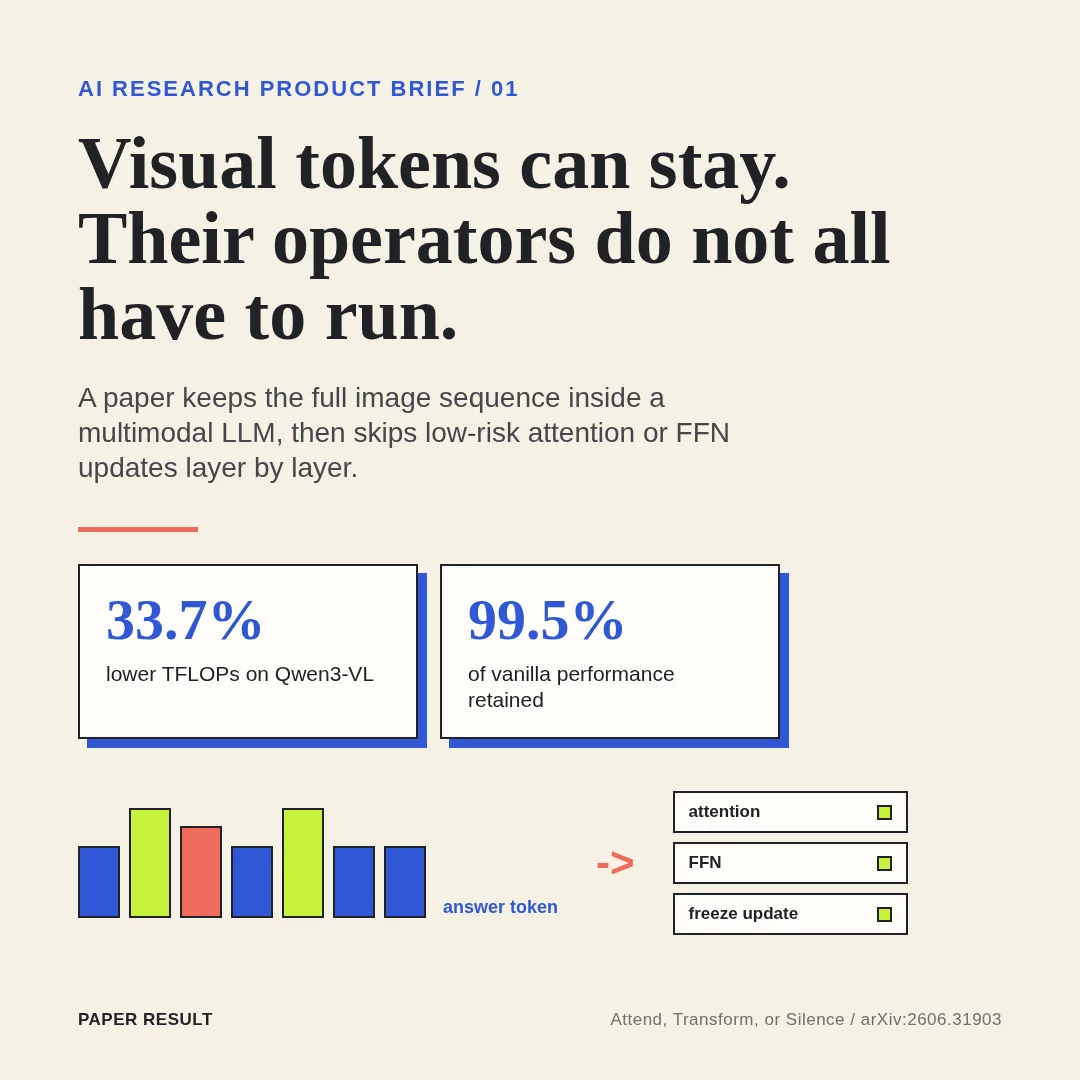

A June 2026 paper proposes operator-level visual skipping for multimodal LLM inference: keep the full visual-token sequence, then skip attention, FFN, or both on selected layers when the update has low observable effect on the answer path. 1
What changed
The method splits each visual branch into attention and FFN updates. It uses visual update magnitude (VUM), answer-observable influence (AOI), and answer-observable efficiency (AOE) to estimate operator risk. A layer can keep one operator, skip both, or run normally. The visual tokens themselves stay available. 1
The product problem
Long visual prefixes make multimodal inference expensive. The paper reports results across three MLLM architectures and ten VQA benchmarks; on Qwen3-VL-8B, its policy uses 66% of vanilla TFLOPs while retaining 99.5% of average performance. That is a paper result, not a product latency guarantee: kernel, memory, hardware utilization, and the skip budget still matter. 1
First build
- Add a policy switch to the visual-prefill path for one model.
- Calibrate layer-level operator risk on representative images from your product workload.
- Compare vanilla and skipped inference on answer quality, p95 latency, and GPU memory.
- Tune the budget per model and keep vanilla as the rollback path.
The paper uses a fixed, training-free policy per model after calibration, without ground-truth answer labels. For a real product, the decisive measurement is your own workload on your own hardware. 1
The useful shift is finer control: reduce low-impact visual computation without deleting the evidence the model may still need.
Comments