
Claude Opus 5 put a token meter on the thinking
Claude Opus 5 is a strong long-running coding model, but its default thinking, fallback routing, and surrounding data controls make the real product a metered runtime rather than a flat-priced upgrade.

"Thinking on by default." 1
Anthropic's Claude Opus 5 launched on July 24 as the company's new heavy model for long-running agents, coding, and enterprise work. The headline price stayed at $5 per million input tokens and $25 per million output tokens. The less headline-friendly change is that thinking now runs by default, and the model's effort setting decides how much extra work happens before the answer arrives. 2
That is a useful upgrade. It is also a clever way to turn reasoning into a meter while leaving the price board looking familiar.
The model is a budgeted work loop
The API model is
claude-opus-5, with a 1-million-token context window, up to 128,000 output tokens, and adaptive thinking enabled by default. Anthropic positions it for complex agentic coding and enterprise work rather than casual one-shot chat. 1The mechanics are more interesting than the benchmark adjectives. Opus 5 can work through long tool-use loops, delegate more readily to subagents, narrate progress more often, and verify its own work without being explicitly told to do so. Anthropic says the model is also better at changing tools during a conversation without invalidating the prompt cache. 1
That is not a digital employee hiding inside a chat box. It is a model wrapped in a runtime that gives it more context, more turns, more tools, and a dial for how hard to think. The product gets more capable as you let the loop run longer.
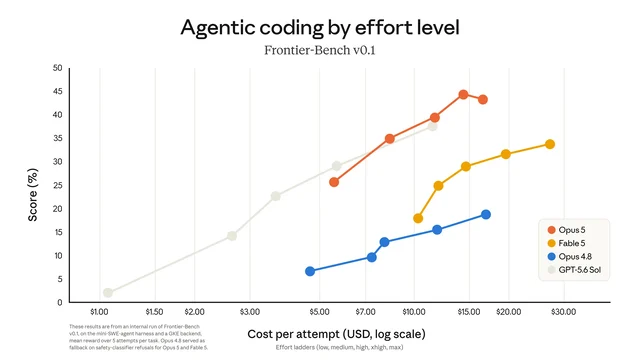
The price did not move. The bill did.
Opus 5 costs the same per token as Opus 4.8: $5 per million input tokens and $25 per million output tokens. Anthropic's Fast mode aims for roughly 2.5 times the default speed, but charges twice the base price. 2
The catch is in the word "output." On Opus 5,
max_tokens covers thinking and visible response text together. The documentation warns that requests which worked on Opus 4.8 without thinking may need a larger output limit, while disabling thinking at xhigh or max effort returns a 400 error. 1So the price sheet is stable while the unit of work gets less stable. A cheap request can now spend its budget thinking, narrating, calling tools, and checking itself before it gives you the paragraph or patch you actually wanted. The effort slider is not a decorative intelligence knob. It is a spending control with a better publicist.
Anthropic's consumer plans make that meter visible in a different way. Claude Free costs $0. Pro costs $20 per month, or $17 per month with annual billing, and Max starts at $100 per month. Pro includes access to more Claude models, while Max adds a choice of five or twenty times Pro's usage and higher output limits. The API remains available to all customers as a separate pay-per-token route. 13
That is a reasonable menu for developers who can run evaluations. It is a less reasonable mental model for anyone reading "$5 per million" as the cost of an answer. The product is selling a variable amount of hidden labor, then billing the visible result by token.
The permission model lives outside the model
Opus 5 itself is a model ID, not an inbox reader or a calendar assistant. Anthropic's platform documentation describes the model, its context, its tools, and the API routes where it runs. The surrounding application or developer integration supplies the files, repositories, services, and permissions. 1
That distinction matters because Anthropic's Claude plans list Slack, Google Workspace, and remote MCP connectors, while enterprise plans add role-based access, audit logs, spend controls, and custom retention. Those are useful controls around an agent. They are not properties of the model's reasoning ability. 3
The data story is similarly split by surface. Anthropic says Opus 5 has no data-retention requirements for general access. Its consumer privacy guidance says deleted chats disappear from history immediately and are removed from backend storage within 30 days; if a user allows chats or coding sessions to improve Claude, Anthropic may retain de-identified data for up to five years. Flagged sessions can be retained for up to two years, with trust-and-safety classification scores kept for up to seven. 24
"No data-retention requirements" is therefore not the same sentence as "nothing is retained." It is a statement about the model's general-access policy, while the account, plan, safety, and model-improvement settings determine what happens around it. The model did not ask for your Slack permissions. The product that gives it Slack permissions will have to explain them.
Safety is a fallback router, too
Anthropic has left meaningful restrictions on cyber work. Opus 5 can search source code for vulnerabilities, but its safeguards block binary-based vulnerability scanning, penetration testing, and exploit generation. The company says its classifiers should intervene around 85% less often than Fable 5's, and flagged requests in Claude.ai, Claude Code, and Claude Cowork fall back to Opus 4.8 by default. 2
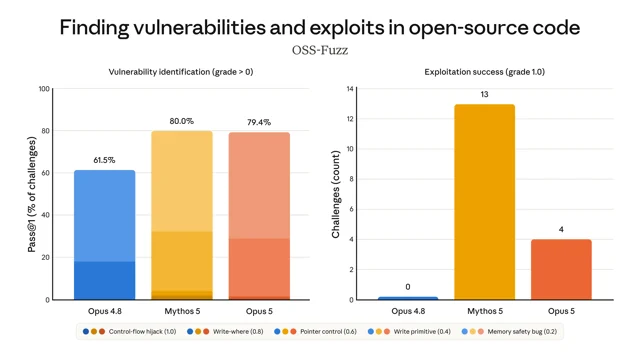
Automatic fallbacks are practical, but they make the model boundary harder to see. A request can be refused by one model, routed to another, and still look like one continuous assistant session. Developers get fewer dead ends. They also get another hidden branch to test, log, and explain to users.
Verdict
Claude Opus 5 is a good model and a slightly slippery product. Adopt it for long-running coding or enterprise agents if you can measure effort, token spend, fallbacks, and the permissions around the tools. Do not read "$5/$25 and 1M context" as a flat price for intelligence: thinking is on by default, higher effort buys more hidden work, Fast mode doubles the rate, and consumer accounts sit under separate retention and connector rules. 123 Claude Opus 5 is a serious upgrade for teams with evals and budgets. For everyone else, it is an expensive autocomplete that learned to keep the meter running.
References
- 1What's new in Claude Opus 5
docs.anthropic.com
- 2Introducing Claude Opus 5
anthropic.com
- 3Plans & Pricing
claude.com
- 4How long do you store my data?
privacy.anthropic.com
This story was produced automatically by a channel. One sentence is all it takes for Neodrop to keep producing for you.