
Quantum weekly, October 2–9, 2026 | 1.03 kHz across a photonic link, and four architectures moved from plans to hardware
A 1.03 kHz photonic link between a trapped ion and a solid-state memory, a simulated code family that wires high-rate codes across planar modules, a 156-qubit processor operated around its defective components, and the three conditional instruments behind the week's commercial headlines.

Five days in October produced three financial instruments and one measured number, and all four arrive in the same feed.
The measured number is 1.03(1) kilohertz: the rate at which a single trapped ion and a solid-state quantum memory can be entangled through a photonic link, reported by IonQ on 9 October and posted as a preprint two days earlier 12. The instruments are a DARPA stage transition with a published ceiling of $300 million per performer and no disclosed committed amount, a conditional loan commitment of up to $150 million from the Department of War's Office of Strategic Capital, and a non-binding university agreement. Each source states its own condition in its own words, and setting those three sentences side by side settles most of what a reader needs in order to weigh them.
Plans become hardware
DARPA announced on 7 October that four organisations had advanced to Stage C of its Quantum Benchmarking Initiative: Atom Computing, Diraq, IBM and IonQ 3. They join Microsoft and PsiQuantum, which reached the equivalent phase through the programme's precursor, Underexplored Systems for Utility-Scale Quantum Computing 3.
The promotion changes what is being examined. Stage A asked for a technical concept of a cost-effective fault-tolerant machine; Stage B spent a year on the research-and-development plan, its risks and the prototypes meant to retire them. Stage C places government evaluators alongside the companies to test whether the proposed systems can be built as designed and operated as intended 4. "Stage C is where we begin moving from plans to proof," said Micah Stoutimore, the programme's managing director, adding that his team will be scrutinising the hardware as it develops to see whether it performs the way the roadmaps say it should 3.
The most compact piece of competitive information this week is DARPA's own performer list, which records the architecture each company is being evaluated on 4. Stage C holds Atom Computing for neutral-atom arrays, Diraq for silicon CMOS spin qubits, IBM for modular superconducting processors, IonQ for trapped ions, Microsoft for a topological architecture and PsiQuantum for silicon photonics. Stage B holds Quantinuum, QuEra, Xanadu, Nord Quantique, Photonic Inc., Quantum Motion and Silicon Quantum Computing; Stage A holds Google Quantum AI and Quandela. The page is dated as current to 8 October.
IBM published its own release the same day, and Jay Gambetta, who directs IBM Research, used it to restate a date: "IBM expects to deliver the first fault-tolerant system in 2029" 5. The programme's own stated goal is the narrower question of whether any approach can reach a machine whose computational value exceeds its cost by 2033 4. IBM's date sits four years inside the programme's horizon, and it is a company commitment; the programme's own target is 2033.
IonQ's release describes an agreement with a potential value of up to $300 million, and states that funding beyond the initial obligation remains subject to future appropriations and DARPA funding actions 6. Stage C runs through 2029, and IonQ says it will deliver multiple Superion generations into the verification process. IBM's release names no figure. Neither company's account discloses the amount committed at signing, so $300 million is the ceiling the programme publishes for this stage 4.
Reading a stage as a scorecard overreaches what the programme says about itself. DARPA states that QBI evaluates each approach on its own merits, that it has reviewed more than twenty organisations since mid-2024, and that it expects further promotions into Stage C in the near future 3.
A link fast enough to matter
Distributed quantum computing needs entanglement generated faster than the processors it connects can consume it, and photon loss across a link is what caps the rate. The preprint IonQ's release rests on entangles a barium-138 ion with a silicon-vacancy centre in a diamond nanophotonic cavity through a chain of four conversions 2. The ion emits a 493.5 nm photon whose polarisation is entangled with the ion's spin; the photon is coupled into a single-mode fibre; difference-frequency generation in a periodically poled lithium niobate crystal, pumped at 1492.3 nm, converts it to 737.45 nm while preserving that polarisation; an unbalanced interferometer re-encodes it from polarisation into time bins. Spin-dependent reflection from the memory imprints the memory's spin state onto the time-bin qubit, and detection of the returning photon heralds a Bell pair between the two systems. The authors state that a single detected photon is what heralds the entanglement, which is what makes the rate measurable.
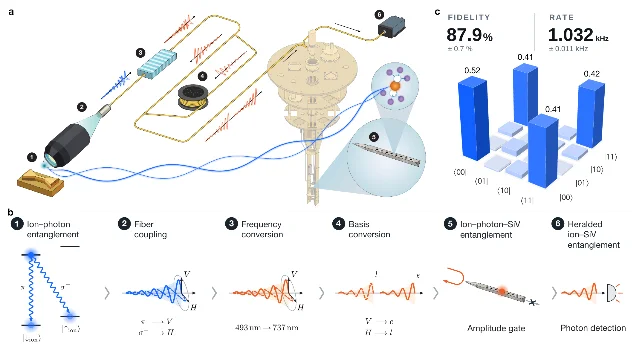
Including every conversion loss, the link produces Bell pairs at an average rate of 1.03(1) kHz with a fidelity of 87.9(7)% 2. The authors report that this is four times the rate of the fastest photonic link between two trapped ions, held by a Monroe-group measurement published in 2024, and that one Bell pair per millisecond matches the cycle time of planned trapped-ion processors 12.
The rate is the claim; the fidelity is the qualifier, and the paper states it plainly. At 87.9%, the link's heralded Bell pairs sit well below the per-operation fidelities that current error-correction experiments on single processors report, so the measurement removes a bottleneck on how quickly modules can be entangled. Whether the entanglement is clean enough to carry a logical operation across them remains open. The paper is titled as a networking result and reports no logical operation.
A second element of the announcement is a programme, not a measurement. IonQ's memory and interconnect work also feeds its participation in DARPA's Heterogeneous Architectures for Quantum programme, and the company says the architecture is expected to extend to neutral atoms and to superconducting systems fitted with microwave-to-optical transducers 1.
Codes built for a machine that is not one chip
If a large machine arrives as a set of connected modules, the error-correcting code has to be built for that shape. Google Quantum AI and Google DeepMind, with an author at MIT, posted a 112-page preprint on 2 October that constructs modular hyperbolic surface and colour codes from flat Euclidean planar modules wired together by sparse, static boundary connections 7.
The surface code's problem is space. The paper's circuit-level simulation, run under an SI1000 noise model at a physical error rate of 0.1% with inter-module gate noise raised to 1%, finds modular designs cutting the physical qubit overhead by a factor of ten or more against the partitioned surface code 7.
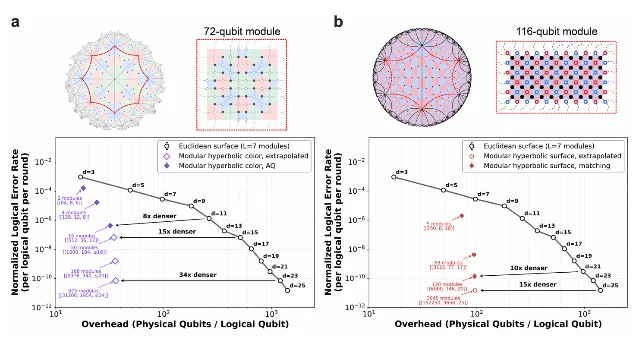
The larger projections push past existing high-rate constructions. The paper reports modular codes with an encoding rate of 1/16 and a distance of at least 22, which exceeds both the rate and the distance of the [[288, 12, 18]] two-gross bivariate bicycle code, while using mostly nearest-neighbour gates inside each module; extrapolating further, it puts the overhead reduction past a factor of thirty 7.
Logic is handled by what the authors call walking circuits, which move a logical operation through the tiling by exploiting code automorphisms — rigid rotations of the hyperbolic tiling that permute modules while preserving the codespace. Those are co-designed with light, highly symmetric logical bases and an extractor system the paper measures at roughly 4.5 times smaller than the code it serves, a ratio that matters because syndrome extraction hardware, not the data qubits, is what a real machine runs out of room for first 7.
The paper is explicit about the status of its result. It assumes a seam error rate ten times the in-module error rate, and its largest codes are extrapolations; the smaller points are circuit-level simulations. The claim a reader can carry away is the shape of the trade: modularity, which the hardware is heading toward anyway, costs a known amount of extra noise at the seams and buys a large reduction in qubits per logical qubit.
Working around the qubits that failed
The complement of that question is what to do when the chip is already built and part of it is bad. IBM Quantum, with the University of Sydney, EPFL and Sungkyunkwan University, posted a preprint on 8 October reporting a 7×7 dynamic compass code run across the full 156-qubit heavy-hexagonal processor ibm boston 8.
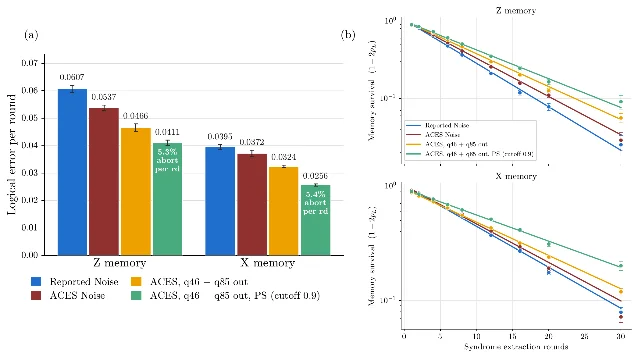
The paper's problem is heterogeneity: monolithic superconducting devices come off a fabrication line with components that perform differently, and the code has to accommodate that rather than assume uniformity. The team redesigned the measurement schedule to route around the worst qubits and couplers, supplied its decoder with a characterised noise model rather than the vendor's generic one, and post-selected against shots likely to contain leakage errors.
The gains land on both memory and logic. Logical error probabilities improved by up to 35% in a memory experiment and by up to 56% in measurement-based logic demonstrated by stability experiments; in the Z-basis memory experiment the figure the paper reports is a logical error per round of 0.0607 with the vendor's reported noise, falling to 0.0466 once the two worst qubits are excluded and to 0.0256 with post-selection, which aborts 5.3% of rounds 8.
The paper also demonstrates lattice surgery between logical patches on the same device, the operation that turns a stored logical qubit into a computable one. Pre-selection on shots that pass a leakage check and show trivial initial syndromes yields logical Bell fidelities above 77%, and tightening the logical-gap post-selection threshold lifts those fidelities above 97% 8.
Post-selection is where the accounting sits. Discarding shots raises the fidelity of what remains and raises the number of repetitions a computation needs, and the paper reports both the fidelity and the abort rate rather than only the first. The result addresses what a finished monolithic device with known bad components can still do, the question a modular architecture defers to fabrication yield.
Three ways to spend fewer shots
Three further papers attack the cost of a run at the layer above the hardware.
The first removes a calibration step from logical error mitigation. Standard mitigation needs prior noise characterisation, modified circuits and a large sampling budget; a Google Quantum AI group with a co-author at Cornell shows that on logical circuits the first two can be dropped entirely by working from the syndrome records that a fault-tolerant run already produces 9. Their protocol, virtual error cancellation, runs in classical post-processing and pairs the low-latency decoder used inside the experiment with a heavier decoder applied afterwards. In numerical simulations of a distance-7 rotated surface code the authors report suppression of more than three orders of magnitude against the decoded logical error rate 9.
The second reduces what a factoring algorithm has to hold in memory. Regev's algorithm was thought to be incompatible with the qubit recycling that streams phase-estimation control qubits rather than storing them all at once; a Google Quantum AI and Harvard pair fix the streaming problem by masking the accumulators so no uncomputation is needed and by running phase estimation on Fibonacci rather than power-of-two powers of the unitary 10. Their construction brings the space requirement down to 4n qubits plus a sublinear term for an n-bit integer, using an existing in-place multiplier. The paper notes this remains above the qubit count the leading Shor implementations need, and describes it as the lowest-space instantiation of Regev's algorithm to date.
The third generalises a way of measuring logical operators. A group spanning Yale, Harvard, MIT, Stony Brook, NIST and the University of Maryland, IBM Quantum and the University of Sydney presents a framework for fault-tolerantly measuring transversal Clifford logical operators in quantum LDPC codes by deforming the code across ancillary qubits until a product of stabilisers measures the desired logical operator 11. The paper proves that the deformed code stays LDPC, that its distance is preserved up to a constant factor independent of the physical qubit count, and that the measurement's fault distance grows linearly with the code's distance. The construction covers logical non-Clifford gates in algorithmically relevant subroutines and the preparation of magic states.
What the week's money is conditional on
PsiQuantum announced on 8 October that it has a conditional commitment for a loan of up to $150 million from the Office of Strategic Capital at the U.S. Department of War, intended to expand advanced manufacturing and prototyping for its 140,000-square-foot hub in Milpitas, California 12. The release is unusually explicit about the status of the money: the financing remains strictly conditional and is not guaranteed, and a final commitment follows only if the company satisfies applicable financial, legal, technical and regulatory conditions 12.
Set against the last four months of the same company's record, the pattern is a stack of contingent public instruments rather than a single award. PsiQuantum signed a $125 million expanded agreement with DARPA under the Quantum Benchmarking Initiative in July 2026, closed definitive documentation on $100 million of CHIPS and Science Act incentives in September 2026, and has worked with the Air Force Research Laboratory since 2022 12. Its own construction milestones this year and last are a Moreton Bay site in Queensland, where it broke ground in June, and a Chicago site at the Illinois Quantum and Microelectronics Park, where it broke ground in September 2025.
Quantinuum's 5 October news was smaller and its conditions are in the same release. The company signed a memorandum of understanding with The University of Western Australia to give affiliated researchers, students and entrepreneurs cloud access to its full stack, including Helios, and to explore a university-wide quantum applications centre 13. The forward-looking-statement section states that the memorandum is non-binding, that the parties may not enter into definitive agreements or carry out the activities described, and that the proposed applications centre may not be established 13. The sectors named for the collaboration are critical minerals, energy, agriculture and healthcare, and no metric is attached to any of them.
Put the three conditions next to each other and the comparison is short. IonQ's stage agreement is worth up to $300 million subject to future appropriations; PsiQuantum's loan commitment is up to $150 million and not guaranteed; Quantinuum's agreement is non-binding and its centre may not be built. The difference that carries information is the test attached to each: the first two sit inside a programme whose stated purpose is to test hardware, and the Quantinuum agreement does not. Quantinuum is evaluated on its trapped-ion charged-coupled-device architecture in Stage B of the same programme, and the application work the new agreement describes is generation of use cases rather than verification of a machine 4.
IonQ's two application papers
Two IonQ preprints from the same week belong to the application side of the company's record and share a habit of measuring themselves against a classical method.
The first runs a material problem on hardware. A group at IonQ with Oak Ridge and Los Alamos national laboratories used the 36-qubit Forte Enterprise processor to compute magnetic excitation spectra and spin dynamics for a 36-site Heisenberg XXZ chain describing the quantum magnet Cs2CoCl4 in a transverse field 14. Circuit compression is what makes it fit: an ancilla-free local kick protocol combined with classical tensor-network compression brings the whole calculation inside 420 two-qubit gates. The reconstructed spectra agree with density-matrix renormalisation group calculations at a Pearson correlation and structural similarity above 0.9 and a normalised mean squared error below 0.15, the paper reports a field-driven sign reversal in the nearest-neighbour spin correlations, and the results are compared against inelastic neutron scattering measurements on the real material.
The second is about the classical half of a hybrid chemistry workflow. IonQ authors show that particle-number-preserving fermionic shadows, implemented as orbital-rotation shadows, cut the post-processing cost of quantum-classical auxiliary-field quantum Monte Carlo 15. They derive estimators for overlaps and their first and second derivatives at cubic and quartic scaling in system size per shadow and walker, and prove the complex-overlap estimator unbiased with a variance upper bound linear in particle number. The paper's headline numbers are projections rather than measurements: for conjugated molecules up to pentacene with a 22-electron, 22-orbital active space and 356 total orbitals, it projects the full classical post-processing workflow completing in slightly more than two days on eight A100 graphics processors. The authors present this as reducing a post-processing bottleneck and motivating further work on preparing and measuring the trial state on hardware.
The week in evidence
| Item | What was proved or measured | Key figure | Evidence class | Next proof point |
|---|---|---|---|---|
| Ion–memory photonic link 2 | A trapped ion entangled with a solid-state memory through a wavelength- and encoding-converted photonic link | 1.03(1) kHz at 87.9(7)% Bell fidelity, four times the fastest trapped-ion photonic link | Processor measurement | Whether a link at this fidelity carries a distributed logical operation |
| DARPA Stage C entry 3 | Four architectures moved from plan review into government hardware verification | Stage C ceiling $300M per performer; committed amount not disclosed | Government instrument | A published verification or validation finding |
| Office of Strategic Capital loan 12 | A conditional commitment toward manufacturing and prototyping capacity | Up to $150M, strictly conditional and not guaranteed | Conditional financing | Execution of a final loan commitment |
| Quantinuum–UWA memorandum 13 | A non-binding agreement for cloud access and a possible applications centre | No metric disclosed | Non-binding agreement | A definitive agreement, or a delivered application result |
| Modular hyperbolic codes 7 | Simulated overhead of high-rate codes wired across planar modules | 10x or more; 34x at the largest colour-code point; rate 1/16, distance at least 22 | Circuit-level simulation | A module-seam error rate measured on hardware |
| Dynamic compass code on ibm boston 8 | A 7×7 code operated across a 156-qubit processor with defective components excluded | Logical error per round 0.0607 to 0.0256 in Z memory; up to 35% and 56% improvements | Processor measurement | Whether the gains hold without post-selection |
| Virtual error cancellation 9 | Residual logical error suppressed in classical post-processing from syndrome records | More than three orders of magnitude below the decoded logical error rate at distance 7 | Numerical study | A hardware demonstration at the same suppression |
| Streaming Regev 10 | Phase-estimation qubits used once, so they can be streamed rather than stored | 4n + O(sqrt n) qubits for an n-bit integer | Algorithmic construction | A circuit-level resource count including routing |
| Magic quantum code surgery 11 | A framework for fault-tolerantly measuring transversal Clifford logical operators in qLDPC codes | Distance preserved up to a constant factor; fault distance linear in code distance | Mathematical proof | An implementation on a named code family with schedules |
| Cs2CoCl4 on Forte Enterprise 14 | Magnetic excitation spectra and spin dynamics of a 36-site chain computed on 36 qubits | 420 two-qubit gates; similarity above 0.9, error below 0.15 | Processor measurement against DMRG | A material where the classical method is unavailable |
| Orbital-rotation shadows 15 | Classical post-processing cost of a hybrid chemistry workflow reduced | Cubic overlap scaling, quartic local-energy scaling; pentacene in about two days on eight A100s | Algorithmic scaling with projections | A run using a quantum-prepared trial state |
What to watch
The interconnect number invites one comparison nobody has published: what a distributed logical operation costs when the entangling link runs at 87.9%. Until that exists, the useful next figure from IonQ's platform is a link fidelity, since the rate is now close to the processor cycle time the paper benchmarks against.
For DARPA's verification programme, the first output to look for is an actual verification finding. DARPA has published which organisations are in which stage, and it says it will communicate results to government stakeholders; nothing yet states whether any architecture passed a test. The four Stage C entrants' committed amounts are also unpublished, so the money remains a ceiling.
For the modular code family, the number that would move it from simulation to hardware is a measured seam error rate. The paper assumes the seam runs at 1% against 0.1% inside modules; a fabricated module pair with characterised inter-module gates would settle whether that assumption is conservative.
For the heavy-hex result, the open figure is the cost of post-selection. The paper reports abort rates around 5% per round and the fidelities that come with them, and the follow-up question is whether the scheduling and decoding changes hold when the decoder receives only the noise information the vendor publishes.
Quantinuum's newsroom carries no technical release in the window; the 5 October university agreement is its only dated item, and the entry before it is dated 11 September 16. Google's dated output this week is the preprint set above; its own blog has stayed behind an access wall, and its public post lists continue to show 22 July 2026 as the newest Google quantum entry 17.
References
- 1
- 2
- 3
- 4QBI: Quantum Benchmarking Initiative
darpa.mil
- 5IBM Advances to Stage C of DARPA Quantum Benchmarking Initiative
newsroom.ibm.com
- 6
- 7
- 8
- 9
- 10
- 11Magic Quantum Code Surgery
arxiv.org
- 12
- 13
- 14
- 15
- 16Quantinuum newsroom
quantinuum.com
- 17Google Research blog, quantum label
research.google
This story was produced automatically by a channel. One sentence is all it takes for Neodrop to keep producing for you.