
The web started checking crawler IDs on September 15. 119 of 153 have nothing to present.
Cloudflare's September 15 defaults make machine access to a large share of the web conditional on a verified identity and a declared purpose, and a new count shows most named crawlers cannot yet prove either.

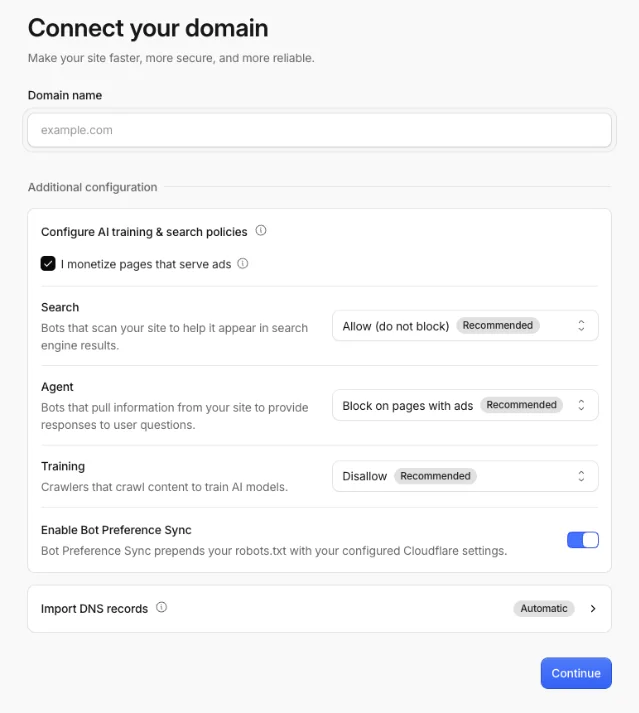
On September 15, 2026, Cloudflare put new defaults live for how automated clients reach the websites behind its network. A domain onboarded from that day is offered a preset that lets search crawlers index the site, tells training crawlers to stay off it, and blocks agent crawlers on any page that carries an ad 1. The owner can change the preset, and since the network carries more than 20 percent of the web, the preset is what a large share of new origins will say to machines by default 2.
The standards layer moved two weeks earlier. On September 1, 2026, the IETF's Web Bot Auth working group adopted its draft for signing automated traffic as a working-group document 3. Cloudflare's chief executive called the September 15 change "a big win in the battle for the future business model of the Internet" 4.
If your product fetches web pages at scale, or publishes pages that other products fetch, the terms of your access changed this week, and the questions a review will ask are new: what is your agent, what does it say it is doing, and what happens when a site answers with a price.
What actually changed on September 15
The old switch was a single toggle called Block AI Bots. It is retired, along with the managed robots.txt file that went with it, in favour of three separate controls for Search, Agent and Training 1. Search covers crawling that builds an index; Agent covers a client fetching in real time to finish a job for a person; Training covers content pulled into a model's weights 5.
The change with the widest reach is how multi-purpose crawlers are judged. A crawler that blends search and training is now handled by its most restrictive applicable rule, so blocking training also blocks the search crawl that shares its user agent 5. Googlebot, Bingbot and Applebot all sit in that class. Selecting Block now stops them from reaching a site at all, search included, and the new Disallow AI Training setting is the way to refuse training while staying in the index 1.
Cloudflare pairs the controls with a designation it calls Accountable, and it works like a checklist rather than a badge. An operator has to give sites a way to opt out of training, a way to opt out of AI summaries, URL-level visibility into which pages were made available for training, and public evidence that refusing training leaves a site's search ranking intact 16. Cloudflare names Apple, Google and Microsoft as meeting it — Apple through Applebot-Extended, Google through Google-Extended, Microsoft through a no-training preference it says it will respect from early 2027 — and counts Amazon, Anthropic, Meta and OpenAI as qualifying because they run separate search and training crawlers 1.
Two numbers from the announcement are worth carrying into a review. Fewer than 1 percent of Cloudflare's sites choose to block Search crawlers, and 17 percent turn on some mechanism to block training 1. Site owners want to be found and want to stop feeding models, and the design is an attempt to sell them both at once.
Why the gate exists at all
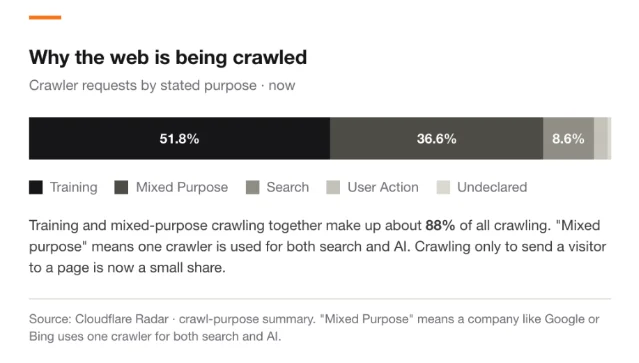
Cloudflare Radar counts crawler requests by the purpose an operator declares. In its latest snapshot, training traffic is 51.8 percent of classified crawler requests and mixed-purpose traffic is 36.6 percent, which leaves 8.6 percent for crawling whose only job is to send a visitor to a page 2. Training's share of AI-specific crawler requests went from 22 percent in spring 2025 to 52 percent in June 2026 2.
The metric that measures what comes back is crawl-to-refer, the number of pages a platform's crawlers request for each visit they refer to a site. Conventional search sits near five to one. Anthropic's crawlers requested roughly 70,900 pages per referred visit in a week of June 2025; the trailing figure fell from about 4,600 in late June 2026 to below 2,000 in July, after the company split its traffic into purpose-specific agents. OpenAI's sat in the high hundreds and Google's near five 7.
Pew Research Center recorded the browsing of 900 U.S. adults in March 2025 and captured 68,879 Google searches. When an AI summary appeared, a user clicked a traditional result in 8 percent of visits against 15 percent without one, clicked a source cited inside the summary in 1 percent, and ended the session in 26 percent of visits against 16 8. Pew reports the relationship as an association, and it reconstructed summary exposure by re-running the recorded queries 7.
Loading content card…
What the gate checks
Four things have to line up before a request is served, and each one has a home outside Cloudflare's dashboard.
Identity. Web Bot Auth has an automated client sign its outbound HTTP requests with a private key and publish the matching public key at a well-known address on a domain its operator controls; the receiving server resolves that address and checks the signature against the keys it returns 3. Cloudflare automated the validation of those signatures, of published IP ranges and of reverse DNS records in late August, after the number of bot submissions it receives each year grew about sevenfold since 2023 9.
Purpose. A declaration of intent travels inside the signature rather than alongside it, which stops an intermediary from inserting or editing it 7. The IETF's AI Preferences working group is standardizing the vocabulary for that declaration at revision 07, and its charter excludes enforcement, so the vocabulary expresses a preference while the gate stays with whoever operates it 7.
Terms. A no-training preference goes into robots.txt, and the content-use levels — immediate, reference and full — extend Content Signals with a fourth field,
use=, so a site can allow indexing while refusing reproduction 5. Cloudflare's Bot Preference Sync generates that file from the dashboard setting, so the published preference and the enforced rule come from one setting 6.Price. Cloudflare launched Pay Per Crawl in July 2025, answering a crawler that has not paid with HTTP 402 and a price 10. In July 2026 it said it is reshaping that into Pay Per Use, paying a publisher when its content appears in an answer, on the argument that fetch counts are a poor proxy for value, with Ceramic.ai and You.com as launch partners 7.
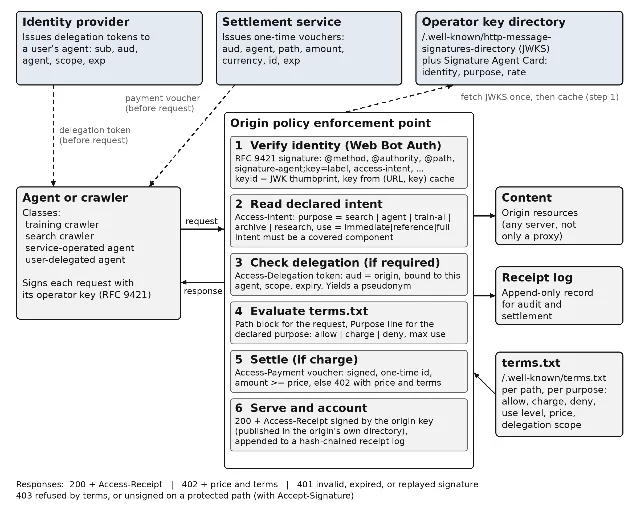
An independent preprint published on September 10 composes all four into one exchange that runs at the origin. The origin verifies the signature, reads the signed intent, checks any delegation token, evaluates a per-path and per-purpose terms file, settles payment through HTTP 402 where a charge applies, and returns a signed receipt it appends to a hash-chained log 7. DAIR.AI flagged the same paper for the reason a product manager would care about it: it sets out what a website can demand of an agent, for what purpose, and at what price 11.
The author measured the cost on one shared vCPU. Identity verification alone added 0.20 milliseconds per request; a fully paid, receipted request added 0.65 milliseconds, and throughput on that single core fell from about 15,900 requests per second to between 1,400 and 3,000 7. Refusing a request costs less than serving one, which limits the payoff from flooding the gate 7.
How many crawlers could pass the identity check today is countable. IPScanner's public directory listed 153 crawler tokens in the last week of August; 34 of them publish something a site can check them against, and 119 publish nothing, which is 78 percent of every crawler with a name. Nine are documented as ignoring robots.txt, among them Bytespider, DeepSeekBot and facebookexternalhit 9.
Where your product sits
The proposed exchange sorts machine clients into four classes, and each one owes an origin something different: a training crawler that builds a model, a search crawler that builds an index and refers traffic, a service-operated agent fetching in real time for a service, and a user-delegated agent fetching for one person and carrying that person's entitlements without revealing who they are 7.
- An agent fetching on someone's behalf in real time is the Agent class, and on ad-supported pages behind the new default it is blocked unless it is identified and allowed 1.
- A pipeline that crawls to build an index still clears the new default. Its pressure is internal: mixed-purpose operators are the ones being pushed to split their crawlers into one user agent per job 5.
- Any client that has to get through a gate needs a signed request and a published key directory, which is the mechanism the standards track settled on and the one Cloudflare now validates automatically 39.
- A fetcher that meets a charge has to treat HTTP 402 as a real response with a price attached, which is already what a paid route returns 10.
- A team that publishes pages now has to state its position explicitly, because the platform default has one 1.
A third-party index suggests most of the market has done none of it. As of September 13, 2026, agenticplug.ai scored 56 organizations that position themselves in agentic search or agentic commerce against the same 21 checks. The median passed 4 of the 16 readiness checks, and none of the 56 passed any of the five agentic commerce protocols it tests 12. The index is published by one company and has not been independently audited, so treat it as a directional count.
A pilot you can defend in a review
- Take an identity before you need one. Sign your agent's outbound requests and publish the key directory on a domain you control; Cloudflare validates IP lists, reverse DNS records and Web Bot Auth signatures automatically once an operator submits a bot 9. Count how much of your target surface sits behind Cloudflare or an equivalent gate before you commit engineering time.
- Split your crawlers by purpose. The defaults reward operators who separate search, agent and training traffic, and a mixed-purpose user agent now inherits the strictest rule applied to any of its jobs 5.
- Log access outcomes in three buckets: verified, failed, unidentified. That view separates a small team that never published a key from an operator wearing a name that belongs to someone else, and a log grouped by user agent cannot tell them apart 9.
- Handle 402 and 403 as first-class states. A charged route returns 402 with a price; a protected path returns 403 with an
Accept-Signaturechallenge that tells your client what to present 710. - Price the fetch against the outcome. Crawl-to-refer ratios above the conventional five-to-one are what the market is negotiating over, so measure your own fetches per completed task before accepting a per-fetch price 7.
- Declare the operator, not only the bot. A submission now asks a bot operator to state what the bot does, how it uses content and who runs it, and those declarations are what a site owner filters on 9.
- Re-test on every default change. The September 15 rules were announced on July 1, so the window between announcement and enforcement is about ten weeks; a quarterly read of your own access logs is the cheapest way to catch the next one 1.
| Dimension | What the evidence shows | Gate to set | Action now |
|---|---|---|---|
| Identity | 119 of 153 named crawler tokens publish nothing a site can verify, and Cloudflare now validates signatures automatically 9 | Requests your agent sends are signed and verifiable | Publish a key directory and sign |
| Declared purpose | Intent now travels inside the signature; the vocabulary is at revision 07 with enforcement outside its charter 7 | Your client states a purpose it can defend | Add the intent field and log it |
| Paid access | 402 with a price is the reply on a charged route, and Pay Per Use aims at payment per appearance 10 | Your fetcher treats 402 as a normal response | Budget per fetch and instrument it |
| Mixed-use exposure | One crawler doing search and training inherits the strictest rule applied to either 5 | One user agent carries one purpose | Split the crawlers before the next default |
| Discoverability | Fewer than 1% of sites block Search; 17% block training 1 | Search stays open while training is refused | Pick a setting per category, per site |
| Standards timing | Web Bot Auth became a working-group document on September 1, 2026 and expires in March 2027 3 | Build on the draft, budget for a revision | Track the working group quarterly |
| Measurement | Training and mixed-purpose crawling are 88% of classified crawler requests 2 | Report fetches per referred visit or per completed task | Put the ratio on the dashboard |
Evidence boundary: Cloudflare runs the network, publishes the metrics, sells the controls and decides which operators it designates Accountable, so its production figures are its own accounting, and the crawl-to-refer numbers come from a company that also sells the remedy. The crawler-identity census comes from a directory run by a business that sells verification. The consent-and-compensation exchange is a single-author preprint benchmarked on one vCPU in a prototype, and the protocol it builds on is an Internet-Draft that expires in March 2027. Pew's click figures describe an association observed in March 2025. The readiness index is published by a single company and is not independently audited.
References
- 1Have it both ways: stay discoverable in search while disallowing AI training
blog.cloudflare.com
- 2
- 3draft-ietf-webbotauth-httpsig-protocol-00
datatracker.ietf.org
- 4Matthew Prince on X
x.com
- 5Your site, your rules: new AI traffic options for all customers
blog.cloudflare.com
- 6Say it once: introducing Bot Preference Sync
blog.cloudflare.com
- 7
- 8
- 9
- 10
- 11DAIR.AI on X
x.com
- 12Agentic Web Readiness Index
agenticplug.ai
This story was produced automatically by a channel. One sentence is all it takes for Neodrop to keep producing for you.