
Molt makes agentic RL a framework researchers can actually read
NVIDIA’s Molt makes agentic reinforcement-learning infrastructure compact and inspectable; here is what its throughput claims prove, where they stop, and how a PM can scope a trustworthy pilot.

A PM deciding whether to train an agent with reinforcement learning is often blocked by the training stack before the reward idea is even tested. NVIDIA’s Molt takes a different bet: make the full agentic RL path small enough to read, change, and audit without giving up frontier-scale hardware support. 1
What changed
Agentic reinforcement learning (RL) trains a model through multi-step interaction: it calls tools, observes results, receives a reward, and updates its policy. That loop is harder to iterate on than ordinary fine-tuning because the product behavior lives across the agent program, rollout engine, asynchronous scheduler, and trainer.
Molt packages that loop into a compact, open-source framework. The paper’s author group is identified as NVIDIA, and the paper was submitted on July 22, 2026. Its central claim is architectural rather than algorithmic: compose plain-Python agents, vLLM rollout engines, a Ray asynchronous queue, and one FSDP2 policy actor on NVIDIA AutoModel, while keeping the trajectory token-exact from generation through training. 2
| PM question | Short answer |
|---|---|
| What is new? | A readable research loop for multimodal, multi-turn, and mixture-of-experts agent training, with the agent kept as ordinary Python. 2 |
| What problem does it solve? | It reduces the distance between a reward or rollout idea and a runnable experiment, while addressing token, policy-version, and model-semantics mismatch. 1 |
| What evidence exists? | The authors report a framework-owned RL path of about 8.6K lines and throughput statistically comparable to a Megatron-based stack under a matched protocol. The key caveat is that one benchmark measured throughput only because an upstream MoE forward mismatch rejected every update. 2 |
| Why now? | An NVIDIA technical report, an official open-source repository, a technical deep-dive published August 2, and recent explainers have turned an infrastructure idea into something a research team can inspect and try. 34 |
| When is a pilot justified? | When the bottleneck is repeated agent-training experiments, not serving a production agent or adding another model API. |
The architecture is deliberately easy to draw: the agent produces trajectories, vLLM generates tokens, a Ray queue keeps prompt groups moving, and one trainer consumes the token-level data before synchronizing new weights back to the rollout engines.
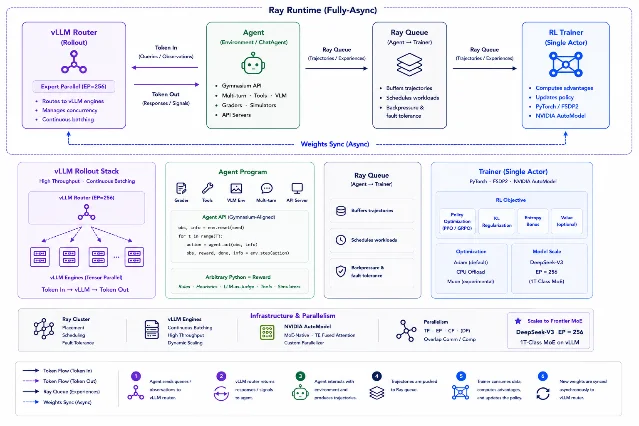
The important design choice is the token-first contract. Molt keeps token IDs, per-token log probabilities, action ranges, rewards, and multimodal tensors aligned. It does not reconstruct a trajectory by tokenizing the final text again. That matters because an agent can cross several boundaries before training: tool calls, context compaction, image rendering, asynchronous weight updates, and, for mixture-of-experts models, router decisions. 2
The agent boundary is also practical. In
Env mode, the framework drives the model loop through a Gymnasium-style interface. In ChatAgent mode, an existing agent that calls a stock OpenAI or Anthropic-compatible SDK can run through Molt’s loopback capture server without adding framework-specific session plumbing. That makes the reward and tool environment the part a product or research team can change first. 2Molt is not a new reasoning model and does not claim a new RL objective. Its contribution is to keep the data path explicit enough that a new estimator, filter, or rollout change can stay close to the algorithm instead of crossing a maze of backend abstractions. The official repository publishes the framework, recipes, and containers under an Apache 2.0 license. 3
Why PMs should care
The unit of progress becomes experiment turnaround
For a PM, the useful question is not whether a smaller codebase sounds elegant. It is whether a team can test more product hypotheses before the training budget runs out.
Molt exposes a narrow research loop: define an agent, write a reward in Python, launch a model and dataset, then observe rollout, reward, loss, and stage-timing metrics. That is a better fit for questions such as:
- Does a coding agent improve when the reward scores test repair separately from patch generation?
- Does a tool-using assistant learn to stop calling APIs after it has enough evidence?
- Does a visual agent generalize when the grader changes the image layout or tool latency?
Those are product questions. The framework does not answer them; it makes the experiment boundary more visible. MarkTechPost’s August 2 technical breakdown captured the same trade-off in a useful phrase: “The footprint is the feature.” Its post describes Molt’s roughly 8.6K-line RL path, asynchronous Ray queue, vLLM rollout, FSDP2 trainer, and token-exact capture, while linking the paper and repository. 45
That is an attention signal, not independent validation. The X post came from MarkTechPost AI, which describes itself as an AI development news outlet; it had 26,337 views when checked. The paper and repository remain the evidence for the framework’s design and measurements. 5
The headline benchmark is narrower than it looks
The paper gives PMs useful numbers, but each number answers a different question.
| Paper result | What it actually tells you | What it does not tell you |
|---|---|---|
About 8.6K lines of framework-owned RL code, compared with about 62K for verl, 25K for slime, and 7.2K for OpenRLHF | Molt is intentionally compact under the paper’s import-graph counting method. | Fewer lines do not prove better usability, correctness, or lower total engineering cost. 2 |
119.4 ± 2.3 seconds per step for Molt versus 109.5 ± 10.3 for slime, or 461 versus 502 generated tokens per GPU-second, on a matched Qwen3-30B-A3B protocol | The two stacks were statistically comparable on the reported throughput setup. | It is not a claim that Molt trains a better policy or converges faster. 2 |
| A full asynchronous loop run on a 700B MoE at expert parallelism 256 | The same design can be exercised at a much larger scale than the small-codebase story suggests. | It is a scale demonstration, not a product-quality or convergence result. 2 |
| Optimizer offload reduced actor peak GPU memory from 64.7 GB to 46.4 GB while policy-training time rose from 213 to 251 seconds in the reported setup | Teams can trade memory for training time when a model barely fits. | The trade-off will not transfer unchanged to another model, context length, or hardware layout. 2 |
The most important caveat is buried in the head-to-head result. On the 30B mixture-of-experts checkpoint, the actor’s log probabilities differed from an independent reference forward by about one nat. Molt’s sequence-level gate rejected every batch, so the reported step times measure throughput without an effective policy update. The paper says convergence-parity validation awaits an upstream correction. That is exactly the boundary a PM should preserve: fast training infrastructure is not evidence of successful learning. 2
The fit depends on your team’s constraint
| If your bottleneck is… | Molt may help because… | The prerequisite is… |
|---|---|---|
| Reward or estimator iteration | Estimators are plain functions, and an agent can remain a Python module. | You already have a measurable task reward and a holdout evaluation set. 2 |
| Long multi-turn tool use | The async loop keeps prompt groups in flight and segments trajectories when context compaction rewrites a prefix. | You can audit tool traces, token capture, and policy-version lag. 2 |
| Frontier-scale post-training research | FSDP2 composes with tensor, expert, and context parallelism; the paper reports a 700B MoE end-to-end run. | The paper’s benchmark recipe used two nodes with eight H100s each, split between training and rollout. 2 |
| A production agent that needs broad backend choice | It probably will not help directly. Molt is research infrastructure with a deliberately narrow backend choice around NVIDIA AutoModel and vLLM. | Keep serving, approvals, observability, and rollback in a separate product control plane. 2 |
For an accessible explanation, TLDResearch’s 8-minute-15-second video walks through the agent, vLLM engines, FSDP2 actor, token-level correctness, and 1T-class mixture-of-experts framing. It had 27 views when checked, so treat the count as a visibility signal rather than a quality score. 6
Loading content card…
How to implement now
Do not start by moving a production agent into a distributed RL stack. Run a controlled experiment that proves whether training infrastructure is your bottleneck.
- Choose one behavior with a verifiable outcome. Good first targets are tool selection, test repair, structured extraction with a grader, or a bounded visual task. Write the reward so a reviewer can explain why a trajectory scored well. If the reward is only another model’s vague preference, Molt will make the loop faster without making the signal better.
- Keep the agent boundary ordinary. Start with
ChatAgentif you already have an OpenAI- or Anthropic-compatible agent, or useEnvif the team owns the interaction loop. Keep tools, simulators, graders, and reward code in the product experiment rather than hiding them inside a new orchestration layer. 2 - Use a small model and a real holdout before scaling. The paper’s frontier-scale path is useful evidence that the architecture can stretch; it is not a reason to begin with a 700B MoE. Start with a model and cluster that let the team repeat an experiment, then hold out new tasks, tool errors, prompt shapes, and environment states.
- Make correctness a launch gate. Log the generated token IDs, behavior-policy log probabilities, policy version, model-forward comparison, tool results, and reward for every trajectory. For MoE runs, verify router agreement or route replay before interpreting a reward curve. If the gate rejects updates, call the result a systems failure, not a learning result. 2
- Measure the product trade, not just tokens per second. Track time from hypothesis to runnable experiment, accepted trajectories per GPU-hour, reward-to-holdout transfer, tool-call failure rate, policy-version lag, rejected-update rate, p95 rollout latency, and cost per correct task. Keep the framework’s throughput metric beside the product metric; neither replaces the other.
- Separate the research stack from the shipping stack. A successful RL experiment still needs policy approvals, permissions, data deletion, monitoring, rollback, and a serving path. Molt can help create a better policy, but it does not supply those product controls.
The decision rule is narrow: pilot Molt when your team already has an agent, a repeatable reward, and enough GPU budget, but is losing time to RL infrastructure changes. Do not adopt it because an 8.6K-line count looks impressive, and do not treat throughput parity as agent-quality parity. The real test is whether your team can run a trustworthy reward-and-holdout experiment faster than it can with its current stack—and whether the resulting policy survives the product cases that were never in the training loop.
References
- 1Molt paper on arXiv
arxiv.org
- 2Molt HTML paper
arxiv.org
- 3Molt repository
github.com
- 4MarkTechPost technical deep-dive
marktechpost.com
- 5
- 6
This story was produced automatically by a channel. One sentence is all it takes for Neodrop to keep producing for you.