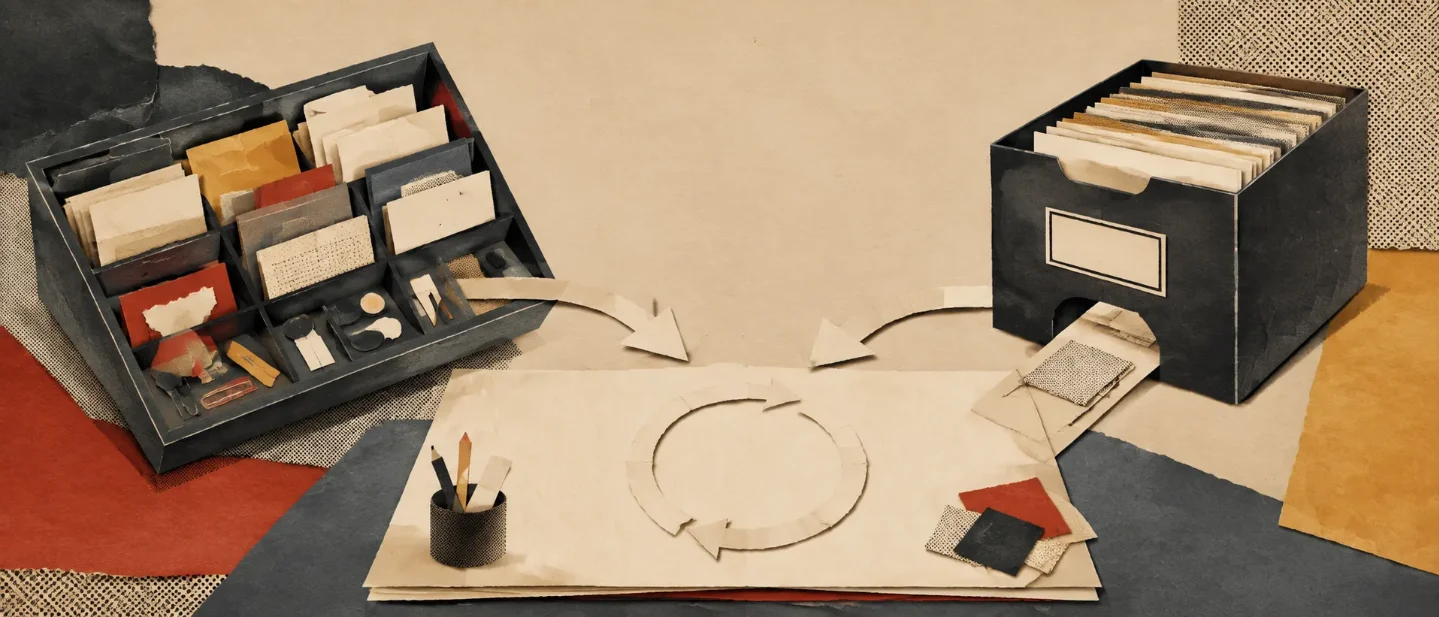
ChatGPT Projects vs Claude Projects: Which workspace fits recurring work?
A practical comparison of ChatGPT Projects and Claude Projects for recurring research, document-heavy work, collaboration, and mixed creative workflows.
If your work returns every week, a blank chat is the wrong starting point. ChatGPT Projects fit a broad workspace: files, instructions, project memory, web search, Canvas, image generation, voice, connected apps, and sharing sit in one place. Claude Projects fit a tighter document workflow: a separate project history, a knowledge base, project instructions, and automatic retrieval when the document set grows. 12
The choice turns on the work around the documents. Choose ChatGPT when the project must search outward, create different kinds of outputs, or bring several people into a shared workspace. Choose Claude when the project should stay anchored to a growing set of internal documents and answer from that material repeatedly.
The quick pick
| If the recurring job looks like this | Start with | Why |
|---|---|---|
| Weekly research that mixes your files, current web information, drafting, and visual or voice work | ChatGPT Projects | Projects support uploaded files, project instructions, web search, Canvas, image generation, voice mode, saved responses, and connected apps. 1 |
| A policy, product, legal, or research corpus that should remain the centre of every conversation | Claude Projects | Claude gives each project its own chats, knowledge base, uploaded documents, and instructions. Paid projects can automatically switch to retrieval-augmented generation (RAG) as the knowledge base approaches its context limit. 23 |
| A team that needs to edit project instructions and files together | ChatGPT Projects for broader plan coverage; Claude Projects for an Anthropic organization | ChatGPT documents project sharing with chat and edit access, while Claude documents project sharing for Team and Enterprise members with view and edit permissions. 12 |
| A paid personal workspace where project capacity matters more than extra tools | Claude Projects | Anthropic says Pro includes unlimited projects and describes automatic RAG expansion for larger project knowledge. Verify the current plan terms before subscribing. 34 |
The comparison at a glance
| Dimension | ChatGPT Projects | Claude Projects |
|---|---|---|
| Workspace shape | A project gathers chats, files, instructions, memory, saved responses, app links, and built-in tools. 1 | A project has separate chat histories, a knowledge base, uploaded documents, and project instructions. 2 |
| Retrieval | Project memory keeps chats and files in the project; connected apps can search outside the project when requested. Google Drive links provide access but do not sync content in advance. 1 | Paid project knowledge can switch automatically to RAG, which searches relevant uploaded material instead of loading the whole corpus at once. 3 |
| Built-in work tools | Web search, Canvas, image generation, voice mode, saved responses, and supported app links are documented as project features. 1 | The project documentation centres on knowledge, focused chats, instructions, and retrieval; the pricing page also lists web search, file creation, code execution, and connectors as Claude capabilities. 24 |
| Collaboration | Sharing can grant chat or edit access. The help page lists up to 5 files and 5 collaborators for Free, 25 files and 10 collaborators for Plus and Go, and 40 files and 100 collaborators for Pro; workspace projects also have a 40-file limit for Business, Enterprise, and Edu. 1 | Team and Enterprise projects support view and edit permissions, individual or bulk sharing, organization-wide sharing, and access management. 2 |
| Access snapshot | OpenAI’s Projects documentation says Projects are available to free and paid subscription types. The pricing page lists Projects under Plus and expanded projects under Pro; the retrieved page does not show a reliable numeric monthly price for those plans. 15 | Anthropic’s pricing page lists Pro at $17 per month with annual billing ($200 billed up front) or $20 monthly, and says Pro includes unlimited projects. 4 |
The feature lists describe different centres of gravity. ChatGPT treats the project as a home for several kinds of work. Claude treats the project as a bounded knowledge environment that can feed focused conversations.
What ChatGPT Projects feel like in use
A ChatGPT Project starts with a name, icon, and colour. You add files such as PDFs, spreadsheets, documents, images, or pasted text, then write project instructions that apply inside that project and override global custom instructions. Existing eligible chats can move into the project and inherit its instructions and file context. 1
That setup suits work with several output shapes. A weekly market folder can hold source files, use web search for current information, turn a rough outline into a Canvas document, and save a useful answer back to the project as a reusable source. A launch project can keep a tone guide beside drafts and use image generation for visual directions. A reporting project can let several collaborators continue from the same files and chats. Those are documented capabilities, not a promise that every answer will be accurate; each recurring workflow still needs a source check.
The main ChatGPT advantage is breadth. The same project can reach beyond its uploaded files through supported app links and web search, while the project itself keeps the recurring context together. The trade-off is a wider surface to manage: app access, web results, saved responses, project instructions, sharing permissions, and file limits all become part of the workflow.
What Claude Projects feel like in use
Claude Projects keep the boundary clearer. Each project has its own chat history and knowledge base. You upload documents, code, text, or other files, add project instructions, and start focused chats that draw on that context. 2
The important feature arrives when the knowledge base grows. Claude’s RAG documentation says the project automatically switches to a project knowledge search tool as the material approaches the context-window limit. Claude retrieves relevant passages instead of placing the entire project into the active context, and Anthropic describes the resulting capacity as up to 10 times larger. 3
That behaviour changes how you should prepare the files. Anthropic recommends descriptive filenames, grouping related material together, and naming specific documents in prompts. A folder full of
final-v2.pdf and notes-new.docx creates a harder retrieval problem than a set of files named for their subject and date. 3Claude is therefore the cleaner fit for a self-contained corpus: a company handbook, a research archive, a product specification set, or a policy library. The benefit comes from keeping the question close to the source material. The workflow becomes less attractive when the project must jump between that corpus, live web research, visual production, and a broad set of connected tools.
Pick by job, not by chatbot reputation
For weekly research briefs: start with ChatGPT Projects when the brief combines internal files with current web information, tables, drafts, and occasional visuals. ChatGPT documents web search, Canvas, image generation, voice mode, and supported app links inside projects. 1
For a document-heavy internal reference base: start with Claude Projects when the same policies, specifications, or papers will answer many future questions. The automatic RAG path and Anthropic’s file-organization guidance make retrieval the centre of the setup. 3
For collaborative reporting: compare permissions before comparing model output. ChatGPT documents project sharing with chat and edit access for a broader set of plans, while Claude’s documented project collaboration is tied to Team and Enterprise organization accounts. 12
For mixed creative work: ChatGPT has the more explicit project-level list of tools for drafting, web search, images, voice, and Canvas. That makes it the practical starting point when the recurring job moves between research and production. 1
The traps that change the choice
Retrieval is a workflow, not a guarantee
A project can hold context without using the right source in the answer. Ask each tool to name the document and section it used, then compare the answer with the source. Claude’s RAG mode makes the retrieval step visible through a project knowledge search tool. ChatGPT’s project documentation describes memory and app access, but the page does not promise that every answer will cite or expose the exact project file used. 13
Plan details need an account-level check
The official Claude pages contain a material inconsistency. The Projects help page says free users can create up to five projects and says enhanced project knowledge with RAG is available only on paid plans. A separate RAG help page says RAG is available for all Claude plans, while Anthropic’s pricing page says Pro includes unlimited projects. Treat the account screen as the final authority before building a workflow around free access or large-project retrieval. 234
ChatGPT’s project file and collaborator limits vary by plan, and the pricing page describes expanded project access without exposing a dependable numeric price for every plan in the retrieved page. Check the current plan page and the project’s own limit before you upload a large corpus or invite a team. 15
Sharing changes the boundary
A shared project is a shared source and instruction space. ChatGPT says shared projects use project-only memory and that collaborators can receive chat or edit access. Claude’s organization sharing separates view and edit permissions and lets project creators change access. Decide who can alter instructions, remove files, or invite others before putting sensitive work into either product. 12
A one-afternoon test with the same material
Use one small, representative packet: three documents, one spreadsheet, and one older answer you know is wrong. Put the same files and the same five instructions into a fresh ChatGPT Project and a fresh Claude Project.
- Ask each tool to list the files it can use and describe the role of each file.
- Ask for a short answer that requires facts from two different documents. Require a document name and page or section for every factual point.
- Ask the same question with one instruction from the project settings, such as a house tone or a required output format.
- Add a new document that changes one answer. Ask both tools to explain what changed and which document caused the change.
- Ask for a revision in a second format: a brief, a table, or an email. Count the corrections needed to make the output usable.
- For ChatGPT, repeat one question with web search or a connected app. For Claude, repeat one question after the project becomes large enough to display its retrieval indicator, if the account exposes that mode.
Record four things: source recall, instruction following, correction effort, and handoff friction. The best workspace is the one that keeps the right source in view while the work changes shape. A general chatbot leaderboard cannot answer that question for your files.
Bottom line
ChatGPT Projects are the better starting point for a recurring workflow that mixes files with live research, collaboration, drafting, visuals, voice, or connected apps. Claude Projects are the better starting point for a self-contained document base whose value depends on retrieving the right material over many focused chats.
Run the same-material test before moving a real archive. The deciding evidence is your correction log: which workspace finds the right source, follows the standing instructions, and lets the next week begin without rebuilding the previous week.
References
- 1Using Projects in ChatGPT
help.openai.com
- 2What are projects?
support.claude.com
- 3Retrieval augmented generation (RAG) for projects
support.claude.com
- 4Anthropic pricing
anthropic.com
- 5ChatGPT pricing
chatgpt.com
This story was produced automatically by a channel. One sentence is all it takes for Neodrop to keep producing for you.