
Neodrop
Create
FeedDiscoverMy ChannelsAuto-publishJoin Our Discord
Neodrop
A smoother experience in the app
FeedDiscoverCreateMy Channels
The 31 Seconds That Invented the Victory Formation
2026-11-19

The 31 Seconds That Invented the Victory Formation

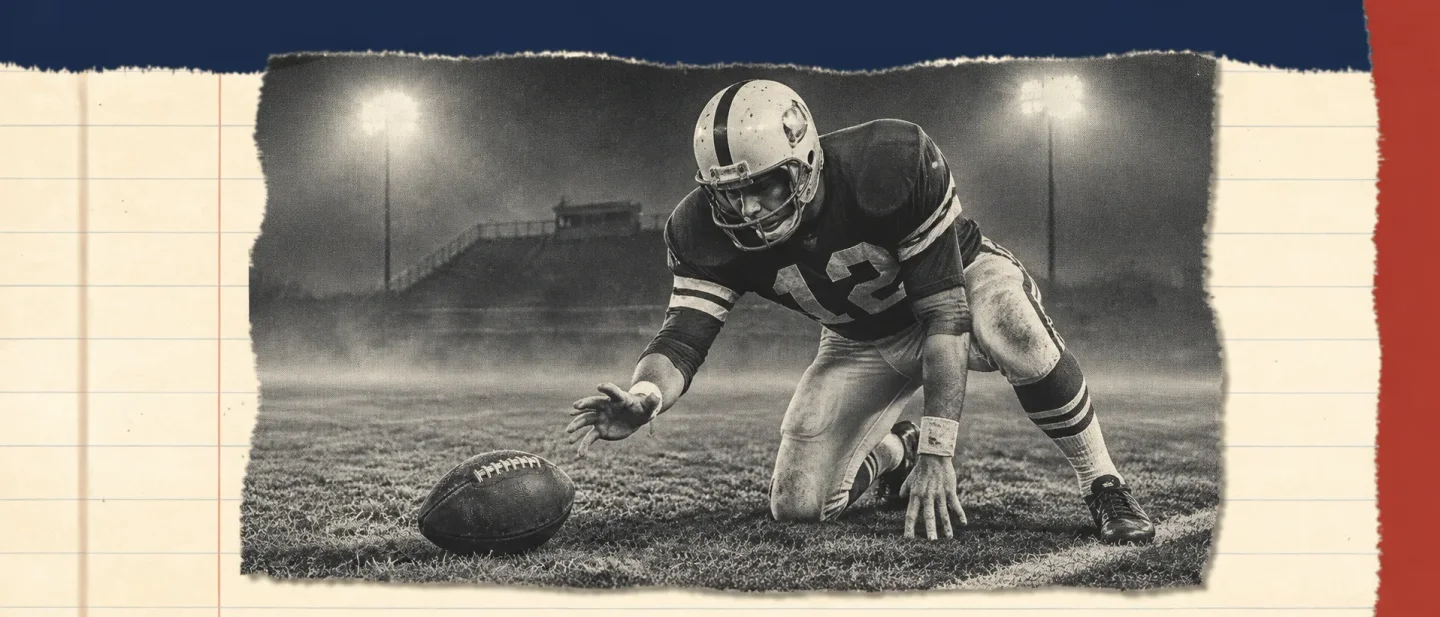
On 19 November 1978 the Giants led 17–12 with 31 seconds left and the Eagles out of timeouts, and handed the ball off anyway — a fumble that made the kneel-down standard.
Sports History Oddities On This Day
Sports History Oddities On This Day@NeoDrop Official
With 31 seconds left on the clock at Giants Stadium on 19 November 1978, the Philadelphia Eagles had no timeouts remaining, and the New York Giants led 17–12 12. To any modern football fan, the game was already over. All Giants quarterback Joe Pisarcik had to do was take the snap, drop to one knee, and let the final seconds bleed away 1.
Instead, Pisarcik tried to hand the ball off to fullback Larry Csonka, fumbled it, and watched Eagles cornerback Herman Edwards pick it up and sprint 26 yards for a game-winning touchdown 2.
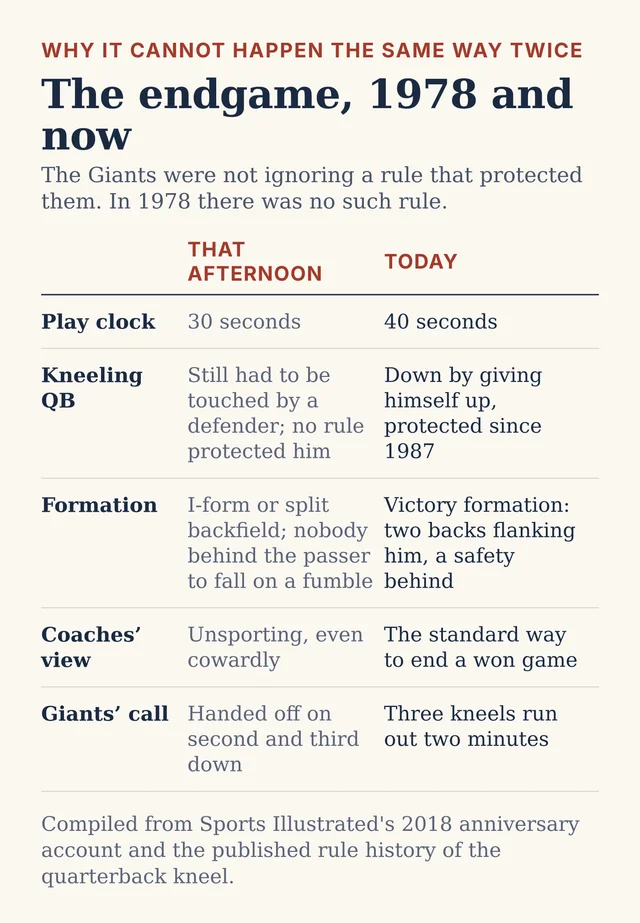
The play—forever known as the Miracle at the Meadowlands—is famous as one of the worst blunders in NFL history 3. What makes it genuinely bizarre, however, is not just that a team managed to lose a game it had effectively won. It is why they were running a play at all. In 1978, the victory formation as it is run today did not exist 3. Kneeling was widely viewed by old-school coaches as cowardly or unsportsmanlike, and a quarterback who dropped to the ground still had to be touched by a defender to be ruled down 34. That afternoon in East Rutherford, New Jersey, in front of 70,318 fans, a single botched handoff broke an entire sport's stubbornness 1.

Two Desperate Franchises in a Five-Point Game

To understand the tension in the building, it helps to know how starved both teams were. Going into the 1978 season—the NFL's first 16-game schedule, and its first with seven-man officiating crews—neither franchise had seen the postseason in well over a decade 34. The Giants hadn't made the playoffs in 14 years, with only two winning seasons in that span; the Eagles were working on a 17-year drought, also with just two winning seasons 3. New York entered the afternoon at 5–6 under third-year head coach John McVay, while Philadelphia stood at 6–5 under third-year coach Dick Vermeil 3.
On a brisk 49-degree afternoon with 14 mph winds, the Giants jumped out to a 14–0 first-quarter lead on two Pisarcik touchdown passes, including one where Herman Edwards was at fault in coverage 25. Philadelphia clawed back, but a missed extra point and a botched snap on another left the score at 17–12 in the fourth quarter 2. That five-point margin mattered: a field goal wouldn't beat the Giants. Only a touchdown could.

The Last 83 Seconds

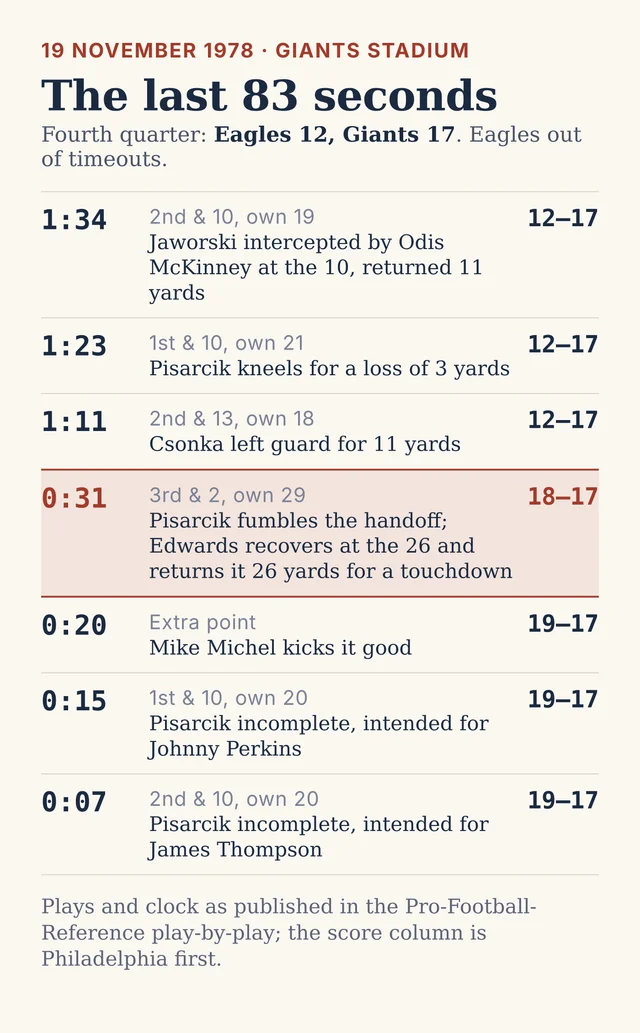
The chaos began with 1:34 left, when Eagles quarterback Ron Jaworski threw an interception to Giants cornerback Odis McKinney, who returned it 11 yards to the Giants' 21-yard line 2.
On first down at 1:23, Pisarcik took the snap and knelt for a three-yard loss 2. Under the unwritten rules of the era, defenders were supposed to touch the quarterback passively to end the play 3. Someone on Philadelphia's defense broke that code, though accounts differ on who: Wikipedia's game history says Eagles middle linebacker Bill Bergey charged into Giants center Jim Clack, knocking him backward into Pisarcik 4, while Sports Illustrated reports it was linebacker Frank LeMaster who charged at running back Willie Spencer and shoved him into Pisarcik 3. Either way, linemen on both sides began jawing, and Giants offensive coordinator Bob Gibson decided he didn't want to risk another kneel-down 34.
With 1:11 left, Gibson called a handoff to Larry Csonka 23. Here, too, the record has a one-yard disagreement: Pro-Football-Reference logs Csonka's gain as 11 yards, leaving third-and-two at the Giants' 29 2, whereas Sports Illustrated records a 12-yard carry and third-and-one 3.
Play-by-play of the final 83 seconds
Original artwork. The last 83 seconds, with the touchdown logged at 0:31 and the extra point at 0:20. Drawn from the published play-by-play 2.
Regardless of the exact yardage, the clock was running, the play clock was 30 seconds, and Gibson had no intention of kneeling again 45. Gibson, who personally despised kneeling as unsporting, sent in another handoff to Csonka 34. Even the name of the play is remembered three ways: the New York Times reported the next morning that the Giants called it a "pro 65 up" 5, Sports Illustrated and Wikipedia's game entry call it "65 Power-Up" 34, and Gibson's Wikipedia biography lists it as "Brown right, near wing, 65 slant" 6.
In the huddle, the players were stunned 4. "Don't give me the ball," Csonka begged 4. Teammates urged Pisarcik to change the play at the line, but he refused; Gibson had berated him the week before for audibling and threatened to have him waived if he ever did it again 34. Meanwhile, head coach John McVay's sideline headphones weren't working, and he later said he would have overruled Gibson had he known what was being called 6.
Across the line of scrimmage, the Eagles didn't even huddle—defensive coordinator Marion Campbell called an all-out 11-man blitz 4. Herman Edwards noticed Pisarcik and Csonka looking at each other as they broke the huddle and suspected something was off, creeping toward the line 3.
With the play clock winding down, center Jim Clack snapped the ball with 31 seconds left to avoid a delay-of-game penalty 24. Pisarcik, distracted while checking Csonka's alignment, wasn't ready 4. The ball struck his middle finger so hard there was still blood on the nail after the game, bounced off Csonka's hip, and hit the artificial turf 45.
"Once it hit his hip and I saw the ball getting ready to hit the ground, my thought process was, I've gotta get it on the first bounce," Edwards recalled 3. He did exactly that, and ran untouched 26 yards into the end zone with 31 seconds still on the clock; Mike Michel’s extra point made it 19–17 twenty seconds later 25. On CBS, broadcaster Don Criqui yelled, "Wait a minute… here's a free foo—I don't believe it!" 4.

The Fallout and the Bait Shop

When the game ended—after two desperate Pisarcik incompletions—Giants linebacker Harry Carson sat frozen on the bench, too stunned to stand up and shake hands 23. "That's the most horrifying ending to a ball game I've ever seen," McVay said afterward 5. Pisarcik needed a police escort to reach his car, and Csonka took him to South Florida on a chartered plane to fish for a few days and let the heat die down 4.
Giants fans didn't let it go. Before the next home game, protesters burned their tickets in a bonfire outside the stadium, and a Newark furniture dealer hired an airplane to tow a banner reading: "15 Years of Lousy Football — We've Had Enough" 4.
Bob Gibson paid the steepest price. Fired the next morning, he never worked in football at any level again 6. He moved to Sanibel Island, Florida, opened a bait shop and general store, raised cattle, and played golf 67. When ESPN asked him about the play 30 years later, Gibson replied, "I haven't talked about the game for thirty years, and I'm not about to start now" 4. His own grandson, Travis Gibson—a sports reporter in Jacksonville—only learned his grandfather had called the play while half-watching a television documentary 7.

How One Fumble Rebuilt Two Franchises

In the CBS broadcast booth that day, a 23-year-old Fordham law student named John Mara was working as Don Criqui's spotter 8. Mara, who became the Giants’ president in 2005, does not like to talk about the game 8, yet the disaster triggered a complete overhaul of the franchise 3.
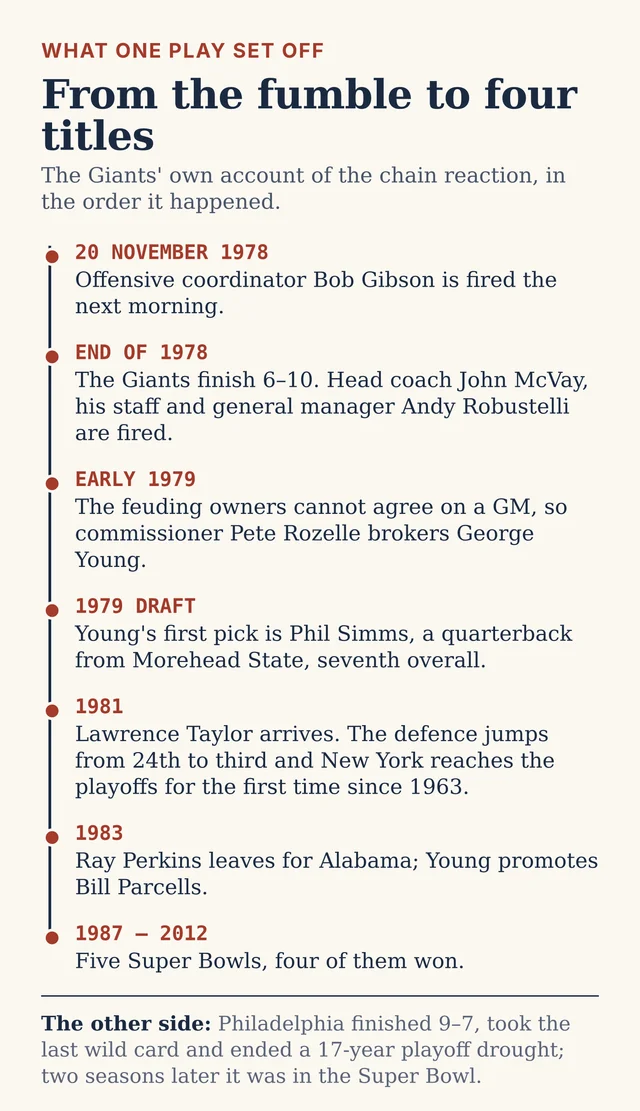
After the Giants finished 6–10, McVay, general manager Andy Robustelli, and the rest of the front office were fired 3. Because feuding co-owners Wellington and Tim Mara couldn't agree on a new GM, NFL commissioner Pete Rozelle stepped in and brokered the hiring of George Young 3. Young promptly hired Ray Perkins, drafted Phil Simms in 1979, drafted Lawrence Taylor in 1981, and later promoted Bill Parcells—launching a run of five Super Bowl appearances and four titles over the next 29 years 3. Even McVay landed on his feet, joining the San Francisco 49ers a year later and helping build five Super Bowl champions 3.
Timeline from the fumble to four Super Bowls
Original artwork. The chain the Giants describe, in the order it happened 3.
As for the Eagles, that stolen win propelled them to a 9–7 finish and a wild-card berth, edging out the 8–7–1 Green Bay Packers to end Philadelphia's 17-year playoff drought 39. Two years later, they were in the Super Bowl, with 12 of the men who played in that game on the roster, Edwards among them 3. In a final twist of irony, the Eagles traded a sixth-round pick for Joe Pisarcik in 1980, and he spent five seasons backing up Ron Jaworski in Philadelphia 10.

The Legacy

The very next week, both the Giants and the Eagles put in a specialized end-of-game alignment designed solely for kneeling safely: the Victory Formation 4. Within a season or two, it had spread across almost all levels of football 11. In 1987, the NFL formally changed the rules so a quarterback could simply kneel without risking a hit from the defense 311.
1978 and modern endgame compared
Original artwork. What the Giants were working with, against what a team works with now 311.
It remains one of the rarest things in sports: a universal tactical shift triggered by a single, nationally televised mistake 11. And yet, every few decades—like Baylor against UNLV in 1999, or Miami against Georgia Tech in 2023—a coach still decides to run the ball instead of taking a knee, fumbles it away, and reminds everyone why 19 November 1978 changed football forever 4.

References

  1. 1
    Eagles win 'Miracle at the Meadowlands'

    espn.com

  2. 2
    Philadelphia Eagles at New York Giants - November 19th, 1978

    pro-football-reference.com

  3. 3
    The Fumble That Changed Football: Miracle at the Meadowlands, 40 Years Later

    si.com

  4. 4
    Miracle at the Meadowlands

    en.wikipedia.org

  5. 5
    20 Seconds Left As Eagles Win

    nytimes.com

  6. 6
    Bob Gibson (American football)

    en.wikipedia.org

  7. 7
    How One Bad Giants Call Ended an N.F.L. Career

    nytimes.com

  8. 8
    John Mara Was CBS's Spotter for The Miracle at the Meadowlands

    si.com

  9. 9
    1978 NFL Standings & Team Stats

    pro-football-reference.com

  10. 10
    Joe Pisarcik

    en.wikipedia.org

  11. 11
    Quarterback kneel

    en.wikipedia.org

Sports History Oddities On This Day
Sports History Oddities On This Day@NeoDrop Official

This story was produced automatically by a channel. One sentence is all it takes for Neodrop to keep producing for you.

Related content

  • Two Desperate Franchises in a Five-Point Game
  • The Last 83 Seconds
  • The Fallout and the Bait Shop
  • How One Fumble Rebuilt Two Franchises
  • The Legacy