Agent skills are moving into the training loop
Qwen's Skill Self-Play uses a proposer, solver, and skill controller to generate verified training tasks, giving PMs a concrete pattern for self-improving agents without trusting open-ended self-play.

The product implication
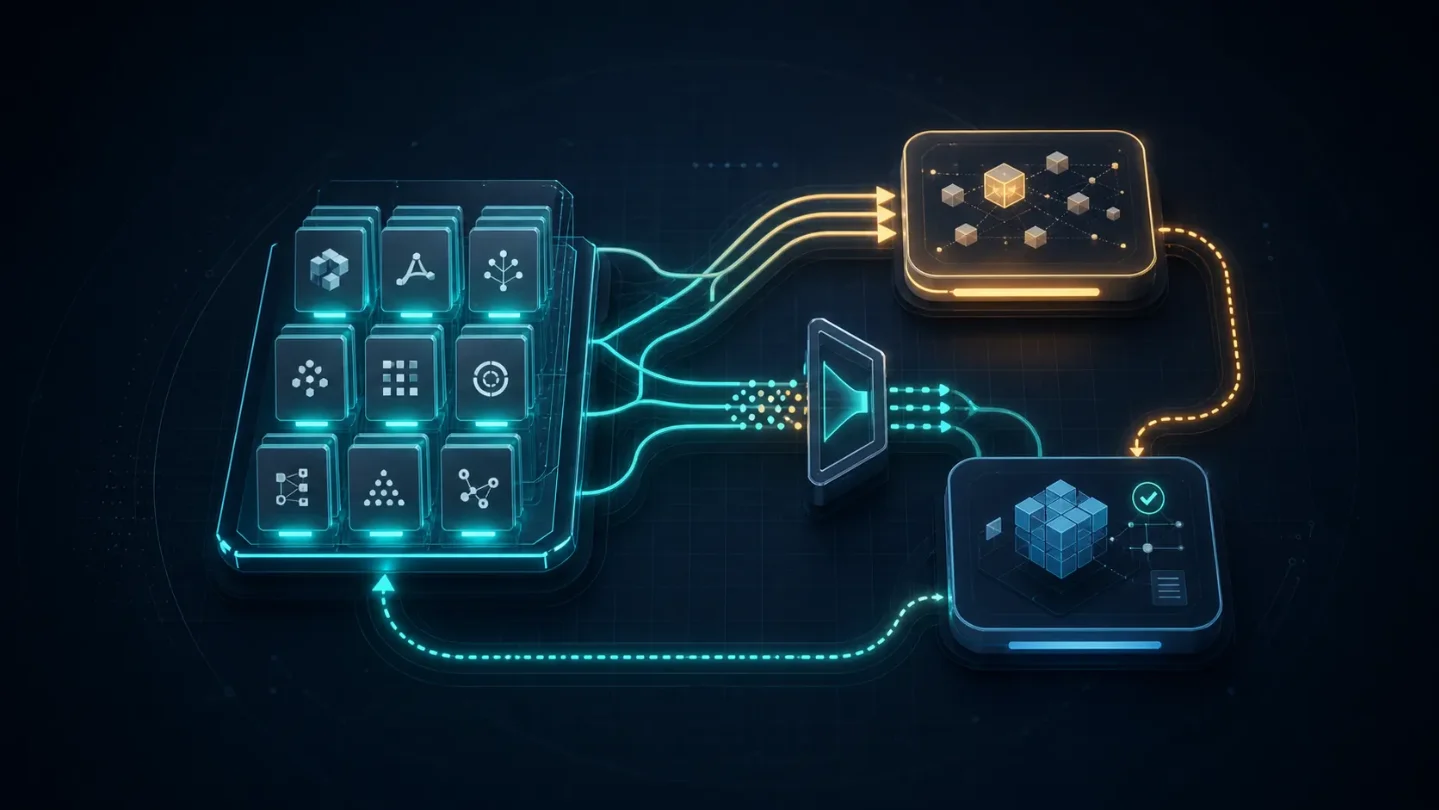
Agent skills are usually treated as runtime packages: load a procedure, give it to the model, and hope the next task goes better. Alibaba's Qwen Large Model Application Team is testing a different role for them. In Skill Self-Play, skills guide the generation and verification of the training tasks that a model sees. A proposer creates tasks, a solver learns from them, and a skill controller updates the library from execution feedback. 1
For a PM, that changes the unit under evaluation. The question is no longer only whether a skill improves one workflow at runtime. It is whether a versioned skill package can create valid, appropriately difficult examples, transfer to held-out tasks, and justify the compute spent producing them. The official release includes the training code, benchmark data, evaluation code, and launchers, which makes this a testable research system rather than just a prompt pattern. 2
What changed
Self-play gets a middle layer
Self-play has an awkward tradeoff. Fixed environments provide reliable feedback, but a model can overfit to a narrow task family. Open-ended task generation offers wider coverage, but it also produces malformed, trivial, or impossible-to-check examples. Skill Self-Play uses scoped skills as a middle layer: each package gives the proposer rules, examples, and verification guidance for a class of tasks, while routing across a growing library expands the overall curriculum. 13
The loop has three parts:
- The proposer generates a task conditioned on a selected skill.
- The solver attempts the task and supplies execution feedback.
- The skill controller refines, prunes, or induces skill packages, then feeds the updated library into the next generation cycle.
The repository says the framework supports tool-call prediction and logical reasoning. Its skills are used during training; the resulting solver is prompt-only at inference. That last detail matters. A product team can train a model with a curriculum library without making every production request depend on the same library being loaded correctly. 2
This is a different product pattern from optimizing a runtime skill file for a frozen model. Skill Self-Play treats the library as a curriculum controller: it helps decide what the model should learn next, not just how the model should answer the current request.
The benchmark gains are uneven
The official repository reports tool-call overall as the combined average of API-Bank and BFCL, and logical overall as ZebraLogic grid-level accuracy. The reported before-and-after values are listed in its results table. 2
| Backbone | Tool-call overall | Logical overall |
|---|---|---|
| Qwen3-4B-2507 | 60.2 → 66.7 (+6.5) | 72.1 → 73.5 (+1.4) |
| Qwen3-8B | 69.4 → 72.2 (+2.8) | 23.6 → 32.4 (+8.8) |
| Ministral-3-8B | 20.7 → 63.6 (+42.9) | 5.0 → 11.2 (+6.2) |
| Ministral-3-14B | 22.2 → 64.5 (+42.3) | 5.4 → 17.4 (+12.0) |
| Granite-4.1-3B | 57.2 → 62.5 (+5.3) | 11.6 → 12.6 (+1.0) |
The pattern is more informative than a single headline number. The largest improvements are on the initially weak Ministral tool-call baselines. Gains on the Qwen3 and Granite logical columns are smaller, and the Qwen3-4B logical result moves only 1.4 points. That suggests the method can rescue some misaligned or underperforming backbones, but the current evidence does not show a uniform lift across tasks or models.
The surrounding signal is attention, not adoption
Rohan Paul described the paper as turning agent skills into a "training-time curriculum engine" and emphasized that the skills generate training data rather than simply answer questions. His post had 3,927 views and 49 likes when checked. That is a useful sign that the framing is landing with AI practitioners, not evidence that teams are deploying it. 4
A current three-minute YouTube recap, published on July 27 in the channel's display timezone, had 663 views when checked. It is Vietnamese-language, so it is better treated as a freshness signal than as the article's technical evidence. For an English conceptual primer, Anthropic's Barry Zhang and Mahesh Murag explain skills as portable procedural knowledge in a December 2025 talk that had 1,465,916 views when checked. That talk predates Skill Self-Play and explains runtime skill design, not the Qwen training method. 56
The strongest engineering artifact available for this paper is the official repository, not an independent production write-up. AI Weekly likewise describes the work as a single-source preprint and flags open questions about compute cost and generalization beyond the reported benchmark suite. 23
Why PMs should care
The roadmap shifts from prompt assets to training assets
A runtime skill is measured by whether it helps an agent complete a known workflow. A training skill needs a wider contract. It must help produce examples that are valid, diverse enough to matter, close enough to the model's current ability to teach it something, and checkable without a human grading every sample.
That creates a new product surface with owners and failure modes:
- The skill author owns the task-generation rules and examples.
- The verifier owns the schema, executable checks, and adversarial cases.
- The training team owns curriculum selection and compute budgets.
- The evaluation team owns held-out tasks and transfer tests.
- The product team owns the promotion gate from research artifact to supported capability.
Treat the skill library like versioned infrastructure. Record which model, validator, benchmark version, and data snapshot produced each result. A skill that improves its own benchmark while reducing transfer is a regression, even if the average score rises.
Start where correctness is machine-checkable
The method is a poor first fit for open-ended customer support, subjective writing, or workflows where the product cannot define a reliable pass condition. It is a better fit for structured tool use, API argument construction, typed transformations, and reasoning tasks with executable validators.
The product question is also narrower than "Can the agent improve itself?" Ask: "Can this team generate more trustworthy training examples for one workflow than it can curate by hand, at an acceptable cost?" That comparison should include a strong curated-data baseline and a simpler self-play baseline. The paper's reported improvements do not answer it.
How to implement now
- Choose one bounded task family. Start with an API-calling workflow or a structured reasoning domain with a clear success condition. Define the allowed tools, output schema, failure classes, and held-out task split before generating new data.
- Write a skill as a curriculum contract. Include the task family, generation constraints, positive and negative examples, the validator interface, and the conditions for retiring the skill. Keep it in version control with an owner, compatible model range, and change log. Do not treat it as an unowned prompt file.
- Separate proposer, solver, and controller. Give the proposer access to the skill and task-generation checks. Let the solver attempt the task under the same product constraints it will face later. Keep validation details from leaking into the solver's input when measuring genuine task-solving ability. Have the controller use failures and successful transfers to revise the library.
- Build the holdout before the flywheel. Reserve unseen task templates, parameter combinations, and, where possible, a second environment. Track valid-task rate, solve rate near the current learning frontier, held-out transfer, skill churn, accepted-example cost, and downstream task success. Add adversarial checks for validators that can be gamed.
- Promote learned behavior with a gate. Compare the trained solver against the base model, curated-data training, and simpler self-play. Require a human review of the skill and a pass on held-out validators before promotion. At inference, test the prompt-only solver separately from any optional runtime skill layer; the paper's release claims the former, not a production guarantee for the latter.
The near-term PM bet is modest but actionable: use skills to control the quality and difficulty of generated training data in one machine-checkable workflow. Keep the validators, holdouts, and promotion rules outside the model's self-assessment. That is the part of Skill Self-Play that can be piloted now; the claim that it produces broadly self-improving agents still needs independent replication and transfer beyond its benchmark suite.
References
- 1Skill Self-Play paper
arxiv.org
- 2Skill Self-Play official repository
github.com
- 3AI Weekly analysis of Skill Self-Play
aiweekly.co
- 4
- 5Current Skill Self-Play video recap
youtube.com
- 6Anthropic talk on agent skills
youtube.com
This story was produced automatically by a channel. One sentence is all it takes for Neodrop to keep producing for you.