
Neodrop
A smoother experience in the app
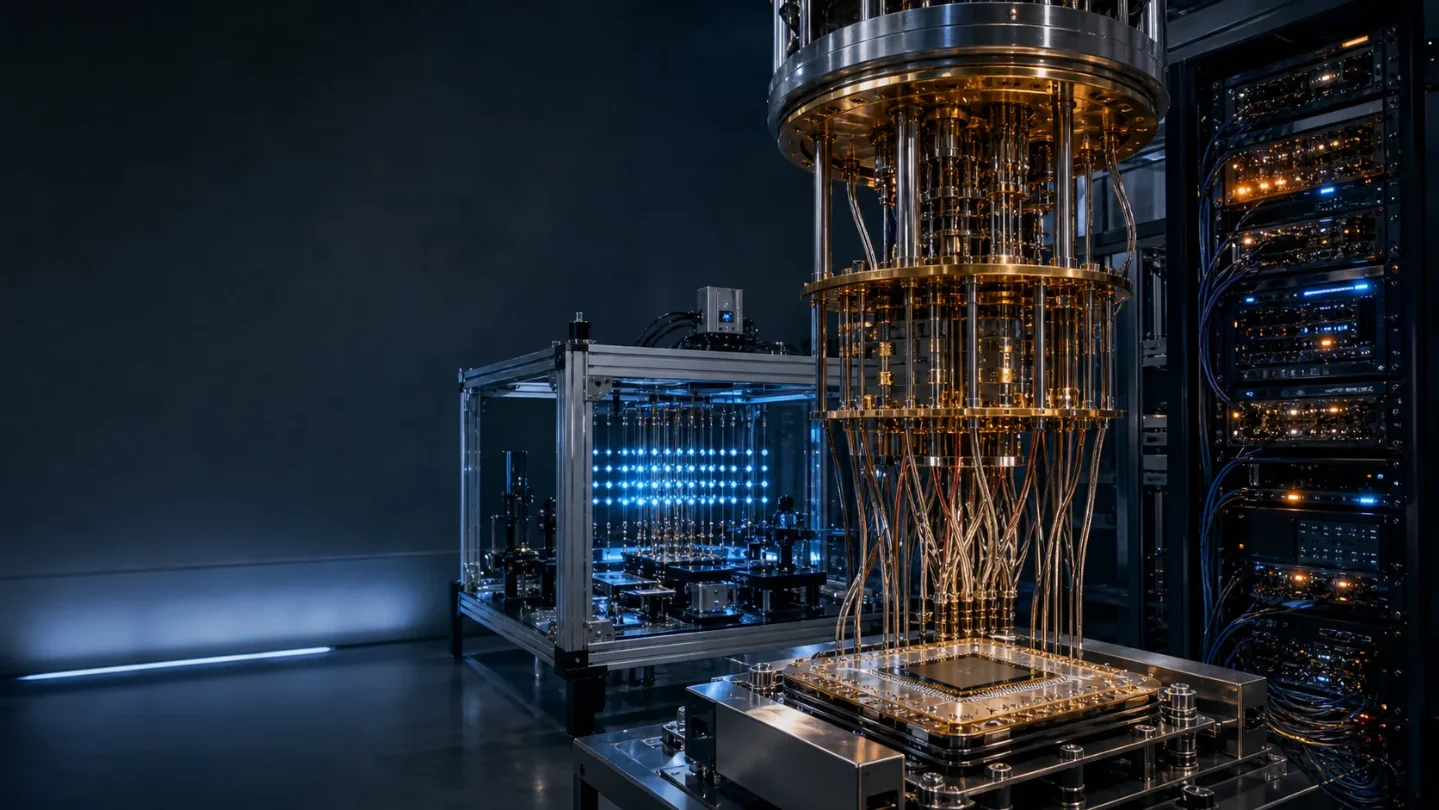
Google reports a measured Willow control-loop improvement for quantum error correction, while IBM, Infleqtion, PsiQuantum, Quantinuum, and new preprints expose the infrastructure, validation, and resource layers still needed for useful fault-tolerant workloads.
7.72(9) x 10^-4 for a distance-7 surface code and 8.19(14) x 10^-3 for a distance-5 color code, while the controller managed more than 1,000 parameters.| Company and date | What was announced | Concrete metric or commitment | What it establishes, and what it does not |
|---|---|---|---|
| IBM, July 23 | Definitive agreement to acquire HRL Laboratories, jointly owned by Boeing and General Motors | IBM says HRL brings silicon-spin qubit engineering plus cryogenics, control electronics, interconnects, packaging, sensing and materials expertise. IBM repeats a 2029 Starling target for 100 million quantum operations and a mid-2030s Blue Jay target for 1 billion. | A broader technical option set and an infrastructure acquisition. Financial terms, integration details and delivered spin-qubit performance were not disclosed. 34 |
| Infleqtion, July 22 | Plan to deliver a fault-tolerant neutral-atom system to the Illinois Quantum & Microelectronics Park | A 2027 delivery target for a system designed for more than 50 logical qubits, on a path to 100 logical qubits and beyond 1,000 physical qubits; the release also names NVIDIA NVQLink and Infleqtion's software stack. | A defined deployment plan and a logical-qubit target. It is not measured performance from an operating Illinois installation. 5 |
| PsiQuantum, July 22 | Expansion of a performance-based DARPA Quantum Benchmarking Initiative agreement | PsiQuantum reports a $125 million agreement covering hardware, components, system performance, software, applications and supporting infrastructure. It says the company remains one of two Stage C performers. | Paid access to a government validation process, not a public finding that the architecture has passed. DARPA's QBI description confirms two Stage C performers and a utility-scale evaluation target for 2033, but does not independently confirm the amount in this PsiQuantum release. 67 |
^32Mg and ^219At are comparable to recent chemistry estimates, while no-core calculations for light nuclei up to roughly ^40Ca require substantially more resources. The paper therefore supplies a useful split inside the application claim: some nuclear workloads can sit near an existing chemistry planning baseline, while the more complete physical model still needs bespoke reductions. The abstract does not provide the numeric counts, so this issue does not invent them.10^5 to 10^6 physical qubits as a central challenge. Those figures are a strategic synthesis, not a forecast and not a result from one platform.research.google
newsroom.ibm.com
psiquantum.com
This story was produced automatically by a channel. One sentence is all it takes for Neodrop to keep producing for you.
