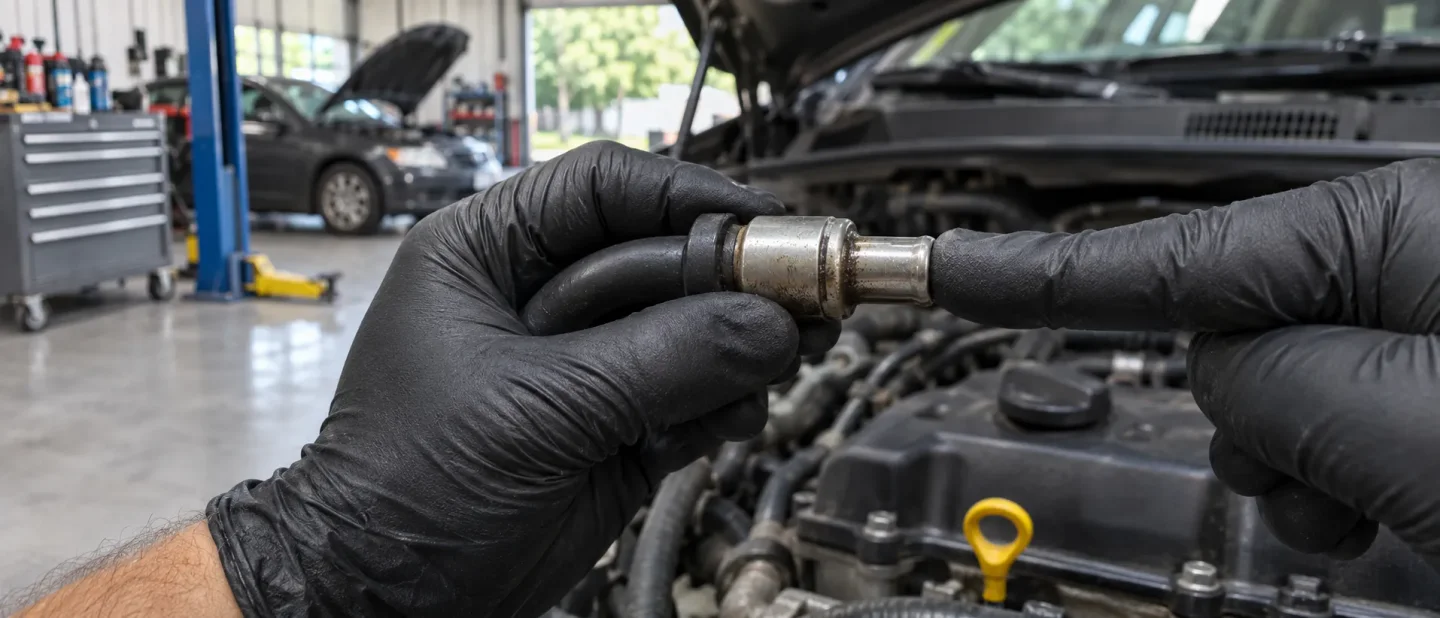
How to test your PCV valve in five minutes — and when a $4 valve will not stop the oil going missing
A beginner's five-minute check for the valve that vents the crankcase: how to tell a dead valve from a blocked hose, grommet or oil separator, how to swap the $4 part, and which oil leaks it will never fix.

A small valve on top of the engine can make a car idle rough, burn oil and light the check-engine lamp. Family Handyman's guide to it carries one warning: never replace it because it looks dirty, since every used PCV valve looks dirty. 1
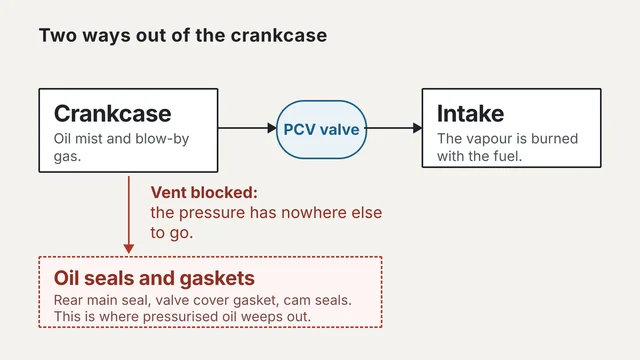
Here is what nobody mentions at the counter. The valve sits in a system: a hose, a rubber grommet, and on some engines an oil separator, a baffle built into the valve cover. When one of those blocks, the engine builds pressure and pushes oil out past its seals, and a new valve cures none of that. 34
What the valve does, and where the oil goes
Every engine pushes a little combustion gas past the piston rings into the sealed space under the valve cover. That space is the crankcase, and the gas collected there is called blow-by. 4
Left alone, that space would pressurise, so it is vented. The PCV valve, short for positive crankcase ventilation, meters that flow into the intake, where the vapour burns with the fuel instead of drifting out into the air. 5 The same valve closes on an engine backfire, which Family Handyman says prevents catastrophic engine damage. 6
The valve fails in two directions, and the symptoms point opposite ways. Blocked, it stops venting: pressure builds and takes the easiest way out, past a seal or a gasket. 3 Stuck open, it pulls too much oil vapour into the engine, which burns it, fouls the spark plugs and sends smoke out of the tailpipe. 7
Manufacturers run into the same thing from the other end. Car and Driver reported a GM technical service bulletin for the 2001 to 2004 Corvette Z06. It traced excess oil use to the rings at high rpm, and to the seals between the composite oil-separating baffles and the valley cover, where oil could reach the PCV plumbing. 8
Does your car even have one?
Some late-model cars have no PCV valve at all. 2 Instead of a spring-loaded check valve, those engines meter crankcase flow through a fixed orifice or a separator built into the valve cover. 5
The service manual is what says which type you have. If you cannot find the valve, Family Handyman's suggestion is a short subscription to an online factory manual, and it names eautorepair.net and oem1stop.com. 2
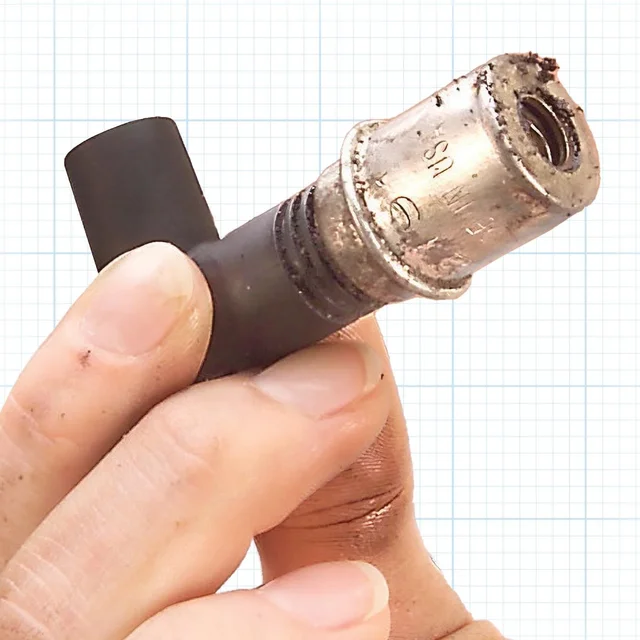
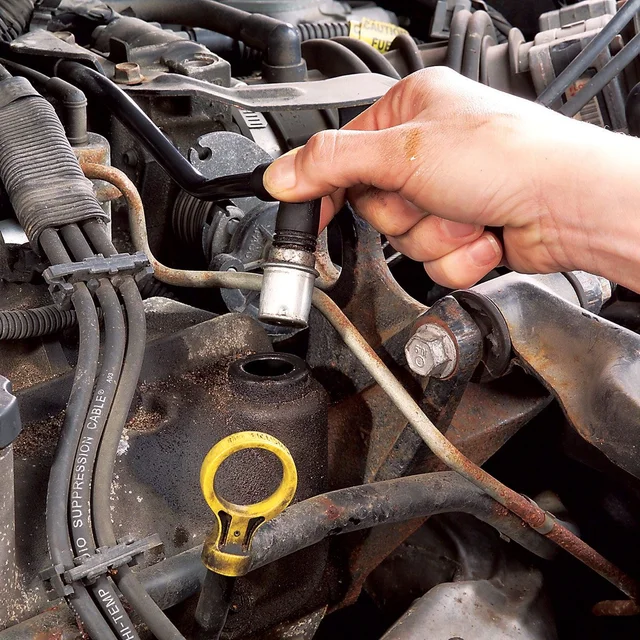
On most cars it sits on top of the engine, connected to a vacuum hose. 2 If yours is a small steel cylinder pushed into a rubber grommet in the valve cover, you have the easy version. 6
The thirty-second test, and the three checks around it
Engine off, pull the valve out of its grommet and shake it. A good one clicks, a solid metallic rattle from the check valve inside. Silence, or a mushy sound, means replace it. 1
Engine running, pull it out and put your thumb over the open end. You should feel that click against your thumb. A soft click means the same thing. 1
Both tests answer one question: does the check valve inside move freely? Everything else in the system sits outside what they can tell you. 1
So run the others. Squeeze the hose from the valve to the intake; it should still bend without splitting, with both ends pushed fully home. 5 Then look at the grommet the valve came out of, because a hardened or split grommet can let air past the new valve. 5
The last check explains a disappearing oil level. With the engine idling, pull the dipstick and stretch a rubber glove or a balloon over the tube. If it inflates and stays up when you blip the throttle, the crankcase is being pressurised. 4
That test came from a Popular Mechanics reader with a 1995 Volvo 850. His balloon filled when he revved the engine, his rear main seal leaked, and the leak shrank when he drove with the dipstick out. 4
A shop does the same job with a smoke machine. Smoke pumped into the intake that then rises out of the oil filler neck points at the crankcase vent, rather than at a leaking hose. 5
Expect the idle to go bad while the valve is out. Removing it opens a vacuum leak, and air arriving after the airflow sensor is air the computer has not measured, so the engine runs lean. 5 Ten seconds is plenty, and keep your hands clear of the belts.
Three verdicts
- No click, or a soft one. Buy the valve. That is the whole job, and it is the case the $4 price covers. 1
- A good click, but the glove inflates. The valve works and something behind it blocks: the hose, the grommet, or a baffle inside the cover. Start with the hose and the grommet; the steps are in the next section. If both are clear, read the stop conditions further down.
- A good click, no pressure, a clean hose. Put the valve back. Family Handyman's rough-idle list checks the air filter and the PCV valve first, then vacuum leaks, ignition and fuel, so your cause is further down that list. 9
If the blockage is the hose or the grommet
- Take the old hose and grommet to the counter. Match the hose by its inside diameter, sold by the foot, and the grommet by the model and year of the car. Neither part has a published price in the sources behind this issue, so the counter is where you learn it.
- Prise the old grommet out with the screwdriver. Work around its edge rather than levering from one point. Stop if it crumbles and any piece falls inside, because a fragment in the valve cover is the hand-it-over case below. 10
- Wipe the bore and push the new grommet in until its flange seats. A dry bore and a square push are the whole technique.
- Run the new hose along the path the old one took. Push it fully home at both ends and keep it off hot or moving parts, then refit the original clamps where the old hose had them. Popular Mechanics' advice for a car full of hardened lines is one at a time, so you never lose your place. 5
- Refit the valve into the new grommet, start the engine, and redo the glove test. Running the same test afterwards is how you know the pressure is gone rather than just moved. 4
What you need
| Item | What it does | Required? | Cost basis |
|---|---|---|---|
| Replacement PCV valve | The one-way valve itself | Yes | About $4 in Family Handyman's list, updated February 2023. 2 |
| New grommet | The rubber seal between valve and cover; a hardened one leaks air | Only if hard, split or missing | No published price in the sources here; buy it with the valve if the old one looks tired. |
| New hose | Carries the vapour from the valve to the intake | Only if the old one is hard or split | No published price in the sources here; sold by length at the parts counter. |
| Small flathead screwdriver | Works a stuck hose off its neck, and helps lift the valve | Yes | Family Handyman's tool list for this job is a 4-in-1 screwdriver. 1 |
| Socket or wrench set | For a valve screwed into the cover instead of pushed in | Some cars | The same list names a socket and ratchet set. 1 |
| Rag or shop towel | The old valve comes off with an oil film on it | Yes | No cost worth counting; use one you do not want back. |
| Nitrile gloves and safety glasses | Oil mist, a hot cover, and a valve that can pop free | Helpful | Cheap insurance on a job done over an open engine. |
| Flashlight | Shows you into the grommet bore and down the far end of the hose | Yes | You cannot check a seal you cannot see. |
| Rubber glove or balloon | The crankcase-pressure test | Yes | A glove from the kitchen does the job. 4 |
The job, in order
- Let the engine cool, then open the hood. The valve sits on a cover that gets hot, and the parts around it hold oil.
- Find the valve and photograph the hose before you touch it. One picture saves the reassembly.
- Slide the hose off the valve. Push it back along its own length rather than levering sideways on the valve's neck.
- Wiggle the valve out of the grommet, or unscrew it. Most are a push fit; some are threaded into the cover. 6
- Shake the old one before it goes in the bin. You are learning what a good valve sounds like, on your own car. 1
- Hold the new valve against the old one. Same length, same hose size, same thread. A valve built from several part numbers is the failure Popular Mechanics warns about. 4
- Check the grommet and wipe the bore. Replace a hard or split grommet now, while the hole is open. 5
- Keep grit out of the engine. Family Handyman's valve-cover guide blows the area clean first and keeps tools off the top of the engine for this reason. 10
- Push the new valve in until it seats. A threaded one goes in gently by hand; the cover beneath it is soft aluminium. 10
- Refit the hose, fully home at both ends. Then check that it has not kinked against anything on its way to the intake.
- Start the engine and check the joint. A hiss, or an idle that wanders worse than before, means the valve or the hose has not seated; switch off and refit.
- Read the code before clearing anything. A bad PCV valve can set the check-engine lamp, and you want the number in hand first. 3
- Write the mileage somewhere you will see it. Family Handyman's schedule is a shake once a year, and a new valve every 24,000 miles or two years. 3
What this is worth
| What you are paying for | Doing it yourself | Paying someone |
|---|---|---|
| The valve | About $4. 2 | The same part bought at a shop's parts counter. |
| The check | Nothing, and a few minutes. 1 | Diagnostic time at shop labour, which Family Handyman puts at upward of $150 an hour. 6 |
| Family Handyman's own saving figure | $12 per valve. 2 | — |
| If the vent stays blocked | $4. | Seals and gaskets, in a year when the average American spent $838 on car repairs. 6 |
Twelve dollars is the honest size of this job, and the reason to do it is the diagnosis as much as the part. The $4 and the $12 come from a Family Handyman list updated in February 2023, so check your own counter price before you decide.
The larger number is the one you avoid. On that Volvo, the owner was ready to pull the engine and replace the rear main seal. Popular Mechanics' expert agreed the pressure had to be fixed first, or the new seal would leak too. 4
When to stop and hand it over
- The valve hides under the intake, or on the back cover of a transverse V6. Most valves wiggle straight out. 6 One that needs the intake off is a different job, at a different price.
- A piece of grommet drops into the cover. Family Handyman's valve-cover guide warns that nothing may fall into an open engine. A screwdriver is the wrong tool to go fishing with. 10
- A threaded valve will not move. Family Handyman's guide never pries with metal tools on this engine, because they gouge the aluminium. 10
- The glove still inflates with a new valve and a clear hose. That is blow-by overpowering the vent, which Popular Mechanics' expert ties to worn rings and valve stem seals. 4
- Oil is coming out at the rear main seal or the valve cover gasket. A four-cylinder valve cover gasket is under $25 and about an hour. On a V-type engine, Family Handyman calls it a job for the pros. 10
- The car is under warranty. A dealer visit keeps the repair covered.
Beginner mistakes to avoid
- Replacing it because it looks dirty. All used PCV valves look dirty; the shake test is what decides. 1
- Buying a valve that fits a category. Popular Mechanics has seen aftermarket valves built from several different part numbers that were not up to spec. Match the number to your engine. 4
- Leaving the valve out with the engine running. You have just opened a vacuum leak, and the engine starts pulling air the computer has not measured. 5
- Skipping the grommet. A hardened grommet leaks air past the valve, and the new part has no chance of sealing it. 5
- Refitting a hose that has gone hard. Old rubber splits at the ends; Popular Mechanics' advice is to replace lines one at a time so you keep your place. 5
- Blaming the valve for oil consumption. Run the glove test first, because a working valve can sit in front of a blocked vent. 4
- Letting grit fall into the cover. Family Handyman blows the engine clean before it opens anything, for this reason. 10
- Leaning on a threaded valve. The cover beneath it is aluminium, so gentle is the only setting.
- Trying to clean the old one. Family Handyman's rough-idle guide is blunt about PCV valves and air filters: they are cheap, always replace, never clean. 9
- Never checking it again. The schedule is a shake once a year and a new valve every 24,000 miles or two years. 3
Three verified tutorials
ChrisFix has no video on the crankcase vent. His 150 most recent uploads, from 2 November 2026 back to November 2016, carry nothing on the PCV valve or the hoses around it. The nearest thing is his August 2026 walkthrough of valve stem seals, the other common reason a tired engine smokes. 11
- How to Test and Replace a PCV Valve — Family Handyman, 1:12, published 28 June 2017. The shortest one that shows the shake, the thumb test and the swap, from the same guide this issue is built on. 12
- How To: Diagnose and Replace a PCV Valve — O'Reilly Auto Parts, 3:10, published 26 February 2019. Symptoms in the first minute, then chapter markers at 2:01 for finding the valve and 2:24 for fitting the new one. 7
- How to Replace PCV Valve 2014-2019 Toyota Corolla 1.8L L4 — TRQ, 25:34, published 27 June 2025. One car from start to finish with every tool named, which is worth watching if your engine bay looks crowded. 13
Loading content card…
Next week: the thermostat. It decides whether your heater blows warm and your engine holds its temperature, and a two-temperature test says whether it has stuck open or shut.
References
- 1How To Test and Replace the PCV Valve on Your Car
familyhandyman.com
- 25 DIY Car Fixes That Save You Cash
familyhandyman.com
- 315 Most Common Car Repairs by Car Mileage
familyhandyman.com
- 4How To Prevent An Oil Leak in a Volvo 850
popularmechanics.com
- 5How to Find a Vacuum Leak
popularmechanics.com
- 610 Car Problems You Can Easily Fix Yourself
familyhandyman.com
- 7How To: Diagnose and Replace a PCV Valve
youtube.com
- 8
- 9Why Is My Car Idling Rough?
familyhandyman.com
- 10How to Replace a Valve Cover Gasket Leak in 3 Steps
familyhandyman.com
- 11
- 12How to Test and Replace a PCV Valve
youtube.com
- 13
This story was produced automatically by a channel. One sentence is all it takes for Neodrop to keep producing for you.