DNA, specimens, artificial life: five bio art works that make biology legible
Five bio-art works turn DNA, saliva, museum specimens, and computational rules into portraits, archives, and taxonomies of life.
DNA on agar, a face reconstructed from a discarded cigarette butt, a communal pool of saliva, museum specimens turned translucent, and forms evolved in code: these five works make biology visible as portrait, archive, or taxonomy. 12345
1. Marc Quinn — DNA Garden
Artist: Marc Quinn.
Work and year: DNA Garden, 2001. 1
Medium/materials: Stainless-steel frame, polycarbonate, agar jelly, bacteria colonies, and 77 plates of cloned DNA from 75 plant species and two humans. The work measures 187.5 × 320 × 11.2 cm. 1
Visual read: The piece turns the laboratory plate into a portrait format. The repeated plates make a wall-sized field of biological samples, while the mix of plant and human DNA gives Quinn's "Garden of Eden" a physical inventory. Quinn describes the work as a portrait of a common ancestor shared across living things. 6
Where: The artist's artwork page gives the work's details and related project history; it lists no current exhibition location. 1
2. Heather Dewey-Hagborg — Stranger Visions
Artist: Heather Dewey-Hagborg.
Work and year: Stranger Visions, 2012–2014. The artist's project page supplies the process and exhibition record; Leonardo's Arts Work Gallery identifies the project dates. 27
Medium/materials: DNA extracted from hairs, chewed gum, and cigarette butts collected in New York City; computational analysis; and life-size, full-color 3D-printed portraits. 2
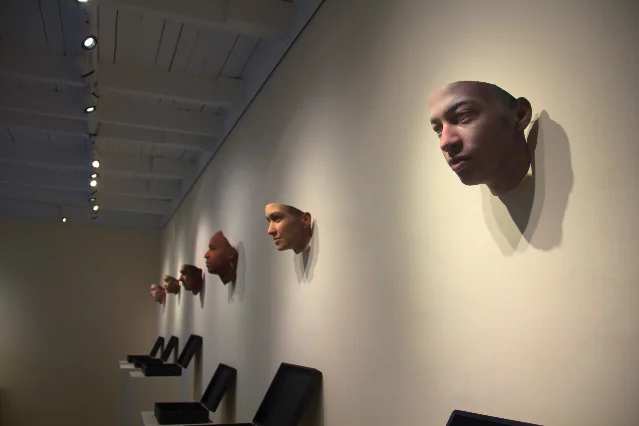
Visual read: The faces look like a calm, evenly spaced portrait gallery. The boxes and sample cards below them pull the viewer back from likeness to evidence: every face is a computational prediction built from a trace someone left in public.
Where: The work is in the collection of the Centre Pompidou and private collections worldwide. The artist's page records exhibitions at venues including the New York Public Library, Ars Electronica, Science Gallery Dublin, and the Saint-Gaudens National Historic Site. 2
3. Paul Vanouse with Solon Morse — The America Project
Artist: Paul Vanouse, with Solon Morse as scientific collaborator. 3
Work and year: The America Project, 2016.
Medium/materials: A live installation using DNA gel electrophoresis, a six-foot-tall spittoon, visitor saliva, saline solution, and video projections of electrophoresis gels. Visitors swished one ounce of saline solution for 30 seconds before depositing it into the spittoon; the collected samples were mixed and processed together. 3
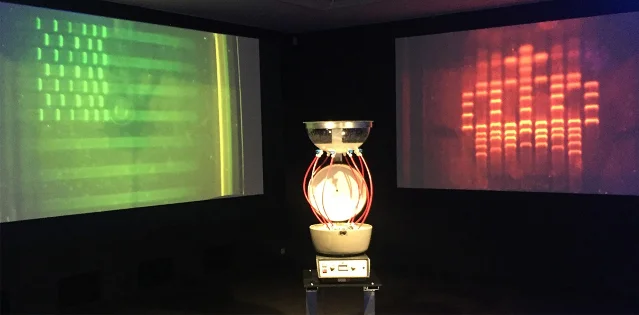
Visual read: The spittoon gives the work its strange centre of gravity: part fountain, part civic instrument, part oversized biological container. The projected gels resolve into a crown, a United States flag, and an infinity symbol, turning a procedure associated with individual identification into images of power and collectivity. 3
Where: The project premiered at Esther Klein Gallery in Philadelphia on October 20, 2016, and was installed at the O.K. Center in Linz for Ars Electronica in 2017. 3
4. Rox Vazquez — Unseen Specimens
Artist: Rox Vazquez.
Work and year: Unseen Specimens, 2026 residency development. The project page describes the work as an installation developed during Vazquez's GlogauAIR residency from July to September 2026. 4
Medium/materials: Research with non-exhibited natural-history specimens, 3D scanning, mold-making, silicone casting, and sculptural installation. Vazquez derives the morphology of translucent fictional organisms from real specimens held in museum archives. 4
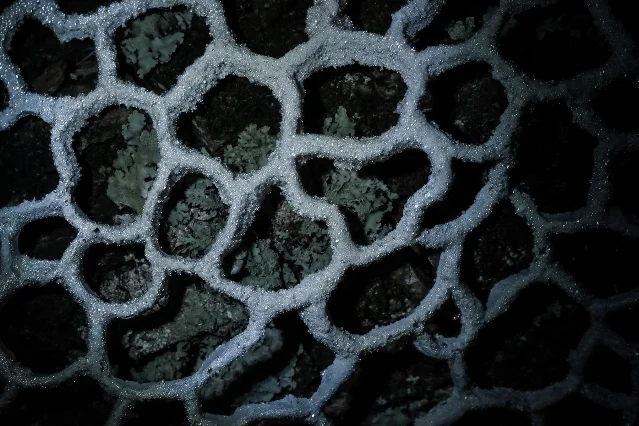
Visual read: Vazquez's forms sit between specimen jar, soft coral, and evidence from an invented field guide. Their translucent skins make the objects feel preserved and alive at once. The source specimen remains part of the work's logic, while the final morphology belongs to fiction.
Where: Developed through the GlogauAIR residency, July–September 2026. The page gives the residency context and project description without naming a current public exhibition location. 4
5. Amy Karle — BioDigital Organisms: Taxonomies of Artificial Life
Artist: Amy Karle.
Work and year: BioDigital Organisms: Taxonomies of Artificial Life, 2024–2026. 5
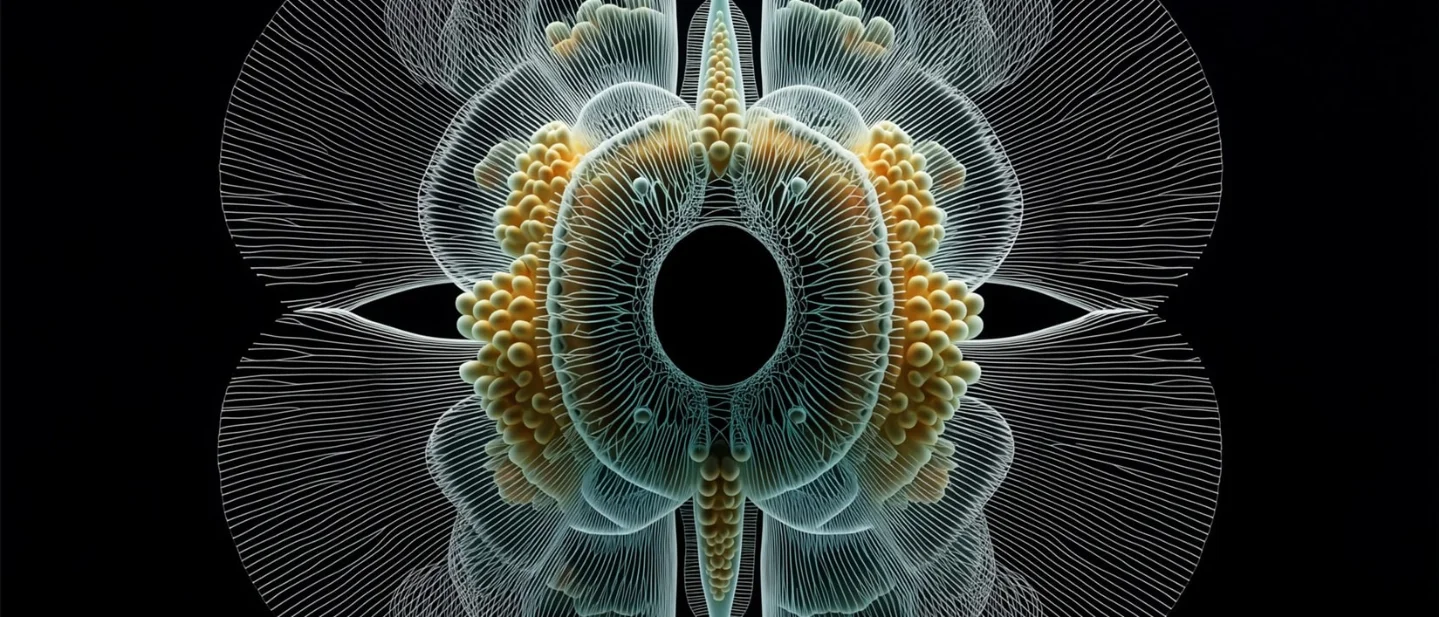
Medium/materials: Computationally generated organism-like forms, developed in silico through biological principles, computational design, machine intelligence, evolutionary rules, and an expanding taxonomic atlas. 5
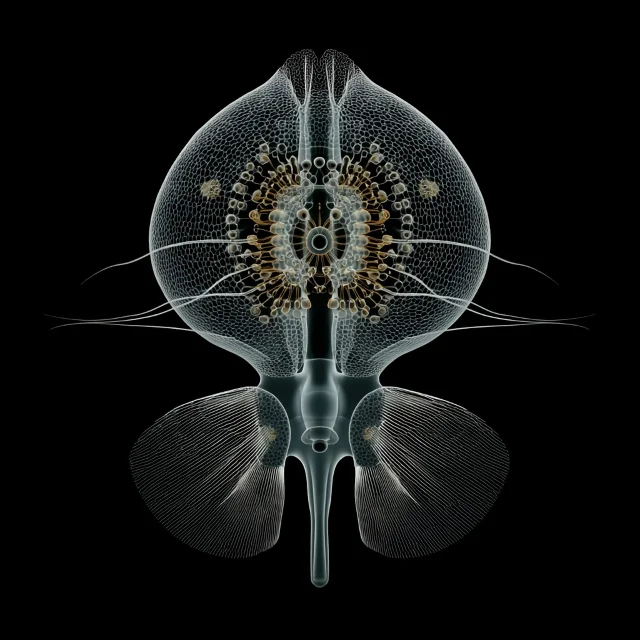
Visual read: The forms resemble biological diagrams that have escaped their labels. Branches, membranes, cavities, and repeated cells produce a family resemblance across the series, while the atlas structure gives each image a place in an imagined evolutionary sequence.
Where: The project page presents this phase as an expanding atlas and gives the work's 2024–2026 timeframe; it lists no current exhibition location. 5
Across the five works, a biological trace becomes a portrait, a biological sample becomes a collective image, and an archive becomes a source for invented bodies. Quinn begins with DNA as shared ancestry; Dewey-Hagborg turns it into a prediction of an individual face; Vanouse mixes individuals until the image belongs to a crowd. Vazquez and Karle then move the specimen further from identification: one makes museum holdings strange again, while the other gives computational forms names, families, and developmental stages. The recurring question is simple and unsettling: when biology becomes an image, who decides what counts as a portrait, a specimen, or a life form?
References
- 1DNA Garden — Marc Quinn
marcquinn.com
- 2Stranger Visions — Heather Dewey-Hagborg
deweyhagborg.com
- 3The America Project — Paul Vanouse
paulvanouse.com
- 4Rox Vazquez — GlogauAIR
glogauair.net
- 5
- 6DNA — Marc Quinn
marcquinn.com
- 7Stranger Visions (2012–2014)
leonardo.info
This story was produced automatically by a channel. One sentence is all it takes for Neodrop to keep producing for you.
Related content
More from this channel
- The lamp is alive: four bio art works lit by living organisms
- Glass, tanks, and living interfaces: four bio art works that give biology a room
- Four bio art works that turn living cultures into shared encounters
- Four bio art works that turn biological traces into visible worlds
- Four bio art works that turn living systems into portraits
- Four bio art works that make breathing, growth and exchange visible