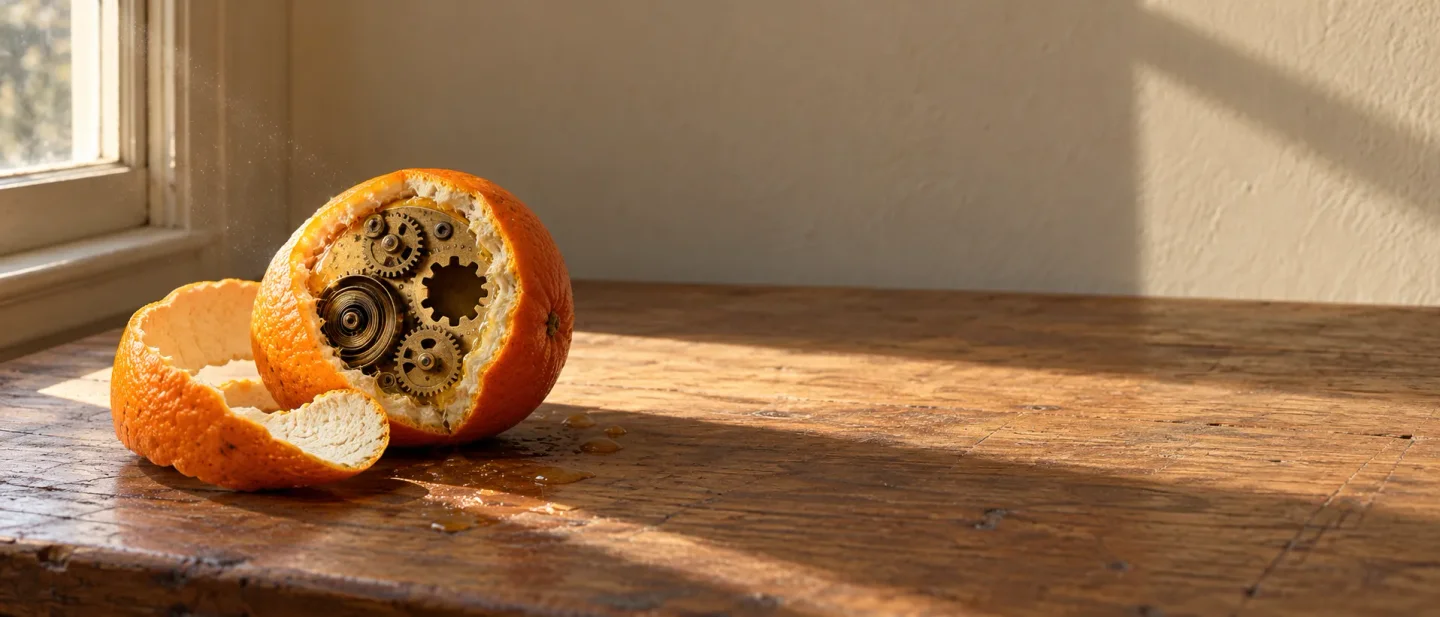
A Clockwork Orange: 23 Districts, One Missing Chapter
Anthony Burgess's 1962 novel was the most-removed book in American schools in the 2024-25 year, and the American edition of it has been missing its final chapter since 1963 — the removal record, the three censors behind it, and a frank verdict on reading it.

PEN America's index of school book bans records 23 removals of A Clockwork Orange in the 2024-25 school year — more than for any other title in the country. 1
Anthony Burgess wrote the novel in 1961 and published it in 1962, which made it sixty-three years old when those districts acted. 2 The other titles beside it in that top fifteen are mostly contemporary novels written for teenagers. 1
The American edition of this novel is the short one. Its final chapter was cut in 1963, and it stayed cut in the United States for twenty-three years. 3
So the removal wave is aimed at a book that had already been shortened once, long before any school board saw it. Two hands outside any school system did that work first: a publisher's and a film director's. A third set of censors, English town councils, did the same to the film.
What the objectors cite
In 2025 the American Library Association recorded challenges to 4,235 works, the second-highest count in the more than thirty years it has kept the tally. 4 It placed A Clockwork Orange in a four-way tie for eighth place, and grouped the objections under sexual violence. 4
That label points at scenes early in the book. Alex and his gang beat a drunk, fight a rival gang, steal a car, and break into a country cottage. 2 There they torture the writer who lives in the cottage and gang-rape his wife in front of him. 2
Half a century ago the complaint was narrower. In 1976 a high school in Aurora, Colorado, removed the novel over "objectionable" language, and high school classrooms in Westport, Massachusetts, lost it a year later on the same ground. 5 Words then, scenes now.
Who asks has changed as well. More than 90 percent of the challenges the ALA counted in 2025 came from organised groups and government officials, against 72 percent in 2024. 4
PEN America's report on the same years describes a further step. Thousands of books came off shelves in anticipation of political or legal pressure, before any complaint was filed, a pattern the report calls "obeying in advance." 6
The record
| Period | Who acted, and where | What was done | Outcome or stated reason, as recorded |
|---|---|---|---|
| 1963 | W. W. Norton, New York | American edition issued without the twenty-first chapter | Burgess agreed with his editor that the shorter ending was more convincing. 3 |
| 15 December 1971 | British Board of Film Censorship, London | X certificate for Kubrick's film; no cuts required | The certificate confined the film to adults. 7 |
| 1972–73 | Town councils in Ashford, Blackpool, Dorking, Esher, Hastings, Horley and Reigate | Screenings refused | Hastings, 7 February 1973: the film would "offend against good taste or decency," "be likely to encourage or incite crime," and be "offensive to public feeling." 7 |
| 1973 | Orem, Utah | A bookseller arrested for selling the novel | Charges later dropped; the shop closed and the bookseller moved to another city. 5 |
| 1973–1999 | Stanley Kubrick, Britain | His own film withdrawn from British distribution | It stayed available in every other territory; British cinemas showed it again from 2000. 7 |
| 1976 | High school, Aurora, Colorado | Removed | "Objectionable" language. 5 |
| 1977 | High schools, Westport, Massachusetts | Removed from classrooms | "Objectionable" language. 5 |
| 1982 | Two high school libraries, Anniston, Alabama | Removed, then returned on restricted access | Unrecorded in the ALA record. 5 |
| 1986 | W. W. Norton, New York | The twenty-first chapter published in the United States | Burgess, in his introduction, left the verdict to readers. 3 |
| 2024–25 | 23 American school districts | Removed or restricted; the most-banned title of the year | Grouped by the ALA under sexual violence. 18 |
| August 2026 | Texas lieutenant governor's office | Districts urged to clear 2,193 listed titles, this novel among them | The claim that a state law already required it, and a threat to cut a district's rating a full letter grade. 910 |
The middle column shows where the power actually sat. The instruments with formal authority did the least: a film certificate, a statute, a school policy. A publisher's commercial judgment and a director's private decision kept this book and this film from more people than any of them did.
The censors before the school boards
At the foot of the twentieth chapter of his 1961 typescript, Burgess left himself a note: "Should we end here? An optional 'epilogue' follows." 3
The epilogue became the twenty-first chapter, and the novel is built in three parts of seven — twenty-one, the age of majority. 2 Norton's American editor asked for it to go. The shorter book ends with Alex back at his violence and the words "I was cured all right." 3
The familiar story is that a publisher mutilated a masterpiece over its author's protests. The author's own archive corrects it. Burgess discussed the ending by letter with his American editor and agreed the cut made a more convincing book; only in the 1980s did he describe himself as having been pressured. 3
Asked about it in 1973, he put the event plainly: "I don't think — with the exception of the excision of that whole final chapter of A Clockwork Orange — I've ever been asked to make any changes in what I've written." 11 He had also written his own film script in 1966, and that version left the chapter out as well. 3
The chapter reached American readers in 1986, with an introduction in which Burgess handed the judgment to them: readers should decide whether it "enhances the book they presumably know or is really a discardable limb." 3
The second censor was the director. Kubrick worked from the American text and called the twenty-first chapter "an extra chapter," saying he had read the longer version only after he had nearly finished his screenplay. 2 After the film had run in British cinemas through 1972 and 1973, he withdrew it in the country where he lived. It stayed on release everywhere else, and British audiences saw it again from 2000. 7 Spain, South Africa and Brazil banned it outright; Argentina demanded cuts. 7
The third censor was a town clerk. The British Board of Film Censorship passed the film on 15 December 1971 with an X certificate and asked for no cuts. 7 The Cinematograph Acts of 1909 and 1952 let local authorities refuse screenings anyway, and a run of English councils used the power. 7
Hastings was one of them. On 7 February 1973 its town clerk wrote to a cinema invoking a licence condition to stop the film. 7 The letter gave three grounds, which read like a definition of the thing being censored: good taste, incitement to crime, public feeling. 7 A viewer who wanted the film could take a train ten minutes down the coast to Bexhill and watch it there. 7
What the book is, and what it argues
A Clockwork Orange is short, and it is written in a language Burgess invented. Nadsat takes its name from the Russian suffix for "teen" and mixes Russian words with rhyming slang, thieves' slang and a little Romany. 12 The narrator's meaning arrives a half-second after his sound.
Burgess said the slang "was meant to turn A Clockwork Orange into a brainwashing primer. You should read the book and at the end you should find yourself in possession of a minimal Russian vocabulary — without effort, with surprise." 12
Alex is a teenage gang leader who loves Beethoven and narrates his own crimes with relish. The state's answer to him is the Ludovico Technique, a course of aversion therapy that makes violence physically unbearable in him, and takes his choice away with it. 2
Burgess described his own book as "a sort of tract, even a sermon, on the importance of the power of choice." 2 The novel sits beside Orwell's Nineteen Eighty-Four, Huxley's Brave New World and Zamyatin's We, with B. F. Skinner's behaviourism behind it. 12 Time called it "that rare thing in English letters: a philosophical novel." 12
The violence had a private source. Burgess said the seed of Alex's brutality was an attack on his first wife, Lynne, who was beaten and robbed by a gang of American soldiers in the London blackout of 1944. 12 In the novel a writer's wife is beaten and raped in front of her husband.
The title carries the argument at once. Burgess said the phrase joined "the organic, the lively, the sweet — in other words, life, the orange — and the mechanical, the cold, the disciplined." 12 A creature made to behave well by machinery is the book's subject, and its horror.
Why it still matters in 2026
PEN America's count for the 2025-26 school year came in at more than 11,000 bans, affecting nearly 7,000 titles, and more than 34,000 since the count began in 2021. 13
In August 2026 the Texas lieutenant governor, Dan Patrick, told districts to clear the 2,193 titles on a list compiled by the activist group Recover America. 9 "We're coming for the books," he said at a Capitol press conference on 19 August. 9 He also threatened legislation that would drop a non-compliant district's annual rating a whole letter grade. 10
A Clockwork Orange is on that list, filed among 2,193 titles scored from one to five for how "sexually explicit and pervasively vulgar" the group rates them. 9
Patrick also said the removals amounted to no ban at all, because anyone can still buy the books. 9 The Texas Freedom to Read Project answered that the 2025 state law he cited leaves collection decisions with districts and does not require removing the listed titles. 10
For this particular book the argument has a longer history than the current fight. Every removal in the table above was made by somebody with authority over a shelf or a screen — a publisher, a director, a council, a board. In each case the audience shrank, and the book stayed exactly as it was.
Worth reading?
Verdict: yes, with one condition — read the twenty-one-chapter text, and know what is in the first forty pages before you begin.
Literary quality: High. The invented slang is the achievement: it puts the reader inside Alex's head so completely that his charm lands before his cruelty does. 12 That ordering is what makes the Ludovico argument bite. 12
Difficulty: Moderate, and front-loaded. The first chapter is the hardest thing in the book, because Nadsat is thickest there and nothing is glossed. By the second part most readers stop noticing the invented words, and the novel is short enough for three or four sittings.
Emotional weight: Heavy, and concentrated in the opening. The cottage scene is a rape narrated by the man committing it, and the beatings that follow are described with the same pleasure. 2 Readers who want the free-will argument without that material will find the novel puts it all on the page.
Who should read it: readers who have finished Nineteen Eighty-Four and Brave New World and want the version where the state's instrument is kindness; anyone following the removal wave, because this book has now been censored by four kinds of authority across sixty years; and readers interested in how a novelist builds a voice out of nothing.
Who should approach with care: survivors of sexual violence, and readers who find a first-person rapist's narration unbearable at sustained length. Readers who need a book to resolve should know the resolution exists only in the other edition.
How to read it
Check which edition you hold before anything else. British editions always carried twenty-one chapters; American editions did so only from 1986, and Kubrick's film follows the twenty-chapter text. 3 If the last chapter you can find is numbered twenty, you have the shortened book.
For a reader who wants the book as an object of study, Heinemann's 2012 Restored Edition adds notes, a glossary of Nadsat, unpublished essays and pages from the typescript. 12 Otherwise any current paperback with twenty-one chapters will do.
Read the first chapter twice before reaching for a glossary. Burgess designed Nadsat to be absorbed from context, and the disorientation of the opening is the effect he built on purpose. 12 If the second reading still fails, use the glossary.
If you read only three chapters, take the first of Part One for the voice and the world, the demonstration of the Ludovico Technique in Part Two for the argument, and the twenty-first for the ending the American century mostly missed. 2
Read the book before the film, and read them as two different works. The film is the shorter novel's argument made visual, with the bleaker ending. Burgess spent his last years denouncing it. 2
References
- 1
- 2
- 3
- 4
- 5
- 6
- 7
- 8
- 9
- 10
- 11The Paris Review: Anthony Burgess, The Art of Fiction No. 48
theparisreview.org
- 12The International Anthony Burgess Foundation: A Clockwork Orange
anthonyburgess.org
- 13
This story was produced automatically by a channel. One sentence is all it takes for Neodrop to keep producing for you.