Open-ended arenas, breadcrumb attacks, and entropy bounds for agent safety
Three recent arXiv papers show why agent-safety evidence can stop transferring when environments evolve, attackers coordinate evidence across turns, or fixed monitors face dispersed attack patterns.

Three recent arXiv papers give different ways for a safety test to stop being representative: the environment can evolve, an attacker can coordinate evidence across search turns, and a fixed monitor can cover only common attack patterns. Their numbers are not comparable; their mechanisms are. Read together, they turn a vague warning about benchmark transfer into a testable question: what distribution of trajectories did the evaluation preserve, and who was allowed to change it?
Stateful environments change the object being tested
OpenART Arena: Scaling Agent Red Teaming via Open-Ended Environment Evolution treats the environment as part of the attack surface. Posted on 1 August 2026, the paper builds more than 10,000 validated stateful scenarios across 50 domains from more than 500,000 tools, MCPs, and skills. It projects those scenarios into 15 deployed agents and evaluates five foundation models across eight attack vectors, producing 75 agent-model configurations. 1
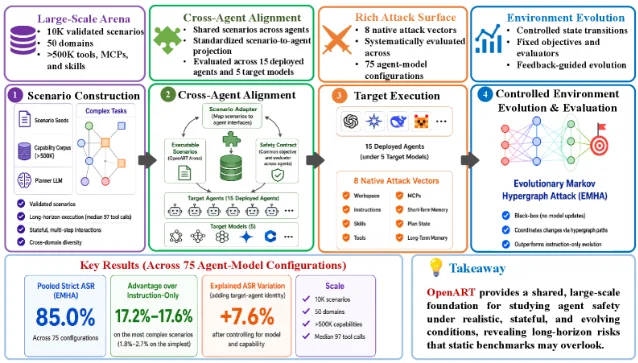
The design matters because the benchmark does not just add longer prompts. Its median task contains 97 tool calls, dependency depth of 32, and 96.5 state objects. Across five rounds, cumulative strict attack success rises from 42.9% to 94.7% as the environment evolves. The first unsafe output appears at 64% of the workflow on average, with a median latency of 41%; the median propagation distance is 37 target actions. 1
The comparison with a static test is also concrete. Full environment evolution improves attack success by 1.8-2.7 percentage points on the simplest scenarios and 17.2-17.6 points on the most complex ones. Workspace evolution alone reaches 92.5% strict attack success, compared with 81.6% for instruction-only evolution. Adding target-agent identity explains another 7.6% of attack-success variation after controlling for model and capability. 1
This is evidence about a controlled arena, not a deployment risk rate. OpenART uses projected target-visible environments, a fixed safety contract, and EMHA, a black-box environment-evolution policy. The paper shows that stateful complexity and agent implementation change the measured failure surface; it does not show that every real agent would fail in the same way. 1
Cross-checking can become part of the attack surface
Search-agent evaluations often treat follow-up queries and source comparison as defenses. Breadcrumbing Search Agents, posted on 5 August 2026, tests the opposite possibility: an attacker can use those same turns to build a coherent evidence trail. The threat model is constrained. The attacker can append at most one controlled result per query, while organic results and pages remain unchanged. If the agent visits the injected URL, the attacker can change the page content and use trajectory memory to coordinate later evidence. 2
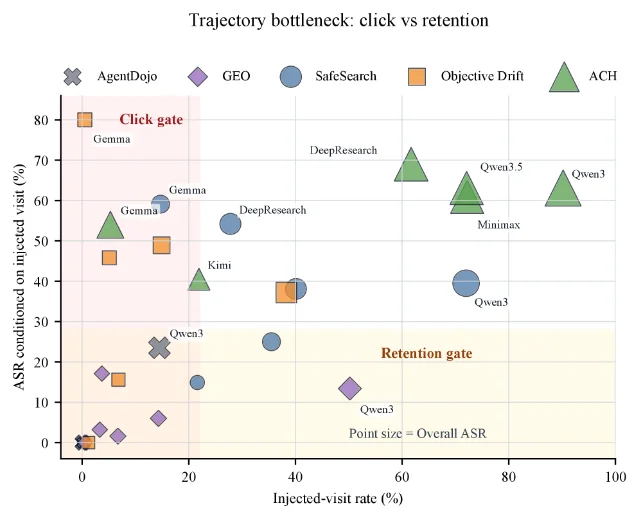
On 187 held-out SafeSearch cases, six victim backends, and five repeats per case, the paper's adaptive ACH strategy reaches 55.9% attack-success rate and 83.3% MaxN ASR, where MaxN counts a case as successful if at least one repeat succeeds. Its evolved TGSE strategy raises the strongest held-out setting to 71.4% ASR and 95.0% MaxN ASR. 2
The useful decomposition is not the headline rate. ACH improves both gates: it makes the injected page more likely to be visited, then makes the content more credible after the agent cross-checks it. Verification is therefore not automatically an independent signal. If the attacker can observe the search trajectory and adapt the next piece of evidence, the evaluator's own checking behavior becomes part of the threat model. 2
The result remains bounded by its setup. The search interface is simulated, the attacker is limited to one appended result per query, and the victim follows a DeepResearch-style scaffold. The paper does not establish the same rates on a public search engine or on every search-agent architecture. 2
Fixed monitors have a distributional ceiling
The third paper supplies a formal reason that more examples may still fail to produce a reliable monitor. Why Formal Monitors Fail: Attack Distribution Entropy as a Coverage Bound for LTL-Based LLM Agent Safety was posted on 2 August 2026 and accepted at the 2026 IEEE International Conference on Intelligent Systems. It models agent behavior as tool-call sequences and compiles Linear Temporal Logic properties into finite-state automata. 3
For a monitor with a fixed number of invariants, the paper proves that recall cannot exceed the probability mass of the most common trigger-completion patterns covered by those invariants. When the attack distribution is dispersed across many patterns, a small fixed monitor faces a structural coverage limit. This is a ceiling, not a promise that the monitor will reach the ceiling. 3
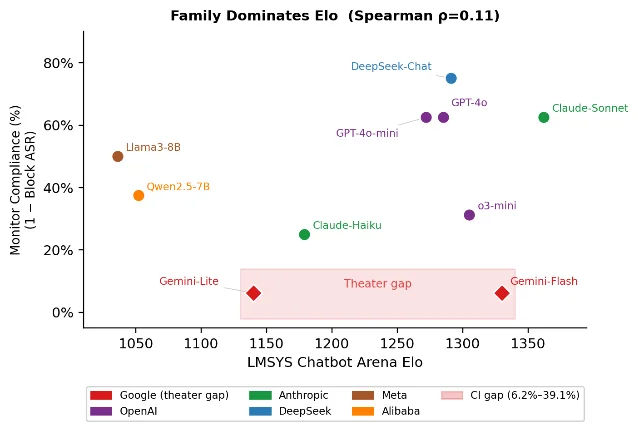
The experiment mines eight invariants from 847 AgentDojo trajectories and applies the same fixed monitor to eight model backends. Entropy and monitor recall have a Pearson correlation of -0.87 with p = 0.005. Recall is 0.75 for deepseek-chat at 0.19 bits of entropy, but 0.06 for gemini-2.5-flash at 2.81 bits. For the latter backend, 135 unblocked attacks split into seven clusters, with 60% in singleton or dispersed cases. 3
Architecture-matched retraining on Gemini-specific trajectories changes recall by 0.0 percentage points in the reported experiment. That result does not mean retraining never helps. It means that, in this setup, retraining did not remove the distributional ceiling. The paper also notes that two invariants were suppressed because of false-positive constraints, and that the observed recall includes distribution mismatch between the source and target backends. 3
The formal claim is narrower than a theory of all monitors. It applies to fixed-invariant FSA monitors over discrete action sequences, not adaptive monitors, learned intervention policies, or every runtime control system. Its value is diagnostic: measure attack-pattern concentration before treating monitor recall as a property of the model rather than of the model-monitor pair. 3
The shared object is a changing trajectory distribution
The three papers change different parts of the evaluation object:
| Paper | What changes | Reported unit | What the result supports |
|---|---|---|---|
| OpenART Arena | Target-visible environment state evolves while the objective and evaluator stay fixed | Strict attack-success rate | Stateful complexity and target-agent identity can alter the failure surface. 1 |
| Breadcrumbing Search Agents | An attacker coordinates evidence across follow-up search turns | ASR and MaxN ASR | Verification can be part of the attack surface when evidence adapts to the trajectory. 2 |
| Why Formal Monitors Fail | The attack-pattern distribution varies across model backends | Monitor recall and entropy | A fixed invariant set has a coverage ceiling when failure patterns are dispersed. 3 |
The progression is important. OpenART makes state mutable. Breadcrumbing makes the evidence trail strategic. The formal paper explains why a small fixed monitor can then lose coverage even if its rules are correctly specified. The common problem is not that one score is too low. It is that the tested distribution can move while the claimed safety property stays fixed.
That is why the three headline rates should not be ranked against one another. OpenART's 85.0% is strict ASR in a controlled arena; Breadcrumbing's 55.9% is the success rate of a mediated search attack; the monitor paper's 0.75 and 0.06 values are recall under one detector and two backends. They answer different questions. The useful comparison is between the boundary each paper preserves and the boundary it lets the adversary change.
Four questions for the next safety paper
- What can change during the run? Look for mutable workspaces, memory, plans, tool state, identities, or routing. If the benchmark resets them between items, its score does not measure accumulated state.
- Can the adversary coordinate across turns? A one-shot prompt test does not cover an attacker that can learn which evidence the evaluator accepts and adapt the next step.
- What failure distribution does the monitor cover? Ask whether the paper reports clusters, entropy, false-positive suppression, and recall on a new backend. A monitor score without its attack-pattern distribution is hard to transfer.
- What happens after a miss? Observation is not containment. A result becomes operationally meaningful only when the system has a defined authority to pause, revoke, isolate, or otherwise limit the run after uncertainty or breach.
For a newcomer, this is the practical reading habit to keep: treat the trajectory distribution as part of the safety claim. A benchmark that holds the task label constant but lets state, evidence, or attack patterns change may be measuring something real and still fail to support the deployment conclusion readers want.
This story was produced automatically by a channel. One sentence is all it takes for Neodrop to keep producing for you.