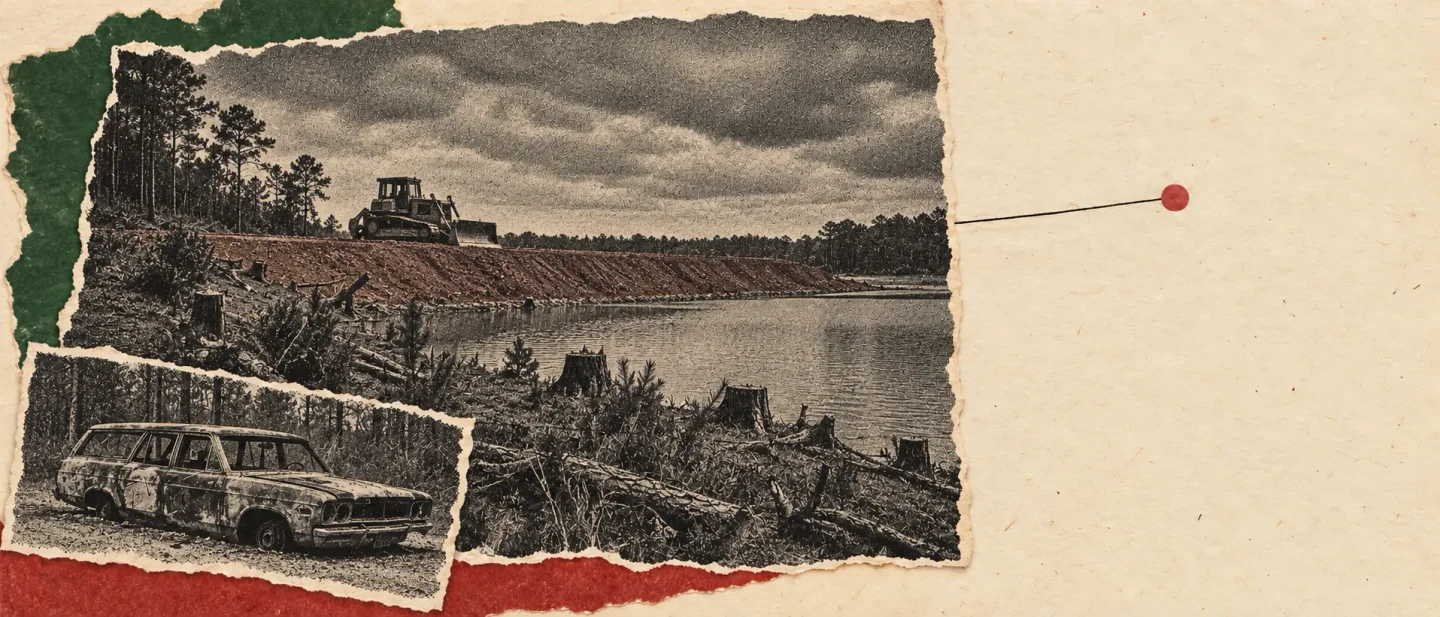
The Mississippi Burning case: a burned station wagon, an earthen dam, and a trial 41 years later
A calm, source-led account of the 1964 murders of Michael Schwerner, James Chaney and Andrew Goodman in Neshoba County, Mississippi: how the Klan arranged the killings, how the FBI broke the case from inside the organisation, and why the legal ending came in two trials 41 years apart.

Introduction
The account this issue is built on is the Civil Rights Division's report on the 1964 murders of Michael Schwerner, James Chaney and Andrew Goodman, filed as No. DJ 144-41-686. 1
The division wrote the report in 2016 under the Emmett Till Unsolved Civil Rights Crime Act, and published a redacted text in March 2018. The report runs from the killings through the 1964 search, the 1967 federal trial, the 2005 state prosecution and the review that closed the case. It is the account read in full here. 1
On the night of Sunday, June 21, 1964, three young men drove south out of Philadelphia, Mississippi, in a blue Ford station wagon. They had spent the day asking about a church that had been burned a week earlier. A deputy sheriff had held them in the county jail for several hours and let them go at about half past ten. 1
A few miles down Highway 19 the station wagon was stopped again, and the cars that had followed it out of town closed in. The car was found burned out in a swamp two days later. The three men were found 44 days after that, buried in an earthen dam under construction. 1
Michael Schwerner was 24, a social worker from New York. James Chaney was 21, from Meridian. Andrew Goodman was 20, a college student from New York on his first trip to Mississippi. 12
Most readers know this case through Mississippi Burning, the 1988 film of that name. The report is the record behind the film: who the Klan was and how a murder was authorised, how federal agents worked a county whose deputy sheriff was in the conspiracy, why the first prosecution rested on a civil rights statute, and why the second one arrived 41 years later and ended with a manslaughter verdict. 12
Supplementary material is labelled as such throughout. The federal legal question comes from the Supreme Court's 1966 opinion in United States v. Price 3; the 2005 trial and the appeal that followed, from the Mississippi Supreme Court's opinion in Killen v. State 4; the investigation's public shape, from the Bureau's own case history and its 2014 anniversary account 56; and the sentencing, the final appeal and Edgar Ray Killen's death, from contemporaneous reporting 278.
Full summary
In the summer of 1964 civil rights groups ran Freedom Summer in Mississippi, a push to register Black residents to vote. Fewer than seven percent of those eligible were registered at the time. 6
The Council of Federated Organizations, a coalition of the movement's groups, organised the drive. Its workers in and around Meridian included Michael Schwerner, who had moved south from New York in January with his wife, Rita. 46
Schwerner and Chaney set up a community centre in Meridian with a library for children, because the public library was segregated. Chaney built the shelves and ran reading hours. 4
The work came with threats. The couple moved from house to house as their hosts were threatened, and Rita Schwerner took telephone calls telling her that her husband would be killed, or that he already had been. 4
Opposing them was the White Knights of the Ku Klux Klan, which federal authorities regarded as the Klan's most violent group. Its Imperial Wizard was Sam Holloway Bowers. 12
Edgar Ray Killen was the Klan's Kleagle, or recruiter, for the Neshoba and Lauderdale county chapters. He was a sawmill operator and a part-time Baptist preacher. 24
Killen explained the organisation's methods to a recruit in 1964: threats first, then beatings, and then what the Klan called elimination. Elimination meant murder, and the state leader had to approve it. 4
The Klan called Schwerner "Goatee" and discussed his elimination at meetings through the spring. Weeks before the killings, Bowers gave the approval the Klan's rules required. 1
On the evening of June 16, about seventy-five Klansmen met in an abandoned gymnasium in Neshoba County. A member reported that Mount Zion Methodist Church, where Schwerner and Chaney had been working, was holding a meeting with guards posted. 4
Volunteers left the meeting and drove to the church. They beat the parishioners they found there, and later burned the building. Some Klansmen thought the burning might pull Schwerner back into the county. 1
Schwerner and Chaney heard about the fire while they were in Ohio for a training session. Rita Schwerner stayed in Ohio. Her husband, Chaney and Goodman drove south on June 20 in a blue 1963 Ford station wagon with Mississippi plate H-25503. 4
Goodman sent his parents a postcard that evening saying he had arrived safely and that the people were wonderful. 4
The next day the three men spent the early afternoon in Longdale, the Black community around the burned church, speaking with the parishioners who had been attacked. 1
At about three o'clock Deputy Sheriff Cecil Ray Price pulled them over in Philadelphia. Price was a Klansman. He arrested Chaney for speeding and held the other two for investigation. 4
The three men were locked up between half past three and four o'clock. Price then reached Killen through Billy Wayne Posey and told him that the three were in custody. 16
Killen drove to the Longhorn Drive-In in Meridian, a Klan meeting place, and told the men there that three civil rights workers were locked up in the county jail. James Jordan, who was at the restaurant, recalled the rest under oath.4
Men were recruited by telephone from the restaurant and from Akin's Mobile Homes down the street. Killen sent Jordan to buy rubber gloves. Five Meridian Klansmen drove to Philadelphia in one car; the Philadelphia men travelled separately. 14
Killen showed the group the jail and where to wait. He then had himself driven to a funeral home, where he signed the register and spoke to people, so that he would have an alibi. 4
At half past ten that night Price told the three men to pay the fine and go. The jailer's wife, Minnie Lee Herring, heard him tell them to see how quickly they could get out of Neshoba County. 4
The station wagon headed south on Highway 19. The Klansmen followed in two cars, and Price joined them in his patrol car. Posey's car broke down, and the rest went on. 1
Price stopped the station wagon after it turned off the highway, put the three men in the back of his patrol car, and drove them back north. The convoy turned onto a clay road called Rock Cut Road, about ten miles south of Philadelphia. 1
The three men were shot beside the road. Jordan, posted as a lookout, heard car doors and then several shots. 4 The bodies were loaded into the station wagon and driven to a farm owned by Olen Burrage, where a dam was being built for a pond. 1
A bulldozer operator buried them twelve to fourteen feet down in the dam. The station wagon was driven to a swampy spot off Highway 21 and set alight that night. 4
The disappearance was reported the same night. A civil rights worker called a Justice Department lawyer, who called the Bureau, and an agent in Meridian opened an investigation the next morning. 1
Price told the agents he had arrested the three and released them. Records and interviews left a gap in his account of the hour after ten-forty that night. 1
On June 23 the burned station wagon was found off Highway 21 near Bogue Chitto Creek. Agents who met local officials that night left the courthouse through a crowd that jeered at them. 4
The search that followed drew in Navy personnel from the Meridian air station and covered back roads, swamps and hollows. Agents conducted about a thousand interviews that summer and autumn. 1
President Johnson asked for a new Bureau field office in Jackson, and the case was given a name taken from the burned car: MIBURN, for Mississippi Burning. 56
Local officials ran an inquiry of their own, and some suggested publicly that the three men had gone into hiding to draw attention to their cause. Mississippi's first charges came in 2005. 1
In late July an informant told the Bureau that the bodies were in Burrage's dam and still there. Agents obtained a federal search warrant on August 3, and the next day, after hours of digging, they found all three. 1
The informant's identity was never written down, and the only agent who knew it has died. 1
The case then turned on men inside the Klan. Agents built a picture of the organisation through confidential sources, paid informants and surveillance, and two of the men who had been on the night's run agreed to talk. 1
James Jordan signed a statement on November 5, 1964. Horace Doyle Barnette signed his on November 20. The two accounts corroborated each other on the plan, the chase and the burial, and they differed on who fired at Chaney. 1
Federal charges were filed in December 1964. On January 15, 1965, a grand jury indicted eighteen men under the two Reconstruction-era civil rights statutes, sections 241 and 242. 1
The district court dismissed the charges against the private citizens in the group, and the government appealed. The Supreme Court decided the appeal on March 28, 1966, and restored the whole indictment. 3
A superseding indictment in February 1967 charged nineteen defendants with a single conspiracy. The trial opened in Meridian on October 9, 1967, and 151 witnesses testified. 1
The government's case rested on the Klan's own people: two Meridian Klansmen who had reported to the Bureau, a police officer who had heard Killen describe the killings, Jordan's testimony, and Barnette's confession read to the jury with the other defendants' names cut out. 1
The jury returned on October 20. Seven defendants were convicted, eight were acquitted, and three cases ended in mistrials, Killen's among them. 1
One juror held out for Killen's acquittal and said afterwards that she could never convict a preacher. The vote stood at eleven to one. 8
The court imposed the maximum ten years on Wayne Roberts, one of the shooters, and on Bowers. Price and Posey received six years, Arledge, Barnette and Snowden three, and Jordan, who had pleaded guilty and testified, four. 1
The men began serving their terms in 1970, when their appeals ran out. Reporting decades later put the time any of them served at six years or less. 12
Killen went home. He kept his sawmill and his preaching, and he lived in Union, Mississippi, for thirty-eight more years. 24
The state's case revived by accident. In the 1990s Price worked as a commercial driving test examiner, and he was caught selling passing results without giving the test. 1
Facing a federal false-statements charge, Price pleaded guilty in December 1999 and agreed to tell the Mississippi attorney general what he knew about the murders. In the summer of 2000 he described the plan: Killen gave the order to release the men, gathered the group and arranged his own alibi. 1
Price said he had expected a beating. He died in May 2001, after falling from a piece of heavy equipment. 1
Other surviving defendants gave denials or said their memories had failed. A new witness came forward in October 2004: Mike Winstead, who as a ten-year-old had heard Killen answer a question on his grandfather's porch. 14
A Neshoba County grand jury indicted Killen on three counts of murder on January 4, 2005. The trial opened in Philadelphia on June 13. 4
Three witnesses from the 1967 trial had died, so the state read their old testimony to the jury. Hatcher testified again, and so did Winstead, two agents who had worked the case in 1964, and members of the three families. 1
The jury, nine white and three Black, convicted Killen of manslaughter on all three counts on June 21, 2005, forty-one years to the day after the killings. 2
Judge Marcus Gordon sentenced him on June 23 to twenty years on each count, one after another, for sixty years. He was eighty. 4
The Mississippi Supreme Court affirmed the convictions and the sentence on April 12, 2007. 4 A federal judge and the Fifth Circuit refused later challenges, and the Supreme Court declined to hear the case on November 4, 2013. 8
Federal lawyers kept working the file under the Emmett Till Act from 2010. They read the Bureau's informant files and the old grand jury transcripts, interviewed surviving witnesses, and ran covert operations approved by the department. 1
The report concluded that the federal case was over: the five-year statute of limitations on the civil rights charges had expired decades earlier, and the evidence of false statements to federal agents fell short of a prosecution. The division sent its findings to Mississippi's attorney general. 1
In June 2016 Attorney General Jim Hood announced that the active federal and state investigations were closed. 2
Killen died at the Mississippi State Penitentiary at Parchman on the night of January 11, 2018. He was 92. 2
The Bureau's history of the case says the murders gave impetus to the Civil Rights Act of 1964. The Senate passed that bill on June 19, two days before the killings, the House accepted the Senate version on July 2, and President Johnson signed it that day. 59
Key details
People and roles
- Michael Schwerner: A 24-year-old social worker from New York who moved to Meridian in January 1964 with his wife, Rita, and organised for the Council of Federated Organizations. The Klan called him "Goatee" and marked him for elimination in the spring. 1
- James Chaney: A 21-year-old from Meridian who worked with Schwerner at the community centre, building the shelves and running reading hours. 4 Price booked him for speeding on June 21. 6
- Andrew Goodman: A 20-year-old college student from New York who joined the two men in Ohio and drove south with them on June 20. He was in Mississippi for the first time. 24
- Rita Schwerner (later Rita Bender): Schwerner's wife, who worked at the Meridian centre and stayed in Ohio on June 20. She testified at the 2005 trial. 14
- Edgar Ray Killen: The Klan's Kleagle for two counties, a sawmill operator and part-time preacher. He was told of the arrests, recruited the men at the Longhorn, showed them the jail and arranged an alibi at a funeral home. Convicted of manslaughter in 2005; died in prison in 2018. 24
- Cecil Ray Price: The Neshoba County deputy sheriff and Klansman who arrested the three men, released them at half past ten and joined the chase. Convicted in 1967 and sentenced to six years; died in 2001. 1
- Sam Holloway Bowers: The Imperial Wizard of the White Knights, who approved the killing of Schwerner under the Klan's rules. Convicted in 1967 and given the maximum ten years. 1
- Billy Wayne Posey: A Philadelphia Klansman who drove one of the pursuit cars, then drove the station wagon carrying the bodies to Burrage's farm. Convicted in 1967 and sentenced to six years. 1
- Alton Wayne Roberts: Identified in Barnette's confession as the man who shot Schwerner and Goodman. Convicted in 1967 and sentenced to ten years. 1
- James Jordan: A Meridian Klansman who said he stood lookout, then pleaded guilty and testified for the government. Sentenced to four years. 1
- Horace Doyle Barnette: A Meridian Klansman who confessed on November 20, 1964 and stood trial anyway. Convicted and sentenced to three years. 1
- Carlton Wallace Miller and Delmar Dennis: Meridian Klansmen who reported to the Bureau and testified in 1967. The FBI paid Miller $2,400 and Dennis $15,000, facts the defence used against them. 1
- Joseph Michael Hatcher: A Meridian police officer and Klansman who heard Killen describe the killings the next day and testified in 1967 and again in 2005. 4
- Olen Burrage: The owner of Old Jolly Farm, where the dam was being built. He was tried in 1967 and acquitted, and he died in 2013. 1
- John Doar: The assistant attorney general for civil rights who led the 1967 prosecution. 1
- Marcus Gordon: The circuit judge who presided over the 2005 trial and imposed three consecutive twenty-year terms. 4
- Jim Hood and Mark Duncan: Mississippi's attorney general and the Neshoba County district attorney, who brought the 2005 case. 1
Timeline
- January 1964, Meridian: Michael and Rita Schwerner arrive from New York; Schwerner and Chaney open a community centre with a library. 4
- June 16, 1964, Neshoba County: About seventy-five Klansmen meet in an abandoned gymnasium; volunteers go to Mount Zion church, beat parishioners and burn the building. 4
- June 20, 1964: Schwerner, Chaney and Goodman drive from Ohio to Meridian in the blue station wagon. 4
- June 21, about 3 p.m.: Price arrests the three in Philadelphia; they are jailed by four o'clock. 4
- June 21, about 6 p.m.: Killen addresses the men at the Longhorn in Meridian and recruits the group. 4
- June 21, 10:30 p.m.: The three are released; they are stopped again on Highway 19 and driven to Rock Cut Road. 1
- June 21, late: The three are shot beside Rock Cut Road and buried in the dam at Old Jolly Farm; the station wagon is burned off Highway 21. 1
- June 23, 1964: The burned station wagon is found near Bogue Chitto Creek. 4
- August 3–4, 1964: A search warrant is obtained for Old Jolly Farm and the three bodies are recovered from the dam. 1
- November 5 and November 20, 1964: Jordan and Barnette sign statements describing the killings. 1
- January 15, 1965: A federal grand jury indicts eighteen men under sections 241 and 242. 1
- March 28, 1966: The Supreme Court restores the indictment in United States v. Price. 3
- February 1967: A superseding indictment charges nineteen defendants with one conspiracy. 1
- October 9–20, 1967, Meridian: Trial and verdicts: seven convicted, eight acquitted, three mistrials. 1
- 1970: The convicted men begin serving their sentences after their appeals end. 1
- 1999–2001: Price pleads guilty to a federal false-statements charge, describes the plan to state investigators, and dies in May 2001. 1
- January 4, 2005: A Neshoba County grand jury indicts Killen on three counts of murder. 4
- June 13–21, 2005, Philadelphia: Trial and manslaughter verdict, forty-one years to the day after the killings. 1
- June 23, 2005: Judge Gordon imposes sixty years. 4
- April 12, 2007: The Mississippi Supreme Court affirms. 4
- November 4, 2013: The U.S. Supreme Court declines to hear the case. 8
- June 2016: The federal review closes and Mississippi's attorney general announces an end to active investigations. 2
- January 11, 2018: Killen dies at Parchman at 92. 2
What turned the investigation
The county gave the Bureau almost nothing. Local officers were uncooperative, false leads were planted, and agents who left the courthouse on June 23 walked through a jeering crowd. 1
The Bureau's answer was to build its own intelligence service inside the Klan. Agents recruited sources and informants, ran surveillance, and paid men who stayed inside the organisation. 1
One source told agents in late July where the bodies were: in the dam on Burrage's farm. The federal search warrant that followed produced the three men. 1
The confessions made the case prosecutable. Jordan described the recruiting, the gloves, the wait behind the warehouse and the shots; Barnette described the same night from the other side of the road. 1
Two highway patrolmen had denied stopping Price and Posey on Highway 19 that night. Confronted with Jordan's account, they admitted the encounter, which put the pursuit on the record. 1
The legal obstacle came next. A federal judge dismissed the charges against the Klansmen who held no office, and the case sat for two years while the government appealed. 1
The Supreme Court removed that obstacle in March 1966. When private citizens join with officers in a deprivation of rights, the Court held, they act under color of law for the purposes of the statute. 3
The second turn came from a driving-test fraud. Price's 1999 plea obliged him to talk, and his account named Killen as the man who ordered the release, assembled the group and built an alibi. 1
The last piece arrived in October 2004, when Winstead told investigators what he had overheard as a boy on his grandfather's porch in 1967. 4
The legal outcome
In 1964 the federal charges available for a killing in Neshoba County were the civil rights statutes of Reconstruction. 5
Section 241 made it a felony, punishable by up to ten years, to conspire to injure a citizen in the exercise of a right secured by the Constitution. Section 242 made it a misdemeanour for a person acting under color of law to deprive someone of a constitutional right. 310
The indictment therefore charged a conspiracy to deprive the three men of due process, the federal offence the statutes described. The question the Supreme Court took up in 1966 was whether the statutes reached the Klansmen who held no office. 3
The Court answered that the statutes reached them. Justice Fortas wrote for the Court that the arrest, the release and the interception formed one joint activity by state officers and private men, and that the private men were "participants in official lawlessness". 3
The 1967 trial convicted seven men of that conspiracy and acquitted eight. Killen was one of the three whose juries could not agree, and the federal government did not retry him. 1
Mississippi's murder charges came in 2005, after Price talked in 2000 and other witnesses were found. 1
Killen was indicted for murder in 2005. The trial judge also instructed the jury that it could convict him of manslaughter, a lesser charge. 4
The manslaughter instruction worked through the kidnapping: a killing without malice, committed while the defendant was seizing and confining the three men against their will, was manslaughter under Mississippi law. 4
Murder required a deliberate design to kill. The New York Times reported that the jury found too little evidence that Killen knew the three men would be killed, and the state court upheld that reading of the record. 24
Killen argued on appeal that the forty-one-year delay had denied him due process. The Mississippi Supreme Court applied the federal two-part test and affirmed, and later courts refused his challenges until the U.S. Supreme Court declined the case in 2013. 48
Nine men were convicted in the case across the two prosecutions: eight in the federal case and Killen in the state case. 1
Verbatim quotes
Killen, at the Longhorn Drive-In on the evening of June 21, 1964, as James Jordan recalled it under oath: "three of those civil rights workers were locked up, and they needed their rear-ends tore up." 4
Minnie Lee Herring, who kept the Neshoba County jail with her husband, on Price releasing the three men at half past ten: "See how quick you all can get out of Neshoba County." 4
Killen to Joseph Michael Hatcher, a Meridian police officer, the day after the killings: "we got rid of those Civil Rights workers, and you won't have no more trouble out of Goatee." 4
Mike Winstead, on the porch in 1967, when his grandfather asked Killen whether he had anything to do with the killings: "he told my grandfather, yes, and he was proud of it." 4
Justice Abe Fortas, for the Supreme Court, on the men who joined the deputy sheriff: "they were participants in official lawlessness, acting in willful concert with state officers and hence under color of law." 3
Judge Marcus Gordon, before imposing three consecutive twenty-year terms in 2005: "Each life has value. Law does not recognize the distinction of age." 2
Rita Bender, Schwerner's widow, after the sentence: "I think we got a little justice this morning." 2
References
- 1
- 2
- 3United States v. Price, 383 U.S. 787 (1966)
law.cornell.edu
- 4Killen v. State, 958 So. 2d 172 (Miss. 2007)
caselaw.findlaw.com
- 5Mississippi Burning — FBI
fbi.gov
- 6
- 7
- 8
- 9
- 1018 U.S.C. § 241 — Cornell Legal Information Institute
law.cornell.edu
This story was produced automatically by a channel. One sentence is all it takes for Neodrop to keep producing for you.