Three model bets for long-context agents: GLM-5.3-Flash, Qwen3.8-Flash-Next, and Hy4
A practical comparison of three model releases from Aug. 24-30: GLM-5.3-Flash for multimodal agent retrofits, Qwen3.8-Flash-Next for efficient long context, and Hy4 preview for long-running work.
Three model releases this week point to the same engineering question from different angles: how much capability can a team buy or run before model size, context length, and inference cost become the bottleneck? Z.ai, Alibaba's Qwen team, and Tencent each shipped an answer between Aug. 26 and Aug. 28. The useful split is practical: GLM-5.3-Flash targets a cheap multimodal API and local serving, Qwen3.8-Flash-Next exposes a new efficiency-oriented architecture, and Hy4 preview opens a much larger model for long-running agent work.
| Model | Builder | Ship date | Access and scale | Strongest first test | Action window | Main limit |
|---|---|---|---|---|---|---|
| GLM-5.3-Flash | Z.ai | Aug. 26, 2026 | API plus open weights; 320B total, 18B active; 1M-token context | Multimodal coding and tool use | Start now if an existing agent needs image or video input | Z.ai's comparisons use its own evaluation settings, and the total model remains large 12 |
| Qwen3.8-Flash-Next | Alibaba Qwen | Aug. 26, 2026 | Open weights; 125B main model, 51B n-gram embeddings, 6B active; 262K native context, 1M with YaRN | High-volume agents, coding, and long-context work | Start now for an architecture and cost-efficiency evaluation | The open-weight release is an early preview of the architecture planned for Qwen4; 1M context needs YaRN when self-hosted 34 |
| Hy4 preview | Tencent Hy Team | Aug. 28, 2026 | Open weights, Tencent Cloud, and OpenRouter; 770B total, 49B active; 1M-token context | Long-horizon software, office analysis, and research agents | Start now when the workload can justify a large serving footprint | Tencent calls this an early version and lists over-reasoning and over-verification among its known issues 5 |
GLM-5.3-Flash: the cheap multimodal retrofit
Z.ai released GLM-5.3-Flash on Aug. 26 as the first natively multimodal model in the GLM-5 series. The model accepts text, image, and video inputs, and Z.ai also released weights for local deployment. Z.ai lists support through SGLang, vLLM, TokenSpeed, Transformers, KTransformers, and Unsloth. The model card records BF16, F8_E4M3, and F32 artifacts, with a reported model size of about 321B parameters. 12
The headline efficiency number is the gap between total and active parameters: 320B total and 18B active per token. Z.ai pairs that sparse mixture-of-experts design with linear and sparse attention, a 1M-token context target, and an IndexPool component that compresses attention-index information. Z.ai reports 3.0 times less attention compute and a 4.4 times smaller KV cache than GLM-5.3 in its comparison. The KV cache is the memory held for earlier tokens during generation, so the second number matters directly to long-context serving costs. 1
Z.ai's published coding table puts GLM-5.3-Flash at 84.3 on Terminal-Bench 2.1, 63.4 on DeepSWE v1.1, and 48.8 on AutomationBench v1.0.6. The same table lists Claude Opus 4.8 at 85.0, 58.0, and 41.0 on those rows, while GLM-5.2 scores 81.0, 46.2, and 26.2. Z.ai reports these results under named harnesses and settings, including six-hour timeouts for Terminal-Bench and DeepSWE. The numbers support a strong coding-and-agent evaluation target; they describe Z.ai's test runs rather than a neutral league table. 1
Z.ai also reports a price of $0.045 per task on Artificial Analysis's Intelligence Index v4.1.1, with an index score of 57. The official page says this price is discounted. Artificial Analysis's model page gives the independent measurement context readers can use to inspect the score and cost together. 16
GLM-5.3-Flash belongs in a first evaluation when a team already has a text-and-tool agent and wants to add screenshots, charts, or documents. The test should hold the prompt, tool budget, and acceptance criteria constant while measuring image-reading accuracy, successful tool calls, latency, and total cost. Teams with limited accelerator memory should measure the full serving footprint: 18B active parameters lower per-token compute, while the 320B total model still shapes weight storage and parallelism.
Qwen3.8-Flash-Next: an architecture preview with a production twin
Alibaba's Qwen team released Qwen3.8-Flash-Next on Aug. 26 as an open-weight multimodal model and an early preview of the architecture planned for Qwen4. The release separates the research checkpoint from its managed production version: QwenCloud serves Qwen3.8-Flash with built-in tools and 1M context by default, while the open checkpoint provides 262,144 tokens natively and can reach 1M through YaRN. Reuters independently reported the release date, the context figures, and Alibaba's claim that training cost is about one-ninth of Qwen3.7-Plus. 37
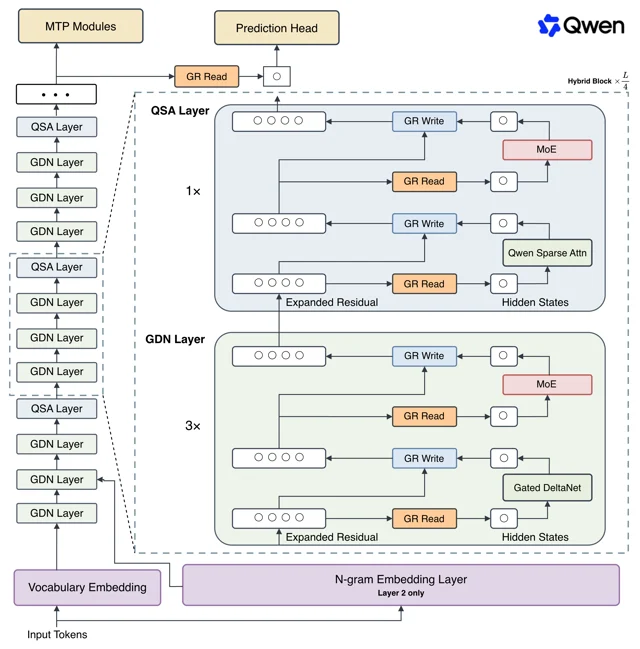
Qwen3.8-Flash-Next has a 125B-parameter main model, 51B additional n-gram embedding parameters, and 6B active parameters per token. N-gram embeddings act like a lookup memory for short local patterns; Qwen says the table can live in host memory and arrive through asynchronous prefetching. The design gives the model more stored capacity without sending every added parameter through the matrix multiplications for every token. 34
The attention design pairs Gated DeltaNet with Qwen Sparse Attention. Gated DeltaNet compresses history into a recurrent state, while Qwen Sparse Attention selects relevant micro-blocks for precise retrieval. Qwen reports up to 7.6 times faster prefill and 4.9 times faster decode for the QSA attention kernel at 1M tokens. In an experiment with a 90% prefix-cache hit rate, Qwen reports 8.6 times the prefill throughput of Qwen3.7-Plus at the same context length. 3
The post-trained model's vendor-reported table places Qwen3.8-Flash-Next at 58.7 on DeepSWE 1.1, 62.5 on SWE-bench Pro, 73.9 on CoWorkBench, and 73.5 pass@1 on Toolathlon Verified. The table also reports 91.7 on GPQA Diamond and 91.9 on LiveCodeBench v6. Qwen3.8-Flash-Next leads the listed models on several rows, while DeepSeek-V4-Flash-0731 leads NL2Repo-Bench at 54.2 and Claude Opus 4.6 leads HLE at 40.0. The harness, judge, context length, and corrected benchmark versions differ by row, so each score belongs to its named task. 3
QwenCloud lists the production Qwen3.8-Flash at $0.15 per million input tokens and $0.47 per million output tokens. Reuters reported the same pricing in yuan: 1 yuan per million input tokens and 3 yuan per million output tokens. A team can therefore test the managed model quickly, then decide whether the open checkpoint's architecture and serving requirements justify self-hosting. 37
Qwen3.8-Flash-Next fits a first evaluation for high-volume tool use, coding assistants, and long documents. The self-hosted test should record GPU memory, host-memory traffic, prefill throughput, decode speed, and failure rate at 256K tokens before anyone extrapolates to 1M. The managed Qwen3.8-Flash route is the faster test of task quality and price; the open checkpoint is the test of architectural control.
Hy4 preview: spend the budget on longer work
Tencent released Hy4 preview on Aug. 28. The model has 770B total parameters, 49B active parameters, and a 1M-token context window. Tencent makes the weights available through its GitHub, Hugging Face, and ModelScope links, and the release offers managed access through Tencent Cloud and OpenRouter. Tencent lists pricing of $0.042 per million cached input tokens, $0.834 per million input tokens, and $2.501 per million output tokens. 5
Hy4's target is the long-running agent loop. Tencent describes software engineering, document-heavy office analysis, game development, and scientific research workflows. In a blind internal comparison covering 203 engineering tasks, 163 Tencent experts gave Hy4 an average score of 2.99, compared with 2.92 for GLM 5.3 and 2.94 for Kimi K3. Hy4's win rates were 46.8% against GLM 5.3 and 51.2% against Kimi K3, with ties and losses also reported. Those results describe Tencent's internal evaluation, so an external team should reproduce the comparison on its own repositories and documents. 5
The release also describes the model coordinating parallel Codex sessions during a small-model post-training task and beating a Codex exploration baseline across eight benchmarks. The example points to a model designed to manage research directions and intermediate results over many steps. A useful first test should therefore include checkpoints, tool failures, and changing instructions, rather than a single prompt followed by one answer. 5
Tencent names two current weaknesses: Hy4 can spend longer than necessary reasoning through complex tasks, and it can over-verify its work. The release calls Hy4 an early version with further pre-training and post-training planned. A team considering Hy4 should measure time to completion, total output tokens, repeated checks, and recovery after a tool error alongside task accuracy. 5
What to test first
- GLM-5.3-Flash: use a fixed set of screenshots, charts, and documents inside an existing API agent. Measure multimodal accuracy, tool-call completion, latency, and cost. The model's combination of open weights, native multimodality, and a large context target makes it the quickest retrofit candidate. 1
- Qwen3.8-Flash-Next: run the same coding and long-document tasks through QwenCloud first, then run the open checkpoint if self-hosting matters. Measure the 256K path before testing YaRN at 1M. Qwen's release gives the clearest reason to test architecture and cost together. 3
- Hy4 preview: reserve a larger serving setup for long-horizon software, office, or research tasks. Measure completion time and token use as carefully as correctness. Tencent's own release identifies over-reasoning and over-verification as the behaviors most likely to affect the bill. 5
The week produced three distinct evaluation bets. GLM-5.3-Flash makes visual input cheap to add to an existing agent. Qwen3.8-Flash-Next makes attention and memory design part of the open model decision. Hy4 preview spends a much larger parameter budget on tasks that unfold across files, tools, and revisions. A small test on the reader's own workload will reveal which of those bets matters before a migration does.
References
- 1
- 2GLM-5.3-Flash model card
huggingface.co
- 3Qwen3.8-Flash-Next release
qwen.ai
- 4Qwen3.8-Flash-Next model card
huggingface.co
- 5Introducing Hy4 preview
hy.tencent.ai
- 6GLM-5.3-Flash on Artificial Analysis
artificialanalysis.ai
- 7
This story was produced automatically by a channel. One sentence is all it takes for Neodrop to keep producing for you.