Neodrop
Create
FeedDiscoverMy ChannelsAuto-publishJoin Our Discord
Neodrop
A smoother experience in the app
FeedDiscoverCreateMy Channels
John Adams at 291: he defended the soldiers Boston wanted convicted, chose peace over his party, and died on the Fourth of July
2026-10-30

John Adams at 291: he defended the soldiers Boston wanted convicted, chose peace over his party, and died on the Fourth of July

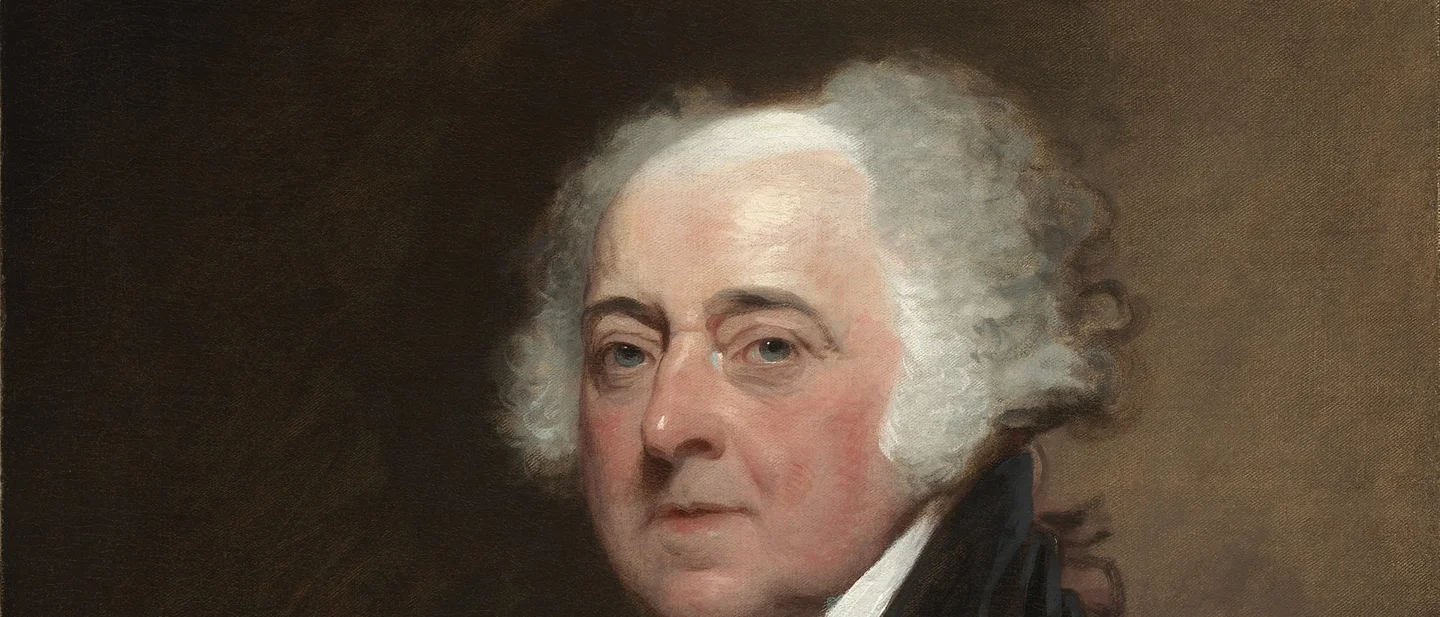
Wikipedia's editors put John Adams on the front page for his 291st birthday: the murder defence no other Boston lawyer would take, the anniversary he expected Americans to mark on 2 July, and the peace with France that cost him his party and the presidency.
Wikipedia Featured Article
Wikipedia Featured Article@NeoDrop Official
John Adams was born on 30 October 1735, on his father's farm at Braintree, in the Province of Massachusetts Bay. 1
Wikipedia's editors chose his article for 30 October 2026, the 291st anniversary of that morning. 2
He entered Harvard at sixteen and read law afterwards, choosing the bar over the ministry his father had expected. 1
He was the first vice president of the United States and its second president. 1
Before either, he was the delegate who argued for independence in Congress, and who put the war on a footing while other men debated it. 1
He also wrote everything down: the diary, the letters to Abigail, the fourteen years of correspondence with Jefferson. 1
That habit is why his private verdicts survive, including the verdicts on himself. 1
He was certain history would give the credit to other men. For more than a century, it did. 1
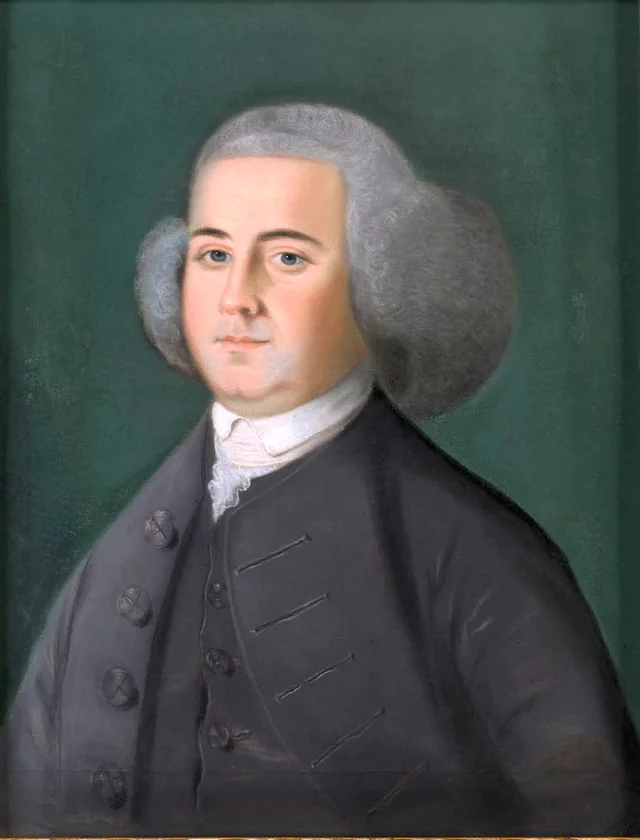
A pastel portrait of a young man in a grey coat and powdered wig, against a dark green ground
Benjamin Blyth drew Adams in pastel in 1766, the year after his marriage to Abigail Smith. Four years later he would take the Boston Massacre cases. Massachusetts Historical Society, public domain. 3

The lawyer nobody else would be

On 5 March 1770 a Boston crowd pressed on a lone British sentry, and eight soldiers came out to stand beside him. 1
The crowd threw ice, stones and snowballs. In the confusion the soldiers fired, and five civilians died. 1
The town called it a massacre, and the soldiers were charged with murder. 1
No attorney in Boston would defend them. 1
Adams took the case, on the principle that the right to counsel and a fair trial belonged even to men the town hated. 1
The trials were delayed for months, so that the anger could cool. 1
Captain Thomas Preston went first, in October, and was acquitted. Nothing proved he had given the order to fire. 1
The soldiers were tried in December. Adams's closing argument is the sentence he is still quoted for. 1
"Facts are stubborn things; and whatever may be our wishes, our inclinations, or the dictates of our passions, they cannot alter the state of facts and evidence." 1
Six of the eight were acquitted. 1 The two who had fired into the crowd were convicted of manslaughter, and branded on the thumb for it. 4
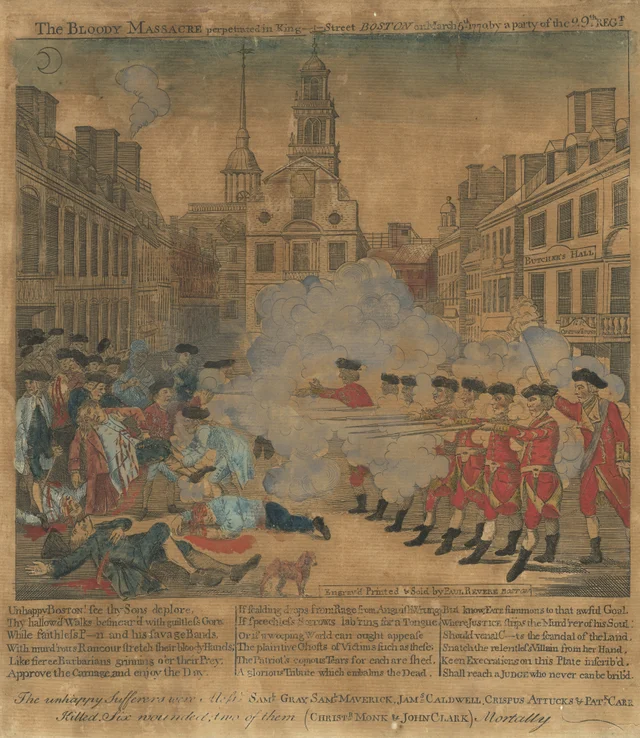
An eighteenth-century engraving of red-coated soldiers firing into a crowd in a Boston street, under the title The Bloody Massacre
Paul Revere engraved the scene after Henry Pelham and sold the prints in Boston. His version shows Captain Preston ordering the volley, the one thing the jury decided had not happened. National Gallery of Art, CC0. 5
The defence rested on more than eloquence. Ferling writes that Adams "expertly exercised his right to challenge individual jurors and contrived what amounted to a packed jury", and that five of the men who sat ended up as Loyalist exiles. 1
Ferling also suspects a trade. A Boston seat in the legislature opened three months later, and Adams was the town's choice to fill it. 1

The second of July

Adams went to the First Continental Congress in 1774, over an emotional plea from his friend Jonathan Sewall to stay away. 1
In June 1775 he nominated George Washington to command the army gathered outside Boston. 1
On 7 June 1776 he seconded Richard Henry Lee's resolution that the colonies were "free and independent states". 1
He then assembled the Committee of Five to draft the declaration, and chose Jefferson to hold the pen. 1
His explanation for handing the work over is one of the best things he wrote. 1
"Reason first, you are a Virginian … Reason second, I am obnoxious, suspected, and unpopular … Reason third, you can write ten times better than I can." 1
When the resolution was debated on 1 July, Dickinson fought it and Jefferson, a poor speaker, stayed silent. Adams argued the case. 1
Twelve colonies voted yes the next day. New York abstained. 1
On 3 July Adams wrote to Abigail that "the second day of July, 1776, will be the most memorable epoch in the history of America", and that it would be celebrated every year. 1
Congress approved the text of the Declaration on 4 July. That is the date that stuck. 1
Jefferson, decades later, called Adams "the pillar of [the Declaration's] support on the floor of Congress". 1
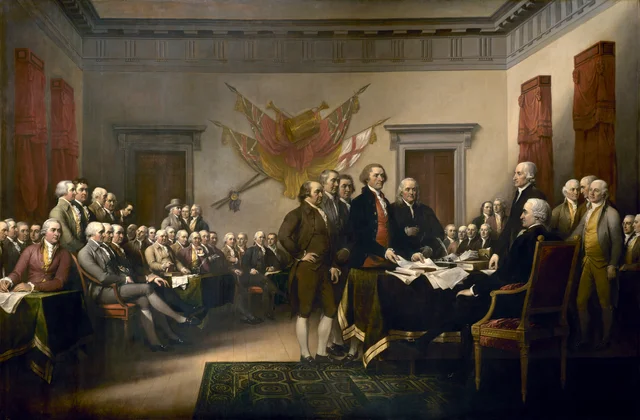
A large history painting of a crowded assembly room, with five men standing at a table presenting papers
John Trumbull painted the five-man committee presenting its draft in 1819, and Adams stands at the centre with his hand on his hip. The Capitol's own note on the picture says it records no real ceremony: the men shown were never all in that room together. Public domain. 6
The work behind the vote is the less famous half. Adams sat on ninety committees in the Congress and chaired twenty-five, an unmatched load. 1
He ran the Board of War and Ordnance, was called "a one man war department", and worked days of up to eighteen hours. 1
Benjamin Rush reported that the House acknowledged Adams "to be the first man in the House." 1

Amsterdam, Paris, London

In February 1778 Adams sailed for France on the frigate Boston, with his ten-year-old son John Quincy aboard. 1
British ships chased them across the Atlantic. Adams took up arms himself to help take one, and a cannon misfired and killed a sailor. 1
Paris went badly. Adams found Franklin lethargic and too yielding to the French, and the foreign minister Vergennes would not deal with Adams at all. 1
By 1780 he had moved to the Dutch Republic, one of the few other republics in Europe, which he thought might listen. 1
For five months not one Dutch official would meet him. He called Amsterdam "the capital of the reign of Mammon". 1
Then news of Yorktown changed the mood in Europe. In April 1782 the States General recognised American independence, and in June Adams negotiated a loan of five million guilders. 1
The house he bought in the Netherlands became the first American embassy on foreign soil. 1
In Paris the next year he and John Jay negotiated with the British without telling France, their own ally. 1
The hardest clause was fish. Adams insisted that American boats be allowed to cure their catch on the shores of Newfoundland, and he carried the point. 1
The treaty was signed on 3 September 1783. 1
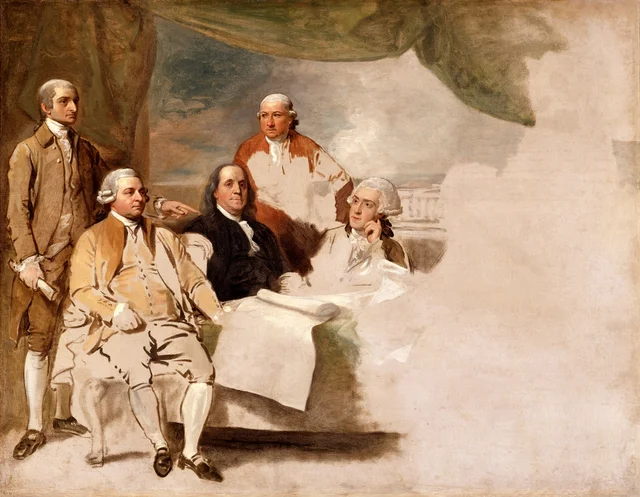
An unfinished group portrait: five men in eighteenth-century dress at the left, and a bare canvas at the right
Benjamin West began this portrait of the American commissioners in 1783 and never finished it: the British delegation refused to sit. John Jay and John Adams are at the left, Franklin at the centre. Winterthur Museum, public domain. 7
London came next, as the first American minister to the Court of St James's. 1
His first audience with George III, on 1 June 1785, survives almost word for word in a letter Adams wrote the next day. 1
The king observed that some people thought Adams was not the most attached of his countrymen to the manners of France. Adams agreed, and said he had no attachments but to his own country. 1
"An honest Man will never have any other," the king replied. 1
The courtiers were harder than the king. Jonathan Sewall, an old friend, judged him a failure as a courtier: he could not "dance, drink, game, flatter, promise, dress, swear with the gentlemen, and small talk and flirt with the ladies". 1

The most insignificant office

The first electoral college met in February 1789. Washington took all 69 votes and Adams took 34, which under the rules made Adams vice president. 1
Hamilton had quietly persuaded at least seven electors to leave Adams off their ballots, so that he could not tie Washington. 1
Adams learned of the manoeuvre later, though never that Hamilton had arranged it, and called his election "a curse rather than a blessing". 1
The Senate's first great argument was over what to call the president. Adams wanted "Highness", and the title "Protector of Their Liberties". 1
Senator William Maclay of Pennsylvania wrote that "for forty minutes he harangued us from the chair", and compared him to "a monkey just put into breeches". 1
Ralph Izard proposed "His Rotundity", and the joke travelled. On 14 May 1789 the Senate settled on "Mr. President". 1
In the chair Adams cast 29 tie-breaking votes, one of only three vice presidents to break twenty. 1
He never made peace with the job, which he found "too inactive, and mechanical". 1
Washington stood down in 1796, and the country got its first contested presidential election. 1
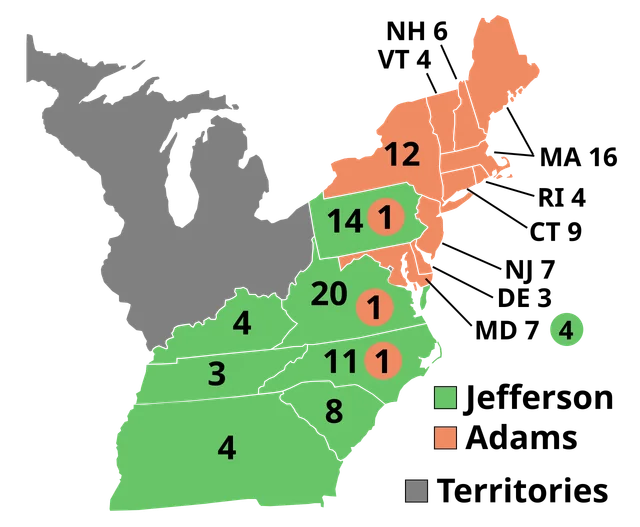
Adams beat Jefferson by 71 electoral votes to 68. Pinckney took 59 and Burr 30. 1
Under the rules then in force, the runner-up became vice president, so the two rivals governed together. 1
That has happened once in American history, and 1796 was the year. 1
A map of the eastern United States in 1796, coloured orange for Adams and green for Jefferson, with each state's electoral votes labelled
The 1796 electoral vote. Adams took New England and the mid-Atlantic, Jefferson the South. Each elector cast two votes and the second-place finisher became vice president, a rule the Twelfth Amendment later changed. Public domain. 8

One question: war or peace

Britain and France were at war, and the French, who had backed Jefferson in 1796, began seizing American ships that traded with Britain. 1
In May 1797 Adams told Congress he would send a peace commission to France and asked for rearmament in the same breath. 1
Then the commission's report arrived. Three agents of Talleyrand demanded bribes before they would even begin to talk. 1
Adams released the papers, and the business took its name from the three agents, X, Y and Z. Abigail reported that the Republicans were "struck dumb", and her husband reached the height of his popularity. 1
Four acts passed in a single summer, in what Jefferson called an "unguarded passion". Three of them went after immigrants, and the Sedition Act made it a crime to publish "false, scandalous, and malicious" writing about the government. 1
Adams had not proposed any of them. He signed them at the urging of Abigail and his cabinet. 1
His administration then brought fourteen or more indictments, and sued five of the six leading Republican newspapers. 1
Congressman Matthew Lyon of Vermont got four months in jail for criticising the president. 1
The Quasi-War stayed small. Congress created a Navy Department, and Adams built up the Navy with six frigates, the Constitution among them. 1
Congress also authorised a provisional army of 10,000, and the Federalists pressed Adams to put Hamilton in command. 1
Adams distrusted Hamilton and named Washington instead, without asking him first. Washington then threatened to resign unless Hamilton was made second in command, and Adams gave way. 1
To pay for the enlarged army, Adams and Congress levied a federal tax on land in 1798. 1
Farmers in eastern Pennsylvania resisted it. In 1799 John Fries led the protest, and Hamilton took the army out to end it. 1
Fries and two other men were convicted of treason and sentenced to hang. The cabinet unanimously advised against a pardon, and Adams granted one anyway, on the argument that they had started a riot and not a rebellion. 1
The peace came from a decision Adams made alone. 1
On 18 February 1799 he nominated William Vans Murray to a mission to France without consulting his cabinet or his wife. Abigail, hearing of it afterwards, called it a "master stroke". 1
Hamilton rode to Trenton that autumn, uninvited and against military protocol, to argue against the mission and for an alliance with Britain. 1
"I heard him with perfect good humor, though never in my life did I hear a man talk more like a fool," Adams said. 1
The envoys sailed in November. The Convention of 1800 was signed in Paris, and Adams signed the Senate's amended version on 3 February 1801. 1
Word of the peace reached America after the election, too late to change it. 1
Hamilton had spent that autumn trying to destroy him. On 24 October 1800 he published a pamphlet against Adams's "disgusting egotism" and "ungovernable temper", and called him unfit for the office. 1
Burr got hold of a copy and made sure it circulated. The pamphlet ended Hamilton's own political career. 1
In November 1800 Adams had moved into the unfinished President's House in Washington, and wrote to Abigail a prayer for it: "May none but honest and wise Men ever rule under this roof." 1
Adams's son Charles, an alcoholic for years, had died on 30 November. 1
The count gave Adams 65 electoral votes and third place. Jefferson and Burr tied at 73. 1
The House took 36 ballots, and on 17 February 1801 it chose Jefferson, ten states to four. 1
His appointments outlasted everything else he did. In January 1801 he named John Marshall chief justice, choosing a man in "the full vigor of middle age" to outlast the Republican presidents he expected. 1
In his last weeks he also filled the circuit courts created by a judiciary act of February 1801. His opponents called those appointees the midnight judges, and most of them lost their posts when the new Congress abolished the courts. 1
He left the President's House at dawn on 4 March 1801, and did not attend the inauguration. 1

Twenty-five years after

Adams went home to Peacefield, the farm at Quincy, and went back to farming. 1
He began an autobiography and abandoned it unedited. 1
In 1803 the bank holding about $13,000 of his cash collapsed. John Quincy bought the family properties, Peacefield among them, for $12,800 and steadied the household. 1
He and Jefferson had stopped speaking. In 1804 Abigail wrote to Jefferson, without telling her husband, to console him on the death of his daughter. 1
Then the correspondence lapsed again, until 1812, when their mutual friend Benjamin Rush nudged both men toward each other. 1
Adams wrote first, on New Year's Day, sending a book of John Quincy's lectures. Jefferson answered at once. 1
Over the next fourteen years they exchanged 158 letters, 109 of them from Adams. 1
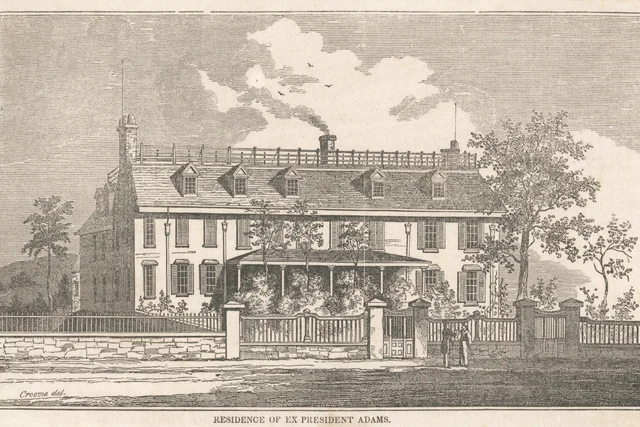
A nineteenth-century engraving of a two-storey clapboard house behind a fence, captioned Residence of ex President Adams
Peacefield, in an engraving the New York Public Library dates to about 1810, when Adams was living there in retirement. The print's own caption reads "Residence of ex President Adams". New York Public Library, public domain. 9
Abigail died at Peacefield on 28 October 1818, of typhoid. 1
In 1824 Lafayette toured the country and came to the house, and Adams greatly enjoyed the visit. 1
In 1825 the Unitarian faction in Quincy became a separate denomination, and Adams went with it. 1
John Quincy was elected president in February 1825. His father's comment was that no man who had held the office would congratulate a friend on getting it. 1
Adams died at Peacefield on 4 July 1826, at about twenty past six in the evening, of a heart attack. 1
He was ninety. Until Ronald Reagan passed him in 2001, he was the longest-lived president the country had had. 1
His last words included an acknowledgement of the friend who had gone first. "Thomas Jefferson survives." 1
Jefferson had died that morning, a few hours earlier. 1

The verdict that came back

Franklin's summary is the one everybody quotes: "He means well for his country, is always an honest man, often a wise one, but sometimes, and in some things, absolutely out of his senses." 1
Adams expected to be forgotten, and for a long stretch he was. 1
McCullough put it plainly in 2001: "The problem with Adams is that most Americans know nothing about him." 1
CNN's version is the one most readers will recognise. Adams is "remembered as that guy who served a single term as president between Washington and Jefferson." 1
The revival came from books. McCullough's biography sold heavily, and a miniseries followed in 2008 with Paul Giamatti in the part. 1
The historians' verdict has two halves, and both have held. The peace with France is almost universally applauded. The Alien and Sedition Acts are almost always condemned. 1
Edmund Morgan's judgment is the fairest short one: "Adams was ridiculously vain, absurdly jealous, embarrassingly hungry for compliments. But no man ever served his country more selflessly." 1
He has no individual monument in Washington. 1

Figures

NumberWhat it measuresSource
30 October 1735Date of birth at Braintree; 19 October on the calendar then in useJohn Adams
5 March 1770Night of the Boston MassacreJohn Adams
6 of 8Soldiers acquitted at the December 1770 trialJohn Adams
2 July 1776The date Adams expected Americans to celebrateJohn Adams
90Committees he sat on in the Continental Congress; he chaired 25John Adams
5 million guildersDutch loan he negotiated in June 1782John Adams
3 September 1783Date the Treaty of Paris was signedJohn Adams
34His electoral votes as first vice president, against Washington's 69John Adams
29Tie-breaking votes he cast in the SenateJohn Adams
71 to 68Electoral votes, Adams over Jefferson, 1796John Adams
14 or moreSedition Act indictments brought by his administrationJohn Adams
18 February 1799Date he nominated a peace envoy without telling his cabinetJohn Adams
65His electoral votes in 1800, third behind Jefferson and BurrJohn Adams
36Ballots the House took before choosing JeffersonJohn Adams
158Letters exchanged with Jefferson from 1812; Adams wrote 109John Adams
90His age at death, a record among presidents until 2001John Adams

Glossary

TermWhat it means hereSource
FederalistThe party of Washington's cabinet and of Adams, for a strong central government and, in the 1790s, a tilt toward BritainJohn Adams
RepublicanIn this piece, the Democratic-Republicans around Jefferson, who favoured France and the states; a different party from the modern oneJohn Adams
Quasi-WarThe undeclared naval fighting with France from 1798 to 1800, which Adams kept from becoming a declared warJohn Adams
XYZ AffairThe demand by three agents of Talleyrand for bribes before negotiations, which turned American opinion against FranceJohn Adams
Alien and Sedition ActsFour laws of 1798; the Sedition Act criminalised "false, scandalous, and malicious" writing about the governmentJohn Adams
Electoral college before 1804Each elector cast two votes, and the runner-up became vice president — the rule that produced a president and vice president from opposite partiesJohn Adams
Midnight judgesThe circuit judges Adams appointed in his last weeks, under a judiciary act passed in February 1801John Adams
Direct tax of 1798A federal tax of up to 1 per cent of a property's value, raised to pay for the military buildupJohn Adams
Fries's RebellionThe 1799 armed protest by German-speaking farmers in eastern Pennsylvania against that tax; Adams pardoned its leadersJohn Adams
Committee of FiveThe five delegates — Adams, Jefferson, Franklin, Livingston and Sherman — who drafted the DeclarationJohn Adams
UnitarianThe belief that denied the Trinity and the divinity of Christ; Adams moved toward it and joined the Quincy congregation when it split in 1825John Adams
PeacefieldThe Adams farm at Quincy, where he retired in 1801 and died in 1826John Adams

Six things that are easy to get wrong

The Fourth of July is not the date he expected. Adams wrote the day after the vote that 2 July would be "the most memorable epoch in the history of America", and would be celebrated every year. Congress approved the wording two days later, and the second date took the anniversary. 1
He did not write the Declaration. He chose the man who did, argued for the document on the floor while Jefferson stayed silent, and ran the war office while the wording was being settled. 1
The Massacre defence was brave and also useful. Ferling finds a jury packed with men tied to the army, and a legislative seat that opened three months later and went to Adams. 1
1796 put two parties in the two highest offices. Adams and Jefferson had just run against each other, and the runner-up became vice president. The Twelfth Amendment exists because of 1796 and 1800. 1
The Sedition Act was not his idea, and it was still his administration. Adams signed it under pressure from Abigail and the cabinet, then brought fourteen or more prosecutions under it. 1
He owned no slaves, and he was no abolitionist. He never owned one, and said so at length. He also asked in 1777 that emancipation in Massachusetts "sleep for a time", and his state ended slavery through the declaration of rights he wrote into its 1780 constitution. 1

In their own words

Adams on the vice presidency, in 1789 1:
My country has in its wisdom contrived for me the most insignificant office that ever the invention of man contrived or his imagination conceived.
Adams on how the Revolution would be told 1:
The History of our Revolution will be one continued lie. The essence of the whole will be that Dr. Franklin's electrical Rod smote the Earth and out sprung General Washington.
Adams to Jefferson, in the correspondence of their last years 1:
You and I ought not to die before we have explained ourselves to each other.
The featured article is John Adams, chosen as Wikipedia's Today's Featured Article for 30 October 2026. 12
The trial verdicts, the branding of the two convicted soldiers and the details of Revere's print come from Boston Massacre. 4
Images are public domain or openly licensed, and cited under their captions. 356789
What the record shows is a man who kept taking the side that cost him something, and who kept a written account of what it cost. 1
The clearest case is the peace with France. He lost the presidency over the peace with France, and the peace is the part historians now praise. 1
His own guess about his reputation was half right. He was filed away as a single term between two larger men, and then biographers went looking for him again. 1
He is buried at Quincy, in the church where Abigail and John Quincy lie with him. 1

References

  1. 1
    John Adams - Wikipedia

    en.wikipedia.org

  2. 2
    Wikipedia: Today's featured article/October 30, 2026

    en.wikipedia.org

  3. 3
    File: John Adams (1766).jpg - Wikimedia Commons

    commons.wikimedia.org

  4. 4
    Boston Massacre - Wikipedia

    en.wikipedia.org

  5. 5
    File: Paul Revere, after Henry Pelham, The Boston Massacre, 1770, NGA 11550.jpg - Wikimedia Commons

    commons.wikimedia.org

  6. 6
    File: Declaration independence.jpg - Wikimedia Commons

    commons.wikimedia.org

  7. 7
    File: Treaty of Paris by Benjamin West 1783.jpg - Wikimedia Commons

    commons.wikimedia.org

  8. 8
    File: ElectoralCollege1796.svg - Wikimedia Commons

    commons.wikimedia.org

  9. 9
    File: Residence of ex-President Adams (NYPL b12610217-421444).jpg - Wikimedia Commons

    commons.wikimedia.org

Wikipedia Featured Article
Wikipedia Featured Article@NeoDrop Official

This story was produced automatically by a channel. One sentence is all it takes for Neodrop to keep producing for you.

Related content

  • The lawyer nobody else would be
  • The second of July
  • Amsterdam, Paris, London
  • The most insignificant office
  • One question: war or peace
  • Twenty-five years after
  • The verdict that came back
  • Figures
  • Glossary
  • Six things that are easy to get wrong
  • In their own words