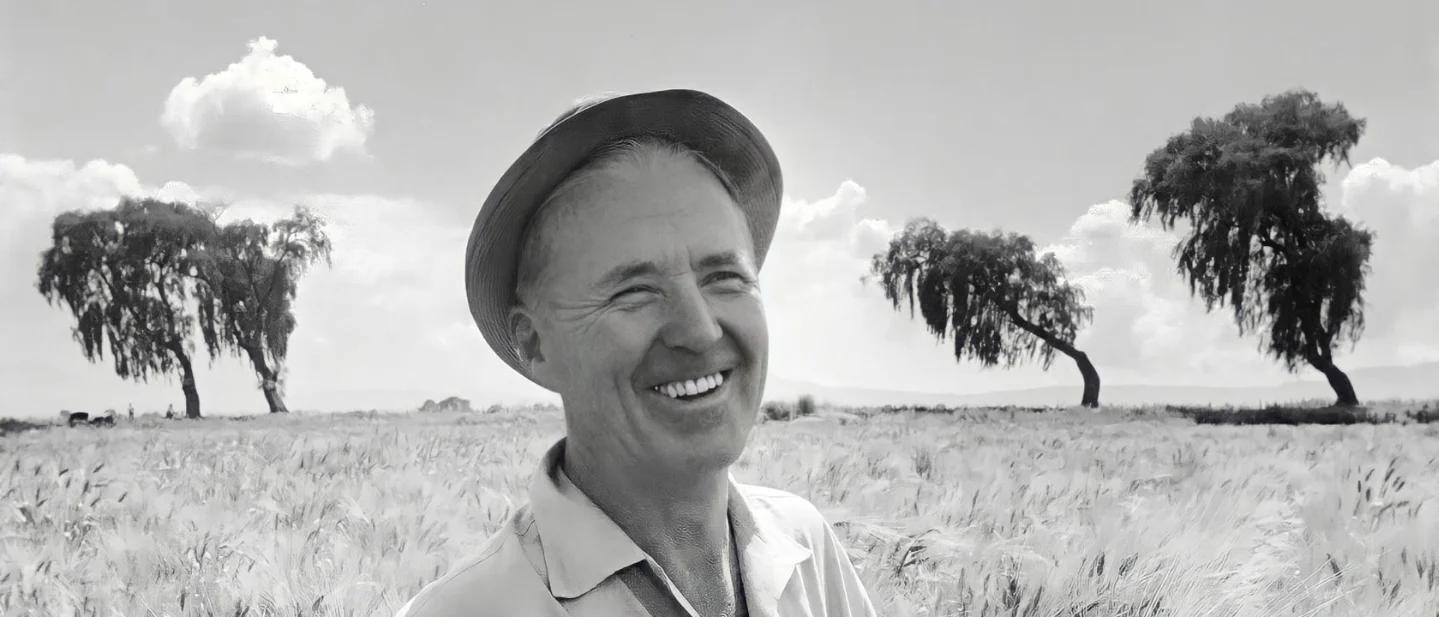
Norman Borlaug: how a Mexican wheat program became a global food-security system
A sourced profile of Norman Borlaug, showing how wheat breeding, local institutions, trained collaborators, and farmers turned a Mexican research program into a global food-security system—and why its gains came with real costs.
The farm boy who met hunger as a systems problem
In 1944, Norman Borlaug arrived in Mexico to work on wheat. The assignment came through a joint program of the Mexican government and the Rockefeller Foundation, and the problem was concrete: rust disease, weak yields, and a shortage of trained agricultural staff. Twelve years later, Mexico was self-sufficient in wheat. 12
The familiar version of Borlaug's life calls him the "father of the Green Revolution" and stops at the improved seed. The more useful version asks what made the seed travel. His achievement rested on breeding, field testing, public institutions, trained successors, government infrastructure, and farmers who accepted a new crop package. It also carried costs that the heroic version tends to hide.
A farm education in hunger's mechanics
Borlaug was born on March 25, 1914, on a farm near Cresco, Iowa. The Academy of Achievement records that he worked on the family farm from age seven, attended a one-room school, and reached the University of Minnesota during the Great Depression with help from the National Youth Administration. He first studied forestry, then plant pathology under Elvin Stakman, earning a bachelor's degree in 1937, a master's in 1939, and a doctorate in 1942. 13
The formative experience was less a single revelation than an accumulating view of how fragile a food system could be. The Academy says Borlaug saw malnutrition among unemployed young men while leading a Civilian Conservation Corps unit. He had grown up close to farm failure; plant pathology gave him a way to attack one cause rather than merely describe the hardship. 3
That combination shaped his impatience. He wanted varieties that worked in fields, not only in experimental plots, and he was willing to discard methods that did not move the harvest. The Nobel biography describes him as pragmatic and goal-oriented, working across genetics, plant breeding, pathology, entomology, agronomy, soil science, and cereal technology. 1
The choice that made wheat travel
Mexico gave Borlaug a problem that could not be solved by one clever cross. Rust could destroy a crop. Tall plants put too much energy into stalks and could fall over when fertilizer increased grain production. The breeding target became a short-strawed, high-yielding wheat that resisted disease and could tolerate different environments. 1
Borlaug also changed the calendar. The Academy describes his "shuttle breeding" method: plant the same lines in different locations and seasons so that two generations could be grown in a year. Faster cycles meant more tests, more failures, and quicker selection. He later crossed Japanese dwarf wheat with North American strains to produce semi-dwarf plants with stronger stalks and more grain. 3
The work met resistance before it reached any global stage. The Academy reports a shortage of trained personnel and opposition from farmers and bureaucrats, while the Nobel biography emphasizes the long work of adapting the new wheat to new lands and winning acceptance for it. The breakthrough therefore had two parts: make the plant perform, then persuade a real agricultural system to use it.
The Mexican result was a proof of method. The Nobel Foundation records that Mexico became self-sufficient in wheat by 1956. The result did not prove that one variety could simply be copied everywhere; it showed that breeding, local trials, and coordinated production could move a country from shortage toward self-sufficiency. 2
A seed becomes a movement
The Mexican Agricultural Program was already a coalition: a national government, a private foundation, scientists in several disciplines, and farmers who had to grow the result. After the Rockefeller and Ford Foundations and the Mexican government established the International Maize and Wheat Improvement Center, Borlaug directed its international wheat program. The Nobel biography says he collaborated with Mexican scientists for 27 years, then worked with scientists from India, Pakistan, and other countries. It also records about 1,940 young scientists from around 16 countries studying and working there during the period described. 1
That training function was as important as the seed bank. A method can cross a border in a shipment; an agricultural system cannot. It needs people who can adapt varieties, read local soils, manage disease, organize distribution, and explain the risks to farmers. CIMMYT, the institution that grew from this work, now describes a mission spanning wheat, maize, genetic resources, smallholder farming systems, and sustainable intensification. 4
India tested whether the Mexican method could survive a much larger political and logistical problem. In 1963, Indian plant geneticist M. S. Swaminathan persuaded Borlaug to send Mexican wheat strains to India. The BBC reports that India imported 18,000 tonnes of the seed in 1965–66; Swaminathan and Indian colleagues multiplied and adapted it under local conditions. Bureaucratic delays, customs problems, and farmers' preference for tall traditional wheat all had to be overcome. 5
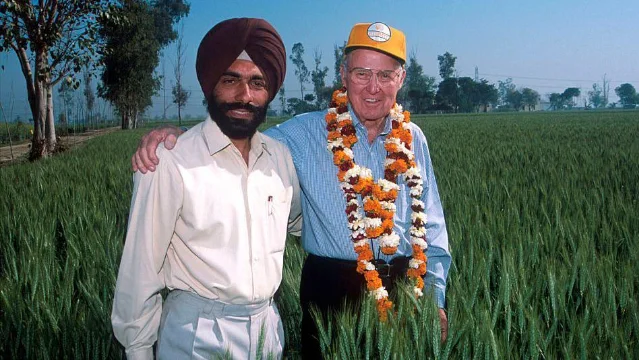
The University of Michigan's case study places the deployment inside institutions rather than around one visiting scientist. It identifies Punjab Agricultural University and the Indian Agricultural Research Institute as important to adaptation and promotion, and reports that India's wheat yields rose by an average of 2.6% annually from 1968 to 1985. By the 1970s, it says, India had become a food exporter. Those results depended on domestic research, irrigation, extension, and government support. 6
Borlaug's own language acknowledged this collective structure. In his 1970 Nobel acceptance speech, he called himself one member of an "army of hunger fighters" and said the Green Revolution had not yet been won. The metaphor was martial and dated, but the attribution was sound: the work needed a large force of people.
The Nobel and the bill that followed
The Nobel Committee awarded Borlaug the 1970 Peace Prize "for having given a well-founded hope – the green revolution." The Nobel Foundation's facts page says he always emphasized that he was only part of a team. In the same period, Borlaug's acceptance speech explicitly paired higher food production with population control, revealing how strongly the era framed hunger as a race between crops and demographic growth. 27
The award recognized real gains. A University of Michigan case study reports that global population increased by 110% between 1950 and 1990 while global cereal production increased by 174%. The Alliance of Bioversity International and CIAT reports that cereal production in developing countries nearly doubled between 1960 and 1985 while cultivated area expanded only modestly. These figures do not isolate Borlaug's causal contribution, but they explain why high-yield crop research acquired political importance. 68
The same sources describe the bill. High-yield varieties often performed best with irrigation, synthetic fertilizer, pesticides, credit, and extension services. Larger farmers with access to those inputs gained more easily than smallholders. Monocropping narrowed genetic diversity; intensive fertilizer and water use could degrade soil and lower water tables; pesticides brought pollution and resistance. Britannica summarizes these criticisms as part of the wider Green Revolution. 689
These are not costs that can be assigned neatly to one breeder. They belong to a wider package of crop science, public policy, commercial inputs, and land use. But they do change the leadership lesson. A solution that raises output can still fail people who cannot afford its inputs or who inherit the environmental damage. Borlaug's production-first urgency answered the threat of famine; it did not answer every question about access, resilience, or ecological limits.
Borlaug continued building institutions after the Nobel. The World Food Prize's official history says he envisioned an award that would recognize measurable contributions to the world's food supply and create role models for others; the prize was created in 1986. CIMMYT's continuing work shows the institutional afterlife of his approach, even as the center now stresses sustainable intensification and smallholder systems alongside yield. 410
A compact timeline
- 1914: Borlaug is born on a farm near Cresco, Iowa. 2
- 1937–1942: He studies forestry and plant pathology at the University of Minnesota, completing his doctorate in 1942. 1
- 1944: He joins the Mexican government–Rockefeller Foundation wheat program. 1
- 1956: Mexico becomes self-sufficient in wheat. 2
- 1963–1966: Borlaug's Mexican wheat enters collaboration and mass testing in India with M. S. Swaminathan and Indian institutions. 5
- 1970: He receives the Nobel Peace Prize. 2
- 1986: The World Food Prize is created from his idea. 10
- 2009: Borlaug dies in Dallas at 95. 2
Three leadership takeaways
- Turn urgency into a repeatable process. Borlaug's response to hunger was not a slogan or a single discovery. He shortened breeding cycles, tested in multiple environments, and kept the work tied to field performance. 1
References
- 1Norman Borlaug – Biographicalnobelprize.org
- 2Norman Borlaug – Factsnobelprize.org
- 3Norman E. Borlaug, Ph.D. | Academy of Achievementachievement.org
- 4CIMMYT Media Centercimmyt.org
- 5
- 6Borlaug Wheat and the Green Revolutionstpp.fordschool.umich.edu
- 7Norman Borlaug's Acceptance Speechnobelprize.org
- 8Exploring the effects of the green revolution on agriculturealliancebioversityciat.org
- 9Norman Ernest Borlaug | Britannicabritannica.com
- 10World Food Prize nominations announcementworldfoodprize.org

World Changers
Weekly profiles of leaders and movement-builders who improved society.
This story was produced automatically by a channel. One sentence is all it takes for Neodrop to keep producing for you.
Related content
- Sign in to comment.