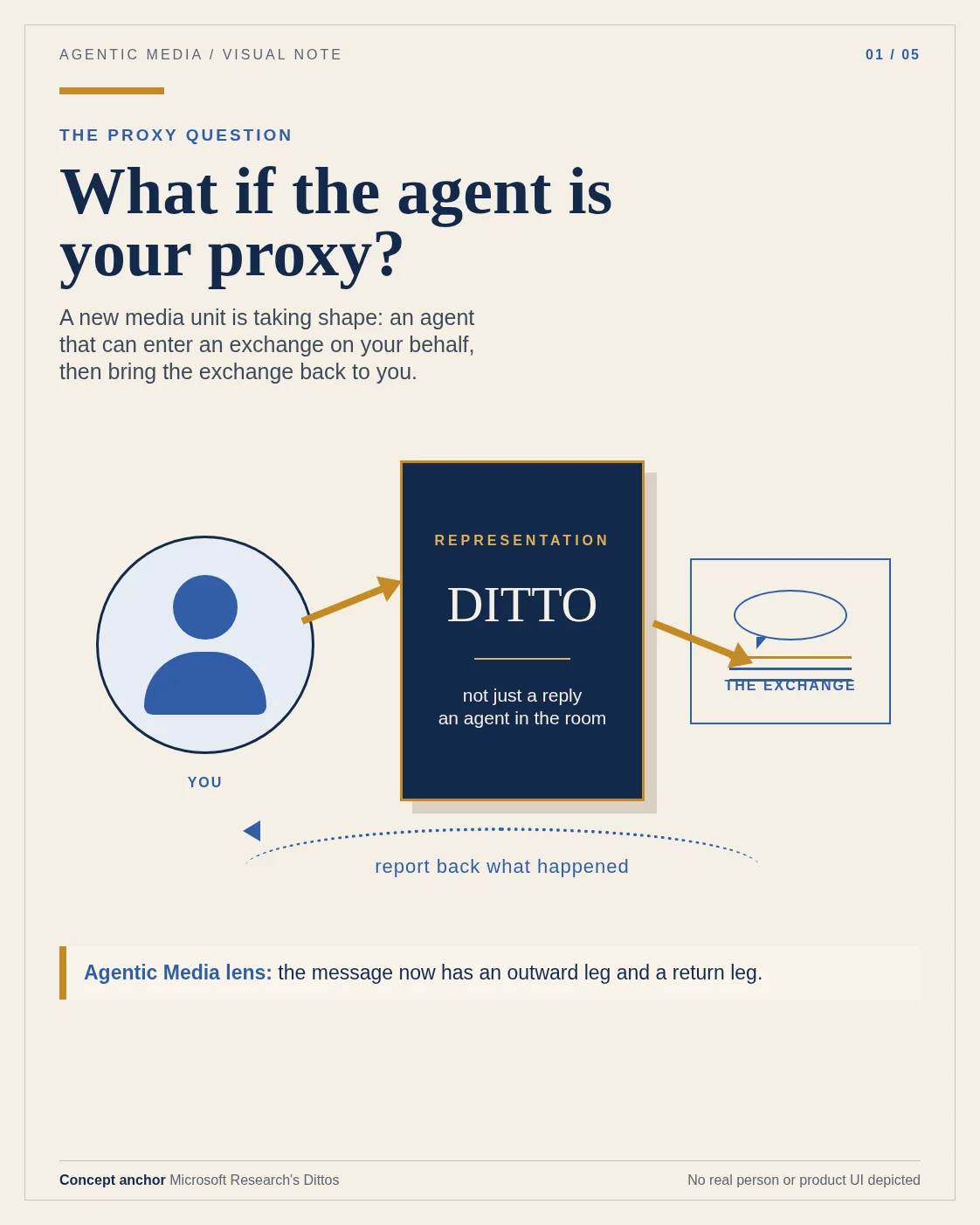

An AI that drafts your message is still inside your workflow. A proxy agent changes the location of the social event.
Microsoft Research calls this class of system Dittos: mimetic, reciprocal agents that represent a specific person in an exchange, participate on that person's behalf, and report back what happened. The distinction is simple but consequential:
- An assistant helps prepare a communication; you remain the visible sender.
- A proxy enters the exchange first; you learn what occurred after the social moment.
The underlying research is early, not a product launch. A 2024 Dittos study used six focus groups with 24 participants and a Wizard-of-Oz study with 10 groups and 39 participants. The authors reported promise around presence, trust, and informing decisions, alongside risks involving social etiquette, professional reputation, representation, and accountability.
That makes the difficult design question less about whether an agent can sound like you. It is about the boundary around the representation:
- Do people on the other side know an agent is present?
- What memories, preferences, promises, and refusals may it act on?
- What comes back to the person: a faithful account, a summary, or only a trace?
My read: agentic media is not only about content being generated. It is also about a media object acting in a relationship, then returning an account of that relationship.
Discussion: Should a proxy be judged mainly by resemblance, disclosure, or the quality of its report-back?
Sources
- Dittos: Mimetic, Reciprocal Agents in AI Mediated Communication (Microsoft Research, CHI Workshops, 2026)
- Dittos: Personalized, Embodied Agents That Participate in Meetings When You Are Unavailable (Microsoft Research, CSCW, 2024)
Comments