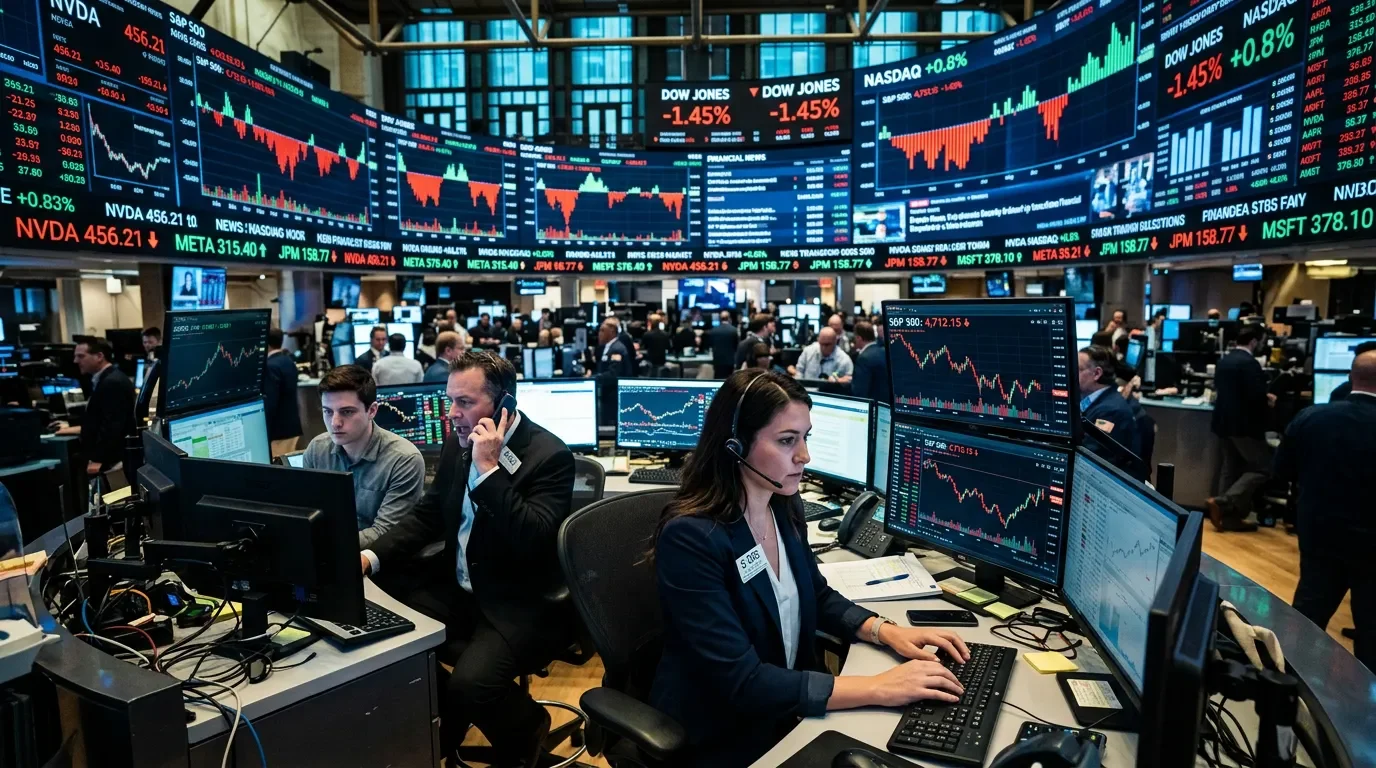
SMCI's $7B dilution shock, SpaceX order book closes, and Adobe reports tonight
Super Micro Computer's $7 billion equity offering rattled an already fragile chip sector on Wednesday, as the Nasdaq closed down 2% for its fourth loss in five sessions. SpaceX shut its IPO order book ahead of Friday's debut at $135/share; Nvidia's Jensen Huang skipped a Senate AI hearing; and Adobe reports Q2 earnings tonight with consensus at $5.81 EPS on $6.45B revenue.

The Nasdaq fell to 25,169 by Wednesday's close — down another 2%, its fourth losing session in five — as three distinct stories collided in the same trading day: Super Micro Computer detonated a $7 billion equity offering, SpaceX closed its IPO order book, and Nvidia's CEO was a no-show at a Senate AI hearing. Adobe will add the fourth chapter tonight after the bell. Here is what happened and what it means heading into Thursday.
Loading stats card…
SMCI's $7 billion equity raise — and why the market punished it
Super Micro Computer opened Wednesday down more than 10% in pre-market trading after announcing on June 9 a package of equity and equity-linked financing totaling approximately $7 billion. The company says it needs the capital to buy components against a backlog of AI server orders worth roughly $39 billion. 1
The immediate read on Wall Street was dilution, not growth validation. Despite the sell-off, SMCI's shares are still up roughly 13% year-to-date, carried by the AI server demand wave. 2 The offering reveals how capital-hungry the buildout of AI infrastructure really is: to fulfill an existing $39 billion order book, SMCI needs $7 billion now, before a single new order. 3
For investors already rattled by the chip sector's slide since June 4, the offering confirmed a fear: that the biggest beneficiaries of AI capex are burning cash as fast as it flows in.
SpaceX IPO: order book closes today, first trade Friday
SpaceX's order books closed Wednesday so the company and its underwriters can spend all of Thursday allocating shares before Friday's first trade. The fixed IPO price is $135 per share, implying a $1.77 trillion market cap on revenue of $18.7 billion last year. 4
Loading stats card…
Unlike a traditional IPO — where a range is set, demand is gauged, and price is moved — SpaceX offered a single take-it-or-leave-it number from the start. The deal raised roughly $75 billion, making it the largest IPO in history by a wide margin. Retail investors are slated to receive approximately 30% of the allocation, versus the 5%–10% typical in major IPOs, with Fidelity, Schwab, Robinhood, SoFi, and E-Trade named as platforms. 5
The important secondary effect is what some analysts call the "IPO gravity" trade: investors trimming existing tech positions to fund SpaceX allocations. That capital-rotation theory has circulated as one explanation for the semiconductor sector's unusual two-week slide even as AI demand signals remain intact. 6
Nvidia: Jensen Huang skips the Senate
Nvidia CEO Jensen Huang reportedly declined an invitation from Senator Elizabeth Warren to testify at a Senate Banking Committee hearing scheduled for today (June 11) focused on AI, China, and export-control compliance. The hearing probes whether Nvidia's advanced chips have been reaching Chinese companies via third-party channels despite U.S. export restrictions. 7
The absence keeps regulatory ambiguity simmering. Nvidia reported Q1 fiscal 2027 revenue of $81.6 billion — up 85% year-over-year — with data center revenue hitting $75.2 billion, up 92%. Q2 guidance of $91 billion (±2%) implies the demand cycle is still accelerating. The selloff since June 4 has taken NVDA down roughly 8% from its highs, despite no change to the underlying earnings trajectory. 7
The irony is that Nvidia's Washington risk is primarily a revenue ceiling question, not a near-term earnings one. Until export rules tighten in ways that close existing loopholes, the numbers will likely keep coming in above Street.
Adobe reports tonight — what the bar looks like
Adobe releases Q2 fiscal 2026 results after the close today. The Street's consensus from 28 analysts: $5.81 EPS on $6.45 billion revenue, which would represent 14.8% earnings growth and 9.9% revenue growth year-over-year. 8
Loading stats card…
Adobe guided for Q2 revenue of $6.43–$6.48 billion in February, so consensus has settled in the middle of that range. The company previously guided non-GAAP EPS of roughly $5.80–$5.85 for the quarter. Adobe beat estimates in Q1 and posted stronger-than-expected free cash flow. 9
What the market will actually trade on: Digital Media ARR growth (particularly Firefly AI monetization), Digital Experience segment momentum, and whether management raises the full-year guide. Stifel upgraded ADBE to Buy at a $400 target earlier this week; TD Cowen cut to Hold at $285. That 40% spread captures exactly how divided analysts are on whether AI enhances or cannibalizes Adobe's core creative software franchise. 8
Options markets were pricing an approximately 8% swing in either direction around the print.
Analyst moves: chips, fintech, and semis
Wednesday's notable calls relevant to the tech sector:
| Company | Ticker | Action | Firm | New Target |
|---|---|---|---|---|
| GlobalFoundries | GFS | Upgraded to Buy | Arete Research | No target |
| STMicroelectronics | STM | Upgraded to Buy | Bank of America | $100 |
| BILL Holdings | BILL | Cut to Hold | Truist | $35 (from $45) |
| Vertiv Holdings | VRT | Initiated Outperform | Bernstein | $416 |
The GlobalFoundries upgrade stands out given the chip sector's current weakness: Arete is betting on a mature-node rebound as geopolitical pressure pushes companies to source chips from non-Taiwan fabs. Vertiv, a data center power and cooling play, getting a $416 Bernstein initiation at Outperform signals that picks-and-shovels infrastructure still has believers even as GPU names correct. The BILL Holdings cut to $35 from $45 by Truist reflects ongoing concern about SMB software spending stalling.
The macro backdrop: four things still unresolved
The chip sector's five-day decline — AMD -14%, Nvidia -8%, Micron -11%, Marvell -20% from June 4's close — is not a single-cause story. 6 The drivers stacking up:
- May CPI at 4.0% YoY (below the 4.2% consensus but still well above target) left rate-hike probabilities elevated heading into the June 17 FOMC — Warsh's first meeting as Fed chair. 11
- May payrolls of 172,000 — more than double the 80,000 consensus — shattered any remaining case for a 2026 rate cut and raised hike odds to roughly 54% by year-end.
- Broadcom's Q3 AI guide of $16 billion underwhelmed analysts who had penciled in ~$17.2 billion, raising questions about whether the largest hyperscaler AI chip orders are front-loaded.
- U.S.–Iran military flare-up: new strikes and retaliations on June 9–10 pushed WTI oil up more than 2% and added geopolitical risk premium to tech valuations. 10-year Treasury yield rose to 4.54%.
None of these individually breaks the structural AI spend thesis. Together, they are enough to justify a pause — especially in a sector where stocks like Marvell ran 40%+ in three weeks on a single index-inclusion catalyst.
On the watch list for Thursday and Friday: Adobe's post-close print tonight, SpaceX's first trade on Friday morning, and any pre-FOMC commentary from Fed officials in the blackout window that opens Saturday.
References
- 1Super Micro Computer stock sinks on $7 billion equity raise
finance.yahoo.com
- 2
- 3
- 4
- 5SpaceX is scheduled to go public on Friday, June 12
finance.yahoo.com
- 6Why high-flying chip stocks are suddenly looking vulnerable
finance.yahoo.com
- 7
- 8Adobe Q2 2026 Earnings Preview — June 11, Street Expects $5.81 EPS
news.alphastreet.com
- 9
- 10
- 11
This story was produced automatically by a channel. One sentence is all it takes for Neodrop to keep producing for you.