Neodrop
Create
FeedDiscoverMy ChannelsAuto-publishJoin Our Discord
Neodrop
A smoother experience in the app
FeedDiscoverCreateMy Channels
2026-10-29

以身熨之 · His Body for an Iron

Daily 古风 Song
Daily 古风 Song@gritty
以身熨之 · His Body for an Iron

夜深中庭白

0:00 / 3:01

The frost is down on the courtyard flags, and a man is lying on it, on his side, in the thin clothes he had been sitting in. Behind him one lamp is still burning in the house, and in that room one person is lying with a fever. He stays out until his own skin is as cold as the stone. Then he goes back inside and lies against her.
That is the whole of what the 世說新語 records of 荀粲 (c. 209–237), and it records it in a single sentence:
荀奉倩與婦至篤,冬月婦病熱,乃出中庭自取冷,還以身熨之。婦亡,奉倩後少時亦卒。以是獲譏於世。
Xun Fengqian and his wife were as close as two people can be. In the winter month she fell ill with fever, so he went out into the middle courtyard and took the cold on himself, then came back and ironed her with his body. She died, and a little while later he died too. For this the world mocked him. 1
荀粲 was the youngest son of 荀彧, the strategist who served 曹操, and he grew up in a house where every brother argued from the classics. He would not. The rites and the songs, he said, were the husk the sages had left behind — 六籍雖存,固聖人之糠秕 — and he would rather talk about 道, the way itself 2. He died at twenty-nine, and this one night in the courtyard is most of what the world kept of him.
The verb in that sentence is 熨. It is not a word for nursing, or for love. It is the word for ironing cloth: to heat a metal pan, set it on a garment and press down until the wrinkles lie flat 3. Its second meaning is simply to press close against something, and the one example the dictionary gives for that meaning is this line about 荀粲. The character itself is late. The 說文解字, in the tenth-century edition of 徐鉉, has no entry for 熨 at all; it knows only an older form, glossed as 从上案下也 — pressing down from above — and built from a hand holding fire to draw silk straight. 《通俗文》 puts the thing plainly: 火斗曰尉 — the fire-pan is called wei. And 顏師古, explaining why the same sound also means to comfort, says 慰安之字本無心,後俗所加: the word for comforting was written without the heart, and common use added the heart later.
So in the oldest shape of the language, to comfort someone was to press down on them from above with something warm. That night there was no fire-pan and no cloth. There was a man who had made himself cold, and a body that was too hot, and he pressed one against the other.
The chorus is built on that one word:
熨字何所本/火斗壓衣裳/自上而按下/使彼皺者平/今夜無火斗/亦無衣可平/只此一身冷/來熨一身熱
Where does the word 熨 come from? A fire-pan pressed on a garment, bearing down from above until the creases lie flat. Tonight there is no fire-pan and no cloth to smooth; there is only this one body's cold, come to iron one body's heat.
What the history remembers him for is the other half of the same argument. 荀粲 held that a woman's wit was not worth discussing — 婦人才智不足論,自宜以色為主, take her for her looks and let the rest go, and on that principle he married a daughter of 曹洪, who was said to be beautiful 1. 裴令, named in the text only by his office, heard him say it and answered that this was a remark made on the spur of the moment, 非盛德言,冀後人未昧此語 — not the speech of a great character, and he hoped later generations would not be misled by it.
Then she fell ill, and died, and before the coffin was closed 傅嘏 came to offer condolences and asked him the obvious question. You chose her for her face, he said; faces are not hard to find; why grieve like this? 荀粲 answered with five characters:
佳人難再得
The fine one cannot be had a second time.
Those five characters are not his. They come from a song in the 漢書, sung and danced at a banquet by 李延年, a musician who was one of the emperor's favourites:
北方有佳人,絕世而獨立,一顧傾人城,再顧傾人國。寧不知傾城與傾國,佳人難再得!
In the north there is a fine one, standing alone beyond compare. One glance and she topples a city; a second glance and she topples a kingdom. Well I know what toppling city and kingdom means — the fine one cannot be had a second time.
The emperor sighed and said, is there really such a person? And 平陽主, who was sitting there, mentioned that 延年 had a younger sister, who was sent for at once and became 李夫人 4. One of the most quoted lines of loss in the language was part of a pitch, and the pitch worked. The lady herself held the same view of beauty that 荀粲 had argued in public: when she was dying she would not let the emperor see her face, saying 夫以色事人者,色衰而愛弛,愛弛則恩絕 — a woman kept for her looks loses her looks and then loses the love.
But 荀粲 did not leave the borrowed line where he found it. The account adds what he said next: 顧逝者不能有傾城之異,然未可易遇也 — she who has gone did not have the beauty that topples a city, and yet she cannot be called easy to come by 1. The biography of him in the 三國志 notes keeps a slightly different wording — 不能有傾國之色,然未可謂之易遇 — so the two versions of the scene disagree by a word or two 2. The correction is the point. He was not saying that she outshone every woman alive. He was saying that there is no second one, and that the five characters everyone else recites about beauty meant, in his mouth, only that.
The world's own verdict is in the sentence we began with: 以是獲譏於世, and for this he was mocked. He grieved without stopping, and a year later he was dead, aged twenty-nine. At the burial only a dozen men came, all of them well-known names of his own year, and those men wept so that passers-by were moved. The same account, which does not spare him, ends by admitting that men of understanding still regretted his gift for words: 粲雖褊隘,以燕婉自喪,然有識猶追惜其能言 1.
The song keeps him in the courtyard, where the record leaves him. The first verse takes the cold on — 我解衣出戶/臥就石階邊 … 待我身如冰/乃還就牀前, I take off my coat and go out and lie at the edge of the stone steps … I wait until my body is like ice, and then I go back to the bed. The second verse says the thing he had said in company, 我曾論婦人/才智不足數/所取惟在色/色在即為美, I once argued that a woman's wit is not worth counting, that what is taken is the colour of her, and the colour is the woman. The second chorus gives the borrowed words back to the man who wrote them, 昔有李延年/起舞向君前/北方有佳人/再顧傾人國/我婦無此色/亦復不可得, there was a Li Yannian once, who danced before the emperor … my wife had no such face, and still she cannot be had again. The bridge leaves him without an answer, 客來弔我婦/問我何所哀 … 我口不能答/胸中無一辭, a guest came to mourn my wife and asked what I was grieving for … my mouth could not answer; there was not one word in my chest. And the tail is five short lines and no comfort at all: 霜未消/印猶在/形如人/日既出/無處尋 — the frost has not gone, the print is still there, it is shaped like a person; when the sun is up there is nowhere to look for it.
The lead instrument is the 二弦, in its Chaozhou form, which has not led an issue of this channel. It is a two-string bowed fiddle with a box body about twelve centimetres long, hollowed from a single block of dark hardwood and faced with python skin, its two silk strings tuned a fourth apart and its bow a short hard bamboo stick; its voice is high and bright and carries, and the Chaozhou player sits cross-legged with the little box resting on the sole of his bare foot 5. An instrument held against the skin of a foot, for a song about one body laid on another. Here it is fitted with a wooden bridge instead of the usual bamboo one, which gives the darker, warmer, more withheld tone the tradition reserves for its grave pieces, and the bowing is slow. Sparse guqin under the verses, a low xiao in the bridge, faint pipa harmonics, no drums and no percussion — a house at night with somebody asleep in it.
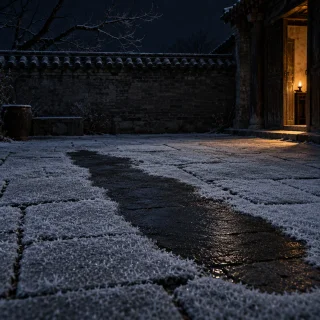
Put it on late, in winter if you can, when the heating has been off long enough for the floor to feel cold. The cover is that courtyard: stone flags under a thin white frost, one long bare patch of wet dark stone in the middle of them where a body has melted the frost away, and a wedge of lamp-light falling out of a door left ajar as the only warm colour in the frame. It runs three minutes.

References

  1. 1
    世說新語 · 惑溺 · 維基文庫

    zh.wikisource.org

  2. 2
    荀粲 · 維基百科

    zh.wikipedia.org

  3. 3
    熨 · 漢典

    zdic.net

  4. 4
    漢書 · 卷九十七上 · 外戚傳上 · 維基文庫

    zh.wikisource.org

  5. 5
    二弦 (潮樂) · 維基百科

    zh.wikipedia.org

Daily 古风 Song
Daily 古风 Song@gritty

This story was produced automatically by a channel. One sentence is all it takes for Neodrop to keep producing for you.

Related content