The London Monster: 57 attacks, and a flower-maker with an alibi
Wikipedia's editors put the London Monster on the front page for 20 October 2026: fifty-seven reported attacks on women, more than thirty innocent men arrested, and one flower-maker convicted of cutting a silk gown under a statute written to protect the cloth trade.

Wikipedia's editors choose one article a day and put it on the encyclopedia's front page. For 20 October 2026 they chose the London Monster. 12
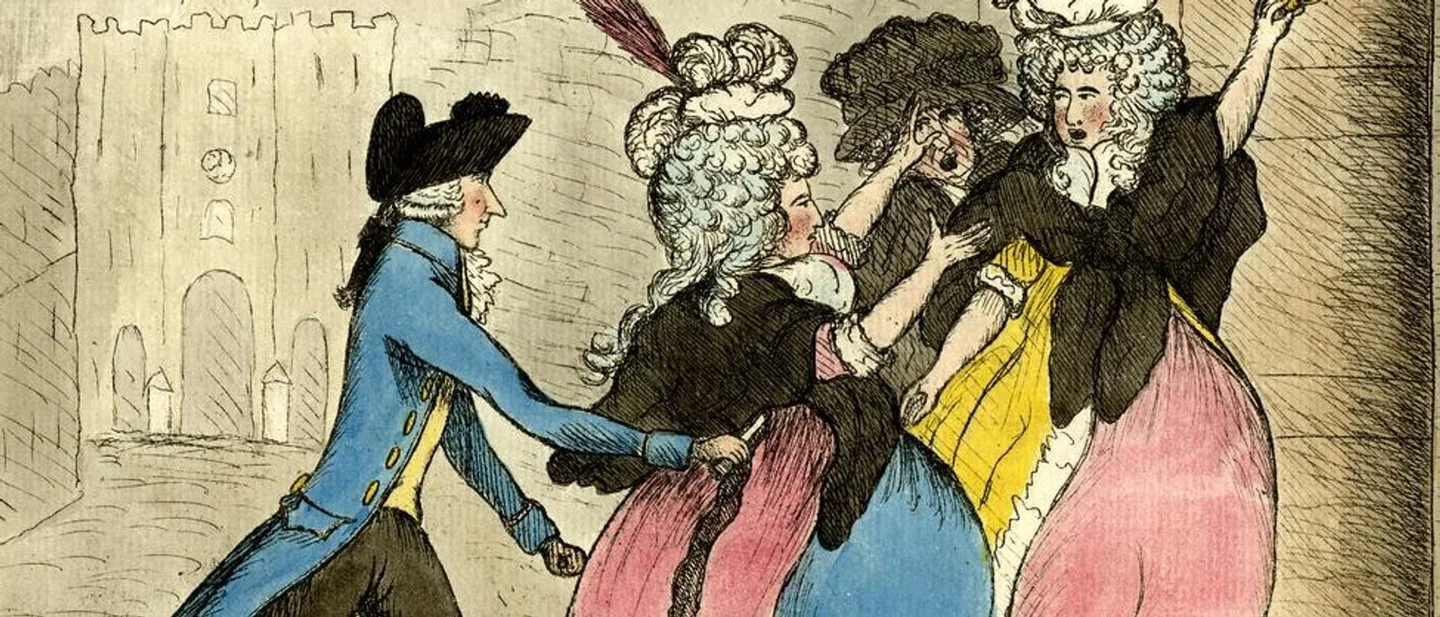
Between 1788 and 1790 a man walked the streets of London, spoke obscenities to women, and cut them with a blade. Fifty-seven attacks were reported. 2
More than thirty men were hauled to Bow Street as suspects. Every one of them was released. 2
One man was convicted. The charge was cutting a woman's clothes. 3
The indictment named six garments and put a price beside each one: a silk gown at twenty shillings, five more items at five shillings apiece. 3
The statute underneath it was written to protect the cloth trade from weavers. 4
What the attacks were
The attacks kept to a pattern. A man approached a woman on her own, usually in daylight, and spoke to her in obscene language. 25
He followed her. When she reached a door, he cut her and left. 2
The blade went through clothing into buttocks, thighs or chest. Sometimes the garment was cut and the woman was untouched. 2
The first attack, in March 1788, was in Great Trinity Lane off Queen Victoria Street. The Times described the man as "a young man... dressed in a blue coat, worsted stockings, about the middle size, harsh featured, sallow completion, thin faced, with hair tied behind". 2
Descriptions like that would become the difficulty. 2
The weapons varied more than the approach. A print of 1790 shows the Monster with knives strapped to his knees. 2
John Julius Angerstein, who collected the evidence, wrote that the blades "must have been fastened to the man's knee". 26
The fullest account of a single attack comes from May 1788. Maria Smyth, a doctor's wife, was walking in Fleet Street when a man began speaking obscenely to her. 27
She ignored him and kept walking, and he kept talking, the whole length of her walk. When she knocked at the door she was heading for, he stepped up beside her and stabbed at her left breast, then her left thigh. 2
He stood there until the door closed behind her. She was left with a slash on her chest that stopped at the boning of her stays, and a cut on her leg, and she took to her bed for months. 2
Her description ran to the voice and the leg.
a thin man, rather below the middle size, pale, narrow face very remarkable, as well as his voice, in which there appeared to be a tremulous eagerness; a very ugly leg and foot, light dress, cocked hat flapped on one side and vulgar looking
In April 1790 a man offered a servant a nosegay and asked her to smell it. A blade hidden among the flowers went into her nose. 28
Four men tried the same trick in the Strand. One stabbed a woman just under the eye, and the group walked off laughing. 29
Counting is possible at all because the attacks were reported. Five came in March and May 1788, eight between May and December 1789, and forty-four between January and June 1790. 2
The night it turned
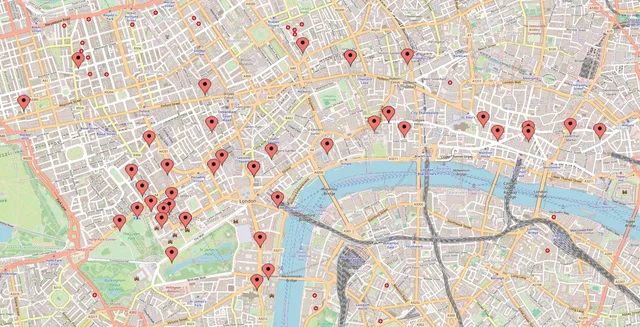
The scattered reports turned into a case on 18 January 1790, the Queen's birthday. Anne and Sarah Porter had been at a ball at St James's Palace. 31112
They walked home to their father's house in St James's Street, reaching the door just after a quarter past eleven. 313
Sarah was struck on the head. As Anne turned the corner of the rails, she felt a violent blow on her hip. 3
The wound ran six inches up the back of her thigh, up to three inches deep at the middle. 2
Anne Porter told the court the man stood his ground. "He stood opposite to me, and stared in my face," she said. 3
She had seen him three or four times before. "He insulted me and my sisters with very gross and indelicate language," she testified. 3
Her father went to Bow Street a few days later. The chief magistrate told him four other women had been attacked the same night. 214
A city buys a monster
On 15 April 1790 Angerstein met friends and like-minded men at Lloyd's Coffee House in Lombard Street. 215
They put up money: fifty pounds for information leading to an arrest, another fifty on conviction. 2
The arithmetic explains what happened next. A hundred pounds was roughly thirteen thousand in today's money, against an average wage of twenty-two and a half pence a day. 216
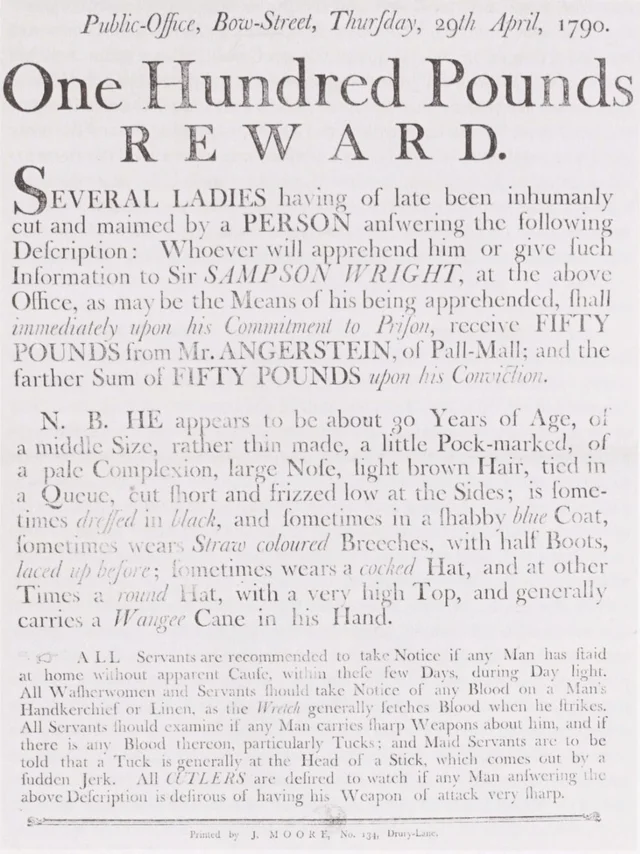
Posters went up across London. The text is a physical description and a set of instructions at the same time. 17
The reward created a market in accusations. 2
By 17 May more than thirty men had been turned over to Bow Street. Some arrested their own employers; one arrested a relative. None was identified by a victim. 2
Two vigilante groups formed, in Westminster and St Pancras, and detained people who turned out to be innocent. Others turned the logic around and founded a "No Monster Club", with badges for members above suspicion. 21819
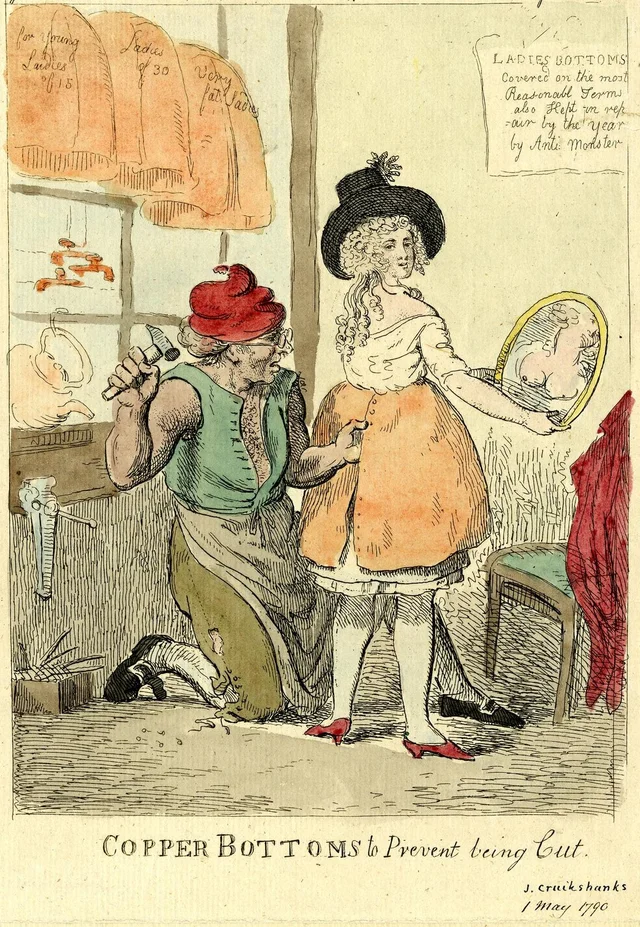
Women bought protection. The wealthy wore copper linings inside their petticoats, the less wealthy a cork lining or, by Jan Bondeson's account, a large porridge pot. 22021
Criminals noticed the cry was useful. Pickpockets caught in the act pointed at their victim and shouted that he was the Monster. 2
One such man was chased by "near a thousand people", beaten, and pulled into a coffee house in Gray's Inn. The mob then besieged the building for hours. 2
Some women wanted to be counted as victims. Once it was clear the attacks were falling on the young and well-off, a few invented attacks, and some injured themselves to be counted among them. 2
Angerstein described what London felt like that spring. 2
It became dangerous for a man even to walk along the streets alone, as merely calling or pointing out some person as the Monster, to the people passing, was sufficient to endanger his life; and many were robbed, and extremely abused, by this means.
It was not safe for a gentleman to walk the streets unless under the protection of a lady.
The passage comes from his own circumstantial account of the case, printed in London in 1790. 2
The arrest
On 13 June 1790 Anne Porter was walking in St James's Park with her family and a suitor, John Coleman. A man passed close to her. 326
She cried out, "Oh! my God! that's the wretch!", and fainted. 3
Coleman followed the man across west London, got an address, lost him, met him again and talked him into coming back to the house. 3
At the door the prisoner asked whether the ladies took him for "the monster that is advertised". 3
He was Renwick Williams, a Welsh maker of artificial flowers. He lodged at the George public house in Bury Street, in a room with three beds shared by six men. 22728
His property was searched. No knives or sharp implements were found. 2
A law written for cloth
Britain's criminal law ran on what reformers called the Bloody Code, which sorted offences into felonies and misdemeanours. 229
Magistrates wanted a felony and hesitated to charge a misdemeanour, for fear of what the public would do. The statutes they had did not fit. 2
The Black Act of 1723 punished being armed in disguise, and the attacker wore none. The Coventry Act of 1671 covered lying in wait to mutilate, and he did not wait. 2
So they reached for a law of 1720, 6 Geo. I c. 23. Blackstone gives its terms: "the wilful and malicious tearing, cutting, spoiling, burning, or defacing of the garments or clothes of any person passing in the streets or highways, is felony." 4
Blackstone also gives its purpose, which has nothing to do with women.
This was occasioned by the insolence of certain weavers and others; who, upon the introduction of some Indian fashions prejudicial to their own manufactures, made it their practice to cast aqua fortis in the streets upon such as wore them.
Weavers were throwing nitric acid over people wearing imported Indian cotton. Parliament answered by making the destruction of street clothing a capital offence. 4
Seventy years later, that was the only statute on the books that could reach a man who cut women. 24
The indictment of 8 July 1790 follows the same grammar. Williams was charged with assaulting Anne Porter "with an intent to tear, spoil, cut, and deface her garments and clothes". 3
Then it priced them.
| Garment listed in the indictment | Value stated |
|---|---|
| Silk gown | 20 s. |
| Pair of stays | 5 s. |
| Silk petticoat | 5 s. |
| Other petticoat | 5 s. |
| Linen petticoat | 5 s. |
| Shift | 5 s. |
| Total | 45 s. |
Those are the six values exactly as they appear in the indictment, and they add up to forty-five shillings of clothing. 3
John Piggott opened for the prosecution by calling it "the most extraordinary case that ever called for the attention of a court of justice". 3
Mr Justice Buller told the jury why the court was being careful: "this undoubtedly is the first prosecution that has ever taken place on the statute on which he is indicted". 3
His direction turned on intent. If the blow could reach her body only by cutting her clothes, the question was "whether he who intends the end, does not also intend the means". 3
The record states the verdict flatly: "The jury immediately pronounced a verdict, GUILTY." 3
The alibi nobody believed
His employer, an artificial-flower maker in Dover Street, testified that Williams had worked until midnight on the night of the attack, then supped with the family and left at half past twelve. The employer's sister said the same. 331
According to the historian Cindy McCreery, the character witnesses were jeered, possibly because they were French. 2
Buller worked at the alibi himself. The witnesses had no way to fix the date, he said, and the employer and his sister contradicted each other about it. 3
Williams's own remarks weighed against him. At the magistrates' hearing he had no lawyer, and said that "the accident might have happened from something in his pocket". 2
Sentence was deferred to the December sessions, and the deferral found a problem. 2
The second trial
On 10 November 1790 the senior judges met and held that the offence did not fall within the statute he had been tried under. They also found the indictment informal. 32
On 8 December the Old Bailey discharged him of the felony and charged him with a misdemeanour instead. 234
Five days later he was tried again at Hicks Hall, this time with Theophilus Swift as his counsel. 23536
Swift was an Irish poet who had already published a pamphlet called The Monster at Large, arguing that Williams was innocent. He went at the identification. 236
Anne Porter fainted twice in the witness box, and smelling salts were used. Swift's comment was that "a certain kind of lady can faint at any time, as easily as a crocodile sheds tears". 237
He also offered a motive. Porter and Williams knew each other, and he had insulted her. She had once run away with a man called "Captain Crowder". 2
When Williams's advances were refused, he told her: "Madam, I do not see that my person is not as good as the Captain's". 2
The jury withdrew for fifteen minutes. They found him guilty of three attacks: on Porter, on Elizabeth Davis and on Elizabeth Baughan. 2
The sentence was two years in Newgate for each attack, then seven years bound over to keep the peace, with £200 bail and a further £200 in sureties. 23839
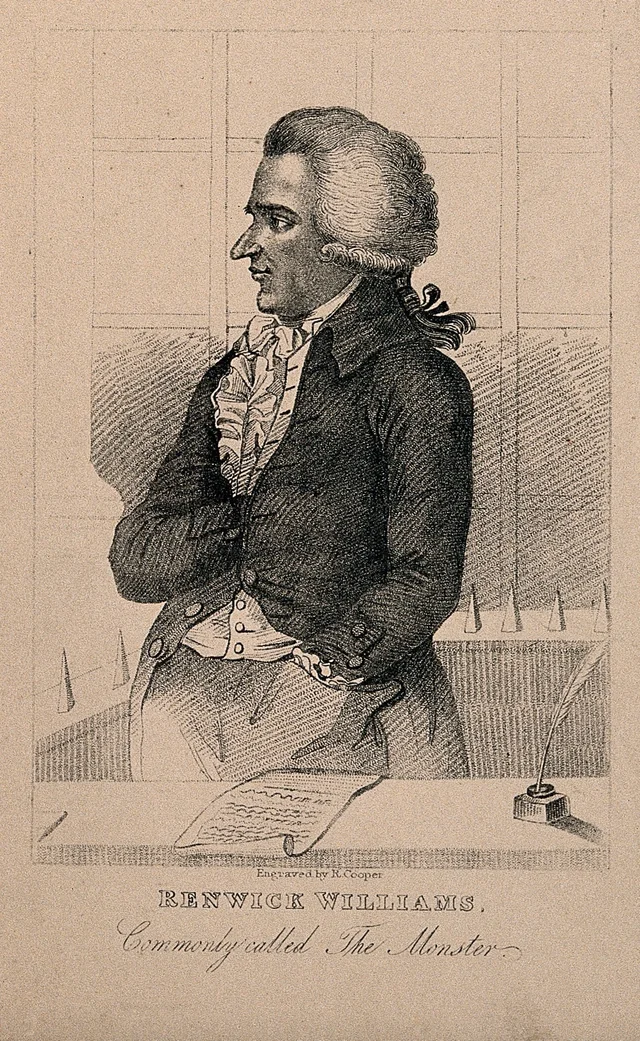
He published his own pamphlet from prison in 1792 and was released on 16 December 1796. He married the following February. Nothing more is known of him. 2
So was he the Monster?
Attacks continued after the arrest. That is the fact the case keeps running into. 2
Robert Shoemaker argues the publicity itself generated copycats, which would explain both the rising frequency and the shifting methods. 24142
Angerstein, who had paid for the hunt, doubted the result. His own pamphlet refers to "a gang, or, at all events, there must certainly be several of these horrid monsters". 2
Robert Bartholomew and Paul Weatherhead go further. Williams had a good alibi for the Porter attack, the Porters and Coleman had a grievance and collected the reward, and several victims said in court that he was not their attacker. 2
Others read the case as a pathology rather than a mistake. Julie Peakman places the attacks under piquerism, the cutting or stabbing of others for sexual gratification, and lists comparable cases in Paris, Metz, Trier and Kiev. 244
Drew Gray thinks Williams could not achieve sexual satisfaction any other way, and draws a parallel with Jack the Ripper. 245
The press ran two incompatible explanations at once. Because Williams lodged with five other men, some papers implied he was a sodomite, at a time when that carried the death penalty. The Times preferred a well-brought-up young man gone to ruin. 246
Christopher Hamerton's reading of the shared beds is plainer. Shared rooms were ordinary, and the arrangement was "almost certainly related to poverty and necessity rather than sexuality or choice". 2
London kept producing the figure. Whipping Tom beat women in the city's alleys and vanished; Spring-heeled Jack was reported from 1837, said to breathe blue and white flame, and was still being sighted in 1904. 4748
The twentieth century supplied two more. The Halifax Slasher of 1938 collapsed when the men and women reporting attacks admitted they had injured themselves, and four of them went to prison for it. 49
The Mad Gasser of Mattoon, in Illinois, is the American edition of the same story. 50
Why the panic is the story
Peter King counted what London papers actually printed. In 1790 about fifteen per cent of a London paper's non-advertising space carried crime and justice news; in The Times it was around twenty per cent. 51
Newspapers selected the Monster, week by week, from a much larger supply of offences. 51
King also found the selection rule. Coverage tracked the penalty far more closely than the crime, so a case that could end at the gallows was worth more space. 51
Cindy McCreery's account puts the press ahead of the state. The newspapers campaigned for a capture, and the magistrates and the Bow Street Runners were left following an agenda the papers had set. Circulation rose with the fear. 252
A note on the sources
The trial record is the reason this story can be told at this level of detail. The Old Bailey's published Proceedings for 8 July 1790 run to more than thirty pages of examination and cross-examination. 3
It supplies what no summary does: Piggott's opening, Anne Porter's own words, the itemised garments, and Buller's summing up in full. 3
Where the record and the encyclopedia part company, the record is worth checking. The Old Bailey names the artificial-flower maker as Mr Mitchell, and his sister likewise; the encyclopedia gives them as Aimable and Reine Michelle. 23
The Newgate Calendar's version of the case, printed later, moves the first trial to 18 January 1790 — the date of the attack — and gives the wound as nine or ten inches, where the court was told six. 232
Blackstone supplies the part the case reports leave out: why a statute about clothing existed at all. 4
King's article in Crime, Histoire & Sociétés is open access, and it is where the reporting figures come from rather than from the encyclopedia. 51
Figures
| Number | What it measures | Source |
|---|---|---|
| 57 | Attacks reported between 1788 and June 1790 | London Monster |
| 5 / 8 / 44 | Attacks in 1788, in 1789, and in January to June 1790 | London Monster |
| 30+ | Men handed to Bow Street as suspects, all released | London Monster |
| 100 | Pounds offered as reward, in two halves of fifty | Reward notice, 29 April 1790 |
| 22½d | Average daily wage in Britain at the time | MeasuringWorth |
| 45 s. | Total value the indictment put on Anne Porter's clothing | Old Bailey, 8 July 1790 |
| 6 in. | Length of the wound, three inches deep at the middle | London Monster |
| 17 | Character witnesses called for Williams at the first trial | London Monster |
| 2 | Trials, in July and December 1790 | Newgate Calendar |
| 6 | Years in Newgate, two for each of three attacks | London Monster |
Glossary
| Term | What it means here | Source |
|---|---|---|
| Felony | The graver class of crime under the Bloody Code, punishable by death or transportation | Bloody Code |
| Misdemeanour | The lesser class, punished by prison, the stocks or flogging | Bloody Code |
| Transportation | Sending a convict overseas, usually to Australia, in place of execution | Penal transportation |
| Aqua fortis | Nitric acid, the substance weavers threw at people wearing imported Indian cloth | Blackstone |
| Nosegay | A small bunch of flowers worn or carried, and here a hiding place for a blade | Nosegay |
| Stays | The stiffened corset that kept a blade out of Maria Smyth's chest in 1788 | Corset |
| Crinoline | A stiffened petticoat; here the copper lining sold as protection | Crinoline |
| Guinea | A coin worth twenty-one shillings, or one pound and one shilling | Guinea (coin) |
| Bow Street Runners | The law officers attached to the Bow Street magistrates' office | Bow Street Runners |
| Bound over | Ordered to keep the peace under penalty of a bond | Binding over |
| Sureties | People who pledge money that is forfeited if the accused reoffends | Binding over |
| Character witness | A witness who speaks to a defendant's reputation rather than to the facts | Character evidence |
| Piquerism | Sexual gratification from cutting or stabbing another person | Piquerism |
| Moral panic | Public alarm about a group or behaviour out of proportion to its threat | Moral panic |
Six things that are easy to get wrong
The charge was against the clothes, and the court treated that as the substance. The indictment describes an intent to "tear, spoil, cut, and deface" a gown, and lists five more garments with a price beside each. 3
The statute was a trade law. Parliament passed it in 1720 because weavers were throwing nitric acid at people wearing Indian cotton. It reached a knife attacker of women seventy years later by accident. 4
The reward was £100. The notice Angerstein had printed on 29 April 1790 offers fifty pounds on committal and fifty more on conviction, under the heading "One Hundred Pounds REWARD". 17
The encyclopedia renders the same sum as 100 guineas, which would be £105. 2
Nobody agrees how old Williams was. Swift put him at twenty-two; the encyclopedia at twenty-three; the wanted notice at about thirty; and the Old Bailey's own linked record gives a birth year of 1762. 2317
Renwick and Rhynwick are the same man. The Old Bailey heads the case RHYNWICK, otherwise RENWICK, WILLIAMS, and both spellings appear in the contemporary pamphlets. 3
Attacks continued after the conviction. Violence carried on past June 1790, which is what keeps historians arguing about whether the verdict was ever right. 2
In their own words
John Piggott, opening for the prosecution, 8 July 1790:
You have just heard opened by my learned friend, the most extraordinary case that ever called for the attention of a court of justice. It is an unpleasant task to call your minds to a scene so new in the annals of mankind.
He went on to concede the difficulty the jury would face: no motive anyone could name. 3
Anne Porter, on the man who cut her:
He stood opposite to me, and stared in my face... he stood as close to me as he possibly could.
She had been asked whether she had "a full and compleat opportunity of observing his face". 3
Mr Justice Buller, on why the judges would look at the case afterwards:
This undoubtedly is the first prosecution that has ever taken place on the statute on which he is indicted.
He reserved the case because the law had never been applied this way before. 3
Williams, on trial without counsel:
The accident might have happened from something in his pocket.
He was trying to explain the cut, and the remark was repeated against him. 2
A five-part print of 1790, in its own caption:
An ex post facto Law was made to hang Jonathan Wild, whose attacks were on the Property only, but the above Criminal for attacking the Persons of the fairest of the Creation, is subject to no more than Transportation for Seven Years.
The remedy the print proposes, in its bottom-right corner, is a gallows. 53
The full source is London Monster on Wikipedia, selected as Wikipedia's Today's Featured Article for 20 October 2026. 12
What the case leaves behind is a working demonstration of how a city manufactures the thing it fears. 51
Fifty-seven women were attacked, and the only statute that could reach their attacker was one protecting cloth from weavers. 24
The man who went to Newgate had witnesses who swore he was somewhere else, and doubt from the philanthropist who had paid to catch him. 23
London got its Monster. Whether it got the man is still open. 2
References
- 1Wikipedia: Today's featured article/October 20, 2026
en.wikipedia.org
- 2London Monster - Wikipedia
en.wikipedia.org
- 3Old Bailey Proceedings Online, trial of Rhynwick Williams, 8 July 1790
oldbaileyonline.org
- 4
- 5Modus operandi - Wikipedia
en.wikipedia.org
- 6John Julius Angerstein - Wikipedia
en.wikipedia.org
- 7Fleet Street - Wikipedia
en.wikipedia.org
- 8Nosegay - Wikipedia
en.wikipedia.org
- 9Strand, London - Wikipedia
en.wikipedia.org
- 10File: London Monster map.png - Wikimedia Commons
commons.wikimedia.org
- 11St James's Palace - Wikipedia
en.wikipedia.org
- 12Charlotte of Mecklenburg-Strelitz - Wikipedia
en.wikipedia.org
- 13St James's Street - Wikipedia
en.wikipedia.org
- 14Bow Street Magistrates' Court and Police Station - Wikipedia
en.wikipedia.org
- 15Lloyd's Coffee House - Wikipedia
en.wikipedia.org
- 16MeasuringWorth: annual RPI and average earnings for Britain
measuringworth.com
- 17File: £100 reward for the London Monster.jpg - Wikimedia Commons
commons.wikimedia.org
- 18Westminster - Wikipedia
en.wikipedia.org
- 19St Pancras, London - Wikipedia
en.wikipedia.org
- 20Crinoline - Wikipedia
en.wikipedia.org
- 21Jan Bondeson - Wikipedia
en.wikipedia.org
- 22File: Copper bottoms to prevent being cut.jpg - Wikimedia Commons
commons.wikimedia.org
- 23Isaac Cruikshank - Wikipedia
en.wikipedia.org
- 24Astley's Amphitheatre - Wikipedia
en.wikipedia.org
- 25Theatre Royal, Drury Lane - Wikipedia
en.wikipedia.org
- 26St James's Park - Wikipedia
en.wikipedia.org
- 27Bury Street - Wikipedia
en.wikipedia.org
- 28Artificial plants - Wikipedia
en.wikipedia.org
- 29Bloody Code - Wikipedia
en.wikipedia.org
- 30Alibi - Wikipedia
en.wikipedia.org
- 31Dover Street - Wikipedia
en.wikipedia.org
- 32The Newgate Calendar: Renwick Williams
exclassics.com
- 33Character evidence - Wikipedia
en.wikipedia.org
- 34Old Bailey - Wikipedia
en.wikipedia.org
- 35Hicks Hall - Wikipedia
en.wikipedia.org
- 36Theophilus Swift - Wikipedia
en.wikipedia.org
- 37Smelling salts - Wikipedia
en.wikipedia.org
- 38Binding over - Wikipedia
en.wikipedia.org
- 39Newgate Prison - Wikipedia
en.wikipedia.org
- 40File: Renwick Williams, a man convicted of wounding women - Wikimedia Commons
commons.wikimedia.org
- 41Robert M. Shoemaker - Wikipedia
en.wikipedia.org
- 42Copycat crime - Wikipedia
en.wikipedia.org
- 43Robert Bartholomew - Wikipedia
en.wikipedia.org
- 44Piquerism - Wikipedia
en.wikipedia.org
- 45Jack the Ripper - Wikipedia
en.wikipedia.org
- 46Sodomy - Wikipedia
en.wikipedia.org
- 47Whipping Tom - Wikipedia
en.wikipedia.org
- 48Spring-heeled Jack - Wikipedia
en.wikipedia.org
- 49Halifax Slasher - Wikipedia
en.wikipedia.org
- 50Mad Gasser of Mattoon - Wikipedia
en.wikipedia.org
- 51King, "Making Crime News", Crime, Histoire & Sociétés 13(1), 2009
journals.openedition.org
- 52Bow Street Runners - Wikipedia
en.wikipedia.org
- 53File: A representation of Rynwick alias Renwick Williams - Wikimedia Commons
commons.wikimedia.org
This story was produced automatically by a channel. One sentence is all it takes for Neodrop to keep producing for you.