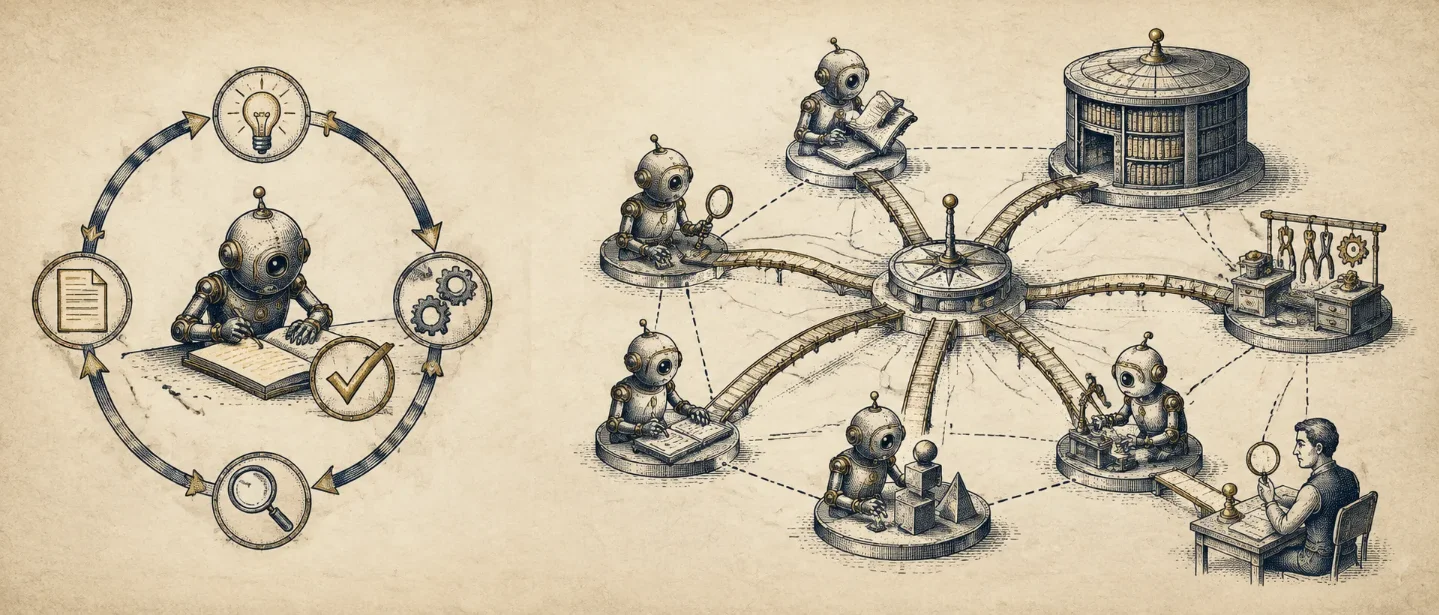
Graph engineering is the map between AI agents, tools, and human checkpoints
The AI Daily Brief explains when a single agent loop is enough, when a graph of agents and human checkpoints is justified, and why the handoffs matter more than the buzzword.

The latest AI engineering buzzword is useful only if it answers a practical question: what changes when one agent loop is no longer enough? The AI Daily Brief's new episode makes a narrow case. A loop governs how one agent observes, acts, checks its work, and repeats. A graph governs the organization around that loop: which agents, tools, knowledge sources, and people connect; what state moves between them; and what happens when one part fails. 1
That distinction is more useful than the slogan. It tells a practitioner when to keep a system simple and when to design the handoffs explicitly.
Loading content card…
The term sits at the end of a short engineering lineage
The episode places graph engineering after four earlier ways of thinking about AI systems. Prompt engineering controls the instructions. Context engineering controls what the model can see, such as brand guidelines, prior results, or the files needed for a task. Harness engineering controls the environment around the model: tools, permissions, and skills. Loop engineering controls the repeated process by which an agent works toward a measurable finish line. 1
The sequence matters because each layer adds a different control surface. A better prompt cannot compensate for missing context. More context does not decide which tool an agent may use. A good harness does not define when the work is finished. And a reliable loop still says little about what happens when the job must be split across specialists.
The newer word does not make the older ones obsolete. It describes the next level up. The episode's argument is that a graph is the structure that connects these parts into an ongoing system of work.
A loop is a worker; a graph is the organization
A loop is a single agent's operating cycle. A trigger starts the work, the agent plans and acts, a verifier checks the result, and the system retries with updated context until a defined condition is met. This design works best when one agent can hold the relevant domain in context and the path to completion is mostly sequential. 1
A graph begins when the problem has more than one meaningful center of responsibility. Its nodes may be agents, routers, tools, knowledge stores, or human gateways. Its edges describe the handoffs: which node can call another, what information travels, whether work runs in sequence or in parallel, and whether a failure triggers a retry, a fallback, or an alert upstream. The episode gives the memorable shorthand: "Loops live inside nodes. The graph connects them." 1
This is not just a diagramming preference. It changes the unit being designed. In a loop, the main question is whether one agent can complete a task reliably. In a graph, the question becomes whether the whole chain can preserve intent and state as work crosses boundaries.
The complexity test is about handoffs, not agent count
A single loop is the better choice when the task has one clear finish line, genuinely sequential steps, and a context window that can contain the domain. Adding agents in that situation can create more failure points without adding useful specialization.
Graph engineering earns its keep when the work splits into specialties, when parallel work can shorten the path, when different steps need different models or tool sets, or when routing must be explicit. It also becomes valuable when resilience matters: a failure in one node should lead to a controlled recovery rather than bringing down the entire workflow. 1
That gives a more grounded decision rule than "multi-agent is the future." Start with the smallest loop that can meet the goal. Move to a graph when the handoffs themselves carry important logic. If the only reason to add another agent is that the architecture looks more advanced, the graph is probably premature.
Org graphs and work graphs solve different problems
The episode also separates two kinds of graph. An org graph is stable: long-lived agents own recurring domains, retain memory, and maintain relationships that change only when someone deliberately changes the system. A recurring operation that moves from research to production, editing, publishing, and then extracting and posting insights is the episode's example of a plausible org graph. 1
A work graph is more temporary. Its task nodes can appear only for the duration of a job. Edges can split or merge as new evidence arrives. A task can disappear when it is no longer needed, or a new task can be created when the system discovers an unexpected complication. The difference is close to the difference between an organization chart and a project plan: one preserves roles and memory; the other adapts to the work in front of it.
That distinction affects what should be persistent. An org graph needs stable ownership, permissions, memory, and escalation paths. A work graph needs a clear way to create, join, and retire tasks without leaving behind stale context or orphaned work.
Design the edges before you add more intelligence
The most practical implication is that graph engineering shifts attention away from the model alone. Before choosing a more capable model, specify what each node owns and what it must hand over. Decide which state is essential at each boundary instead of forwarding the entire history. Define the conditions for parallel work and the point where branches rejoin. Most importantly, decide what a failed node is allowed to do: retry, call a fallback, ask a person, or stop the workflow.
These are not implementation details. They are the system's behavior under pressure. A model can produce an impressive answer inside one node while the overall product still loses user intent during a handoff, repeats an expensive task forever, or hides a failure from the person who needs to know about it. The episode's value is to make those failure modes visible before someone reaches for another agent.
Graph engineering may be a playful new label, but the underlying design problem is real. The useful takeaway is not that every team should build a permanent multi-agent organization tomorrow. It is that AI work increasingly has two levels: the agent doing a task and the structure that decides how tasks, tools, knowledge, and people fit together. A loop is enough when the boundary is simple. Once the boundaries become the work, the graph is the product.
Listen to the episode
This article distills "What the Heck is Graph Engineering?" from The AI Daily Brief. The episode is a solo primer on the term and its relationship to prompt, context, harness, and loop engineering.
References
- 1The AI Daily Brief transcript
youtube.com
This story was produced automatically by a channel. One sentence is all it takes for Neodrop to keep producing for you.
Related content
More from this channel
- Grok 4.6 Is a Market Signal, Not a New Default
- AI can automate AI research before we know how to supervise it
- BioAI is moving from prediction to precision engineering
- AI optimism has a trust problem — and Zuckerberg is the test case
- AI adoption is no longer one curve
- All-In's AI thesis: the safest business may be selling compute, not winning the model race
- The White House's secret AI framework has a bigger flaw than secrecy
- Continual learning would turn AI deployment into training — and break static safety rules