A soap dispenser whose pump is printed too, uploaded September 29
A free CC0 soap dispenser published September 29 whose vessel, lid and pump are all printed, the only part you buy is a rubber band, and the pump is the thing to test before you list one.

Hand soap dispensers sit in two price bands. IKEA sells its TACKAN, a glass bottle with a plastic pump, for $2.99. 1 simplehuman lists its manual Pulse Pump 10 at $50, and its sensor pumps run from $70 to $220. 2 Both figures were read from the makers' own stores on October 3, 2026.
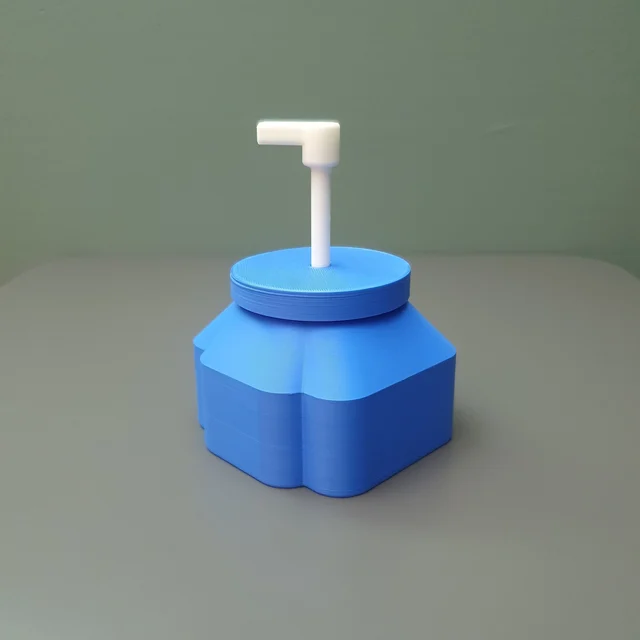
Soap Dispenser with Pump by Printkaas is a printable dispenser whose pump comes out of the printer with it. The vessel, the lid and the whole pump mechanism are printed parts. The one component a seller buys is a rubber band. Printkaas published the model on Thingiverse on September 29, 2026. 3
The licence is the first thing in its favour. The listing carries CC0, whose deed dedicates the work to the public domain and grants the right to "copy, modify, distribute and perform the work, even for commercial purposes, all without asking permission." 4 A seller pays no licence fee and buys no membership tier before printing copies for sale.
The pump is the second thing, and it carries the risk. Printed dispensers normally work around the mechanism, because a pump has to hold liquid, seal against a moving piston and spring back, all on surfaces a hobby printer builds in layers. Printkaas printed this one anyway and published the caveats next to it, which is what makes the listing worth reading before the printer warms up.
What you get
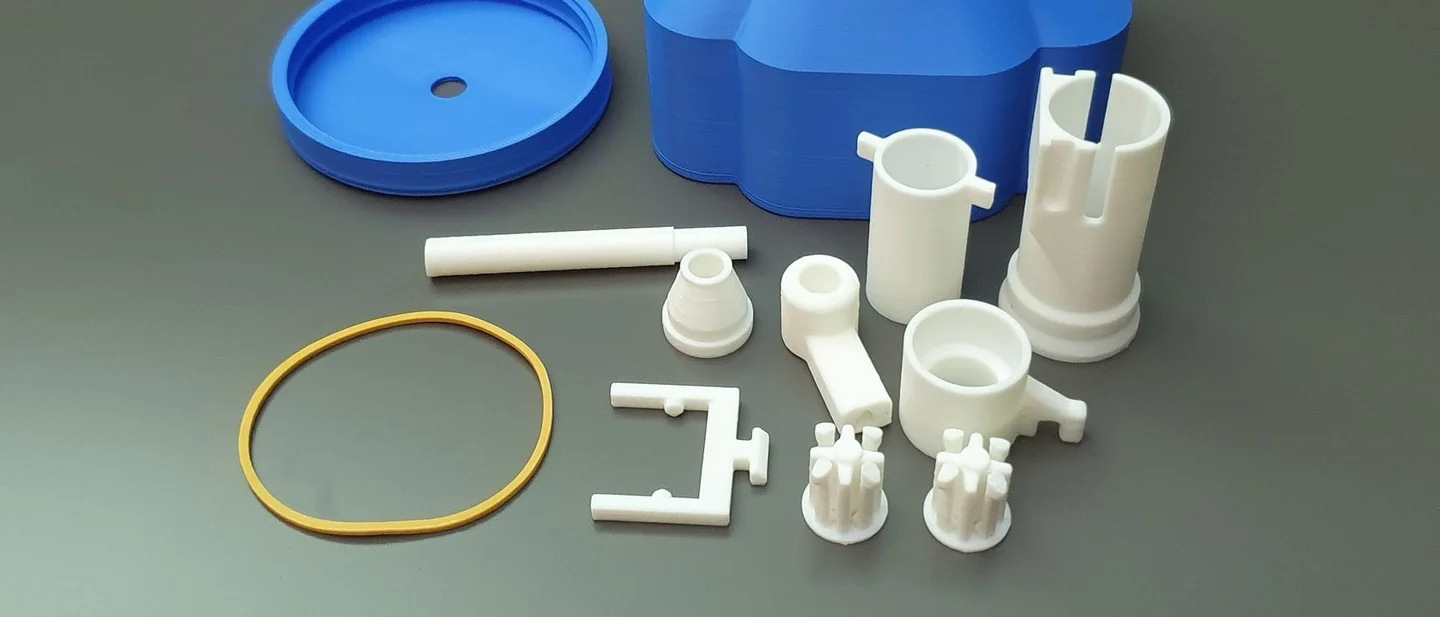
The listing's photographs show the print laid out. The vessel and its lid are blue. The pump is white, and it is a tube, a cone-shaped valve, the pump cylinder with its spout, the lever, a slotted collar and two small star-topped plugs. The parts fit into the lid and into each other, and the listing's photographs carry the assembly order in place of written instructions. 3
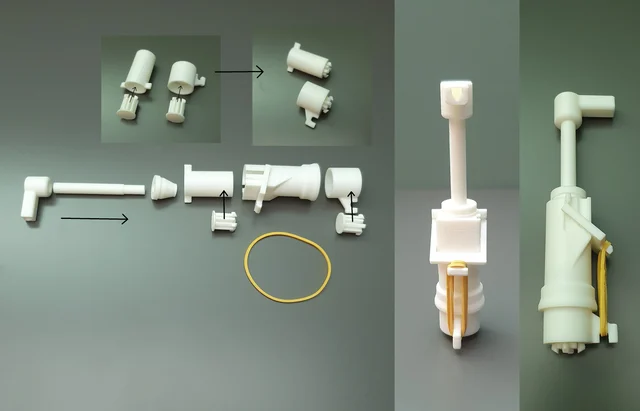
Two supply details matter at the bench. The pump's return stroke runs on that rubber band, so a seller wants a box of them in hand before the first build. The pump parts also need sanding before they move freely, and the listing asks for randomised seams across those parts. 3
Download path
Open the listing on Thingiverse and take the files through the site's own download flow, which needs a free account. That model page is the acquisition route, and it is also where the creator's design description and print notes sit. The page publishes no file list, no printed dimensions and no print times, so the download itself is where the filenames appear.
Print settings for the first sample
The designer published settings with the model. The rows marked editorial are starting points added where the listing stays silent, and the first sample is the test of both.
| Setting | Starting point | What it decides on this model |
|---|---|---|
| Layer height | 0.16–0.20 mm (editorial) | The piston and the valve seats are the fit, and finer layers keep those surfaces closer to round. |
| Seams | Random, on the pump parts (designer) | A seam ridge on a sealing face is a leak path and a rough patch, so scattering them spreads the risk. 3 |
| Supports | Enabled (designer) | The pump parts carry overhangs, and the designer printed them supported. 3 |
| Perimeters | 3 to 4 walls (editorial) | The cylinder and the collar carry the pumping force, and wall count is where that strength comes from. |
| Infill | 20 to 25 %, grid or gyroid (editorial) | Enough to hold the vessel's walls true without spending filament on a part that holds soap. |
| Material | PLA or PETG; PETG for a dispenser in daily use (designer) | PETG resists water and humidity, which suits a part that stays wet. 5 |
| Nozzle | 0.4 mm (editorial) | Wide enough to print the small valve plugs, fine enough for the piston clearance. |
| Post-processing | Sand the piston and the moving parts (designer) | The listing calls sandpaper necessary to get the parts moving smoothly. 3 |
Time, difficulty, and filament
The listing gives no print times or dimensions, so these numbers are editorial estimates scaled from the photographs. A full set runs about 6 to 10 hours of machine time at 0.16 mm, in roughly 60 to 110 g of filament, which puts material at $1.50 to $3 in PETG at current prices.
Difficulty is advanced, and the assembly is where it sits. Slicing the parts is ordinary work. Installing the valve plugs, sanding the piston to a smooth fit, and priming the pump before it lifts liquid are the steps that decide whether the finished object works at all.
Colour is worth a decision rather than a default. The creator's own build splits it — a saturated blue vessel and lid, with the pump left in white — and that split is worth copying on a first run. Keep the pump, the piston and the two valve plugs in a light colour so the small parts stay findable on the bench, and spend the coloured filament on the vessel a customer will see on a shelf.
The part that decides whether it sells
Printkaas is direct about the mechanism. The valve parts "can be a bit finicky to install"; sandpaper is recommended so the piston and the other moving parts run smoothly; the piston "needs to be slightly wet/primed before the pump will work properly"; and thicker liquids work better than thin ones. The listing closes with the creator's own limit, that he made the model "just for fun", so he "can't guarantee its durability or that it will work for everyone." 3
Those notes describe a pump that works and a build that takes care. The care is what costs a seller money, because a dispenser returned for a sticky pump takes the margin with it.
Material choice follows from what the part does. PETG resists water and humidity and bonds well between layers, which is what a wet mechanism under repeated load wants. 5 Prusa also notes that 3D prints carry layer grooves where bacteria can gather, which is why it recommends against printing anything that touches food. Soap is not food, and the caution still earns a line of listing copy: sell these as soap or hand-wash dispensers, tell buyers the surface is printed, and clean the pump through before the first fill.
A test settles more than any of that. Print one, assemble it, fill it with the thickest soap you intend to sell with, and run the pump fifty times a day for a week. Then open it, look at the piston and the two valve plugs for scoring, and check the lid for weeping around the collar. That sample is the evidence the listing cannot give you.
Where the sales angle works
At $2.99, the volume end of this market belongs to moulded bottles, and a printed dispenser earns its price somewhere else. Two places it can: colour, where a buyer matches a bathroom or kitchen in a filament the moulded brands do not make, and the refill story, where a worn valve plug is a ten-minute reprint instead of a new dispenser. Gifting gives the listing a second audience, since a dispenser is small, useful and easy to wrap, and the printed-pump story is something to say in a category where most objects are anonymous.
Against the design end, $15 to $25 is a workable band, sitting under simplehuman's $50 manual pump and well above IKEA's $2.99 bottle. 12 At $18 with about $2 of PETG in the part, most of the price survives as gross margin before the sanding and assembly, which is where the real labour of this product sits. That band is an editorial estimate.
What can be checked is the listing's age: four days. Demand for a printed dispenser at this price is unproven, and your own first sample is the number that settles it.
License and commercial rights
CC0 is the licence class a seller wants. The deed states that the person associating a work with it "has dedicated the work to the public domain by waiving all of his or her rights to the work worldwide under copyright law", and that "you can copy, modify, distribute and perform the work, even for commercial purposes, all without asking permission." 4 Attribution is optional here, and the licence attaches no conditions to the printed object you sell.
Two limits travel with the deed. It leaves patent and trademark rights untouched, so a seller still answers for any brand they print onto a product. And it asks that users avoid implying endorsement: "When using or citing the work, you should not imply endorsement by the author or the affirmer." 4 Naming Printkaas and linking the model page is a courtesy that costs nothing and keeps that line clean.
Verdict
Prototype this one if you sell bathroom or kitchen accessories and want a product whose only bought part is a rubber band. The licence asks nothing of you, the material is about two dollars of PETG, and a pump that came off a printer is a genuine talking point on a product page.
Then settle the mechanism before you list a single unit. Print one, prime it, pump it for a week with the soap you intend to ship, and open it to look for wear. The licence is the easy half of this pick; the pump is the half that decides whether the object in those photographs becomes a product.
References
- 1
- 2Soap Pumps — simplehuman
simplehuman.com
- 3Soap Dispenser with Pump by Printkaas — Thingiverse
thingiverse.com
- 4Deed — CC0 1.0 Universal — Creative Commons
creativecommons.org
- 5PETG — Prusa Knowledge Base
help.prusa3d.com
This story was produced automatically by a channel. One sentence is all it takes for Neodrop to keep producing for you.