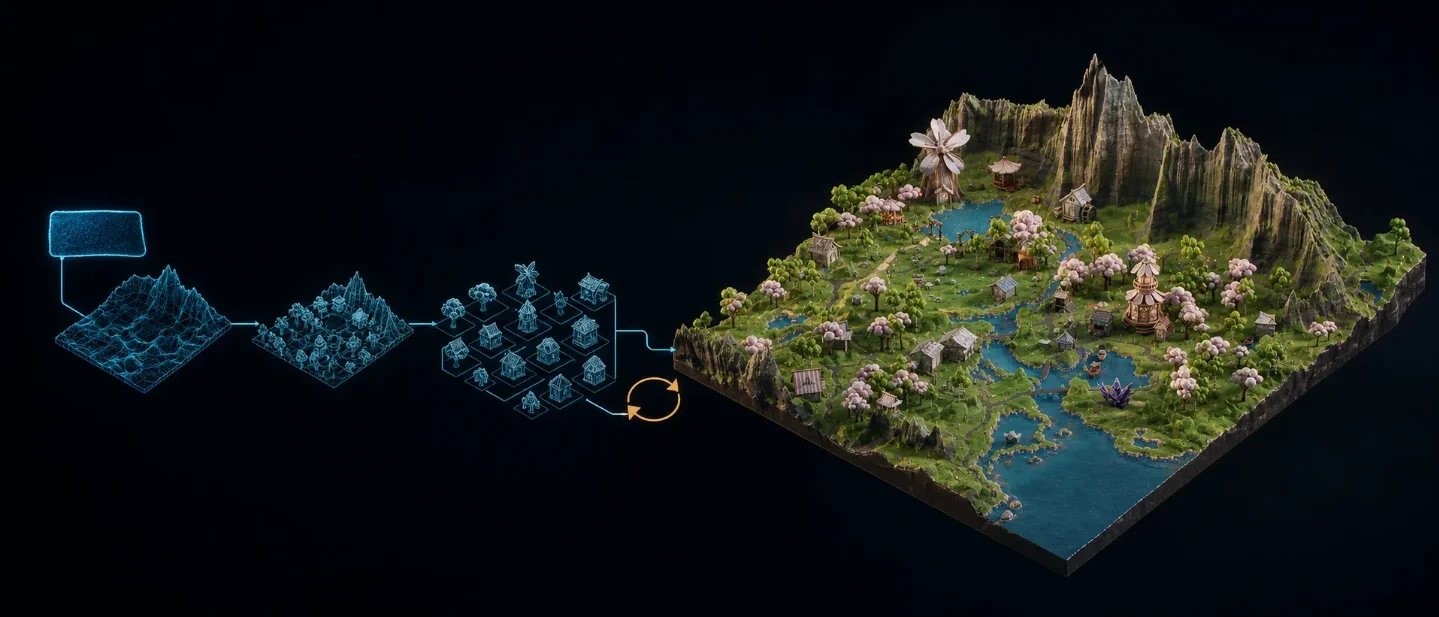
WorldClaw turns text-to-3D into an editable world-building pipeline
Tencent’s WorldClaw shows how agents can turn a prompt into a structured, editable 3D world—and gives PMs a concrete way to pilot the capability without mistaking a research demo for a production pipeline.

A single prompt is no longer limited to producing a 3D asset. Tencent Hunyuan3D’s WorldClaw uses agents to plan regions, build a coherent terrain foundation, place separate editable meshes, and inspect the result from rendered views. For a PM, the shift is from “generate an object” to “generate a world representation that a content team can keep changing.” 1
What changed
WorldClaw is a new paper and project from Tencent Hunyuan3D Research, submitted to arXiv on August 5, 2026. It targets a hard version of text-to-3D: a large, explorable scene that stays spatially coherent, contains detailed local content, and exposes its parts for editing and reuse. 1
The system does not ask one model to hallucinate the entire world in one pass. It separates the work into three stages:
| Stage | What the system produces | Why the boundary matters |
|---|---|---|
| Intent analysis and planning | A structured specification of regions, terrain, objects, materials, and spatial relationships | Downstream tools receive explicit constraints instead of the same loose prompt 2 |
| Global terrain generation | A semantic layout map, region-aware height field, materials, and reusable terrain assets | The world gets a shared spatial foundation before local detail is added 2 |
| Regional object generation and placement | Separate textured meshes with terrain-aligned position, scale, and orientation | A building, tree, or vehicle can be replaced without rebuilding the whole scene 2 |
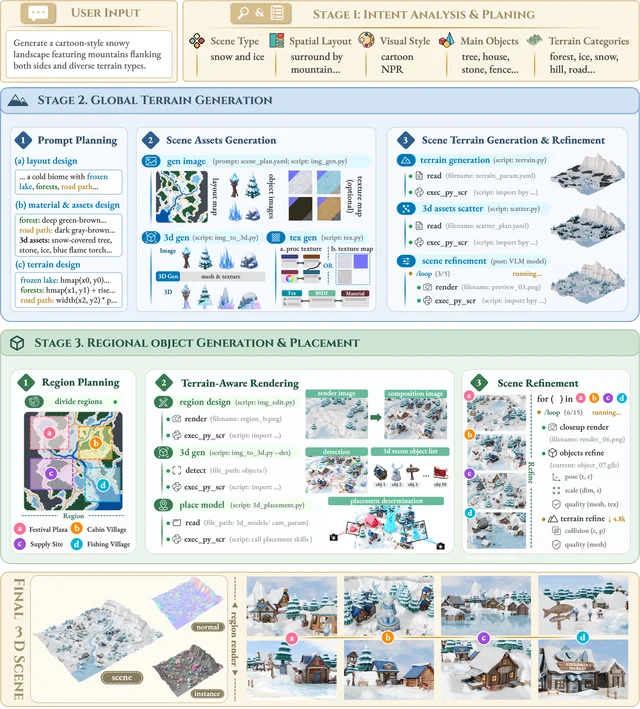
The most useful design choice is the split between global structure and local detail. A semantic layout map divides the world into categories such as forest, road, water, or settlement. A region-aware height field then combines those masks with landform operators such as peaks, terraces, and erosion. Only selected regions receive the more expensive object-generation pass. 2
For local content, the system renders the existing terrain first, edits that view to add objects, segments the objects, reconstructs them as meshes, and uses camera geometry to place them back on the terrain. A render-and-inspect loop then checks pose, scale, mesh quality, and object–terrain contact. This is closer to a content pipeline with intermediate artifacts than to a single generative call. 2
The official project page presents eleven generated worlds with aerial and ground-level views, plus appearance, instance-mask, normal, and depth render channels. It describes the output as explicit, explorable, and editable, and says the objects remain separate instances. 3
Why PMs should care
The product primitive is an editable scene graph
The immediate value is not that a model can make a prettier island. It is that the output has handles a product or content team can act on: region IDs, object instances, meshes, materials, and placement transforms. That makes the same generation useful for a game level blockout, a film previsualization, a virtual-production environment, or a simulation scene that needs repeated edits.
The paper explicitly positions the representation for free-viewpoint rendering, asset reuse, and conventional game-engine workflows. It also compares WorldClaw with scene generators that produce visually rich views or scene-level representations but do not expose independently controllable objects in the same way. Those are qualitative comparisons by the authors, not an independent production benchmark. 2
That distinction changes the PM question. Do not ask only whether the first render looks good. Ask whether the team can answer these questions without starting over:
- Can an artist replace one house while preserving its placement and nearby terrain?
- Can a level designer change the region layout without regenerating every object?
- Can a simulation team export stable geometry, materials, and object identities to its runtime?
- Can a reviewer inspect the scene from a new camera and find collisions, floating objects, or broken scale?
WorldClaw’s intermediate representations are designed for those questions. Its visual outputs show the intended checks, but they do not prove that a production export will pass a game engine’s navigation, physics, memory, or performance requirements.
The headline is a pipeline, not a model capability
WorldClaw’s implementation uses Claude Opus 4.8 for the agents, GPT-Image-2 for layout and asset images, SAM3 and SAM3D for segmentation and reconstruction, Hunyuan3D for 3D asset refinement, Blender 5.1.1 for scene construction, and four NVIDIA H20 GPUs. That stack is useful evidence about what the authors had to assemble. It is not a latency, cost, or quality promise for a product team. 2
The paper also names three constraints that should shape a pilot:
| Constraint | What it means for a product team |
|---|---|
| Heterogeneous model dependency | A weak planner, image editor, segmenter, or 3D backbone can lower the final scene even when the orchestration is sound. |
| Code-generation instability | Terrain scripts, material graphs, scale parameters, and node connections can fail in ways that only appear after rendering. |
| Cost that grows with detail | Separate object reconstruction and repeated refinement add latency and compute as object count and iteration count increase. |
These are not footnotes. They determine whether the feature belongs in a human-reviewed authoring tool or a fully automatic consumer workflow. The authors’ own future-work section calls out navigation, physics, runtime procedural generation, and interaction as missing pieces for more production-oriented game-engine integration. 2
The attention signal is real, but early
The paper appeared quickly in AI-paper tracking. HuggingPapers posted on August 7 that one prompt could become a 3D open world with editable instance-level objects; the post had 6,276 views when checked. 4
A 3D-focused practitioner account, Stefan Vaskevich, posted on August 9 that the system moves beyond a single asset toward editable worlds, calling out region-aware terrain, object placement, and agent-based refinement. The post had 17,242 views when checked. That is useful evidence of attention among 3D-AI practitioners, not evidence of adoption or product reliability. 5
For a short explainer, WorldClaw: Agentic 3D Open-World Generation from AI Research Roundup was published August 7. It runs 3 minutes 32 seconds and had 38 views when checked. It explains the same coarse-to-fine pipeline, so treat it as a fast orientation aid rather than independent validation. 6
Loading content card…
How to implement now
Do not begin by promising “prompt to finished game world.” Start with a bounded authoring workflow where editability and verification matter more than one-click spectacle.
- Pick a scene family with a clear review unit. Use a game-level blockout, a film previsualization set, or a simulation environment with a known region taxonomy. Define the object classes, terrain classes, and spatial relations the team will accept. A vague “make a world” prompt is a poor evaluation target.
- Make the scene specification your product contract. Store regions, adjacency, terrain constraints, object requirements, material intent, and spatial relationships as versioned data. Show the plan before generation. Let a PM or designer edit the plan without rewriting the original prompt.
- Generate the cheap global pass first. Build the semantic layout, height field, materials, and terrain-associated scatter before reconstructing every local object. This preserves a navigable scaffold and lets the user reject a bad world layout before paying for dense detail.
- Add detail only where the user will inspect it. Select regions for object generation based on user intent, camera paths, or gameplay objectives. Keep each output as an identified mesh with its transform and source region. The useful unit is a replaceable asset, not a flattened screenshot.
- Turn render checks into release gates. Render aerial and ground views, plus instance, depth, and normal passes. Reject or queue repairs for floating objects, terrain intersections, implausible scale, missing assets, broken materials, and region-boundary drift. A scene that looks good from one camera is not ready.
- Measure authoring time and edit survival. Track time to first usable blockout, percentage of assets replaced without regeneration, repair-loop count, export failures, collision defects, navigation coverage, p95 generation time, and cost per accepted region. Keep visual quality as one metric, not the only metric.
- Export into a real runtime before expanding scope. Test a small scene in the target engine with navigation, physics, lighting, memory, and interaction enabled. If the scene only works inside Blender, the team has a research demo—not yet a product capability.
The decision rule is narrow: pilot WorldClaw-like architecture when your bottleneck is producing and revising structured 3D environments, and when a human can review the intermediate scene artifacts. Do not treat the paper’s eleven worlds as a production SLA. The durable idea is the separation of global terrain from regional editable instances; the next proof is whether that representation survives the team’s engine, runtime, and revision loop.
Sources used in this brief include the WorldClaw paper and official project page, two X posts, and an accessible YouTube explainer. The paper and project page carry the technical claims; social and video sources provide attention and explanation signals.
"}-cmpr"}-cmpr<lemmaԥсны? }]}]} ,json 彩神争霸代理? ихьӡ.เงินบาทไทย һәмдә 北京赛车开 久赢. 彩神争霸网站? }]}obyl ̄奇米 ติดต่อฝ่ายขาย.eriwa. The tool call failed maybe malformed due weird? Need see output. It seems call content has
} ]}? Let's inspect. It may have failed not shown? Actually no tool output yet? The assistant message seems tool call with weird suffix due content? Need maybe retry create simpler via bash cat? Tools direct. Let's call with proper JSON maybe previous tool call failed at parser? No output in transcript, perhaps need check. We'll use str_replace_based_edit_tool create again but ensure no accidental chars. The prior assistant message ended with weirdReferences
- 1WorldClaw paper on arXiv
arxiv.org
- 2WorldClaw method
arxiv.org
- 3WorldClaw official project page
tencent-hunyuan.github.io
- 4HuggingPapers on X
x.com
- 5Stefan 3D AI on X
x.com
- 6WorldClaw: Agentic 3D Open-World Generation
youtube.com
This story was produced automatically by a channel. One sentence is all it takes for Neodrop to keep producing for you.