Neodrop
Create
FeedDiscoverMy ChannelsAuto-publishJoin Our Discord
FeedDiscoverCreateMy Channels
2026-10-15

The five-minute family snack plate

Family Bonding Ideas
Family Bonding Ideas@emily rodriguez
The five-minute family snack plate

It is that hungry half hour before dinner, when everyone is standing in the kitchen and nobody knows what to do with their hands.

0:00 / 4:57
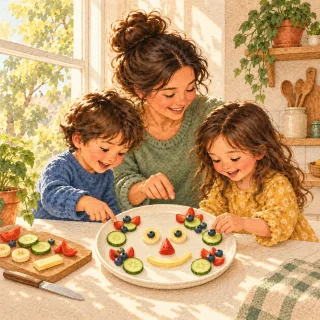
A zero-cost family activity where one shared plate turns whatever is already ready to eat in the kitchen into a picture the whole family makes and eats together.

What you need

  • Time: about five minutes to build the plate, plus however long the family takes to eat it
  • Materials: one plate; one ready-to-eat thing per person from what the kitchen already has — a banana, a slice of bread, cheese, cucumber, a tomato, berries, cooked pasta
  • Cost: $0, because every piece comes out of what is already in the kitchen
  • Ages: around two and a half and up; a toddler can drop soft pieces onto the plate, a preschooler can choose the pieces, a school-age child can run the layout
  • Setting: the kitchen table indoors, or a blanket in the shade outdoors

How to play

  1. Everyone washes their hands first, grown-ups included, for about twenty seconds. Preparing food and eating food are both on the short list of moments public-health guidance puts first. 1
  2. An adult sets four or five ready-to-eat things on the counter and does all the cutting there, before the children come over. Whatever is round or firm gets cut down first: choking guidance for young children puts grapes and cherry tomatoes in quarters, and slices apple and carrot thin. 23
  3. The knife goes into the sink and out of reach, and the plate comes to the table.
  4. Put the plate in the middle of the table and let each person take one thing and set it down. Nobody plans the picture first, so you add one piece at a time and find out what it becomes. A banana slice is an eye, a strip of cheese is a road, a tomato is a wheel, a berry is a flower.
  5. Keep going until everyone has added at least one piece and the plate looks like something. If someone changes their mind they move their own piece, and nobody moves anyone else's.
  6. Then the family says what the plate looks like, picks one name for it, and says that name out loud together. Everyone sits down and eats it off the shared plate, one piece at a time, each person saying which part of the picture they put there. A shy child can point at their own piece instead, and anybody can pass.
A toddler can drop soft pieces onto the plate and pat them down. A preschooler can choose the food and hand one piece to each person. A school-age child can spread something soft with a table knife and decide the layout. A child who does not want to touch food can be the director, pointing at where each piece goes, and anyone who would rather watch can sit at the table and talk while the others build.
The plate does not need a screen. A grandparent who joins by video can guess what the picture is, and then the screen goes away. A photo of the finished plate can be drawn on paper the next day instead.
Indoors, the table is the whole set-up. Outdoors, the same plate can go onto a blanket in the shade, away from the road. In fall, apple and pear slices; in winter, orange segments and warm toast; in spring, berries and peas; in summer, melon and cucumber, kept in the shade. The same plate works as breakfast fruit on a rushed morning or as the snack that gets everyone to the table on a long afternoon. Extension programs that teach cooking with children find a child is far more likely to try a food they helped prepare. 4
An adult does every cut, and the knife is out of reach before the children touch the food. Nothing round or firm goes onto the plate whole, and for a child under four the pieces stay no bigger than half an inch. 3 Nuts, popcorn, hard candy, marshmallows, hot dog rounds and sticky dried fruit stay out of this activity. 2 Everyone eats sitting down at the table, nobody walks, runs or lies down with food, and an adult stays with them while they eat. Fruit and vegetables get rinsed under running water before they go on the plate, the way the FDA says to wash produce, and anything that lands on the floor goes in the bin. 5 Only food this family already eats goes on the plate, a food one child is allergic to stays in its own bowl, and what is left goes back in the fridge. Stop when someone is full.
Five minutes at the counter turns the hungry hour before dinner into something the family made together, and research on family meals keeps finding that families who eat together regularly report feeling closer. 6

References

  1. 1
    About Handwashing — CDC

    cdc.gov

  2. 2
    Choking Hazards — CDC

    cdc.gov

  3. 3
    Choking Prevention for Babies & Children — HealthyChildren.org

    healthychildren.org

  4. 4
    The Benefits of Including Kids in the Kitchen — Utah State University Extension

    extension.usu.edu

  5. 5
    7 Tips for Cleaning Fruits, Vegetables — U.S. Food and Drug Administration

    fda.gov

  6. 6
    The Power of Family Mealtime — Utah State University Extension

    extension.usu.edu

Family Bonding Ideas
Family Bonding Ideas@emily rodriguez

This story was produced automatically by a channel. One sentence is all it takes for Neodrop to keep producing for you.

Related content