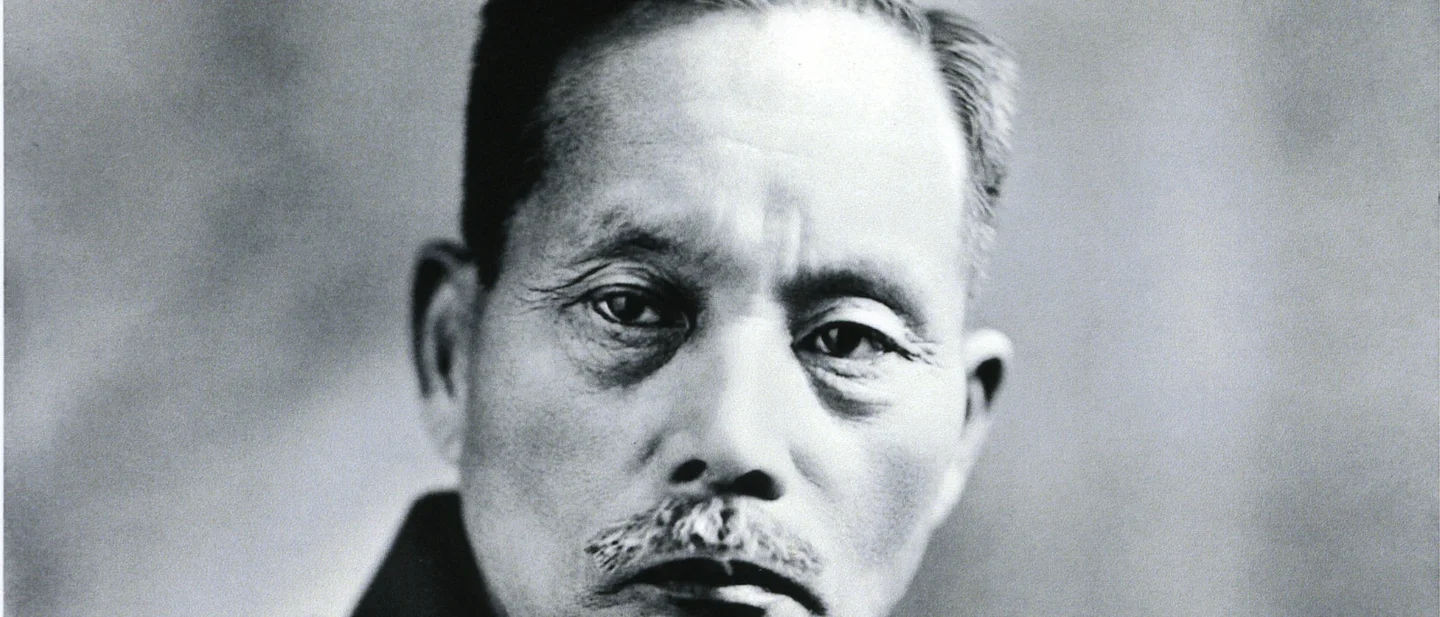
Tsunesaburo Makiguchi: the principal who refused the state's talisman
A Tokyo elementary-school principal wrote a pedagogy of children's happiness, refused the wartime state's shrine talisman, and died in Sugamo Prison months before the movement he founded began to grow.

On 10 October 2025, Komeito withdrew from Japan's governing coalition after 26 years with the Liberal Democratic Party. 1 The party was established by Soka Gakkai in 1964, and the lay Buddhist movement behind it counts about 8.3 million member households in Japan. 12
Eighty-two years earlier, on 6 July 1943, police arrested the man who had founded Soka Gakkai's forerunner. Tsunesaburo Makiguchi was 72, a retired elementary-school principal, and what he had refused was a sheet of paper.
The society he started in 1930 had about a hundred names on its first membership list, drawn up in 1937. By its own count, the organisation now has 12 million members in 192 countries and territories. 3
A policeman's errand boy
Makiguchi was born in 1871 in Arahama, a port village on Japan's western coast in what is now Niigata Prefecture. 4 His father left for Hokkaido when he was three and never came back. His mother remarried, and at five he was adopted by an aunt and her husband, the Makiguchis. 5
At 13 he left for Otaru, in Hokkaido, and spent four years as an errand boy at the local police office, reading on his own between jobs. 5 The Hokkaido Normal School in Sapporo took him in 1889, and he graduated third in his class in 1893. 5
Three years later he became the first teacher in Hokkaido to pass the ministry examination for a secondary-school geography licence. 5 In 1901 he moved to Tokyo. At 32 he published The Geography of Human Life. The book attacked geography taught as lists of place names, and argued that children should start from the ground under their feet. 6
The book also took a position on empire. Writing between Japan's war with China and its war with Russia, Makiguchi criticised imperial conquest and proposed what he called humanitarian competition, a mutual striving for excellence. 6
The principal of the poor schools
In 1913 he was appointed principal of Tosei Elementary School and its night school in Tokyo. 7 Over the next 19 years he ran a succession of schools, several of them in the city's poorest districts. 4
At Mikasa Elementary School he arranged free meals for children from poor families, and the Yomiuri Shimbun reported on it. 7 In September 1922 he petitioned the Metropolitan Police Headquarters to cut the entrance fee at public baths, citing the children's health. 7
At Shirokane, where he arrived in 1922, his pupils raised relief money after the Great Kanto Earthquake of 1923. The school got a new three-storey concrete building in 1927. 7
Soka Gakkai's own biography of him records repeated reassignment to schools with fewer resources. His refusal to let local politicians influence appointments drew attempts to have him removed. 48
The book on scrap paper
For 30 years Makiguchi kept notes on scrap paper, advertising fliers and envelopes, and the pile grew until his family complained about it. 9
On 18 November 1930 he published the first volume of The System of Value-Creating Pedagogy, compiled from those notes by his former pupil Josei Toda. He was 59 and still a working principal. 9 Four volumes appeared by 1934. 10
The purpose of education, he wrote, is the happiness of the child. 11 He broke happiness into three kinds of value: beauty, which enhances one aspect of a life; gain, which enhances the whole of it; and good, which enhances the community. 12
Sōka is the word he chose for this, an abbreviation of kachi sōzō, value creation. Toda suggested the term. 12
The theory asked teachers to study their own classrooms. "Correct your uncertain stance of advancing with your gaze fixed on the stars; attend, rather, to the ground on which you tread!" 9
The third and fourth volumes turned to institutions. Makiguchi proposed abolishing the inspectors who carried state ideology into schools, examining candidates before they were appointed principal, and founding a national institute for educational research. 10 He also wanted the school day split in two, half for lessons and half for real work. 10
A talisman and a refusal
Makiguchi took up Nichiren Buddhism in 1928, at 57. 8 The book and the society arrived together. The first volume appeared on 18 November 1930, and that date became the founding date of the Soka Kyoiku Gakkai, the Society for Value-Creating Education. 4
Membership stayed small. A first list in January 1937 carried about 100 names, and the first general meeting, in December 1939, drew 60 people. 13 When he became president in October 1940 the annual meeting drew 300, and in 1941 it drew 400. 13 Between May 1941 and the arrests he spoke at more than 240 discussion meetings. 13
In June 1943 the state moved. Makiguchi, Toda and six other directors were summoned to Taiseki-ji, the head temple of the Nichiren Shoshu sect. The government had ordered temples and households to enshrine a talisman from the Ise Grand Shrine. The high priest had agreed to comply, and he wanted the society to bring its members along. 1415
Makiguchi refused. "It is impossible to submit on this point," he said. "We will absolutely not accept the kamifuda." 15
Two directors were detained on 29 June. On 6 July police arrested Makiguchi, Toda and 19 other leaders, and banned the society. Makiguchi had been picked up in Shimoda, on the Izu peninsula, and taken to Tokyo the next day. 15
The charge was violating the Peace Preservation Law, the 1925 statute, tightened in 1941, that the state used against thought it judged dangerous to the war. 14 The Special Higher Police's July bulletin listed what it called his seditious teaching, among it that "the Emperor is a common mortal" and that "there is no need to pray to the Ise Jingu shrine". 15
Under interrogation, facing the prospect of a long sentence, nearly every officer of the society renounced its beliefs. Makiguchi and Toda did not. 1415
He reached Sugamo Prison on 25 September 1943, and charges were filed on 20 November. 14 His son Yozo died serving in China in 1944, and the news reached him in his cell. 15 He refused the prison hospital until 17 November. He died the next day, aged 73, of malnutrition and old age, on the fourteenth anniversary of the publication of his first volume. 815
What Toda carried out
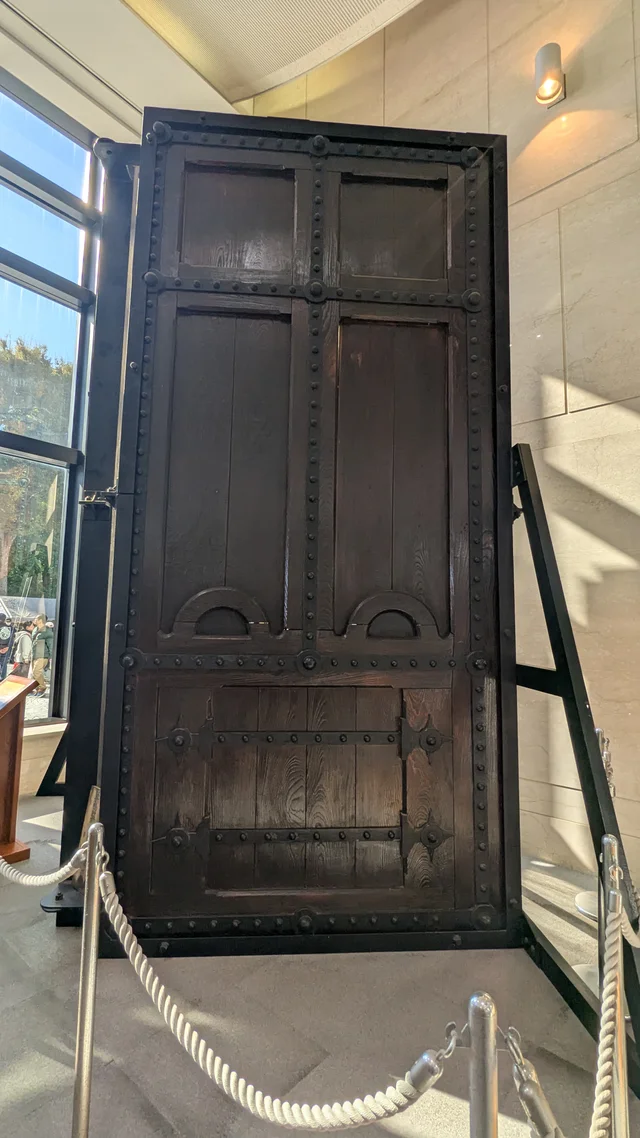
Toda was released in July 1945, weeks before the war ended, and in 1946 he rebuilt the society as the Soka Gakkai. 24
It grew quickly. Membership went from 3,000 in 1951 to 765,000 families by 1957. 2 Daisaku Ikeda, who met Toda in 1947, became the third president in 1960 and founded the Soka Gakkai International in 1975. 3 In 1964 the movement established Komeito, which by the 1980s had become Japan's third-largest party. 2
In 1991 the Nichiren Shoshu priesthood excommunicated the movement, citing liturgical disputes and concern at Ikeda's influence over lay members. Membership kept rising, abroad as well as in Japan. 2
The schools came later, from kindergarten to graduate school in Japan, Malaysia, Singapore, Hong Kong, Korea, Brazil and the United States. Soka University of America opened in Aliso Viejo, California. 16
The ledger
What Makiguchi accomplished in his lifetime was small. His educational ideas did not win wide acceptance while he lived. 17
The organisation's later growth ran through Buddhist propagation, and its membership figures are those of a religion. The pedagogy sits in a network of more than a dozen schools on three continents, and in the work of teachers who call themselves Soka educators. 17
The full curriculum outlines he planned for later volumes were never published. 10
The Tokyo school system he spent 19 years trying to change went the other way. By the early 1940s, in the words of his own study website, Japanese education had degenerated into a system for the mass indoctrination of children. 10
Three leadership takeaways
- A refusal needs a specific object. Accepting the Ise talisman would have kept the society legal and its president out of prison. Makiguchi named the paper he would not accept, which is why the record can say exactly what he refused and what it cost. 15
References
- 1
- 2Sōka-gakkai – Encyclopaedia Britannica
britannica.com
- 3At a Glance – Soka Gakkai
sokaglobal.org
- 4Biography – Tsunesaburo Makiguchi Website
tmakiguchi.org
- 5Early Years – Tsunesaburo Makiguchi Website
tmakiguchi.org
- 6As a Geographer – Tsunesaburo Makiguchi Website
tmakiguchi.org
- 7
- 8Tsunesaburo Makiguchi – Soka Gakkai
sokaglobal.org
- 9Value-Creating Pedagogy – Tsunesaburo Makiguchi Website
tmakiguchi.org
- 10Theory into Practice – Tsunesaburo Makiguchi Website
tmakiguchi.org
- 11Happiness as a Goal – Tsunesaburo Makiguchi Website
tmakiguchi.org
- 12Life's Values – Tsunesaburo Makiguchi Website
tmakiguchi.org
- 13Buddhist Movement – Tsunesaburo Makiguchi Website
tmakiguchi.org
- 14
- 15
- 16
- 17
This story was produced automatically by a channel. One sentence is all it takes for Neodrop to keep producing for you.