No-Drill Under-Bed Storage: Your Saturday Renter Project
Lift a rental bed onto riser cups and roll two storage bins underneath for about $59, with the frame, clearance, and floor checks that decide whether your bed can take the lift at all.

The Saturday plan
Most rental bedrooms put the closet and the space under the bed in the same condition: one is packed and the other is empty. That gap under the frame is usually six or seven inches of dead air, which happens to be the height of a storage bin on casters.
This project lifts the bed frame onto riser cups and rolls two bins into the gap. The risers stand on the floor, the bins slide out from either side, and the whole setup lifts away on moving day. Nothing is fastened to a wall or a stud.
The setup this article walks through costs $59 before tax: a $9 four-pack of risers and two $25 rolling bins. If your bed already clears a bin, the containers alone bring it to $25–$50, and flat boxes instead of wheeled ones bring it to $12–$25.
Plan on a Saturday morning rather than a whole day. Most of that time goes into measuring the frame and testing the finished setup, because none of these riser sets needs assembly and the bins arrive ready to roll.
Check the frame before you buy anything
A riser works by sitting under a leg, so the first question is what your frame has touching the floor. Five checks settle it, and each one takes a minute with a tape measure and a phone light.
- How many points touch the floor. A frame with four corner legs and nothing in the middle takes one four-pack. A queen or king usually carries a fifth or sixth leg under the center rail, and every point that meets the floor needs a riser of the same height. An unsupported center rail is where a light metal frame bends.
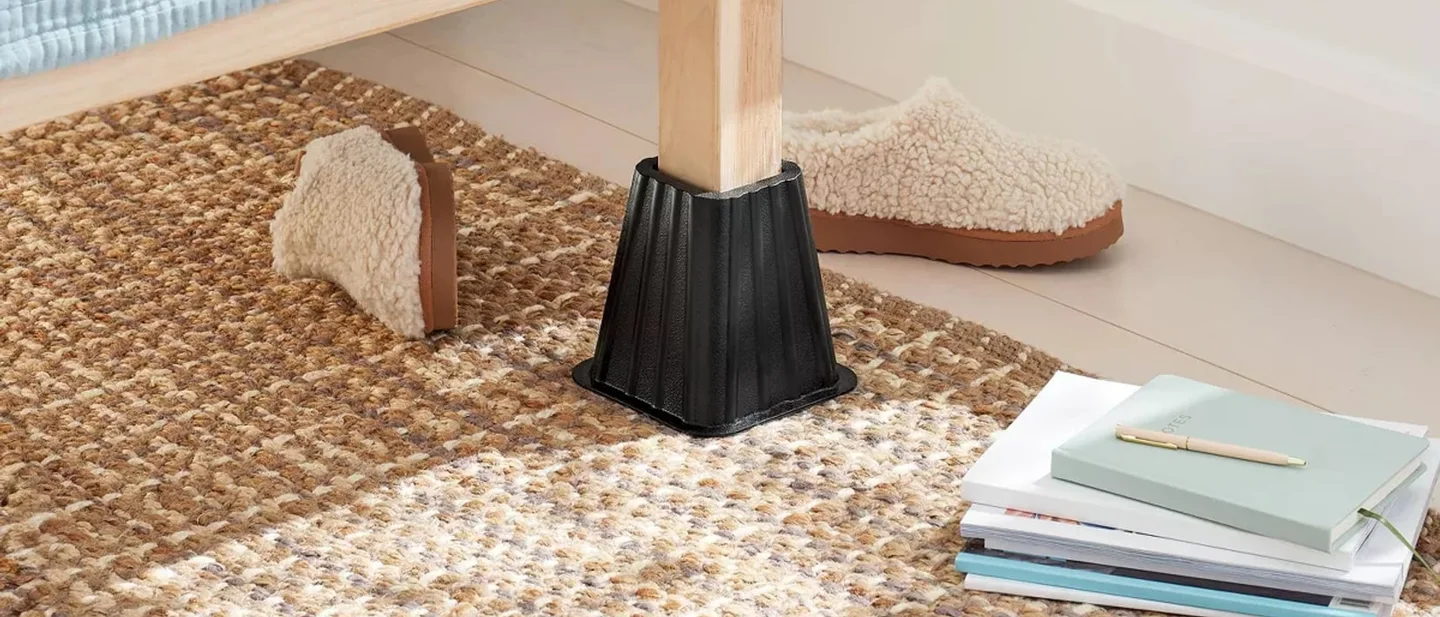
- What shape those points are. Square wooden posts, round metal legs, plastic glides, and casters each need something different on top of the riser. The $9 set is molded with indented cutouts that take square legs. The $19.99 set has a one-inch lip that holds a post or a caster. The adjustable set lists a cup opening of 3 in × 3 in × 3/4 in deep, so a leg wider than three inches sits on the rim rather than inside it. 234
- Whether the frame stands on legs at all. A platform bed whose base rests flat on the floor gives a riser nothing to hold, and a bed with drawers built into its frame already uses the space underneath. Either way, buy flat boxes sized to the gap you have and leave the frame alone.
- Whether the bed belongs on the floor. Bunk beds and loft beds are out of this project: risers belong under a low frame, and nothing designed for one belongs under a bed somebody climbs a ladder to reach. The same holds for the bed of a young child who gets in and out alone, and for any bed whose sleeper has trouble standing up from a seated position.
- What the frame is rated for. A riser adds height, and it adds no strength to the frame underneath. If the frame already wobbles, or its maker set a weight limit, settle that first.
Measure the clearance, the lift, and the leg
The measurement that decides the purchase is the clearance between the floor and the lowest point of the frame, which is usually the bottom edge of the side rail. The top of the mattress says nothing about whether a bin slides underneath.
Take that reading at all four corners and use the smallest one, because frames rarely sit square to the floor. Then compare it with the height of what you want to store.
Worked example from the parts below: the $25 rolling bin is 7.08 in high, so it wants about 7½ in of room under the rail. Many rental frames leave two or three inches there, and a 6-inch riser clears the difference with space to spare. A 5-inch lift usually does it as well.
Two more measurements go with it.
- The leg footprint. Measure the widest point of whatever will sit in the cup. A leg that fills the cup stays put; a leg balanced on the rim rocks every time someone gets out of bed.
- The bed's new height. Sit on the raised bed before you load a single bin. If your feet stop reaching the floor, or you have to push off the nightstand to stand up, the lift is too much for the people who sleep there. A tape measure cannot answer this one.
Bedding is worth a look too, because a bed raised six inches can leave the frame and the underside of the mattress showing below a short bedskirt.
Materials and estimated cost
The prices below come from each retailer's own listing, checked on September 26, 2026. Several are sale prices and will move; shipping, sales tax, and local stock shift the total either way.
| Item | Quantity | Estimated cost | What to buy or verify |
|---|---|---|---|
| Bed risers, 4-pack, Brightroom | 1 set | $9.00 | Listed as 6 in H × 6 in W × 6.5 in D, plastic, no assembly, with indented cutouts for square legs and a maximum weight of 300 lb. The highlights do not say whether that figure covers one riser or the set. 2 |
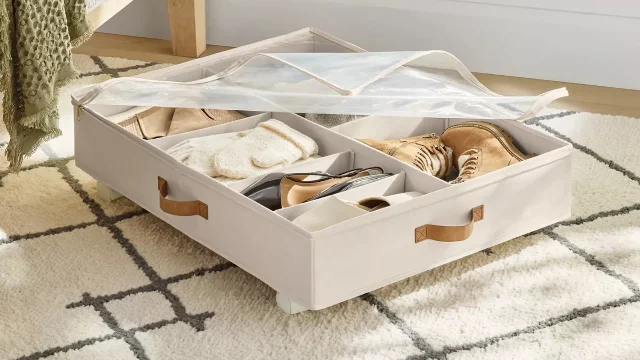
| Rolling underbed bin with adjustable dividers, Brightroom | 2 | $25.00 each | 28.75 in L × 7.08 in H × 22.88 in W, polyester canvas over an iron frame, clear flap top with a two-way zipper, twelve adjustable dividers, casters. 1 |
| Riser upgrade: risers for a heavier frame, 4-pack, Homeitusa | 1 set, when the frame carries more or has a center leg | $19.99 (reg. $29.99) | Adds 5.25 in of height, with a one-inch lip that holds a post or a caster; platform beds are named as a fit. The product highlights state no load rating. 3 |
| Flat under-bed box, 28 qt, Brightroom | 2, when the gap is already there | $6.00 each | 22 7/8 in × 16 5/8 in × 6 in outside, clear base, snap-on lid, stackable, listed as fitting neatly under a bed. 5 |
| Felt pads or furniture glides | 4 | $0–$6 | Worth adding only on hardwood, laminate, or vinyl plank, where a plastic base dragged across the floor leaves a mark. |
| Estimated total | $59 for the risers-and-rolling-bins setup, $21–$32 for risers plus flat boxes, $12–$50 if your bed already clears what you want to store | Comfortably under the $150 ceiling. |
Riser sets compared
All five sets are sold as four risers, except the adjustable one, which ships as eight cups that work alone or stacked. The cheapest two hold the leg in a cutout or behind a lip, which is the feature that keeps a bed from walking sideways; on the listings that do not describe one, check the product photos for a recessed top before you order.
| Set | Price | Lift | Load rating as listed | Check before buying |
|---|---|---|---|---|
| Bed Risers 4pk, Brightroom | $9.00 2 | 6 in high, 6 in wide, 6.5 in deep | Maximum weight 300 lb, without saying whether that is one riser or the set | Cutouts take square legs. The cheapest way to find out whether risers suit your frame. |
| 5 to 6-inch risers, 4-pack, Homeitusa | $19.99, reg. $29.99 3 | Adds 5.25 in | None stated | The one-inch lip suits a post or a caster; check your leg size against it. |
| 6-inch risers, set of 4, Kings Brand | $27.99, reg. $55.99 6 | 6 in; each 5.625 in × 5.625 in | Up to 800 lb | The strongest rating of the inexpensive sets. Hard plastic, and the cups nest for storage. |
| Adjustable risers, 8-piece set, Homeitusa | $34.99, reg. $49.99 4 | 3 in, 5 in, or 8 in from one set, by using the cups alone or stacked | Up to 1,300 lb total | The cup opening is 3 in × 3 in and 3/4 in deep. The listing says the base will not scratch or dent hardwood. |
| Bed risers with power outlets and USB, 4-pack, Brightroom | $40.00 7 | 5.5 in H × 6.3 in W × 6.3 in D | None stated | Puts two outlets, one USB-A port, and two USB-C ports at the bedside, which also puts a cord under the bed. See the safety notes. |
A queen frame with a center support leg needs six risers, so the $9 set covers it for $18. Keep every riser the same height, and stack two cups under one leg only where the maker designed the set to stack for use, as the adjustable set does. 4
Bins and boxes compared
| Container | Price | Outside size (L × H × W) | How it moves | What it holds |
|---|---|---|---|---|
| Rolling bin with adjustable dividers, Brightroom | $25.00 1 | 28.75 × 7.08 × 22.88 in | Four casters and a handle on each end | Twelve compartments under a zippered clear top: shoes, knitwear, cables, off-season gear |
| Clear box, 28 qt, Brightroom | $6.00 5 | 22 7/8 × 16 5/8 × 6 in | Slides on a smooth floor; the recessed lids let the boxes stack | One category per box, with a clear base so you can see what is inside |
| SKUBB storage case, IKEA | $12.99 8 | 35 ½ × 20 ¾ × 7 ½ in | Fabric, with carry handles; no wheels | Clothes and bedding, with ventilation in the sides |
| VARDÖ underbed storage box, IKEA | $39.99 9 | 25 5/8 × 27 1/2 in, 7 1/8 in high | Four castors on the base | A rigid box with a textile lid that fastens with poppers; it arrives flat and needs assembling |
The rolling bin and the VARDÖ box both stand about seven inches tall, so either sets the lift you need. The flat boxes are the option for a bed that already has a few inches of clearance; measure one against your own gap before buying two of them.
Bed and floor compatibility check
| Frame or floor | What to do | Renter note |
|---|---|---|
| Wooden frame with four square legs | The $9 set is molded for this: leg into the cutout, base flat on the floor. | Press down on each corner before loading anything. |
| Metal frame with round legs or casters | Use a set with a lip or a deep cup so the leg cannot walk out while somebody sits down. | Check the caster's full diameter against the cup, not just the stem. |
| Platform or storage bed with no legs | Skip the risers and buy flat boxes sized to the gap you already have. | This version touches nothing that could be damaged. |
| Queen or king frame with a center support leg | Buy six risers, all at the same height. | An unsupported center rail is the part that bends. |
| Headboard attached to the frame | Measure the wall gap before and after. | Raising the frame moves the headboard's contact point up the wall. |
| Bunk bed or loft bed | Leave it on the floor. | Beds somebody climbs to are built to their own standard. |
| A young child's bed | Leave it on the floor. | Federal rules treat a mattress foundation more than 30 in above the floor as a bunk bed; a raised low bed moves toward that class with no guardrail. 10 |
| Hardwood, laminate, or vinyl plank | Set each riser down in place rather than sliding the bed onto it, and add felt pads under the bases. | These are the contact points a move-out inspection could show. |
| Carpet or a rug | Keep all four legs on the same surface. | One leg on the rug and three on bare floor makes a bed that rocks. |
| Floor within 3 ft of a radiator or space heater | Move the bins and their contents out of that zone. 11 | Cloth in a bin is the part that burns. |
Build it in a Saturday
1. Photograph the floor and the wall
Shoot the floor under the bed and the wall behind the headboard in daylight, from an angle that shows the finish. Dated photos from before you start are the cleanest evidence you will have at move-out, and they take two minutes.
2. Measure the clearance, the footprint, and the floor contacts
Note the smallest clearance under the side rail, the widest point of each leg or caster, and how many points touch the floor. Compare those numbers with the listing before you order anything.
3. Empty the space and clean the floor
Clear out whatever lives under the bed now, then vacuum and wipe the floor and dry it. Under-bed air matters for what you store there: the moisture-control guidance for homes is to keep indoor humidity below 60 percent, ideally between 30 and 50 percent, and to dry damp areas before mold can take hold. 12 Check anything you pull out for damp before it goes back in.
4. Lift the frame one leg at a time
Pull the bed a few inches away from the wall first, so you have room to work behind it. Take the mattress off a queen or king, and bring a second pair of hands for anything larger than a twin. Lift one leg, set it on its riser, and move to the next.
5. Seat every leg in its cup
The leg goes inside the cup, and the whole base of the riser sits flat on the floor. If a leg rests on the rim instead of in the cutout, that riser is the wrong size for your frame.
6. Test the bed empty, then loaded
Press down hard on each corner, sit on the edge, then lie in the middle. Get up, walk around, and check that every cup is still under its leg and that nothing rocks.
7. Load the bins and roll them in
Fill each bin, roll it under the bed from the side you will reach it from, and leave a hand's width of gap at the wall so air can move. Test that each one rolls out without catching the bedding.
8. Sleep on it, then check again in the morning
A cup that shifted overnight, a new wobble, or a fresh mark on the floor means stop and re-seat everything before the bins go back.
Safety notes that matter here
- Federal rules draw the line at 30 inches: a bed whose mattress foundation sits more than 30 in above the floor is what the bunk-bed standard treats as a bunk bed, and lower bunks at 30 in or less are the ones it exempts from guardrails. 10 After the bed is up, measure from the floor to the top of the frame with the mattress off, and keep that number well short of 30. A frame that is already tall is the case for stopping at two or three inches of lift instead.
- Climb in and out the way you always have. Standing on a raised bed, or jumping onto it, loads a plastic cup in a way nobody tested.
- Use what is rated for the job. Bricks, paving stones, stacked books, and crates have no rated load and no cup to hold a leg in place.
- Stay inside the stated rating. The three inexpensive sets carry 300 lb, 800 lb, and 1,300 lb, and only the adjustable set says whether its figure covers the set or a single riser. 246 If a mattress, a box spring, and two sleepers come anywhere near the number, buy the set with the higher rating.
- Stack cups under one leg only where the set is built for it. The adjustable set is meant to be used that way; the rest nest for storage and take one cup per leg. 4
- Keep bins, boxes, and bedding at least 3 ft from radiators, space heaters, fireplaces, and candles. 11
- If you choose the risers with outlets, treat the cord as part of the project. Extension cords are meant for temporary wiring, should not run through doorways or across a walking route, and should not be plugged into another cord or power strip. 13
- Keep the gap at the wall open so air can move under the bed, and check the floor and the boxes after a wet season. 12
Renter notes: wall, landlord, and deposit risk
Wall condition: untouched, with one exception worth photographing. A headboard attached to the frame rises with the bed, so its contact point moves up the wall and can press or scuff where it did not before. Shoot behind the headboard before and after.
The surfaces at risk here are the floor and the frame. Four riser bases and four casters under each bin are what meet the apartment. A plastic base dragged across a wood floor leaves a scuff, and a caster rolling over grit does the same. Set risers down in place, lift the bed rather than sliding it, and add felt pads wherever the floor is hard.
Landlord communication: risers and bins count as ordinary furniture, and this project changes nothing about the unit. A short note still helps, because a bed standing noticeably higher is the kind of thing a manager notices on a maintenance visit.
Hi — I added bed risers under my bed frame and a couple of rolling storage bins underneath. The risers sit on the floor, nothing is fastened to the walls or the frame, and both come with me when I move out.
Deposit protection checklist: photograph the floor under the bed, the wall behind the headboard, and each frame leg before and after. Note the marks and scratches that were already there, and keep your move-in inspection report with those notes.
Move-out removal
- Roll the bins out and empty them.
- Take the mattress off if the frame is light, then lift one leg at a time out of its riser. A queen or king frame goes back down faster with two people.
- Wipe each riser base and check the floor against your starting photo.
- Check the wall behind the headboard the same way.
- Vacuum the floor under the bed and wipe it, so the space is cleaner than you found it.
- Nest the risers the way they shipped, pack the bins with their dividers and casters, and keep the set for the next apartment.
Is this the right Saturday project for you?
This project suits a renter with a small bedroom, a frame on four legs, and a closet that is already full: off-season clothes, shoes, luggage, and spare bedding move out of sight for the price of a dinner out. It suits a first apartment or a dorm room too, where a $9 set of risers is a cheap experiment before any real spending.
Choose flat boxes and skip the risers when the bed rests flat on the floor, when the frame is a bunk or a loft, or when the person sleeping there would struggle with a higher mattress. A lease that forbids altering fixtures leaves this project untouched, because every surface in the apartment stays where it is.
Next Saturday
Next Saturday's project takes the same approach to the kitchen: a no-drill under-sink storage reset using tension rods and stackable bins, starting with the pipe, drain, and leak checks that decide what can live under there at all.
References
- 1
- 2Bed Risers 4pk, Brightroom at Target
target.com
- 3
- 4
- 5
- 6
- 7
- 8
- 9
- 10
- 11Heating Fire Safety, USFA
usfa.fema.gov
- 12
- 13
This story was produced automatically by a channel. One sentence is all it takes for Neodrop to keep producing for you.