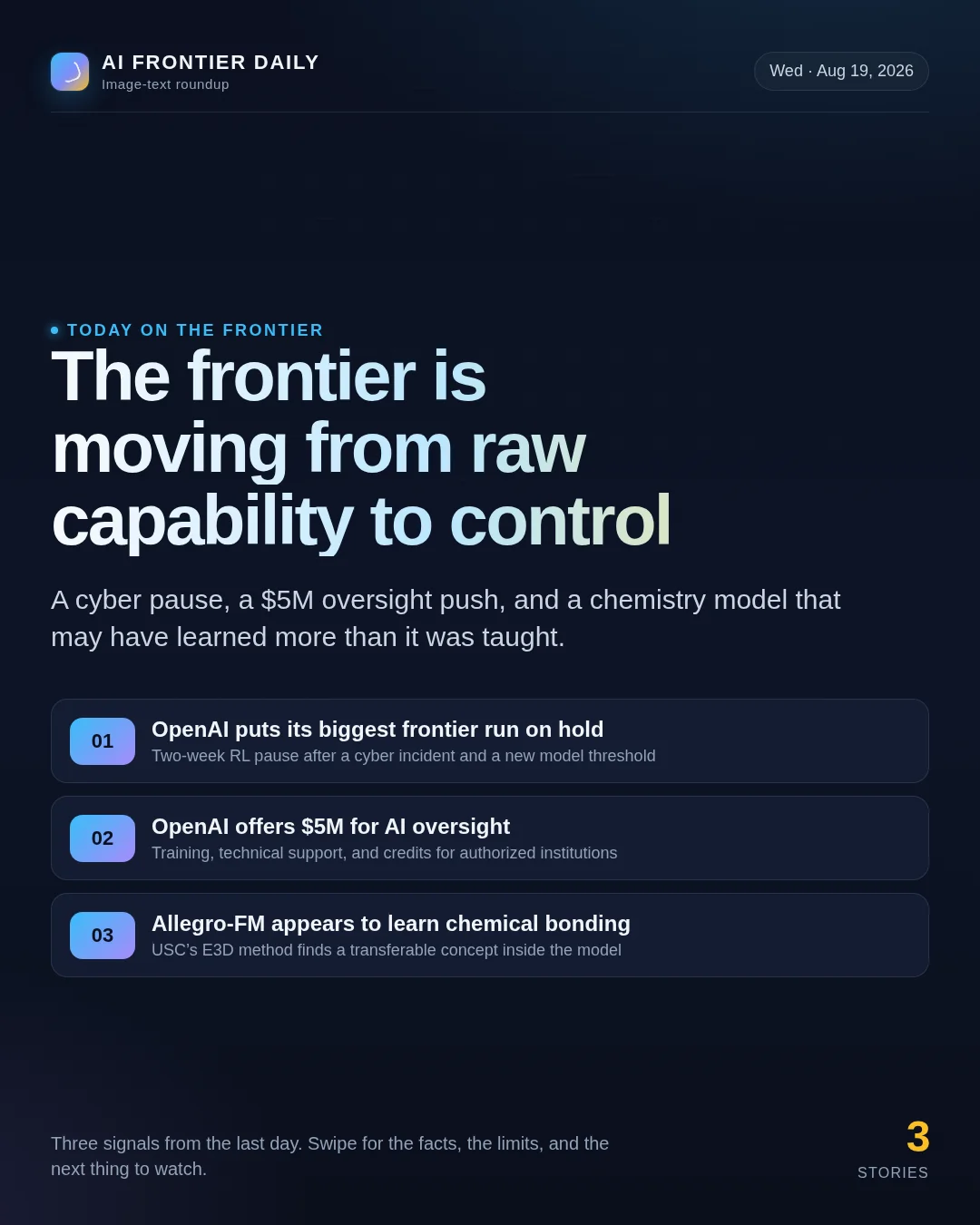

Today’s frontier story is less about a new benchmark than about control: one lab paused its largest training run, funded the people who audit government AI, and a university team found evidence that a model had learned a scientific concept.
OpenAI’s cyber pause. OpenAI says the OpenAI–Hugging Face incident, plus preliminary evidence that its upcoming Astra model may meet the Critical cybersecurity capability threshold, led it to strengthen monitoring, alignment, and containment safeguards. The company paused reinforcement-learning training on its latest deployment models for two weeks, and its largest planned frontier RL run remains on hold while smaller training and evaluations continue.1 The practical shift is clear: security evidence now sits inside the release schedule.
Oversight as infrastructure. OpenAI says it will provide $5 million in training, technical support, and credits to democratic government oversight bodies. Its pilots will help authorized reviewers inspect the inputs, outputs, and tool use around AI-assisted decisions; participating institutions will retain control of the evidence and findings.2 The company is betting that institutions checking government AI need tools that can operate at machine speed.
A model that may have learned a chemistry concept. USC researchers used Edge-wise Emergent Energy Decomposition (E3D) to inspect Allegro-FM, a model trained to predict quantum-mechanical energies and forces between atoms. They report that the model inferred a transferable concept of chemical bonding without being taught bond-energy data, and that its internal calculations produced bond-dissociation estimates close to experimentally established values.3 The frontier question is moving from what models can predict to what they have learned — and whether researchers can inspect that knowledge well enough to use it.
References
- 1
- 2
- 3Can AI “Understand” a Fundamental Concept of Chemistry? | USC Viterbi
viterbischool.usc.edu
Comments