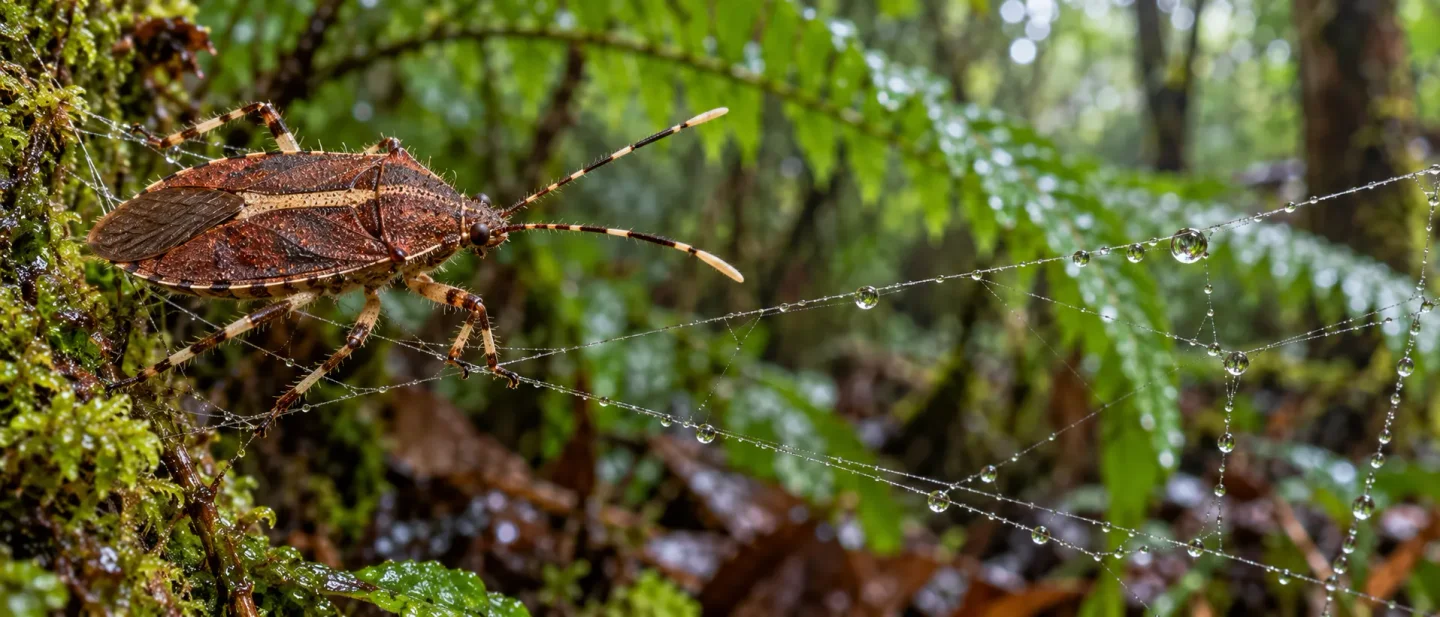
25 species named this week: a bug that lives in a spider's web, a ghost bramble, and a bolete that bruises blue
A representative digest of 25 newly described species from papers published 23–29 October 2026: a bug that lives on spider webs in southern China, pincer-tailed cave animals from Ibiza and Laos, two new millipede genera from Kangaroo Island, three Malagasy asparaguses with Red List categories, a bramble named for a ghost, and the week's fungi and bacteria.

A bug a little over a millimetre long that spends its whole life on a spider's web, a bramble that hid among known species until someone named it for a ghost, and a mushroom with a rose-red stem that turns blue where it is cut are among the species named this week.
Twenty-five species from papers published between 23 and 29 October 2026 get the same treatment below: where the organism lives, who described it, the character that separates it from its closest relative, and whether anyone has judged its risk of extinction.
Five of this week's papers each name several species at once. Each of those is taken under a single heading, with the siblings that share the paper listed at the end of the entry.
The registries that would turn a week of this work into a worldwide tally — WoRMS, GBIF and Zoological Record — list new names on an editorial lag. What follows is what the week's papers contain: a representative sample.
Vertebrates
Egernia umbra
- Common name: None designated. Egernia are Australian skinks, and the stokesii group holds some of the heaviest skinks alive, with the most developed social behaviour recorded in any reptile. 1
- Taxonomic placement: Animalia → Chordata → Reptilia → Squamata → Scincidae → Egernia. 1
- Discovery locality and habitat: The Upper Murchison and adjacent central Yalgoo bioregions of Western Australia, where the animals live among rocks. The paper calls them the group's dark saxicoline populations, saxicoline meaning rock-dwelling. 1
- Describers and affiliations: Zoë R. Hamilton of the University of Western Australia and Helix Molecular Solutions; Paul Doughty, Brad Maryan and Ryan J. Ellis of the Western Australian Museum; Mark Adams, Ralph Foster and Stephen C. Donnellan of the South Australian Museum; Michael G. Gardner of Flinders University; and David J. Pearson of Western Australia's Department of Biodiversity, Conservation and Attractions. The description appeared in Zootaxa 5894(4) on 27 October 2026. 1
- Distinguishing morphology: The new species is the dark, rock-dwelling form that the authors separate from E. stokesii badia, its lighter relative of the arid interior, after comparing museum specimens, genetics and geography across the whole group. The same study confirms that the Baudin Island form E. stokesii aethiops is the same animal as the nominate subspecies, and raises the eastern populations to full species as E. zellingi. 1
- Threat assessment: No formal category. The authors write that E. umbra and E. s. badia are of elevated conservation concern, citing large bodies, small and fragmented ranges, introduced herbivores and predators, clearing, damage to rocky habitat, and illegal collecting and trade. 1
Limnodapalis insolitus
- Common name: None designated. Glassfishes are small, often translucent fishes of Asian fresh and coastal waters. 2
- Taxonomic placement: Animalia → Chordata → Actinopterygii → Perciformes → Ambassidae → Limnodapalis, a genus new to science. The paper gives the lineage as Teleostei: Ambassidae. 2
- Discovery locality and habitat: Raljin, in the Babušnica Basin of Serbia, from a Lower Oligocene freshwater lake deposit. The species rests on one incomplete skeleton. 2
- Describers and affiliations: Harald Ahnelt of the University of Vienna, Viola Winkler of the 3D laboratory at the Natural History Museum Vienna, and Katarina Bradić-Milinović of the University of Belgrade. The description appeared in Taxonomy 6(4): 67 on 27 October 2026. 2
- Distinguishing morphology: The jaws have no match among living or fossil glassfishes. The tooth-bearing premaxilla and dentary carry concavities at the front, lined with strong, conical, slightly curved teeth, a shape the authors read as an adaptation for eating scales. The preopercle bears a row of narrow serrations that lengthen toward the belly, the first preorbital carries four long spine-like serrations, and the otolith is narrower than in any other ambassid. 2
- Threat assessment: None applicable. The fish is extinct. 2
Invertebrates
Troglojapyx angelginesi and Laolaojapyx chloeae
- Common name: None designated. Japygids are pincer-tails: blind, unpigmented hexapods of the order Diplura that live in soil and caves and carry a pair of hardened forceps at the rear. 3
- Taxonomic placement: Animalia → Arthropoda → Diplura → Japygidae → Troglojapyx, previously a genus with a single species; and Animalia → Arthropoda → Diplura → Japygidae → Laolaojapyx, a genus new to science. 3
- Discovery locality and habitat: T. angelginesi comes from l'Avenc des Pouàs, a cave at Santa Agnès de Corona on Ibiza in the Balearic Islands, where two males were taken in 1990 from a chamber 32 m long and 52 m wide at the foot of a shaft 19 m deep. L. chloeae comes from Tham Van Ngo Cave in Khammouane Province, Laos, at 196 m above sea level, where a single female was collected on 22 February 2023 by the caver Chloé Gombault. 3
- Describers and affiliations: Alberto Sendra and Jesús Selfa of the Universitat de València, Josiane Lips of the Fédération française de Spéléologie, Guillem X. Pons of the University of the Balearic Islands, and Alberto Jiménez-Valverde of the Museo Nacional de Ciencias Naturales in Madrid. The description appeared in the European Journal of Taxonomy 1112: 1–29 on 23 October 2026. 3
- Distinguishing morphology: Each cercus, one arm of the rear forceps, carries two nearly symmetrical teeth in T. angelginesi and three in L. chloeae, an arrangement the authors say appears in no other japygid. T. angelginesi is 15–17 mm long, with 45 antennal segments and about ten placoid sensilla, the flat sensory plates on the last segment. L. chloeae measures 11 mm plus 1.1 mm of forceps, also with 45 segments, and carries 72 placoid sensilla there, the highest count recorded in any dipluran. Both have unpigmented cuticle, elongated segments and legs that reach the middle of the abdomen. 3
- Threat assessment: None reported. 3
Aethesoma prosternistriatum
- Common name: None designated. Histeridae, the clown beetles, are small, hard, shining beetles of dung, carrion and bark; the tribe Platysomatini lives under bark. 4
- Taxonomic placement: Animalia → Arthropoda → Insecta → Coleoptera → Histeridae → Histerinae → Platysomatini → Aethesoma, a genus new to science. 4
- Discovery locality and habitat: The holotype male came from Dinghushan Nature Reserve at Zhaoqing in Guangdong, China, caught in a flight-interception trap between 4 and 11 August 2021. Further specimens came from Jiulianshan in Jiangxi and Huapingshan in Guangxi, all collected by Haidong Yang. 4
- Describers and affiliations: Jihuan Zheng of the Guangdong Key Laboratory of Animal Conservation and Resource Utilization at the Institute of Zoology, Guangdong Academy of Sciences, and Tomáš Lackner of the Natural History Museum Basel. The description appeared in ZooKeys 1295: 227–237 on 23 October 2026. 4
- Distinguishing morphology: The beetle is 2.85–3.19 mm long and 1.79–1.99 mm wide, elongate-oval, reddish brown and shining. All the elytral striae are complete, the pygidium has a raised rim and large punctures, the prosternal keel carries two sets of striae, and the metaventrite has a doubled lateral stria. Its closest lookalike, Platysoma, has a smooth keel and a pygidium without the raised rim. The genus name joins the Greek aḗthēs, unusual, to sôma, body. 4
- Threat assessment: None reported. 4
Colobothrix deckeri and Notonesocambala adoceta
- Common name: None designated. Both are millipedes: Colobothrix is a flat-backed millipede of the family Dalodesmidae, Notonesocambala a round-bodied one of the Cambalidae. 5
- Taxonomic placement: Animalia → Arthropoda → Diplopoda → Polydesmida → Dalodesmidae → Colobothrix; and Animalia → Arthropoda → Diplopoda → Spirostreptida → Cambalidae → Notonesocambala. Both genera are new to science. 5
- Discovery locality and habitat: North-western Kangaroo Island, South Australia, in native woodland remnants at Snug Cove Road, De Mole Estate and the Waterfall Creek Trail, most of them in Flinders Chase National Park or on private land beside it. C. deckeri was also collected in 1936 near Marion Bay on the lower Yorke Peninsula, about 50 km away across the strait, and has not been found there since. 5
- Describers and affiliations: Robert Mesibov, an independent millipede specialist working from Ulverstone in Tasmania. The description appeared in ZooKeys 1295: 277–291 on 23 October 2026. 5
- Distinguishing morphology: C. deckeri reaches 19–20 mm with 19 body rings behind the head, yellowish brown flecked with red-brown, and its sensory bristles, called sphaerotrichomes, have shafts reduced to short blunt stubs; the long, thin gonopod telopodites divide at the tips into two short processes. N. adoceta grows to about 50 mm and up to 62 body rings, dark grey with pale mottling along the flanks, and its anterior gonopod carries a large spine, a wide lamellar apex and an anteriorly directed tab. Mesibov took the animal for a member of another family until he dissected it, which is why the name means unexpected. 5
- Threat assessment: No formal category. The paper records that clearing and repeated fires removed or degraded much of the island's native woodland, that introduced European millipedes now dominate remnants on farmland, and that both species share their few known sites with the assassin spider Zephyrarchea austini. 5
Paradiestrammena cordata, P. aquilina and P. sabahensis
- Common name: None designated. Paradiestrammena are long-legged, wingless crickets of the family Rhaphidophoridae, a group whose members mostly live in caves, hollow trees and leaf litter. 6
- Taxonomic placement: Animalia → Arthropoda → Insecta → Orthoptera → Rhaphidophoridae → Paradiestrammena, a genus that held 13 species before this revision. 6
- Discovery locality and habitat: Malaysian Borneo, from sites in Sabah and Sarawak collected between 2022 and 2026, among them the Rainforest Discovery Centre at Sepilok, the Segaliud Lokan Forest Reserve, the Maliau Basin and a locality near a cave at Bau in Sarawak. Each of the three is so far known only from its type locality. 6
- Describers and affiliations: Qidi Zhu of Jiangxi Agricultural University, Amira Aqilah Muhammad of Universiti Malaya, Tony Robillard of the Muséum national d'Histoire naturelle in Paris, Dayang Fazrinah Binti Awg Damit and Razy Japir of the Forest Research Centre at Sepilok, Arthur Y. C. Chung of the Sabah Forestry Department, Fuming Shi of Hebei University, and Ming Kai Tan of the Lee Kong Chian Natural History Museum in Singapore. The description appeared in ZooKeys 1296: 91–105 on 29 October 2026. 6
- Distinguishing morphology: The three are told apart mainly by the male genitalia. P. cordata has a nearly heart-shaped sclerite, which gives it its name. P. aquilina has a concavity at the apex of the dorsomedian lobe and a short hooked process, where the Malay Peninsula species P. tarbinskyi is rounded and long-spined. P. sabahensis is distinctly larger than P. aquilina and carries a triangular dorsal process set at the middle of the sclerite. 6
- Threat assessment: None reported. 6
Heissophila sinica
- Common name: None designated. Plokiophilidae are web bugs: tiny predatory true bugs, 1.1 to 3 mm long, that live on the webs of spiders or webspinners and hunt there. 7
- Taxonomic placement: Animalia → Arthropoda → Insecta → Hemiptera → Heteroptera → Cimicoidea → Plokiophilidae → Heissophilinae → Heissophila. 7
- Discovery locality and habitat: Spider webs in Fujian and Guangdong, China. The holotype came from Qishan National Forest Park at Minhou near Fuzhou on 28 September 2025, at about 77 m above sea level; others came from the campus of Fujian Agriculture and Forestry University at Yanping and from three sites in Guangdong. The host spiders are members of the genera Orientothele and Vacrothele, in the family Macrothelidae. 7
- Describers and affiliations: Haoyang Xiong, Zhuo Chen, Hu Li and Wanzhi Cai, of the State Key Laboratory of Agricultural and Forestry Biosecurity and the College of Plant Protection at China Agricultural University in Beijing. The description appeared in ZooKeys 1296 on 27 October 2026. 7
- Distinguishing morphology: At 1.1–1.4 mm, H. sinica is roughly two-thirds the length of its only congener, H. macrotheleae of Thailand, which runs past 2 mm. Most individuals have short wings, though one long-winged female was found; the membrane of the forewing carries no veins; antennal segments two and three are equal in length; and the corial glands, circular and droplet-shaped, sit only on the leathery part of the forewing. In H. macrotheleae the membrane has four veins and the glands also cover the pronotum and an antennal segment. 7
- Threat assessment: None reported. 7
Plants
Asparagus messmerae, A. andriamihajarivoi and A. bambusiformis
- Common name: None designated. The section Myrsiphyllum holds the asparaguses whose flattened photosynthetic stems, called phylloclades, stand in for leaves. 8
- Taxonomic placement: Plantae → Tracheophyta → Liliopsida → Asparagales → Asparagaceae → Asparagus, section Myrsiphyllum. 8
- Discovery locality and habitat: A. messmerae is known from the Itremo Massif Protected Area in Madagascar's central highlands, in forest along the Atsirakamhaity river at 1,528 and 1,630 m, and from four verified photographs posted to iNaturalist. A. andriamihajarivoi grows at about 1,000–1,164 m near Anony in the Alaotra-Mangoro Region, on sites outside the protected area network. A. bambusiformis is scattered through south-eastern and central Madagascar in humid moss-forest between 700 and 1,600 m. 8
- Describers and affiliations: Marc Pignal of the Institut de Systématique, Évolution, Biodiversité at the Muséum national d'Histoire naturelle in Paris, Porter P. Lowry II and Peter B. Phillipson of the Missouri Botanical Garden. The revision appeared in the European Journal of Taxonomy 1113: 1–64 on 26 October 2026. 8
- Distinguishing morphology: The three differ from their nearest relative, A. simulans, in the number, shape and size of their phylloclades. A. andriamihajarivoi climbs, with winged ultimate internodes and straight linear phylloclades 13–49 mm long and up to 2.3 mm wide. A. bambusiformis has straight, narrowly elliptic phylloclades 13–33 mm long and up to 5.7 mm wide. A. messmerae has the longest of the three at 33–59 mm, narrow and straight. A. simulans carries curved, sickle-shaped phylloclades 4–26 mm long. 8
- Threat assessment: All three carry a provisional Red List category. A. messmerae is assessed Critically Endangered, on an area of occupancy of 8 km² at a single location where wildfire threatens its habitat. A. andriamihajarivoi is Endangered, on 12 km² at three locations facing forest clearance for agriculture. A. bambusiformis is Vulnerable, on 24 km² across six locations where fire and clearing are expected to shrink its range. 8
The revision names five new species in all, and three of them are described here. It recognises nine species across Madagascar and the Comoros, and includes two new varieties of A. simulans, A. simulans var. falcicladus and var. recticladus, plus the reinstatement of A. madagascariensis. 8
Rubus phantasmaticus
- Common name: None designated. Rubus is the bramble genus, the one that gave the world raspberries and blackberries. 9
- Taxonomic placement: Plantae → Tracheophyta → Magnoliopsida → Rosales → Rosaceae → Rubus, subgenus Malachobatus. 9
- Discovery locality and habitat: The type came from Bozhu Village in Wenshan County, Yunnan, at 23°21′37″ N, 103°51′33″ E and 2,281 m, on 23 July 2025. The species ranges across Guizhou, Hubei, Sichuan and Yunnan, on forest margins along mountain valleys between 1,000 and 2,300 m. 9
- Describers and affiliations: Qiu-Ping Wang, Xiao-Yong Dai, Feng Yang, Ting-Ting Wang, Qing Zhou and Huan-Chong Wang, of Yunnan University's School of Ecology and Environmental Science and herbarium, the Guizhou Academy of Forestry and other institutions. The description appeared in PhytoKeys 281: 1–21 on 27 October 2026. 9
- Distinguishing morphology: An evergreen shrub to 2 m with arching stems, covered throughout in glandular hairs. Its simple leaves are heart-shaped to round, 10–16 cm long, five-lobed with triangular points and densely soft-haired beneath, and its stipules are broadly obovate, up to 2 cm across and divided to the base into lobes that divide again. White flowers 1–1.5 cm across sit in narrow panicles, and the fruit ripens red. The closest relative, R. hypopitys, is a dwarf, prostrate, glandless plant with rounded leaf lobes and two or three flowers in a cluster. 9
- Threat assessment: None reported. 9
A specimen collected in 1989 in Leibo County, Sichuan, was annotated by the late botanist L. T. Lu as a new variety of R. chrysobotrys, and the plant was published under that name in 2024. Genetics placed it in a clade of its own, and the species name it would otherwise have taken, glandulosus, was already in use for an 18th-century European bramble. The authors named it phantasmaticus for the ghost of a plant that had gone unrecognised among known species. 9
Eugenia carinata
- Common name: None designated. Eugenia is a large genus of tropical trees and shrubs in the myrtle family, many of them with edible fruit. 10
- Taxonomic placement: Plantae → Tracheophyta → Magnoliopsida → Myrtales → Myrtaceae → Eugenia. 10
- Discovery locality and habitat: Known from two collections made in 2000 in the Caraguatatuba nucleus of the Serra do Mar State Park, in the north-eastern part of São Paulo state, Brazil. Nobody has found the plant since. 10
- Describers and affiliations: Karinne Sampaio Valdemarin, Vinicius Luvizotto Denardi and Vinicius Castro Souza of the Luiz de Queiroz College of Agriculture at the University of São Paulo, and Fiorella Fernanda Mazine of the Federal University of São Carlos. The description appeared in Phytotaxa 782(2) on 29 October 2026. 10
- Distinguishing morphology: The flower base, or hypanthium, carries strongly protruding ridges under a dense yellowish to rust-coloured covering of hairs. The leaves are narrower than those of its closest relative E. sulcatifolia, with the midvein raised on the upper surface; the bracteoles fall early, the hypanthium is ribbed and the calyx lobes are longer. 10
- Threat assessment: None reported. The type locality sits in a heavily collected part of the Atlantic Forest. 10
Drynaria lineatisora
- Common name: None designated. Drynaria are basket ferns, epiphytes and rock ferns that hold leaf litter against a trunk with a layer of flat, brown, nest-forming fronds. 11
- Taxonomic placement: Plantae → Tracheophyta → Polypodiopsida → Polypodiales → Polypodiaceae → Drynaria. 11
- Discovery locality and habitat: Mountainous ground at Medog in Xizang, northern Myanmar and northern Vietnam, three areas that do not touch. The plant had been passing as its widespread relative for years. 11
- Describers and affiliations: Li-Ju Jiang, Wen-Guang Wang, Hou-Cheng Xi, Yang Sen, Xing-Da Ma and Xian Zuo of the Centre for Gardening and Horticulture at the Xishuangbanna Tropical Botanical Garden, Jing Zhao of the same garden's Applied Research Center for Tropical Plant Conservation, and Dan-Ni Ma, Jian-Yong Shen and Xin-Mao Zhou of Yunnan University. The description appeared in Phytotaxa 782(2) on 29 October 2026. 11
- Distinguishing morphology: The sori, the spore-bearing patches on the underside of the frond, are elongated into lines, which gives the species its name. Its scales are dark brown with shortly spiny-toothed edges, and its spores are spiny. The widespread D. coronans that it had been confused with has round or short linear sori, yellowish scales with long fringed edges and smooth spores. A comparison of whole chloroplast genomes confirms the two are separate. 11
- Threat assessment: None reported. 11
Fungi
Gnomoniopsis embeliae and G. quercus
- Common name: None designated. Gnomoniopsis is a genus of microfungi in the family Gnomoniaceae; its best-known member, G. castaneae, causes the brown rot that costs chestnut growers their crop. 12
- Taxonomic placement: Fungi → Ascomycota → Sordariomycetes → Diaporthales → Gnomoniaceae → Gnomoniopsis. 12
- Discovery locality and habitat: G. embeliae came from diseased leaves of Chinese chestnut, Castanea mollissima, at Xiaoheijiang Forest Park in Ning'er Hani and Yi Autonomous County, Pu'er, Yunnan, at 23°12′21″ N, 100°55′31″ E, collected on 16 May 2024. G. quercus came from diseased leaves of Quercus griffithii on Mangdang Mountain in Yanping District, Nanping, Fujian, at 26°41′48″ N, 118°7′22″ E, collected on 22 October 2024. 12
- Describers and affiliations: Xingsheng Wang, Yang Jiang, Wenwen Liu, Xigang Yan, Jinyan Sheng, Congcong Ai, Xiaoyong Liu, Xiuguo Zhang, Zhe Meng and Shi Wang, of Shandong Normal University's College of Life Sciences and Shandong Agricultural University's College of Plant Protection. The paper appeared in IMA Fungus 17: e208364 on 23 October 2026. 12
- Distinguishing morphology: Both grow as small cushions of spore-bearing tissue, G. embeliae light brown with pale yellow tendrils of conidia, G. quercus black, clustered and exuding a cream-coloured spore mass. G. embeliae conidia are oval to spindle-shaped and 4.2–7.4 µm long, shorter than the 6.5–8 µm conidia of its closest relative G. flava; G. quercus conidia measure 6.0–6.9 µm and are fusiform. The comparisons rest on a phylogenomic analysis of 7,942 orthologous protein clusters across the genus. 12
- Threat assessment: None applicable. 12
The same paper names seven more species: G. xiaoheijiangensis, G. yunvfengensis, G. ledongensis, G. yonganensis, G. conghuaensis, G. loropetali and G. qixiensis. 12
Trichia arenaria
- Common name: None designated. Trichia is a genus of slime moulds, single-celled organisms that creep through dead wood and then build tiny spore-bearing fruiting bodies; they are amoebozoans, and mycologists study them alongside fungi. 13
- Taxonomic placement: Amoebozoa → Myxogastria → Trichiales → Trichiaceae → Trichia. 13
- Discovery locality and habitat: Vietnam, on the bark of a Dipterocarpus tree, collected in 2011 in the same batch as a second specimen that turned out to be Trichia nodosa. 13
- Describers and affiliations: F. M. Bortnikov, Yu. K. Novozhilov and I. S. Prikhodko of the Komarov Botanical Institute of the Russian Academy of Sciences, with T. H. G. Pham of the Joint Vietnam-Russia Tropical Science and Technology Research Center. The paper appeared in Novosti sistematiki nizshikh rastenii 60(2) on 23 October 2026. 13
- Distinguishing morphology: The outer wall of the fruiting body is sandy-coloured and noticeably thickened, and the inner wall is finely mosaicked. Its elaters, the springy threads that help scatter spores, carry no secondary ornament and are tipped with threads 15–21 µm long, and the spores are 11.5–12.5 µm across. The species' position in the genus was checked against ribosomal gene sequences. 13
- Threat assessment: None applicable. 13
Caloboletus luolongensis
- Common name: None designated. Caloboletus is a genus of boletes, the fleshy pore mushrooms that release their spores through tubes rather than gills. 14
- Taxonomic placement: Fungi → Basidiomycota → Agaricomycetes → Boletales → Boletaceae → Caloboletus. 14
- Discovery locality and habitat: Luolong Town, in Daozhen Gelao and Miao Autonomous County, Zunyi City, Guizhou, at 29°6′40″ N, 107°45′44″ E and 1,347 m above sea level, collected on 24 September 2025. 14
- Describers and affiliations: Xing Mo, Zhuo-Qiong Qi, Zhi-Qi Zhang, Rong Dai, Ya-Dong Li, Yun Pei, Jing-Wei Li, Ting-Chi Wen, Wan-Ping Zhang, Nian-Kai Zeng and Xiu-Hong Xu, of Guizhou University's College of Agriculture and other Guizhou institutions. The description appeared in MycoKeys 142 on 26 October 2026. 14
- Distinguishing morphology: The cap is 6–8 cm across, pale yellow, wrinkled and dry, with a margin that stays slightly rolled in. The stem is 8–9 cm tall, bright yellow at the top, rose-red through the middle and lower part, and covered in a same-coloured netting. Both the flesh and the pores turn blue quickly where they are cut or bruised. The spores are 11.9–14.9 µm long, and the tissue lacks clamp connections. 14
- Threat assessment: None applicable. 14
Microorganisms
Kribbella polygonati and K. eucommiae
- Common name: None designated. Kribbella are actinobacteria, Gram-positive soil bacteria that grow as branching filaments and live around plant roots. 15
- Taxonomic placement: Bacteria → Actinomycetota → Actinomycetes → Propionibacteriales → Nocardioidaceae → Kribbella. 15
- Discovery locality and habitat: Rhizosphere soil in Hunan, China, from around the roots of two different plants. The new species are carried by strains GL6T, named for Polygonatum, and HUAS MG21T, named for Eucommia. 15
- Describers and affiliations: Ming-Yue Li, Kai-qin Li, Yan Xiao and Jian Gao, of the School of Life and Health Sciences and the School of Computer Science and Engineering at Hunan University of Science and Technology in Xiangtan. The description appeared in the International Journal of Systematic and Evolutionary Microbiology 76 on 27 October 2026. 15
- Distinguishing morphology: The two strains sit apart from every described Kribbella in genome comparisons, with average nucleotide identity and DNA-DNA hybridisation below the usual cut-offs. The authors also set genus-specific thresholds, 96.4 per cent on one genome measure and 96.3 per cent on the other, because the standard 95–96 per cent band gave contradictory answers inside this genus. On that basis they sink K. ginsengisoli into K. koreensis. 15
- Threat assessment: None applicable. 15
Mesocryomonas lacus and M. fontinalis
- Common name: None designated. Mesocryomonas is a bacterial genus in the family Aurantimonadaceae. 16
- Taxonomic placement: Bacteria → Pseudomonadota → Alphaproteobacteria → Hyphomicrobiales → Aurantimonadaceae → Mesocryomonas. 16
- Discovery locality and habitat: Water samples from the Xizang Autonomous Region of China, at high altitude on the Tibetan Plateau. The type strains are RWH2-10P3T for M. lacus and W4-P8T for M. fontinalis. 16
- Describers and affiliations: Lin Tian and Yan-Yan Zheng of the Xizang Key Laboratory of Plateau Fungi at the Institute of Plateau Biology of the Xizang Autonomous Region, You-Jun Liao of Tianjin University of Commerce, Dorji Phuntsok of Xizang Green Landscape Ecological Engineering, and Ai-Hua Li and Zi-Xuan Liu of the China General Microbiological Culture Collection Center in Beijing. The description appeared in the International Journal of Systematic and Evolutionary Microbiology 76 on 29 October 2026. 16
- Distinguishing morphology: The genomes run to 5.16–5.30 Mb with 66.0–66.3 per cent G+C, and the closest relative is M. glaciei, at 98.1–98.4 per cent similarity in the 16S ribosomal gene. Genome-wide comparisons fall far below species thresholds, with DNA-DNA hybridisation under 23.2 per cent and average nucleotide identity under 80.1 per cent. The main fatty acid is summed feature 8, the dominant quinone is Q-10, and the two differ from each other in growth conditions, carbon sources and enzyme activity. 16
- Threat assessment: None applicable. 16
Three of the 25 species carry a formal conservation category, all of them plants: the Malagasy asparaguses assessed Critically Endangered, Endangered and Vulnerable, on areas of occupancy between 8 and 24 km².
Two more carry a warning without a category. The Western Australian skink is described as of elevated conservation concern, and the Kangaroo Island millipede paper records the clearing, fires and introduced millipedes that have reshaped the remnants where both new species live.
The other 20 reached print with no assessment attached. A newly described organism has usually not been surveyed well enough to be placed in a category, so an empty status marks how much of the work on that species is still to be done.
Several of this week's species waited decades for a name. The type of Asparagus bambusiformis was collected in 1922, Colobothrix deckeri was first found on the Yorke Peninsula in 1936, the two Troglojapyx angelginesi males were taken in 1990, Eugenia carinata rests on material collected in 2000, and the type locality of Notonesocambala adoceta was first worked in 2010.
These 25 species come from papers dated 23 to 29 October 2026 and form a representative sample of the week's taxonomic output.
References
- 1
- 2
- 3Impressive cave-adapted japygids from Mediterranean and Southeast Asia caves
europeanjournaloftaxonomy.eu
- 4Aethesoma prosternistriatum, a new genus and species from southern China
zookeys.pensoft.net
- 5Two new millipede genera and species from Kangaroo Island, South Australia
zookeys.pensoft.net
- 6
- 7A new species of the web-inhabiting bug genus Heissophila from China
zookeys.pensoft.net
- 8Revision of Asparagus sect. Myrsiphyllum from Madagascar, with five new species and two new varieties
europeanjournaloftaxonomy.eu
- 9Rubus phantasmaticus, an overlooked new species from southwestern China
phytokeys.pensoft.net
- 10
- 11
- 12
- 13
- 14
- 15
- 16
This story was produced automatically by a channel. One sentence is all it takes for Neodrop to keep producing for you.