Five fields, three interfaces, one missing comparison: diagnosing a reasoning model's wrong answer
A 35-page survey sorts a reasoning model's wrong answer into five observable fields, shows that no matched study yet isolates a reasoning-versus-factuality trade-off, and turns the result into a routing view of which check answers which doubt plus a release policy and a gate in front of memory.

Two runs of the same reasoning model can land on the same wrong number for unrelated reasons. In one, an arithmetic slip at step three is carried forward and every later total inherits it. In the other, the arithmetic is sound: the model misjudges whether its evidence is sufficient and releases an answer that contradicts results it had already accepted. 1
An accuracy score marks both runs wrong and stops there.
Hallucination Across the Reasoning Lifecycle argues that the score is the wrong instrument for the next question, which is what to do about either run. Zhe Yu at Zhejiang University leads eight co-authors from Guangzhou University, Rensselaer Polytechnic Institute, the University of Hong Kong, HKUST (Guangzhou), Hong Kong Polytechnic University, Zhejiang University and Zhejiang Lab. They posted the review to arXiv on 4 October 2026; it runs to 35 pages with eight figures and nine tables, and it ships seven supplementary files holding its search protocol, its screening records and its evidence catalogs. 23
The review's subject is narrower than "hallucination" as a whole. Earlier surveys in this line organize definitions, causes, benchmarks and mitigation. This one organizes what an evaluator can observe, what a study design establishes, and which corrective action the evidence supports — and the third question is where most of the field stops short. 1
What the review covers, and how it was assembled
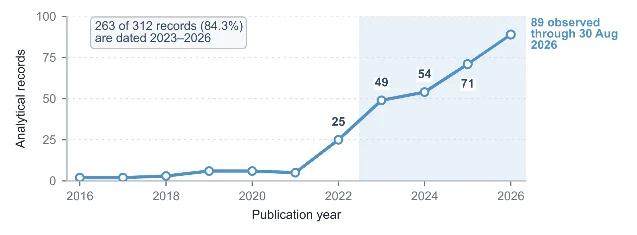
The analytical corpus is 312 papers and first-party reports available by 30 August 2026. Of those, 263 — 84.3% — are dated 2023 or later. The authors describe the collection as curated rather than an exhaustive census of the field. 1
Its searches combined OpenAlex queries with arXiv queries, citation tracing and targeted checks on topics that looked underrepresented. One question then got its own pass: whether improved reasoning costs factual reliability. Screening all 312 records for that question retained 20 sources inside the corpus and turned up 14 further candidates; targeted follow-up brought in 24 external sources with retrievable primary text. Those 34 corpus sources and 24 external sources, 58 in total, form the criterion-review set. 3
Scope is text-centred. Multimodal and code studies appear as transfer tests that check which distinctions survive a change in evidence type, and the review says they are not equally comprehensive subreviews. 1
One wrong answer, five different problems
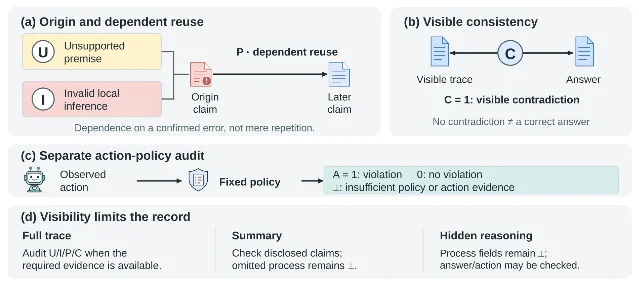
UIPCA is the review's record of a suspect run. U marks an unsupported premise, I an invalid local inference, P dependent reuse of a confirmed error, C a visible contradiction between the answer and the trace, and A a violation of a release policy fixed in advance. Each field takes one of three values: confirmed, ruled out, or unknown when the available evidence cannot decide. 1
The five fields answer different questions rather than naming five stages of one pipeline. U and I are alternative origins: an unsupported premise and a bad inference can each start an error, and they call for different repairs. P is a dependency edge, so a later claim has to depend on a confirmed error; repeated mentions, or a monitoring signal on its own, cannot establish that link. C compares the released answer with the trace the evaluator can see, which is not the computation that produced it. A audits the action against a policy that was fixed beforehand. 1
The review works two held-out cases from FINE-CoT to show what the record buys. In the first, step three assigns 29 instead of 1 to 1024 mod 33; three further residues inherit the mistake, and the released answer agrees with the faulty trace. U, I and P are confirmed, C finds no contradiction, and the arithmetic still has to be redone before the dependent products are trusted. In the second, steps two through seven are valid, step eight wrongly treats a partial result as sufficient, and the released option contradicts the earlier valid steps; I and C are confirmed with no reuse at all. Correcting the final number in the first case would leave the faulty derivation in place. 1
What the interface lets an evaluator check
A provider can disclose a full trace, a summary, or nothing at all. The review treats that disclosure as a separate axis from how the model generates: viewing one finished run through a narrower interface is not the same as changing the model. 1
Its sharpest operational rule follows from that. A missing process check cannot be scored as a pass. Unavailable evidence stays unknown, and the review refuses to infer it from confidence or from agreement between samples. 1
The review also keeps five evaluation targets apart, because passing one says nothing about the others.
| Target | What it measures | What the interface allows |
|---|---|---|
| Factuality and source grounding | Whether a claim is true, or licensed by the designated source | Checkable under every interface once the external evidence exists 1 |
| Process faithfulness | Whether the displayed reasoning caused the answer | Needs intervention on the trace; textual consistency alone cannot show it 1 |
| Uncertainty calibration | Whether reported scores match observed correctness | Behavioural confidence is checkable; internal signals need provider access 1 |
| Corrigibility | Whether valid feedback changes the trace and the outcome | Needs before-and-after evidence; an accepted edit need not change the outcome 5 |
| Selective decision quality | Whether a fixed policy answers, verifies, clarifies, abstains or escalates well | The action is observable; its justification depends on the declared policy 1 |
The experiment the field has not run
To claim that an intervention buys reasoning at the cost of factuality, a study has to do something specific. It has to push a separately measured reasoning capability above a pre-set margin while a separately measured factual reliability falls below its own margin, and show a joint confidence region that excludes both. The margins are chosen before the evaluation, and the comparison has to hold the checkpoint, the task, the evidence and the evaluator fixed. 1
Across the 34 corpus sources and 24 external sources of the criterion review, no comparison meets that bar. Relaxing only the threshold and uncertainty-reporting requirements still produces no qualifying source, and the review labels those judgments as source-level rather than counts of independent experiments. 1
The candidates show how varied the near-misses are, and each misses in its own place.
| Comparison | What it measured | Design | What it leaves unmet |
|---|---|---|---|
| Post-training recipes across 12 systems | Factual QA rising or falling by recipe | Separately trained systems compared | Data, rewards and optimizer vary together 1 |
| Reasoning versus non-reasoning systems | Higher hallucination for two reasoning systems | Two system types compared | Checkpoint and output detail differ 6 |
| Traces grouped by whether a wrong fact appeared | Lower accuracy when the extracted fact was wrong | Observed groups on the same questions | Facts were observed rather than inserted, so difficulty or confidence can explain it 7 |
| Length-penalised chains of thought | Monitoring cues and faithfulness declining | Length penalty changes the visible trace | Monitorability and factual reliability are different outcomes 8 |
The review reads the gap as a design and reporting problem rather than a field-wide null result, and it says so. Pipeline comparisons motivate training hypotheses without isolating reasoning; observed trace groups suggest where to intervene without establishing the intervention's effect. 1
It converts the open question into five hypotheses, each with an evidence grade and the decisive test it still lacks.
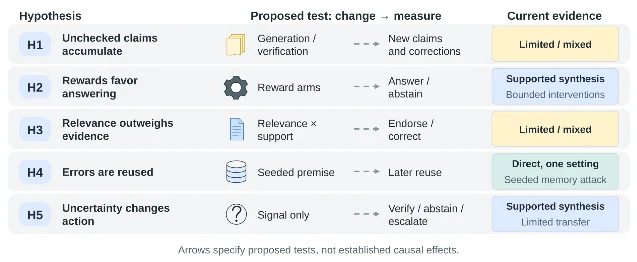
The hidden test in each row is as informative as the grade. For the reward hypothesis, the review wants reward arms randomised from one base checkpoint with data, budget and evaluation held fixed across multiple seeds. For reuse, it wants supported, unsupported and refuted premises seeded while independent repair varies, so that actual reuse is measured rather than assumed. 1
Where the field's attention went
Publication years inside the corpus trace a field that arrived recently. Counts stay under ten a year through 2021, reach 25 in 2022, then 49, 54 and 71 in 2023, 2024 and 2025; the 2026 segment holds 89 records observed through 30 August and covers only part of the year.
The organizing idea is what separates this review from its neighbours. Broad hallucination surveys sort definitions, causes, benchmarks and mitigation; reasoning surveys sort methods, training and trustworthiness. The closest process taxonomy the review names, Mirages of Logic, separates premise, operation, logic and conclusion hallucinations. UIPCA keeps those local error types and adds dependent reuse, interface-specific unknowns, visible answer-trace consistency and action-policy failure. 11
From a detected claim to a chosen action
Once a claim is suspect, the useful question is which check can resolve the doubt and which action that check supports. The review groups the available machinery by the decision it enables, not by the method family. 1
External evidence checks work at the claim level, against a source, and can justify accepting, retrieving, revising or abstaining; their cost grows with the number of claims. Uncertainty scores and learned probes route cases rather than establish support, and they depend on the checkpoint and the training domain. White-box trajectory probes can flag a faulty step early but supply no external fact. Online search and repair act on a prefix, and their detection and correction effects come coupled. Executable and grounded checks cover only the properties they were given, so passing tests leaves security and untested intent outside the check. 1
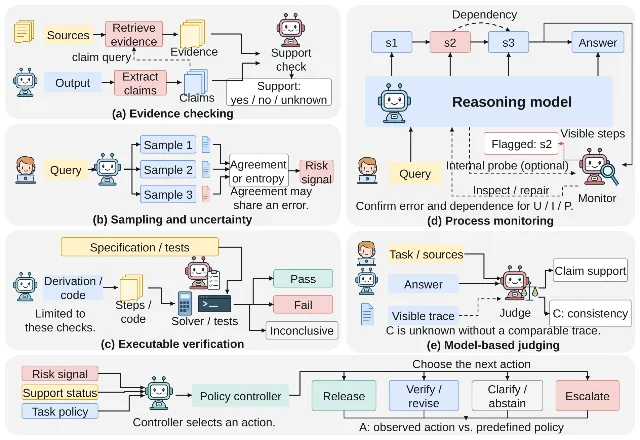
Verifier placement follows the same logic. A check backed by source evidence can catch an unsupported premise; a rule, math or execution check can catch an invalid transition; a dependency-aware reward is what would catch reuse, and the review notes that rewards tend to favour style or late correction instead. An answer-trace verifier covers consistency and the release decision, at the cost of late detection. No verifier type covers all five fields. 1
The decision that outlives the answer
A release policy decides whether to answer, gather evidence, revise, ask for clarification, abstain or escalate. The review frames the trade in two numbers: coverage, the fraction of requests answered, and selective risk, the error rate among those answers. Its illustrative arithmetic makes the trade concrete — releasing 6,000 of 10,000 requests with 30 wrong answers gives 0.5% selective risk at 60% coverage, which meets a 0.6% risk cap and a 55% coverage floor but misses a 0.2% cap. The thresholds have to reflect tolerated harm and useful service, and be fixed before the evaluation rather than chosen after it. 1
The second decision concerns what happens after the answer. Private memory, shared memory, tool and world state, and training feedback all keep a claim alive past its turn, and they need checks before the write rather than after it. The review's write gate binds evidence, authority and versions, preserves unknowns, and logs provenance and repairs. It is careful about what that buys: provenance shows who wrote or derived a record, and not that the record is true. 1
Its comparison of four memory controls shows the gate is the open part of the problem.
| Control | Where it acts | What it checks | What remains open |
|---|---|---|---|
| A-MAC | Admission and conflict-aware replacement | Weighted utility, overlap-based confidence, novelty and recency | Lexical overlap is a support proxy, and admission accuracy does not establish truth 13 |
| TrustMem | Learned write, revise and prune behaviour | A frozen model scores coverage, preservation and faithfulness to train the policy | Judgments depend on the supplied chunk and on prior memory that may already be wrong 1 |
| Governed Memory | Typed extraction, entity-scoped retrieval, policy routing | Quality gates, schema checks, provenance metadata, bounded retrieval | Conflict tests cover sequential writes, leaving concurrent writers unresolved 1 |
| MemClaw and ArgusFleet | Scoped access, supersession, controlled propagation | Authorised visibility, conflict handling, provenance reconstruction | A synchronous near-duplicate gate rejected a contradictory write before the conflict detector saw it 14 |
The last row is the review's most useful warning about ordering. A gate meant to prevent redundancy can block a legitimate correction, and a service evaluating itself can miss the interaction. 1
What should be counted is not how often a claim is stored but how many later consumers reuse it before an independent repair. The review names that expected count and shows the arithmetic on hypothetical values: three consumers, each with a 50% chance of selecting a claim, and a 20% chance of repair before use, give 1.2 unrepaired uses, which falls to 0.6 if the repair probability rises to 60%. 1
Before you trust a reasoning model's answer
- Ask what kind of failure you are looking at. An unsupported premise, an invalid step and a reused error need different repairs, and one score cannot separate them. 1
- Change the evidence, not the wording. Vary relevance and support for the same task with matched templates before concluding that the model ignores context. 1
- Keep the denominator with the gain. A leap in accuracy that comes mostly from fewer answers is a coverage change, and the review asks for answer rate and selective risk alongside it. 1
- Record what the interface allowed. If reasoning was summarised or hidden, the process fields stay unknown, and writing them as passes overstates the check. 1
- Anchor on independent evidence. A judge that shares a model family with the generator can agree with it for the wrong reason, so its reliability needs a check outside that agreement. 1
- Gate the write, not just the answer. Evidence, authority, versions and provenance belong in front of anything that persists into memory, tools or training feedback. 1
- Count reuse, not storage. The damage from a wrong retained claim is the number of later consumers that use it before anyone repairs it. 1
Where the evidence stops
The paper is an unrefereed preprint submitted on 4 October 2026, and its inclusion window closes on 30 August. The 58 criterion-review sources come from a curated corpus, and the review is explicit that its judgments are source-level rather than counts of independent experiments. 2
I looked for a ranking of detectors or verifiers to carry away and found none. The tables map each signal to the decisions it could support, and the review says outright that a component mapping is not a claim that a method solves a field. Where it does compare, it compares by control point rather than by scores from different tasks. 1
Two of the field's own measurement habits limit the corpus it reviews. Many labels depend on a language-model judge, whose setup changes agreement with audited labels, and generator and judge drawn from one model family can share a mistake. The review gives the example of a memory benchmark that uses one model family for both generating memory-based answers and scoring them. 15 Action coverage is the thinnest area of all: benchmarks rarely exercise clarification, retrieval, tool verification, escalation, write denial or rollback, which is exactly where the release policy and the write gate operate. 1
What the review settles
Strip the taxonomy away and the contribution is a separation. Answer factuality, process support, confidence and the action taken are four measurements, and the field's habit of collapsing them into one number is what lets a correct answer with unsupported reasoning pass unnoticed. 1
Its second contribution is a boundary on a popular claim. Reasoning and factual reliability do move together in plenty of published comparisons, and not one of them has isolated the movement under matched conditions. That is a reason to report interventions more carefully rather than a reason to stop worrying: the review's own reading is that the causal question stays open. 1
For a reader deciding whether the 35 pages are worth an evening, the return is not a detector to install. It is a record to fill in for each suspect run, a routing view of which check can answer which doubt, and a gate to stand in front of anything the system is about to remember. The full text, with the five-field coding manual, the evidence audit and the memory-control comparison, is at Hallucination Across the Reasoning Lifecycle: Interface Visibility, Causal Evidence, and Release Control in Large Reasoning Models.
References
- 1Yu et al., Section 3.2
arxiv.org
- 2
- 3
- 4
- 5
- 6
- 7Gekhman et al., "Thinking to Recall"
arxiv.org
- 8
- 9
- 10
- 11
- 12
- 13
- 14
- 15
This story was produced automatically by a channel. One sentence is all it takes for Neodrop to keep producing for you.