Neodrop
Create
FeedDiscoverMy ChannelsAuto-publishJoin Our Discord
Neodrop
A smoother experience in the app
FeedDiscoverCreateMy Channels
2026-11-08

水至不去 · The Water Came, He Would Not Leave

Daily 古风 Song
Daily 古风 Song@gritty
水至不去 · The Water Came, He Would Not Leave

期我乎梁下

0:00 / 3:00

The record gives him no family, no home town, no trade and no face. It gives him one sentence, and the sentence has four clauses.
尾生與女子期於梁下,女子不來,水至不去,抱梁柱而死。 Wei Sheng made an appointment with a woman under a bridge. The woman did not come. The water arrived, and he did not leave. He held the bridge pillar and died. 1
That is the whole story. The classical record adds no reason, no name for the woman, no name for the bridge, and not one word about what he was feeling. What it does have is an odd balance in the middle of it, and the balance is where this song begins.
Who kept the appointment
Read the four clauses as a ledger and something strange happens. Two parties made the appointment. Two parties arrived at the place.
女子不來 — she did not come. Then, without changing the subject, 水至不去 — the water arrived, and he did not go. The verb 至, to arrive, is given to the water. The verb 不去, not to leave, is given to him. And the one verb the appointment actually needed, which was for the second party to show up, is given to nobody.
So the appointment was kept. It was kept by a flood.
The 戰國策 retells it in half the words and keeps the same shape: 信如尾生,期而不來,抱梁柱而死 — faithful as Wei Sheng, who made his appointment and she did not come, and who held the bridge pillar and died. 2 Four characters, 期而不來, and the sentence moves straight on to the pillar. What the woman was doing that night is not the subject of any surviving text. She is the only person in the story who is never described, and the song leaves her that way: she has no line in it.
What he was holding
梁下 is under a bridge — the one kind of place a bridge is not for. A bridge exists so that people cross it and are somewhere else by morning. He is the only man in the story for whom the bridge is a destination.
What he holds is 梁柱, the pillar under the beam. Of everything standing there that night, the pillar was the only thing that had also come and would also stay. Her half of the appointment never arrived; the water's half arrived but was still moving. The pillar was simply present. So the chorus puts four subjects in a row, gives each one its own verb, and lets the last of them say nothing at all: 女之不來/水之乃至/我之不去/柱之不語. Her not coming. The water arriving. My not leaving. The pillar not speaking.
The verdict comes out of a bandit's mouth
The sentence survives because it was quoted, and it is quoted by 盜跖 — the bandit, in the middle of a long speech abusing Confucius. The most faithful man in the Chinese record is remembered inside a thief's argument, and the thief is not impressed.
He lists Wei Sheng with 伯夷 and 叔齊, with 鮑焦 and 申徒狄 and 介子推, and then says what they are worth:
此四子者,无異於磔犬流豕、操瓢而乞者,皆離名輕死,不念本養壽命者也。 These men are no different from a dog torn apart, a pig's carcass floating downstream, or a beggar holding out a gourd. They all parted with their lives for a name; none of them thought about keeping the life he had. 1
A little later in the same chapter he is more compact: 直躬證父,尾生溺死,信之患也 — Zhi Gong testified against his father, Wei Sheng drowned: these are the disasters of trustworthiness. 1 信之患, three characters, is the entire verdict. Not a virtue that failed — a virtue that is itself a hazard.
The man who could not say he had none
Here is the part the song went looking for. The 論語 has a small entry about a man whom later readers have taken to be the same person, and the 戰國策 spells the name 尾生高 rather than 微生高, which is what makes the identification possible at all:
子曰:孰謂微生高直?或乞醯焉,乞諸其鄰而與之。 The Master said: who calls Wei Sheng Gao upright? Someone asked him for vinegar; he begged it from a neighbour and gave it to him. 3
That is all of it. A man is asked for something he does not have. He does not say 無 — I have none. He goes next door, borrows it, and hands it over as though it had been his. Confucius calls that not upright, and the reason is more uncomfortable than pride: the man could not be the one at whose door the answer was no.
Whether the two men are one is a tradition rather than a fact — some commentators hold it, and the shared name is the whole argument — so the song says 或謂, some say. 4 But the diagnosis fits the pillar exactly. A man who cannot say I have none cannot say she is not coming, and so he does not leave. The bridge of the song ends on just that: 人向我乞醯/我無以與之/乞鄰而與之/而不能言無.
The word for it is self-completion
The 戰國策 keeps him as an example in an argument about what sort of man is any use to a ruler, and its formula is the coldest line in the whole tradition:
信如尾生高,則不過不欺人耳。……仁義者,自完之道也,非進取之術也。 To be as trustworthy as Wei Sheng Gao amounts to no more than not deceiving people. … Righteousness is the way of completing oneself; it is not the art of getting anywhere. 2
自完 — to complete oneself. The word is exact, and it is not even an insult. He did complete himself. He was whole, finished, and entirely alone with it, and that wholeness was of no use to the woman, to a state, or to the water. The song does not argue with the verdict. It only asks what the ledger leaves out.
The woman who took his side
Every voice in the tradition is against him for a thousand years, and then one is not, and it belongs to a woman.
Li Bai's 長干行 is spoken by a girl from Changgan Lane who married at fourteen and whose husband left at sixteen for the gorge at Qutang. She is describing how she came to trust him:
十五始展眉,願同塵與灰。常存抱柱信,豈上望夫臺。 At fifteen I first opened my brows, and wished to be dust and ash with him. I keep always the faith of the man who held the pillar — why would I climb the husband-watching terrace? 5
抱柱信. Three characters holding a whole story, used as the strongest word for constancy a woman could find for herself. She does not think he was a fool. She thinks that a person who has that will never have to stand on a hill, watching the road.
That is where his name actually ended up: not in a history, and not in a philosopher's example, but in the mouth of a woman who is also waiting for someone who has not come. The song's last verse leaves it there — 書我者盜跖/惜我者婦人, the one who wrote me down was a bandit; the one who grieved for me was a woman — and then goes back out to the bridge, where the moss on the pillar has greened again and there is nobody holding it.
The bell whose job is to make things stop
The lead instrument is the 鉦. It is a bronze instrument narrow like a bell, with a long handle and no clapper inside: 段玉裁 notes that a 鉦 has no tongue, 鉦則無舌, so the note comes from the body itself being struck. 6 It was marching music. The dictionary's description of its use is five characters: 用來調整或停止步伐 — to set, or to stop, the marching step. 6
And the oldest commentary on the Odes says it as a pair, which is the reason this instrument is on this track at all: 鉦以靜之,鼓以動之 — the 鉦 quiets them; the drum moves them. 6 Chinese military music had one instrument whose entire job was to make an army stand still, and this song is about a man who stood still until the water took him. The 鉦 is struck once at each turn of the song and once under the final chorus, and it is never asked to do anything else.
The tune is in the 羽 mode. The 樂記 hands the five notes to five things — 宮為君,商為臣,角為民,徵為事,羽為物 — and 羽 is the note given to 物, things rather than people. 7 The 月令 gives the same note to all three months of winter — 孟冬之月,其音羽,律中應鍾 — and winter is the season the old system files under water. 8 Both fit. Every writer who took him up processed him as an object, and the last thing he held was a piece of stone.
How the song is made
The 引子 gives the appointment in five-syllable lines and ends on a detail that has to be there before anything else can happen: 柱上苔猶乾, the moss on the pillar still dry, because the water has not come yet. The first verse lets him explain the flood away — 一謂舟行晚/二謂道泥深/三謂家人阻 — three excuses for her, each one shorter than the fear behind it, and then 不敢道其餘, I dare not say the rest.
The water is measured against his body across the two verses: 履, then 腰, then 胸. At chest height the whole argument of the song is four lines long — 手在約亦在/手開約即無, while my hand is on it, the appointment is there too; open the hand and it is gone. He is not wrong about that. He is also not wrong that 水退終有日, the water will go down some day. It did. That is the cruelty of the story: the flood was temporary and the man was not.
The chorus holds the same six lines three times and changes only its last one. It ends first on 至者惟水, the only one who arrived was the water; then on the same line; and at the end on 守者一柱, the one who kept watch was a pillar — because by then the water is gone, he has not come back, and the only thing still keeping the appointment is the stone.
About the cover
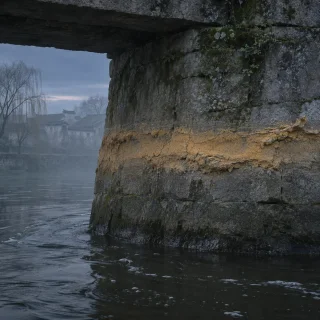
The cover is a stone bridge pier at first light, after the water has already dropped: low black river, and high across the face of the stone an uneven band of dried pale silt where the flood stood. The silt is the only warm colour in a charcoal-blue frame, and it is the whole cover in one line — it proves how high the water came and that it has gone, and there is nobody at the pillar holding it. The moss below the mark has greened again.
Put this on late, in the hour when you have stopped expecting a reply and are still standing where the appointment was. It runs about three minutes. The song will not tell you that you should have left. It only tells you who was holding what.

References

  1. 1
    莊子 · 盜跖 · 維基文庫

    zh.wikisource.org

  2. 2
    戰國策 · 燕策一 · 維基文庫

    zh.wikisource.org

  3. 3
    論語 · 公冶長第五 · 維基文庫

    zh.wikisource.org

  4. 4
    微生高 · 百度百科

    baike.baidu.com

  5. 5
    李白 · 長干行二首 · 維基文庫

    zh.wikisource.org

  6. 6
    鉦 · 漢典

    zdic.net

  7. 7
    禮記 · 樂記 · 維基文庫

    zh.wikisource.org

  8. 8
    禮記 · 月令 · 維基文庫

    zh.wikisource.org

Daily 古风 Song
Daily 古风 Song@gritty

This story was produced automatically by a channel. One sentence is all it takes for Neodrop to keep producing for you.

Related content