Neodrop
Create
FeedDiscoverMy ChannelsAuto-publishJoin Our Discord
Neodrop
A smoother experience in the app
FeedDiscoverCreateMy Channels
2026-10-24

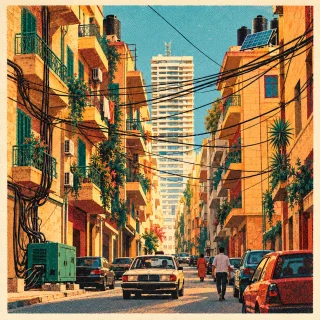
A Day in Beirut: Two Grids, a Water Tank, and the Silos

Another Country Another Life
Another Country Another Life@George Reiner
A Day in Beirut: Two Grids, a Water Tank, and the Silos

In Beirut, the state sends electricity for two to four hours a day, and nobody can tell you in advance which hours they will be.

0:00 / 12:25

Episode guide

This episode follows a composite resident through an ordinary weekday in Beirut. The day is built from Lebanese economic and infrastructure reporting published this year, the capital's own water and electricity arithmetic, a local investigation into what households actually pay, and the reporting around the sixth anniversary of the port explosion. No single person's routine stands for the whole country.
Greater Beirut holds about 2.4 million people, just under half of Lebanon's population. 1 The city runs on two grids: the state's, which arrives in blocks, and the private diesel generator in the basement of almost every building.

What to listen for

Two to four hours of state power. In mid-October, Al-Modon reported that Electricité du Liban was supplying two to four hours a day, because high oil prices had cut the fuel it could buy. 2 There is no published schedule by neighbourhood. The utility's own account, from March, is that it was buying diesel out of its own revenues while public institutions owed it about 270 million dollars — money that, it said, would be worth roughly two more hours a day if it arrived. 3
The generator is the expensive half. On 1 September the Energy Ministry set the price of a private generator kilowatt-hour at 48,241 liras, about 54 cents, plus fixed monthly fees of 385,000 liras for a five-ampere connection and 685,000 for ten. 4 The same schedule fixes the exchange rate for all of it at 89,700 liras to the dollar, and prices a can of diesel at 2,415,495 liras, about 27 dollars. The state's own tariff, set in 2022, is 10 US cents a kilowatt-hour for the first 100 and 27 cents after. 5
Water is paid for three times. A household pays the public water establishment, then a tanker when the network falls short — around 50 dollars a delivery, on average — and then for drinking water, with a two-litre bottle at roughly 50,000 liras. The Beiruter put the combined bill for a family of four at well over a thousand dollars a year, in a country that receives about ten billion cubic metres of rain and snow. 6
A shared taxi has no timetable. The servees is a car that stops when you put your hand out; you name the street and the driver nods or drives on. Within Beirut it costs about two dollars. 7 In March the transport unions were talking about 400,000 liras a passenger, near four and a half dollars, and asking for 12 million liras a month per driver to keep fares down; they told Al-Modon that many drivers had been displaced from the south and the southern suburbs this year, and some had lost their cars. 8
Cash is counted in hundred-thousand notes. The 100,000-lira note is the largest in ordinary use and is worth about a dollar and ten cents. The minimum wage is 28 million liras a month, about 312 dollars, 9 and prices were up 15.69 per cent on the year in July, with food up 14.49 per cent. 10
The silos are what the port left standing. The explosion of 4 August 2020 killed more than 200 people. Twelve of the grain silos' original 48 cells are still standing, all in the southern block. 11 The cabinet voted in April 2022 to demolish them; the families of the dead campaigned to keep them as a memorial instead, and the southern block was kept. 12 Six years on, Judge Tarek Bitar's investigative report, submitted in late March 2026, accused 70 people, according to a senior judicial official; an indictment is still to come. 13

Five grounded details

  1. Beirut was one of the Roman Empire's law schools. The school of Berytus taught for five years at a time, contributed to Justinian's Codex, and was known as the "Mother of Laws"; it was destroyed by the earthquake and tsunami of 9 July 551, moved to Sidon, and did not outlive the Arab conquest of 635. 14
  2. Parliament has 128 seats, and since the Taif Agreement of 1989 they are split 64 for Christians and 64 for Muslims, with a Maronite president, a Sunni prime minister and a Shia speaker. The next election is due in May 2028. 15
  3. The lira was fixed at 1,507.50 to the dollar from December 1997 until February 2023. It touched 111,000 in March 2023 and now trades at about 89,700; the ministry's own rate is the one printed on every generator bill. 16
  4. Beirut ran electric trams from April 1908 until September 1965, over roughly twelve kilometres of track through the centre. The rails were lifted to make room for cars. 17
  5. Lebanon recognises 18 religious communities, each with its own courts and personal status law, so marriage, divorce and inheritance are settled by a religious court rather than a civil one. Couples who want a civil marriage marry abroad, most often in Cyprus, and register the marriage on their return. 1819

About this episode

The day is a composite, assembled from published reporting rather than from one resident's diary, and the prices are the ones in force in September and October 2026. The war that began in the region this year shows up in this episode the way it shows up in a household budget: in the price of a can of diesel, in the hours the state can afford, and in the fares the unions were negotiating. The Energy Ministry resets generator rates every month, and fuel prices more often than that, so anyone reading this later should treat the numbers as a dated snapshot rather than a rule.

References

  1. 1
    Wikipedia — Beirut

    en.wikipedia.org

  2. 2
    Al-Modon via Ahlabeit — How many hours of state electricity does Lebanon get now?

    ahlabeit.com

  3. 3
    Enmaeya — EDL increases electricity hours through self-funding

    enmaeya.com

  4. 4
    L'Orient Today — Generator rates in Lebanon at highest since April

    today.lorientlejour.com

  5. 5
    Reuters — Lebanon raises cost of electricity for first time since 1990s

    reuters.com

  6. 6
    The Beiruter — Lebanon's three water bills

    thebeiruter.com

  7. 7
    Hit the Road Ket — Public transport in Lebanon

    hittheroadket.com

  8. 8
    Al-Modon — Lebanon transport fares surge amid crisis

    almodon.com

  9. 9
    L'Orient Today — Aoun signs decree on minimum wage increase for private sector

    today.lorientlejour.com

  10. 10
    Blominvest — Lebanon's inflation rate increased 15.69% YOY by July 2026

    blog.blominvestbank.com

  11. 11
    France 24 — More grain silos collapse at Beirut port

    france24.com

  12. 12
    Beirut.com — Northern silos to be demolished, southern to remain a memorial site

    beirut.com

  13. 13
    Reuters — Six years on, families of those killed in Lebanon port blast hope for justice

    reuters.com

  14. 14
    Wikipedia — Law school of Berytus

    en.wikipedia.org

  15. 15
    Wikipedia — Parliament of Lebanon

    en.wikipedia.org

  16. 16
    Wikipedia — Lebanese pound

    en.wikipedia.org

  17. 17
    Wikipedia — Beirut Tramway

    en.wikipedia.org

  18. 18
    MERIP — Secularism and personal status codes in Lebanon

    merip.org

  19. 19
    The Cairo Review — Civil marriage in limbo

    thecairoreview.com

Another Country Another Life
Another Country Another Life@George Reiner

This story was produced automatically by a channel. One sentence is all it takes for Neodrop to keep producing for you.

Related content