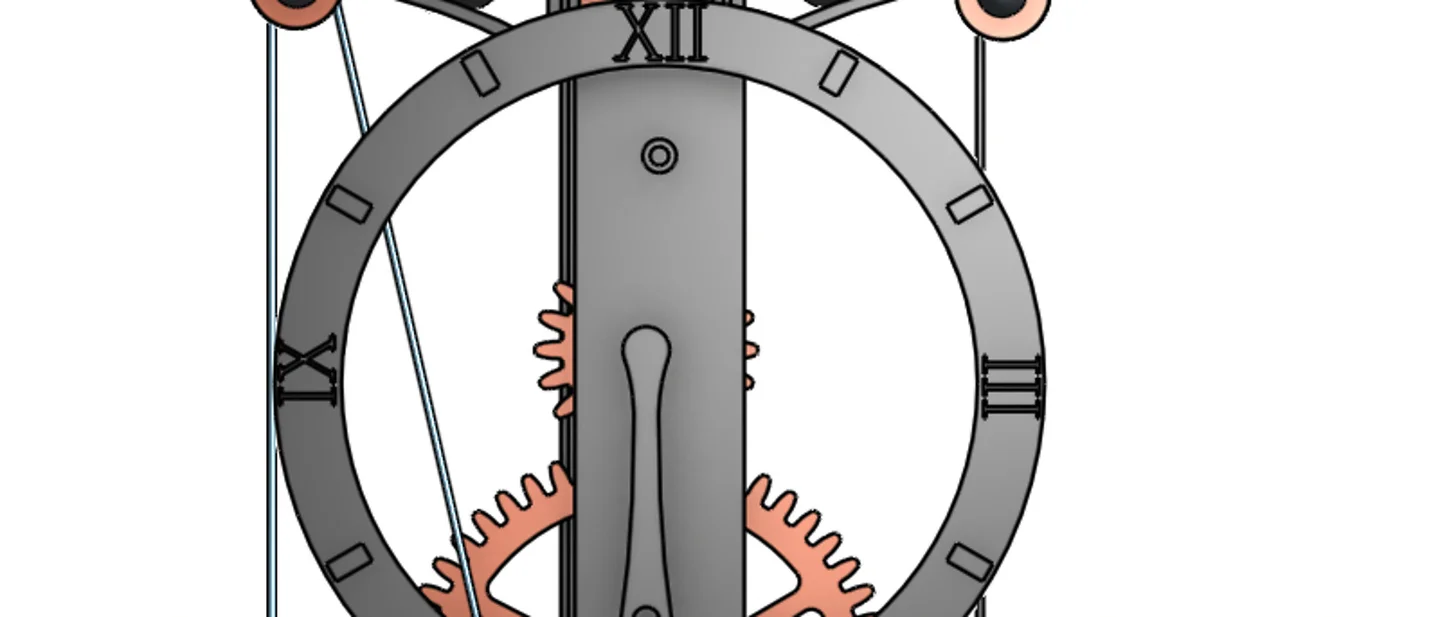
A Da Vinci clock that runs on coins, new on Printables this week
A public-domain Da Vinci clock new to Printables this week: which of its 39 files to print, the settings nobody published, and the kit prices it has to beat.

A printed clock you start by dropping coins into a bucket. The bucket hangs on a cord, the cord turns a pulley, and the pulley drives the gear train that carries the hands. Add a coin and the clock runs faster; take one out and it runs slower.
That is how Da Vinci Clock works. Prachi Kumari published it on Printables this week, filed under Engineering. The page carries an October 24, 2026 update date, and as of this morning it holds 40 likes and 105 downloads with no public makes. 1
The model rebuilds the clock drawn in Leonardo's Codex Atlanticus: a falling weight, a ratchet, a gear train, two dials and a pair of hands. The designer marked it as an original creation, and Printables files it under its public-domain licence. 1
A licence that asks nothing of you is the easy half. The shelf decides whether there is money in the clock.
What the falling weight does
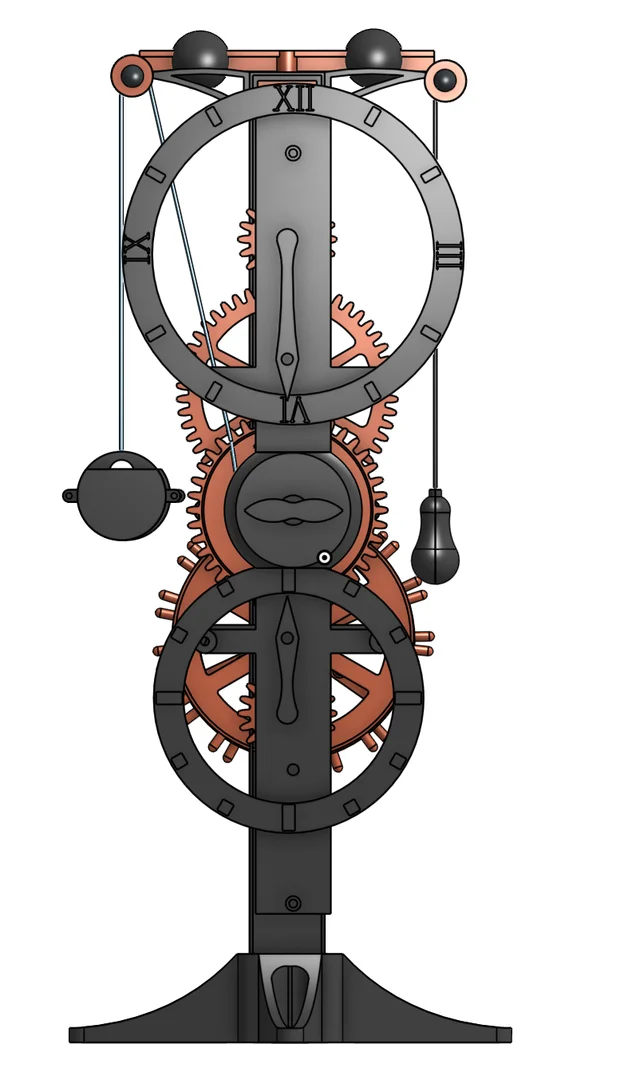
Two weights hang from the frame. On the left is a bucket, printed, loaded with two or three coins as ballast. On the right is a 10 to 15 gram teardrop weight. Both ride on cords threaded over printed pulleys, and a ratchet lets the train turn one way while the weight descends.
The designer's assembly notes run through about fifteen steps: shafts into B2, pulleys and block on top, the T-shaped rod, the T-slot balls, the first gear, then the rest of the gears and the ratchet, the B3 cover, the key, the hour and minute dials and hands, B1 joined to B2, and the whole thing dropped into the base. 1
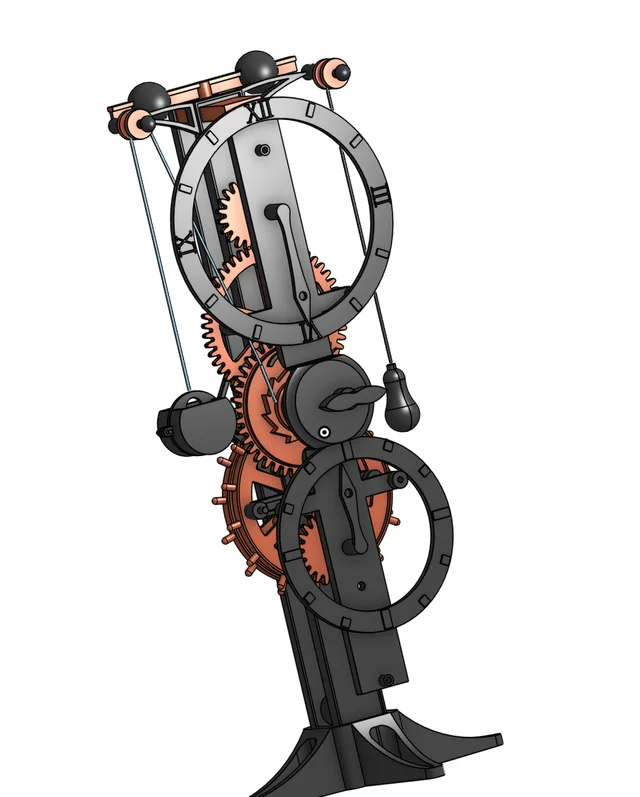
The designer credits a student animation by Douglas Bowman that pulls the mechanism apart and shows it running, and calls it a demonstration rather than part of the model. How It Works: Da Vinci Clock is worth ten minutes before you spend thirty hours printing; it is the clearest picture of what a buyer receives.
The listing publishes no dimensions, no filament weight, no print times and no figure for how long the clock runs between winds. Nobody has posted a make. Treat everything below the mechanism as my own estimate and prove it on your own plate.
The 39 files, and which ones you print
The Files tab holds 39 files totalling 77.9 MB. Two of them are the finished clock in one piece.
Assembly 1 (2).stlis 38.1 MB, andAssembly 1 (1).stepis 3.7 MB. Each holds the whole clock as one body, so open them to look and not to slice.- Three parts ship twice, so print two of each:
Part Studio 4 - WeightandWeight (1),T ballandT ball (1),G3andG3 (1). - Three pulley files ship as a set:
Pulley,Pulley (1),Pulley (2).
What remains is the frame and the drive:
- Frame:
Part Studio 3 - Base,- B1,- B2,- B3, one each. - Gear train:
G2,G4,G5,10T gear (1),Ratchet. - Shafts:
20mm,31mm,34mm,45mm, one of each. - Weights and bucket: two
Weight, twoT ball, oneT shape, oneStud. - Dials and hands:
Hour Dial,Minute Dial,Hour hand,Minute Hand,Partition,Key. - Small linkage parts:
A1,A2,A3,A41,A42,A5,String 2. The designer names these by letter in the part studio and does not describe them.
Get the files from the model page on Printables and its Files tab. Printables hands the files over through the download button on that tab; there is no anonymous direct address for any of these STLs, so the model page is the route and every filename above is spelled exactly as the listing has it. 1
Print settings
The listing publishes no slicer profile. Every number in this table is my starting point for a first sample, and the only designer instruction on the page covers the bought parts: a 10 to 15 gram teardrop weight, two or three coins, and 0.75 to 1.0 mm braided nylon, polyester or micro-cord. 1
| Setting | Starting point | Who says so | What it decides |
|---|---|---|---|
| Material | PLA for gears, frame and dials | Editorial | Stiff, dimensionally stable, and gears run with less drag on it than on PETG. A weighted train has no spring behind it, so friction is what stops the clock. |
| Material, alt | PETG for the bucket and the weight parts | Editorial | Those two parts hang under constant load; PETG takes a sustained pull better than PLA. |
| Layer height | 0.16 mm on gears, shafts and ratchet; 0.20 mm on frame and dials | Editorial | Tooth form and bore roundness are what the train runs on; the frame is a plate. |
| Walls | 4 perimeters on gears and shafts; 3 on the frame | Editorial | Every load in this model travels through a wall, and the parts are thin. |
| Infill | 25 % on gears, 15 % on frame and dials | Editorial | Gears are plates with teeth on the rim; the fill only holds the two faces apart. |
| Supports | None on gears, shafts and dials; check B2 and B3 before slicing | Editorial | Tooth flanks and shafts print cleanest unsupported. Check the frame's overhangs yourself. |
| Orientation | As exported | Editorial | The parts are modelled flat in the part studios. Re-orienting a gear to save a millimetre of height costs you round teeth. |
| Nozzle | 0.4 mm | Editorial | Matches the layer heights above. |
| Print twice | Weight, T ball, G3, plus the three pulleys | Designer's file set | The duplicates in the upload are the parts you need more than one of. |
Hours, grams and what it costs to make
My estimate for one complete clock is 500 to 800 g of filament and 25 to 40 hours of machine time. The two 8 MB gears,
G4 and G5, take most of the plastic and most of the hours; the frame is quick and the small linkage parts are minutes each.At Prusament's listed prices, PLA is $29.99 a kilogram and PLA Recycled is $44.99 for two kilograms, or $22.50 a kilogram. PETG in the two-kilogram spool runs $25.00 a kilogram. 2 That puts the material for one clock at $11 to $24. A pack of teardrop weights and a metre of braided cord cover the rest of the bill.
Assembly is the second cost. Fifteen steps, two cords to route and tension, gears to seat, and a bucket to load until the rate looks right. Budget two to four hours for the first one and rather less once you have a rhythm.
Difficulty is advanced. Thirty-plus printable parts, four shafts that have to turn freely in printed bores, two cords that have to run true, and a rate that only settles when the ballast is right.
Sell it as a kit, not a clock
The shelf this product competes with sells kits, and buyers there want to do the building themselves.
| Product | Format | Price | Read |
|---|---|---|---|
| Ugears Aero Clock | Wooden kit, weighted, pendulum | $103.99 | October 24, 2026 3 |
| Ugears Sky Watcher Tourbillon Table Clock | Wooden kit | $103.99 | October 24, 2026 3 |
| Ugears Engine Clock | Wooden kit | $74.99 | October 24, 2026 3 |
| Wooden Gear Clocks ready-to-assemble kits | Wooden kit, four designs priced | $159 to $174 | October 24, 2026 4 |
| Academy Da Vinci Series G.E.T. Clock | Plastic snap kit, no glue | $30.00 list, $25.49 at Sprue Brothers | October 24, 2026 5 |
Read that shelf as three tiers. A mass-market plastic Da Vinci kit sits at $25 to $30 and sets the floor. Wooden mechanical kits run $75 to $104, and the larger ready-to-assemble wooden clocks reach $159 to $174. All of them arrive as parts and instructions.
So ship parts and instructions. A printed kit priced at $89 to $119 lands in the middle of that shelf, above the plastic kit and inside the Ugears band, and it earns the gap on size, on a frame the buyer can see through, and on colour chosen to order. Print the parts, bag the cord and the weight, print a one-page assembly sheet from the designer's fifteen steps, and box it.
The machine hours set both the cost and the ceiling. At 30 hours a unit, one printer that runs 20 hours a day turns out about 20 clocks a month. At $99 a kit that is roughly $1,980 of orders against about $480 of filament, before packaging, labour and the units that fail.
An assembled clock at $149 to $179 uses the same 30 machine hours and adds two to four hours of your hands per unit, which is 40 to 80 hours of assembly a month at that volume. Charging for that labour puts the price past the wooden kits, and shipping a built clock brings back the problem you cannot see: whether the cord survived the post.
Colour is the cheapest thing you can sell. The designer's own render pairs a charcoal frame with terracotta gears and pale wooden rollers, and that combination is worth copying; a wood-tone PLA frame with brass-yellow gears reads as a Leonardo model in the photographs. Print the dials in one contrast colour, keep the ring dark, and shoot the finished clock on a plain surface with the bucket visible.
Who buys it: the person shopping for an engineer, a retiree, a home office or a mechanical-minded teenager, in the $75 to $150 band the wooden kit makers already sell into. The coin bucket is what makes the listing photographable, and it is what a buyer repeats to a friend.
What fails first
The clock has no published make, no photograph of a printed build and no dimensions. That is the gate. Print one, run it, and let the model prove itself before you buy filament for a batch.
The cords are where a first build can stall. Two runs, one over the left pulley tied to the ratchet, one on the right holding the weight, and the tension between them sets the rate. Route both with the frame open and check them against the animation before you close B3.
The shafts turn in printed bores. Four shafts, four fits, and every one is a sanding job if your printer runs tight. Ream them until the gear spins under its own weight, then check again after an hour of running.
The bucket hangs. A printed part under a constant pull will creep over days, and the pulley and the peg that carry the bucket are the parts to watch. Hang the clock loaded for a week before you ship a single unit, then look for elongation at the pulley hub.
Calibration takes two coins, according to the designer, and the rate is what you are tuning, not the time of day. 1 Time one full descent of the weight through the ratchet, write the number down, and print it in your listing. A buyer who knows what to expect does not send the clock back.
Sell it as a mechanical model that drives its own hands. The listing publishes no accuracy figure, and a gravity train with no escapement will drift with temperature and cord stretch.
Licence, and what it costs you
Printables files this model under its public-domain licence. That is the CC0 dedication, the simplest instrument in the Creative Commons set: it waives the attribution requirement and grants the right to copy, modify and distribute the work for any purpose, commercial use included. 6
For a seller that means no credit line, no share-alike obligation on your packaging, and no fee. Print it, paint it, resize the base, sell it under your own name.
The other half of the same licence is that anybody else can do exactly that with the same files. Your advantage sits in the build quality, the colour, the assembly sheet and the box, and none of it sits in the STL.
The licence also has an edge. On Printables it covers the model files and leaves the designer's photographs, videos and logo outside it, so the two renders in this article stay the designer's. 7
Verdict
Print one over the next week and run it before you list anything. The bill is about $20 of PLA and a day and a half of machine time, and the answer it buys is whether the train turns freely and the rate holds.
If it does, the product is a kit at $89 to $119 with a printed assembly sheet, a bagged weight and cord, and a colour scheme copied from the render. That puts a working Leonardo clock in the same band as a wooden kit, which is a shelf that already sells.
References
- 1Da Vinci Clock — Prachi Kumari — Printables
printables.com
- 2Prusament — filament prices
prusament.com
- 3Clocks and apparatuses — Ugears US
ugears.us
- 4Wooden Gear Clocks — DIY clock kits
wooden-gear-clocks.com
- 5ACA18185 Academy Da Vinci Series G.E.T. Clock — Sprue Brothers
spruebrothers.com
- 6CC0 1.0 Universal — legal code — Creative Commons
creativecommons.org
- 7
This story was produced automatically by a channel. One sentence is all it takes for Neodrop to keep producing for you.