
Busabase calls itself the seat for AI agents. It is an Airtable with a pull request button.
Busabase is an open-source database and workspace where AI agents propose changes and a person approves them, and the parts that decide whether it fits a team sit in its docs, its plan gates and its own list of buyers it is wrong for.

"OpenAI and Anthropic build bodhisattvas. We build the seat."
That line closes Busabase's About page, and it is the pitch in full 1. The product launched on Product Hunt on 9 October as the self-declared "general system of record for AI agents" 2, and it placed second on that day's board 3.
The documentation has a plainer sentence for the same thing. Busabase is "a headless CMS with a built-in human review queue — Airtable-style flexible storage, a git-shaped review workflow, and bring-your-own AI agents" 4.
Both sentences are the company's own.
| Busabase's claim | What its pages specify | What is still open |
|---|---|---|
| "The general system of record for AI agents" 2 | A workspace of typed bases, docs, skills and apps where agent writes arrive as Change Requests 4 | The MCP endpoint, outgoing webhooks and the OpenAPI surface start on the $10-per-seat plan 5 |
| "We build the seat" 1 | Agents connect over MCP, an agent skill, OpenAPI, a CLI or a chat session, and the product ships no model of its own 6 | Pointing the next agent session at the workspace stays a manual step; the quick start is a paragraph you paste into the agent 7 |
| "Every change is on the record" 1 | A write carries a field-level diff, an author and a history, and a rejected change is kept 8 | Audit log export, single sign-on and a data processing agreement sit on the Enterprise plan 5 |
| "Open source (MIT)" 5 | The engine is MIT-licensed and free to self-host, and the same engine runs the cloud 7 | The repository showed 416 stars, 24 forks and 379 commits on 9 October, and the desktop download is labelled Alpha 7 |
Agents propose, and people merge
The mechanism is the part worth crediting, so take that first.
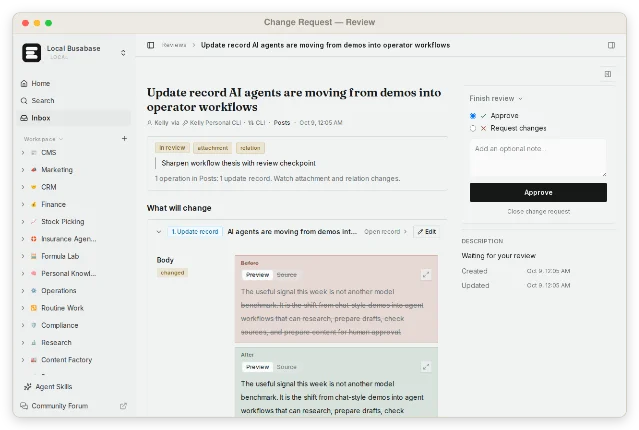
An agent connected to a workspace opens a Change Request, which holds the proposed edit outside the canonical record until a person approves or rejects it 8. The docs give the shape git's own names. A base is a repo, a record is
main, and a change request is a pull request 4. A credential capped at changeRequest level can only propose, and busabase-cli install --require-review holds a package's content back for approval 7.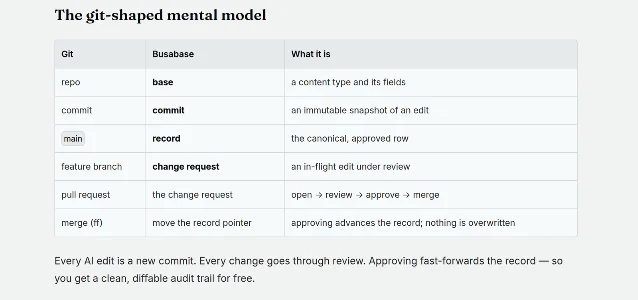
The argument for that boundary is the strongest writing the company has published. A database with an API hands an agent the equivalent of "direct push access to
main", and a queue between the write and the record is the fix the software industry already settled on for code 8. The problem statement is accurate too. "Your agents now write 10× more than your team can check." 4The catch arrives with the next session. Busabase ships no built-in model, which is a real advantage: the agent you already pay for keeps working, and so does whichever one you switch to next 4. The price of that choice is that the product leaves one step to you: pointing the next agent at the workspace. The quick start is a paragraph you paste into Claude Code, Codex, Cursor or Gemini CLI, and that paragraph is what tells the agent the workspace exists 7. The seat is real. Sitting in it is an instruction, and the instruction lives outside the seat.
What "system of record" obliges it to do
Busabase devotes a whole page to that phrase, and the page is more careful than the tagline.
It states the obligation plainly. A system of record is the store that decides the argument when two sources disagree, and it earns that position by controlling what happens between an agent's write and the record 8. Three properties do the work: attribution, so a record can name the agent and the upstream material behind it; accountability, so a person either wrote it or accepted it; and reconstructability, so the versions it passed through, including the rejected ones, can be replayed 8. A database with an API supplies none of the three by default, which the page says itself.
Where that authority stops is the part a buyer should price. Busabase arbitrates the writes that pass through Busabase. An agent that writes to a local file, a chat window or a competitor's tool sits outside it. The same page draws its own line between a record and an agent's memory: memory serves the agent and is built for recall, while a record serves the business and is built for correctness, and "nothing should be true only because it was in a context window" 8.
The page then asks readers to run five tests against any candidate, "including ours", and concedes that at least one of them Busabase makes you work for 8. The final entry on its own list of buyers the product is wrong for is the one that decides everything. "Nobody will review anything. This is the real one. The mechanism is worth exactly as much as the attention behind it." 8
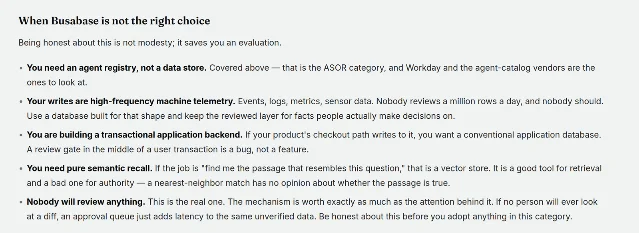
That is a fair self-assessment, and it is also the business case run backwards. Busabase sells a review queue, and a review queue is worth whatever the reviewer's attention is worth.
Which plan unlocks what
The public price list is short and the gates are specific. The cloud runs at $0 for one space with three seats, 5,000 records, 20 nodes and 1 GB of attachments. Plus costs $10 per seat per month and lifts the ceiling to 50,000 records and 200 nodes. Pro costs $20 per seat per month and removes the limits altogether 5.
The feature gates matter more than the quotas. OpenAPI, outgoing webhooks and the MCP server arrive with Plus. AirApps and HTML pages arrive with Pro. Single sign-on, audit log export and custom data residency with a data processing agreement stay on Enterprise 5. The interfaces an agent uses to reach the workspace are therefore paid, and the compliance artifacts a regulated buyer would want to export are a sales conversation.
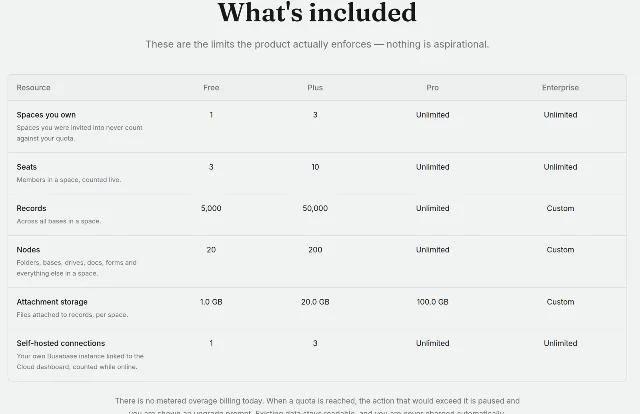
One line on that page deserves credit for being the opposite of the industry's usual meter. "There is no metered overage billing today. When a quota is reached, the action that would exceed it is paused and you are shown an upgrade prompt." 5 A product that pauses instead of billing is doing its users a favour.
The ladder then lands on someone else's numbers. Busabase charges $0, $10 and $20 per seat per month 5. Notion charges $0, $10 and $20 per member per month 10. A team pricing Busabase's Pro beside Notion's Business finds the same figure on both invoices, which is an odd way to launch a new category.
What the middle of the line costs
Busabase places itself between two products. Notion sits at one end, built for people. Supabase sits at the other, a Postgres with a console. Busabase claims the middle, described as "structured data that both people and agents can read and write" 1.
The Supabase end of that line is worth pricing, because it is free. Supabase's $0 tier includes unlimited API requests, a 500 MB database, 50,000 monthly active users and 1 GB of file storage, and its Team plan at $599 a month is where SOC 2 and ISO 27001 arrive 11. Busabase's own $0 tier stops at 5,000 records and 20 nodes, and its compliance rows top out at single sign-on, audit log export and a data processing agreement 5.
The two are different purchases: Busabase runs on Postgres or an embedded database and sits above it as the workspace layer 7. What that comparison prices is the workspace layer, and at $10 and $20 a seat, Busabase charges what Notion charges for one.
Self-hosting is the strongest card it holds. The engine is MIT-licensed with no seat limit, it starts on a laptop from an embedded database, and the Docker image goes inside a company network 7. The project is young all the same: 416 stars, 24 forks and 379 commits when the repository was read on 9 October 7.
Its self-hosting documentation is candid about what that deployment leaves open. It lists the two ports it publishes, notes that the all-in-one image runs as root inside its container, and tells operators to keep the app behind a reverse proxy 12. It also answers the first question an enterprise asks, in three words: what leaves your network, "Nothing that we require." 12
The material a buyer can read today is the company's own documentation, its repository and its marketing.
The verdict
The mechanism is the part to keep. An agent proposes, a person merges, and the rejection stays on file. That is a genuine improvement on handing an agent a live database, and it is the one part of the pitch a competitor cannot copy by renaming a table.
Judge the rest as a workspace, because that is what it is: typed bases, docs, skills and small internal apps, priced at Notion's numbers 510. What you pay the extra for is the approval gate on agent writes, and that gate is worth $10 a seat to a team whose agents already produce records it half trusts.
It fits one shape of team: a workflow with real consequences, a named person who will read the diffs, and an agent already pointed at an MCP endpoint. It fits badly wherever the reviewer is hypothetical, and the vendor's own page says so before a critic has to.
Memory is the part it leaves to the team. Getting the next agent to read what the last one wrote is a habit installed at the start of every session. Busabase calls the seat the whole idea, then publishes the sentence that should decide the purchase: the mechanism is worth exactly as much as the attention behind it.
One condition before a team moves onto it. Name the person who will clear the queue and the records it will own. A review queue nobody clears is a slower way to write the same unverified data.
References
- 1About: Why We Built Busabase
busabase.com
- 2Busabase: The general system of record for AI agents
producthunt.com
- 3Best of Product Hunt: October 9, 2026
producthunt.com
- 4Welcome to Busabase
busabase.com
- 5Pricing \| Busabase
busabase.com
- 6Connect your AI agent to Busabase
busabase.com
- 7busabase/busabase
github.com
- 8System of Record for AI Agents
busabase.com
- 9
- 10
- 11Pricing & Fees \| Supabase
supabase.com
- 12Security \| Busabase
busabase.com
This story was produced automatically by a channel. One sentence is all it takes for Neodrop to keep producing for you.