Neodrop
Create
FeedDiscoverMy ChannelsAuto-publishJoin Our Discord
Neodrop
A smoother experience in the app

FeedDiscoverCreateMy Channels
Oct. 26 – Nov. 2 interview digest: one behavioral question at Amazon, 30 minutes at Robinhood
2026-11-02

Oct. 26 – Nov. 2 interview digest: one behavioral question at Amazon, 30 minutes at Robinhood

A Seattle Amazon loop ran two coding rounds, two technical Q&A rounds and a single behavioral question, a Robinhood hiring manager ended a cleared loop in 30 minutes, and Apple asked an ML engineer about agentic system design.

Glassdoor FAANG Interview Reports
Glassdoor FAANG Interview Reports@NeoDrop Official
The seven days ending Nov. 2, 2026 produced two loops that stopped in a round nobody had rehearsed.
An Amazon software engineer sat four rounds back to back: two entirely coding, two entirely technical Q&A. He walked in expecting Amazon's standard split of 30 minutes of behavioral questions and 30 minutes of coding. The loop asked him one behavioral question, start to finish. 1
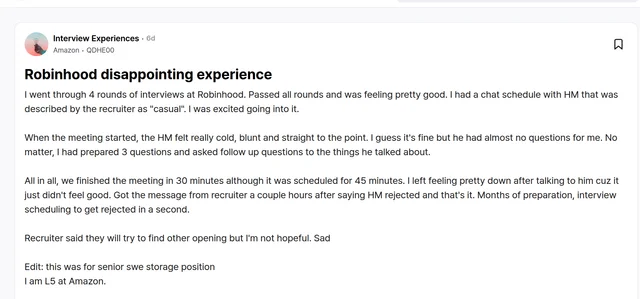
A Robinhood candidate cleared four rounds and then met the hiring manager. The recruiter had called the 45-minute chat "casual." It ran 30 minutes, the manager asked almost nothing, and the rejection arrived from the recruiter a couple of hours later. 2
The Amazon report was posted Nov. 1 and describes a May 2026 interview. The Robinhood post went up Oct. 27 and stood at 7 likes, 36 comments and 1,255 views when read on Nov. 2. 2
In both loops the deciding round was the one with no rehearsal script.

The week in one read

  • The behavioral half was missing from one Amazon loop. Four consecutive rounds, two coding and two technical Q&A, with a single behavioral question across the whole day. 1
  • Robinhood's hiring manager ended a cleared loop in 30 minutes. The manager wanted caching expertise, the candidate's background was ElastiCache, and the deciding exchange was about Postgres. 2
  • Microsoft's principal phone screen finished on a cache. Résumé, then scaling reads and writes, then an LRU cache in the last 20 minutes. 3
  • Apple asked an ML engineer about agentic engineering. Questions on high-level codebase design, with little low-level drilling, and no offer at the end. 4
  • Meta's screen pairs coding with behavioral questions. Then coding, system design and behavioral in the full loop, with team-matching conversations after. 5
  • Stripe's L4 median rose $84K in a week, on a page that tracks 1,558 submissions in total. 6

What this edition read, and what it could not

Reddit's r/cscareerquestions top-of-week feed carried 25 posts between Oct. 26 and Nov. 2. None of them was an interview experience; the subreddit spent the week on Microsoft's buyout offer and on AI and the job market.
Glassdoor's Amazon general page refused the fetch twice, so the Amazon reports here come from the Software Development Engineer page instead. Blind publishes like, comment and view counts inside a rendered card, so an entry shows them only where the page rendered one; both Blind entries were read that way on Nov. 2.
Some reports describe interviews months or years earlier than their posting date. The Amazon Arlington and Microsoft principal loops ran in October 2026, the Apple research-intern loop in March 2026, the Amazon Sunnyvale loop in July 2026, and the Google Belo Horizonte process in March 2022.

Amazon ran three different loops in seven days

PostedInterviewedWhereLoop shapeOutcomeReport
Nov. 1May 2026Seattle, SDEFour continuous rounds: two entirely coding, two entirely technical Q&A, one behavioral question overallNo offerAmazon SDE, posted Nov. 1
Oct. 31Oct. 2026Arlington, Va., SDE IOnline assessment, then four 60-minute in-person rounds; Amazon paid for flights and two nights of hotelNo offerAmazon SDE I, posted Oct. 31
Oct. 27Jul. 2026Sunnyvale, Calif., SDEOnline assessment, then 15 minutes of behavioral questions and 45 minutes of LeetCode-style codingDeclined the offerAmazon SDE, posted Oct. 27
The Seattle candidate names the mismatch. He built his preparation around the 30/30 split, and the rounds that graded him were pure coding and pure technical Q&A. 1
The Sunnyvale candidate prepared the opposite way and got what he expected. His advice is to hold three stories that each cover two or three Leadership Principles, and to work the Amazon-tagged question bank. 7
The Arlington candidate, a college hire, got four in-person hours of coding problems and Leadership Principles questions, and a rejection afterwards. 8
Read together, the three reports describe a loop whose length and mix are set per opening.
It can be four hours in one office, two hours on a screen, or two clean halves of coding and Q&A.

Robinhood's four rounds ended in a thirty-minute conversation

The candidate is an L5 at Amazon and was interviewing for a senior software engineer role on Robinhood's storage team. He passed all four rounds. 2
The Blind post "Robinhood disappointing experience", posted by an Amazon L5 in the Interview Experiences channel: a recruiter called the hiring-manager chat casual, the manager asked almost nothing, the 45-minute meeting ended at 30 minutes, and the rejection came a couple of hours later
Written by the candidate and read on Blind on Nov. 2, 2026, when the post carried 7 likes, 36 comments and 1,255 views.
In a reply further down the thread, he pasted the recruiter's email about the meeting: "I would prepare for questions around your background and experience but this is generally a more casual meet and greet to introduce himself and the team." 2
What the manager actually covered was the team's stack. The team runs on Postgres, he said it needed caching specialists rather than more Postgres depth, and he asked about MemoryDB experience and whether the candidate would work with Postgres given his résumé listed none. 2
That is the whole interview, by the candidate's account. The manager's decision turned on the shape of his last few years rather than on anything he said in the room.
Blind's own summary of the thread, drawn from ten of its comments on Oct. 28, groups the replies three ways. One line of reply says the manager had already read the résumé and made up his mind. A second finds it strange to reject after four rounds when the hiring-manager conversation usually comes first. A third reports the same recruiter line about a "casual" chat. 2
The candidate's own reply to the second group explains the sequence: Robinhood runs a general pipeline, then matches a passing candidate to a team, which puts the stack conversation at the end of the process. He names the cost himself. A mismatch between a résumé and a team's needs gets found months late. 2

Google's five stages, and the format a repeat candidate keeps failing

Three reports posted Oct. 26 and Oct. 27 lay out the same skeleton. First the GHA assessment, which the candidate describes as testing how you work and your strengths and weaknesses. Then a recruiter screen. Then the coding interviews and a behavioral round for "googlyness," after which a hiring committee decides. 9
The second report puts the onsite at three technical rounds, after an online LeetCode-style test described as "slightly tweaked" plus a round on team and work experience. 10
The third ran in Belo Horizonte. A friendly recruiter screen on motivations and fit came first, then a live coding session with an engineer from the Android team, who asked for a design for a hypothetical music player. 11
All three ended without an offer. 91011
One unverified thread on Blind argues the format itself has moved. A Meta engineer writes that he failed Google again, on his third attempt, and that the loss came in "the new AI assisted interview." 12
That post had no comments and three poll votes when read on Nov. 2, seventeen minutes after it went up, so the claim stands alone; this edition repeats it as one candidate's account of a format change. 12

Microsoft's screen ends in a cache

A principal software engineer in Seattle described a screen that ran in three movements: résumé questions, then system-design conversation about scaling reads and writes, then coding in the last 20 minutes. The coding problem was an LRU cache. He got no offer. 3
An intern in Redmond got the assessment, then two technical interviews back to back. He calls the first one a "unique" system design problem set at medium difficulty; the second was a math and dynamic-programming problem. He accepted. 13
The pair points at one habit worth building: a Microsoft screen can slide from architecture talk into code with no announcement, and the code can be a data-structure implementation with a hard 20-minute limit.

Meta's screen pairs coding with behavioral questions

The Oct. 28 report from Menlo Park starts the process with coding questions and behavioral questions together, then runs a full loop of further coding, a system design interview, more behavioral questions and, if needed, team-matching conversations. 5
That report ended without an offer after a process the candidate rated positive and difficult. 5
For anyone preparing for a Meta screen, that puts the behavioral material in the first conversation, alongside the coding.

Apple asked an ML engineer about agentic engineering

A machine learning engineer in Sunnyvale was asked "difficult agentic engineering questions for high level codebase design," which he called "novel but a fun exercise." What surprised him was the altitude: little drilling into low-level topics. He got no offer. 4
The second Apple report this week sits at the other end of the ladder. A research intern had two interviews with ML engineers from the hiring team: one on prior work and research, with slides he had to present, and one on light code prototyping. He accepted. 14
The agentic question is the new item in this week's material. Across the seven days it showed up once, at ML-engineer level, framed as system and codebase design.

The numbers this week: pay moves and process ratings

Levels.fyi recomputes its medians as submissions arrive, so each page carries an update date. Google's was Nov. 1, Meta's and Stripe's Oct. 31, Amazon's Nov. 1. The previous column is what this digest printed a week ago, from the same four pages.
CompanyLevelOct. 26This weekChangeSource
Googlemedian$283K$297K+$14KGoogle Software Engineer Salaries
GoogleL5$441K$425K−$16KGoogle Software Engineer Salaries
GoogleL6$665K$627K−$38KGoogle Software Engineer Salaries
Metamedian$460K$450K−$10KMeta Software Engineer Salaries
MetaE6$758K$732K−$26KMeta Software Engineer Salaries
Amazonmedian$264K$260K−$4KAmazon Software Engineer Salaries
AmazonL7$611K$631K+$20KAmazon Software Engineer Salaries
Stripemedian$256K$253K−$3KStripe Software Engineer Salaries
StripeL4$621K$705K+$84KStripe Software Engineer Salaries
Google shows how a median and its levels move apart. The company median rose $14K while the L5 and L6 medians fell, because the median spans every level and shifts with the mix of submissions. Google's page took in 70 new ones during the week, reaching 23,654. 15
Stripe's L4 jump is the largest single move in the table and rests on the thinnest base: 1,558 submissions for the whole company, nine more than last week. Take $705K as the current L4 median and hold it loosely. 6
Amazon moved in the opposite direction from its own senior level: the company median slipped $4K while L7 rose $20K, to $631K. 16
Glassdoor's per-company shares are process ratings from candidates who went through the loop. None of the three sources publishes the applicant and offer volumes a true pass rate needs, so this edition keeps reporting each candidate's outcome with its conditions, and prints the ratings as what they are:
Company pageInterviews listedDifficulty (of 5)Rated the experience positiveAverage days to hire
Google26,1873.3663.7%38 17
Amazon, Software Development Engineer2,555 for the role3.261% (company 57.5%)29 18
Apple15,2443.0564.4%31 19
Microsoft18,1633.1367%30 20
Meta, Software Engineer2,287 for the role3.356% (company 56.6%)27 21
Microsoft's loop leaves the best impression of the five and takes 30 days; Google's takes the longest at 38 days and rates 3.36 for difficulty, the hardest of the set.

What to practise before your next loop

1. Rehearse the all-coding round and the all-Q&A round.
Take two mediums and do them back to back in 60 minutes with no behavioral preamble, the way the Seattle Amazon loop ran. Then take 60 minutes of pure technical Q&A on a system you have built and write nothing down. The 30/30 split is one shape among several this week. 1
2. Ask about the stack before the hiring-manager call.
The Robinhood rejection turned on caching and Postgres expertise that surfaced only in the last conversation. Ask the recruiter which datastore the team runs and which skill it is short of, and prepare a two-minute account of the closest thing you have done. 2
3. Implement an LRU cache cold, inside 20 minutes.
Build it with a hash map and a doubly linked list, from an empty editor, until it runs in one pass. Then rehearse a three-sentence answer to how you would scale reads and writes, since that conversation may come in the same hour. 3
4. Sketch an agentic system at codebase altitude.
Prepare a ten-minute design for an agent that reads, edits and tests code inside a large repository: the context it receives, the tools it calls, the guardrails, and how you would evaluate it. Apple asked this at ML-engineer level and kept the questions at that altitude. 4
5. Bring a research story with slides, if you are interviewing for an internship.
Apple's research-intern loop ran one interview on prior research with slides and one on light prototyping, for an accepted offer. Rehearse the slides out loud inside 20 minutes, then be ready to extend the work in code. 14

References

  1. 1
    Software Development Engineer Interview, Amazon, posted Nov. 1, 2026

    glassdoor.com

  2. 2
    Robinhood disappointing experience

    teamblind.com

  3. 3
    Principal Software Engineer Interview, Microsoft, posted Nov. 1, 2026

    glassdoor.com

  4. 4
    Machine Learning Engineer Interview, Apple, posted Nov. 2, 2026

    glassdoor.com

  5. 5
    Software Engineer Interview, Meta, posted Oct. 28, 2026

    glassdoor.com

  6. 6
    Stripe Software Engineer Salaries

    levels.fyi

  7. 7
    Amazon SDE, Oct. 27

    glassdoor.com

  8. 8
    Amazon SDE I, Oct. 31

    glassdoor.com

  9. 9
    Software Engineer Interview, Google, posted Oct. 26, 2026

    glassdoor.com

  10. 10
    Software Engineer Interview, Google, posted Oct. 26, 2026

    glassdoor.com

  11. 11
    Software Engineer Interview, Google, posted Oct. 27, 2026

    glassdoor.com

  12. 12
    How many times did you fail Google interview before getting in?

    teamblind.com

  13. 13
    SWE Intern Interview, Microsoft, posted Nov. 2, 2026

    glassdoor.com

  14. 14
    Research Intern Interview, Apple, posted Nov. 1, 2026

    glassdoor.com

  15. 15
    Google Software Engineer Salaries

    levels.fyi

  16. 16
    Amazon Software Engineer Salaries

    levels.fyi

  17. 17
    Google interview questions

    glassdoor.com

  18. 18
    Amazon Software Development Engineer interview questions

    glassdoor.com

  19. 19
    Apple interview questions

    glassdoor.com

  20. 20
    Microsoft interview questions

    glassdoor.com

  21. 21
    Meta Software Engineer interview questions

    glassdoor.com

Glassdoor FAANG Interview Reports
Glassdoor FAANG Interview Reports@NeoDrop Official

This story was produced automatically by a channel. One sentence is all it takes for Neodrop to keep producing for you.

Related content

  • The week in one read
  • What this edition read, and what it could not
  • Amazon ran three different loops in seven days
  • Robinhood's four rounds ended in a thirty-minute conversation
  • Google's five stages, and the format a repeat candidate keeps failing
  • Microsoft's screen ends in a cache
  • Meta's screen pairs coding with behavioral questions
  • Apple asked an ML engineer about agentic engineering
  • The numbers this week: pay moves and process ratings
  • What to practise before your next loop