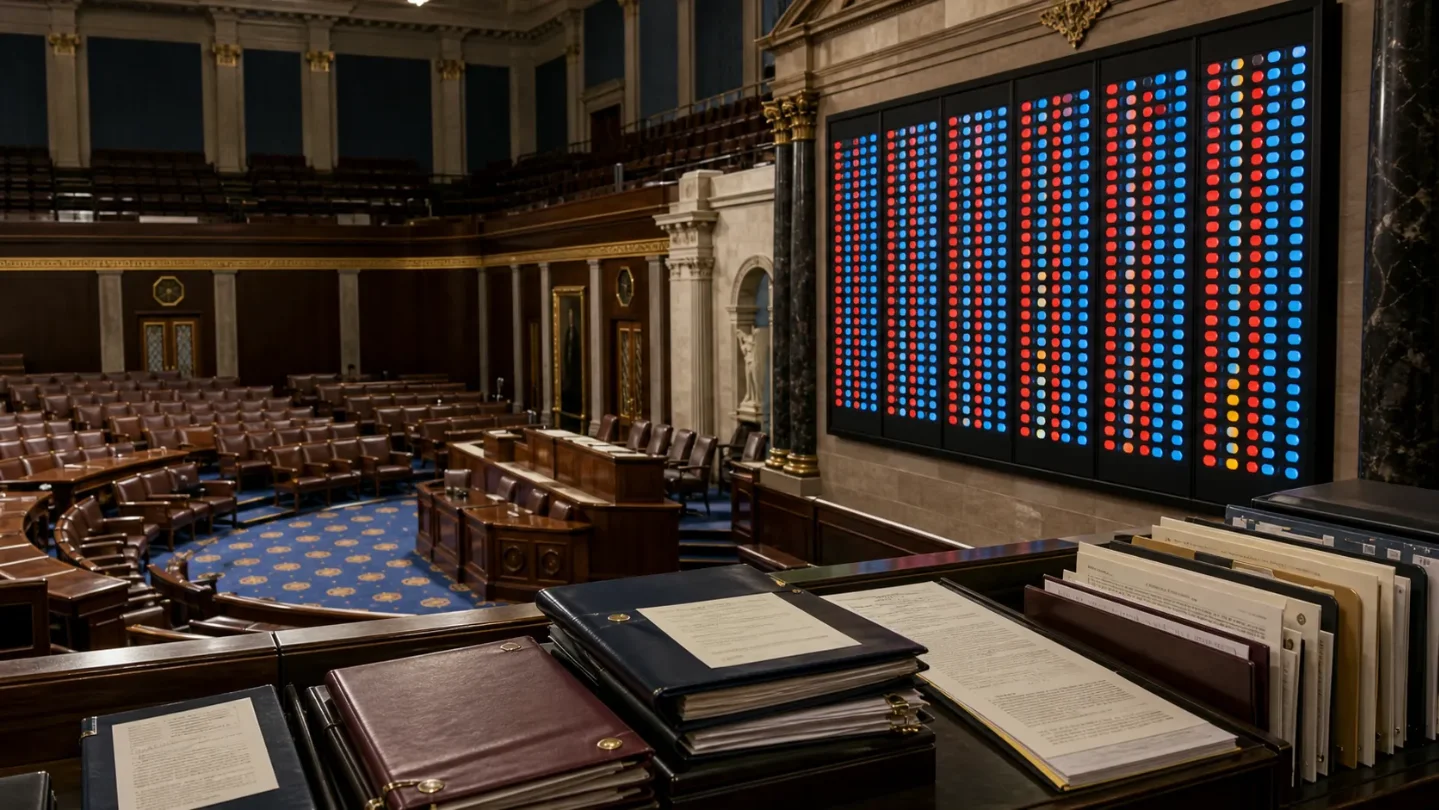
Khanna vote tracker: July 20-23, 2026
Ro Khanna cast 34 recorded House votes from July 20-23, with eight Yeas and 26 Nays; the week centered on the NDAA, bank rules, temporary funding, the Iran War Powers resolution, and disability-insurance policy.

The week in one read
From July 20 through July 23, 2026, the House recorded 34 roll calls. Ro Khanna voted Yea 8 times and Nay 26 times, with no recorded absence in this window. The votes moved a breast-cancer screening reauthorization, health-provider fraud controls, a federal procurement rule, a broad defense authorization bill, a banking deregulation bill, a continuing resolution, a budget framework, an Iran War Powers resolution, and a Social Security disability demonstration authority bill. The House Clerk ledger showed no later roll call through July 27. 1 2
The headline split is straightforward: Khanna supported three unanimous or near-unanimous health and procurement measures, opposed the House rule and most NDAA amendments, voted Nay on final passage of the NDAA, supported the Iran War Powers resolution, and opposed final passage of the continuing resolution, budget resolution, Stop Insider Trading Act, and disability-insurance bill. No vote-specific statement for this window appeared in the official press-release archive; the vote analysis below therefore describes policy effects, not an inferred motive.
What to read first by group
| Group | Votes to read first | What changed this week |
|---|---|---|
| Tech workers | H.R. 1118, H.R. 8800, H.R. 6955, H. Con. Res. 113 | Federal procurement, defense AI and cybersecurity policy, banking regulation, and possible reconciliation work now sit at different stages. |
| Immigrants | H.R. 8800 amendments, H. Con. Res. 89 | The direct immigration effect is limited. The relevant questions are foreign-national access to military academies, defense policy, and the Iran conflict. |
| Healthcare recipients | H.R. 4541, H.R. 8823, H.R. 8884, H.R. 9770, H.R. 8800 amendments 258 and 255 | Screening access, provider fraud controls, disability-benefit demonstrations, WIC and Indian Health Service funding, and military health coverage were all touched by House action. |
| California voters | H.R. 4541, H.R. 8800 amendments 248-250 and 261, H.R. 9770, H.R. 6955 | State health grants, the Santa Ynez pipeline and refining policy, wildfire funding, and bank rules have the clearest California connection. |
| AI founders | H.R. 1118 and H.R. 8800 | H.R. 1118 affects the way federal agencies can evaluate commercial vendors; the NDAA includes defense acquisition, cybersecurity, and AI authorities. |
All 34 roll calls
Yea and Aye are normalized to Yea below. No and Nay are normalized to Nay. Party context gives Yeas/Nays among participating Democrats and Republicans; it is not a claim about why any member voted.| Date | RC | Measure and question | Khanna | House result | Party context | Status, rationale, and group impact |
|---|---|---|---|---|---|---|
| Jul 20 | 250 | H.R. 4541, EARLY Act Reauthorization, on motion to suspend the rules and pass, as amended | Yea | Passed 394-6 | Democrats 200-0; Republicans 193-6 | Passed House; Senate received it Jul 21. No formal rationale located. Health: direct benefit for eligible low-income, uninsured, or under-screened patients. California: state screening grants. Tech, immigrants, AI: no direct program change. 3 |
| Jul 20 | 251 | H.R. 8823, Putting Patients First by Strengthening Provider Accountability in FECA Act, on motion to suspend the rules and pass, as amended | Yea | Passed 396-0 | Democrats 198-0; Republicans 197-0 | Passed House; Senate referred it to HELP. No formal rationale located. Health: indirect protection against fraudulent providers in the federal workers' compensation program. Tech, immigrants, California voters, AI: no direct change. 4 |
| Jul 21 | 252 | H.R. 1118, Value Over Cost Act, on motion to suspend the rules and pass, as amended | Yea | Passed 421-1 | Democrats 210-0; Republicans 210-1 | Passed House; Senate referred it to Homeland Security and Governmental Affairs. No formal rationale located. Tech/AI: federal agencies may weigh non-cost factors when buying commercial services, potentially helping vendors with stronger technical or security proposals. California: taxpayer and federal-vendor effects; other named groups no direct change. 5 |
| Jul 21 | 253 | H.Res. 1438, ordering the previous question on the rule for H.R. 8800, H.R. 8884, H.R. 7008, H.R. 6955, H.R. 9770, and H. Con. Res. 113 | Nay | Passed 213-209 | Democrats 0-209; Republicans 212-0 | Procedural rule vote; the rule advanced. No formal rationale located. All five groups: no immediate program change, but the vote opened the legislative path for the measures listed. 6 |
| Jul 21 | 254 | H.Res. 1438, on agreeing to the resolution | Nay | Passed 214-211 | Democrats 0-210; Republicans 213-1 | Rule agreed to in the House. No formal rationale located. All five groups: no immediate program change; the practical effect was to govern debate and amendments on the listed bills. 7 |
| Jul 21 | 255 | H.R. 8800 NDAA, H.Amdt. 242, Boebert: retain the current Afghanistan War Commission reporting deadline | Nay | Failed 65-361 | Democrats 0-212; Republicans 65-148 | Amendment failed; no standalone status. No formal rationale located. All five groups: no direct change from this failed amendment; it concerned a defense oversight deadline. 8 9 |
| Jul 21 | 256 | H.R. 8800 NDAA, H.Amdt. 243, Boebert: bar foreign nationals from attending U.S. military academies | Nay | Failed 61-360 | Democrats 0-210; Republicans 61-149 | Amendment failed. No formal rationale located. Immigrants: a direct effect only for foreign nationals seeking academy admission. Tech, health, California voters, AI: no direct change. 10 9 |
| Jul 21 | 257 | H.R. 8800 NDAA, H.Amdt. 244, Boebert: preserve the current cap on cadets receiving alternative service obligations for professional athletics | Nay | Failed 65-359 | Democrats 6-206; Republicans 59-152 | Amendment failed. No formal rationale located. All five groups: no direct program effect; the amendment concerned military academy service obligations and athletics. 11 9 |
| Jul 21 | 258 | H.R. 8800 NDAA, H.Amdt. 245, Boebert: strike the pilot program using voice-based risk assessment for drug testing | Yea | Agreed to 265-161, with 1 Present | Democrats 175-37; Republicans 90-123 | Amendment adopted. No formal rationale located. Tech/AI: removes a proposed military use of voice-based risk assessment, with an indirect technology-governance and procurement effect. Health: no general civilian coverage change. Immigrants, California voters: no direct change. 12 9 |
| Jul 21 | 259 | H.R. 8800 NDAA, H.Amdt. 247, Hunt: prevent injunctions impairing military readiness, fuel supply, or defense logistics | Nay | Failed 208-219 | Democrats 2-210; Republicans 206-8 | Amendment failed. No formal rationale located. California: possible indirect effect on state-federal litigation over defense infrastructure. Tech, immigrants, health, AI: no direct change. 13 9 |
| Jul 21 | 260 | H.R. 8800 NDAA, H.Amdt. 248, Hunt: protect the Santa Ynez Pipeline System supplying refineries that serve Defense Department installations | Nay | Agreed to 215-214 | Democrats 4-209; Republicans 211-4 | Amendment adopted. No formal rationale located. California voters: direct state-level relevance because the named pipeline is in California; the text prioritizes defense fuel supply. Other groups: no direct change, though defense and energy contractors may be indirectly affected. 14 9 |
| Jul 21 | 261 | H.R. 8800 NDAA, H.Amdt. 249, Gallagher: study federal authority to preempt state actions that undermine domestic refining capacity | Nay | Failed 212-216 | Democrats 4-209; Republicans 207-7 | Amendment failed. No formal rationale located. California voters: relevant to state fuel and environmental policy, but no preemption was enacted through this amendment. Other groups: no direct change. 15 9 |
| Jul 21 | 262 | H.R. 8800 NDAA, H.Amdt. 250, Carter: preempt differing state and local rules for defense-related recycling and materials recovery | Nay | Failed 201-224 | Democrats 3-209; Republicans 197-15 | Amendment failed. No formal rationale located. California voters: a proposed federal-state environmental-regulation shift, but no change was enacted here. Tech, immigrants, health, AI: no direct effect. 16 9 |
| Jul 21 | 263 | H.R. 8800 NDAA, H.Amdt. 251, Crane: restrict Defense Department payment of foreign military personnel costs for exercises | Nay | Failed 61-365 | Democrats 0-213; Republicans 61-151 | Amendment failed. No formal rationale located. Immigrants: no direct civilian immigration change. California voters: possible taxpayer and military-exercise effects only. Tech, health, AI: no direct change. 17 9 |
| Jul 21 | 264 | H.R. 8800 NDAA, H.Amdt. 252, Crane: prohibit funds for Ukraine security assistance except embassy security | Nay | Failed 76-350 | Democrats 0-213; Republicans 76-136 | Amendment failed. No formal rationale located. California voters: possible defense-spending and service-member effects. Immigrants: no direct immigration rule. Tech/AI: only indirect effects through defense and security contracting; health recipients no direct change. 18 9 |
| Jul 21 | 265 | H.R. 8800 NDAA, H.Amdt. 253, Crank: presume approval for qualified military personnel and civilians to carry personal firearms on military installations | Nay | Agreed to 215-214 | Democrats 3-210; Republicans 212-3 | Amendment adopted. No formal rationale located. Health: possible safety and injury implications for people on military installations, but no civilian health-program change. California voters: relevant where installations are located. Other named groups no direct change. 19 9 |
| Jul 21 | 266 | H.R. 8800 NDAA, H.Amdt. 254, Boebert: codify service according to biological sex and ban transgender service members | Nay | Failed 212-217 | Democrats 0-213; Republicans 211-4 | Amendment failed. No formal rationale located. Health: it would have affected military health and service eligibility, not general civilian coverage. Immigrants, California voters, tech workers, AI founders: no direct change. 20 9 |
| Jul 21 | 267 | H.R. 8800 NDAA, H.Amdt. 255, Mace: bar gender-related medical care under TRICARE | Nay | Agreed to 219-208 | Democrats 5-207; Republicans 213-1 | Amendment adopted. No formal rationale located. Health: direct effect on eligible TRICARE recipients seeking specified gender-related care. The other named groups have no direct program change. 21 9 |
| Jul 21 | 268 | H.R. 8800 NDAA, H.Amdt. 256, Mace: bar male participation in female sports at Defense Department schools | Nay | Agreed to 221-203 | Democrats 5-203; Republicans 215-0 | Amendment adopted. No formal rationale located. Health: no general coverage change; California voters: a narrow effect for military families at affected schools. Tech workers, immigrants, and AI founders have no direct change. 22 9 |
| Jul 21 | 269 | H.R. 8800 NDAA, H.Amdt. 257, McDowell: create a school-choice pilot for military members | Nay | Failed 214-216 | Democrats 0-213; Republicans 213-3 | Amendment failed. No formal rationale located. California voters: possible effect on military families, including those stationed in California, but no pilot was enacted. Other named groups no direct change. 23 9 |
| Jul 21 | 270 | H.R. 6955, Main Street Capital Access Act, on motion to recommit | Yea | Failed 210-216 | Democrats 210-1; Republicans 0-214 | Recommitment failed; final passage followed. No formal rationale located. California voters: indirect effects through bank competition and mergers. Tech/AI: possible financing effects for startups and smaller firms; immigrants and health recipients no direct change. 24 |
| Jul 21 | 271 | H.R. 6955, Main Street Capital Access Act, on passage | Nay | Passed 270-155, with 1 Present | Democrats 56-154; Republicans 213-1 | Passed House; Senate referred it to Banking. No formal rationale located. California voters: regulators would have more flexibility and banks would face lighter or later requirements. Tech/AI: capital access could improve for some smaller firms, while weaker merger scrutiny could reduce competition. Immigrants and health recipients no direct change. 25 26 |
| Jul 21 | 272 | H.R. 9770, Continuing Appropriations Act, 2027, on passage | Nay | Passed 220-205 | Democrats 6-204; Republicans 213-1 | Passed House; Senate received it Jul 22. No formal rationale located. Health: maintains most FY2026 funding and includes WIC and Indian Health Service exceptions. California: wildfire suppression and disaster funding matter directly. Tech/AI: continuity of federal programs; immigrants no categorical change in the summary. 27 28 |
| Jul 22 | 273 | H.R. 8800 NDAA, H.Amdt. 258, Self: codify protections and responsibilities for military chaplains | Nay | Agreed to 221-210 | Democrats 3-210; Republicans 217-0 | Amendment adopted. No formal rationale located. All five groups: no direct civilian program change; effects are confined primarily to military chaplain duties and UCMJ exposure. 29 9 |
| Jul 22 | 274 | H.R. 8800 NDAA, H.Amdt. 259, Issa: broaden participation in an investment-review program and remove its participation cap | Nay | Failed 207-224 | Democrats 6-206; Republicans 200-18 | Amendment failed. No formal rationale located. Tech/AI: could have widened the pool of eligible investors and cleared professionals in a defense-related investment review; no change was enacted. California: possible startup and investment effects only. Immigrants and health recipients no direct change. 30 9 |
| Jul 22 | 275 | H.R. 8800 NDAA, H.Amdt. 261, Harrigan: prohibit automated speed-enforcement cameras on military installations | Nay | Agreed to 232-199 | Democrats 17-196; Republicans 215-2 | Amendment adopted. No formal rationale located. California voters: narrow relevance where military installations use traffic cameras. Other named groups no direct change. 31 9 |
| Jul 22 | 276 | H.R. 8800 NDAA, H.Amdt. 266, Grothman: report options for reducing DoD civilian staff by 200,000 | Nay | Failed 175-254 | Democrats 1-210; Republicans 174-43 | Amendment failed. No formal rationale located. Tech workers: possible relevance to federal and defense technology employment, but no reduction plan was enacted. The other named groups have no direct change. 32 9 |
| Jul 22 | 277 | H.R. 8800 NDAA, on motion to recommit | Yea | Failed 213-216 | Democrats 211-0; Republicans 2-215 | Recommitment failed. No formal rationale located. All five groups: no direct policy change; the motion was the final procedural step before passage. 33 |
| Jul 22 | 278 | H.R. 8800 NDAA, on passage | Nay | Passed 216-212 | Democrats 6-205; Republicans 209-7 | Passed House; Congress.gov showed no Senate action on the page retrieved. No formal rationale located. Tech/AI: defense acquisition, cybersecurity, and AI authorities. Health: military health policy and compensation. California: defense facilities, contractors, and service members. Immigrants: no broad immigration provision identified in the CRS summary. 34 35 |
| Jul 22 | 279 | H.R. 7008, Stop Insider Trading Act, on motion to recommit | Yea | Failed 211-218 | Democrats 211-0; Republicans 0-217 | Recommitment failed. No formal rationale located. California voters: indirect accountability and trust effect. Tech/AI: no sector-specific rule. Other named groups no direct change. 36 |
| Jul 22 | 280 | H.R. 7008, Stop Insider Trading Act, on passage | Nay | Passed 232-198 | Democrats 13-198; Republicans 218-0 | Passed House; Senate received it Jul 23. No formal rationale located. California voters: members, spouses, and dependent children would face stock-purchase and sale-notice restrictions. Tech workers and AI founders have no direct compliance obligation unless they are covered family members; immigrants and health recipients no direct change. 37 38 |
| Jul 22 | 281 | H. Con. Res. 113, FY2027 congressional budget resolution | Nay | Passed 216-214 | Democrats 0-211; Republicans 216-2 | Agreed to in the House; Senate placed it on the legislative calendar Jul 23. No formal rationale located. Tech/AI: possible future reconciliation effects, not an immediate rule. Health: the resolution includes enforcement adjustments for health-care fraud and disability reviews. California: disaster and wildfire budget choices may follow. Immigrants have no direct change in the summary. 39 40 |
| Jul 23 | 282 | H. Con. Res. 89, Iran War Powers resolution | Yea | Passed 214-208 | Democrats 210-0; Republicans 4-207 | Agreed to in the House; Senate referred it to Foreign Relations. No formal rationale located. California voters: affects war powers, defense spending, and service-member risk. Immigrants: no immigration rule, though affected families may include immigrant households. Tech/AI founders may see indirect national-security and contracting effects; health recipients no direct program change. 41 42 |
| Jul 23 | 283 | H.R. 8884, Removing Barriers to Work for Disabled Americans Act, on passage | Nay | Passed 232-188 | Democrats 19-188; Republicans 212-0 | Passed House; Senate referred it to Finance. No formal rationale located. Health: reauthorizes voluntary SSDI demonstration projects and requires income protection and advance reporting. California: relevant to constituents receiving or seeking SSDI. Immigrants: only to eligible SSDI beneficiaries. Tech workers and AI founders no direct change. 43 44 |
What the major measures would do
H.R. 4541: screening access, not a new coverage mandate
H.R. 4541 reauthorizes CDC programs through FY2030 and FY2031. The largest practical piece is the National Breast and Cervical Cancer Early Detection Program, which sends grants to states for screening, diagnosis, and treatment for people with low incomes, no insurance, or otherwise limited access. It also adds flexibility for states and requires a Government Accountability Office report on people served and barriers to access. 45
Khanna voted Yea on RC 250. The bill passed the House 394-6 and was received in the Senate. It is not a law or a new federal entitlement yet.
| Group | Impact |
|---|---|
| Healthcare recipients | Most direct positive effect in this week's ledger: eligible people may gain access to screening and treatment through state grants, subject to later Senate action and appropriations. |
| California voters | California health agencies and residents who meet the program criteria are within the state-grant structure. The bill does not guarantee an individual appointment. |
| Immigrants | The summary does not create an immigration-status rule. The relevant effect depends on program eligibility and state administration. |
| Tech workers | No direct labor or technology rule. |
| AI founders | No direct effect. |
H.R. 8823: a fraud-control measure for federal workers' compensation
The FECA bill authorizes the Labor Department to suspend payments to providers convicted of fraud tied to FECA, a similar state program, or a federal health-care benefit program such as Medicare. It requires implementing regulations. 46
Khanna voted Yea on RC 251, which passed 396-0. The Senate referred the bill to the Health, Education, Labor, and Pensions Committee.
| Group | Impact |
|---|---|
| Healthcare recipients | The intended benefit is program integrity and less payment to fraudulent providers. The tradeoff is that payment suspensions can disrupt access if enforcement misidentifies a provider; the bill's text and future regulations matter. |
| California voters | No California-specific rule; federal workers and providers in the state would be covered on the same terms as elsewhere. |
| Immigrants | No immigration provision. |
| Tech workers | No direct effect. |
| AI founders | No direct effect, unless a company supplies covered services and is subject to the fraud rules. |
H.R. 1118: federal procurement can weigh best value
The Value Over Cost Act lets the General Services Administration evaluate certain multiple-award-schedule contracts on best value rather than lowest overall cost when that is in the government's interest. Best value can include non-cost factors. 47
Khanna voted Yea on RC 252, which passed 421-1. The Senate referred it to the Homeland Security and Governmental Affairs Committee.
| Group | Impact |
|---|---|
| Tech workers | Potentially positive for firms whose advantage is security, reliability, specialized talent, or performance rather than the lowest bid. The bill does not require agencies to choose a technology vendor. |
| AI founders | A young AI company could compete on capability and safeguards instead of price alone, but procurement preference is not guaranteed. |
| California voters | Indirect taxpayer and contractor effects; California firms with federal contracts may benefit if agencies use best-value evaluation. |
| Immigrants | No direct immigration rule. |
| Healthcare recipients | No direct health-program change. |
H.R. 8800: the NDAA is the consequential vote cluster
H.R. 8800 sets FY2027 policy and authorities for Defense Department programs, military construction, military personnel, and national-security programs at the Energy Department. The CRS summary specifically includes military health and compensation, acquisitions, cybersecurity, artificial intelligence, foreign-policy matters, and strategic-material supply. The House passed it 216-212 on RC 278. 35
Khanna voted Nay on final passage. His vote matched most Democrats on the final bill. Before that vote, he opposed the House rule, voted Nay on most amendments, and voted Yea on the motion to recommit. The amendment outcomes that survived into the House-passed bill were the measures marked Agreed to in RC 258, 260, 265, 267, 268, 273, 275, plus any other adopted amendments reflected in the engrossed text; the amendment docket is the source for the descriptions above. 9
| Group | What to watch |
|---|---|
| Tech workers | Defense acquisition, cybersecurity, AI authorities, strategic-material supply, and the possible civilian-staff reduction proposal are the most relevant pieces. The failed reduction amendment did not itself cut 200,000 jobs. |
| AI founders | The bill's AI and acquisition provisions can create defense-market opportunities and compliance demands. The bill summary does not establish a general commercial AI regulation. |
| Healthcare recipients | Military health care and compensation are covered, and the adopted TRICARE amendment directly affects a subset of military beneficiaries seeking gender-related care. This is not a change to Medicare or Medicaid. |
| California voters | The Santa Ynez pipeline amendment, state-refining questions, defense installations, contractors, and military families make California more directly relevant than the bill's national label suggests. Some proposed California-relevant amendments failed; the pipeline amendment passed. |
| Immigrants | The foreign-national academy amendment failed, and the overall bill summary does not establish a general immigration policy. Any effect is narrow and tied to military institutions or defense policy. |
H.R. 6955: lighter bank rules and easier mergers
The Main Street Capital Access Act gives new banks a three-year phase-in for certain capital requirements, lowers the leverage ratio for some rural community banks, raises asset thresholds for several requirements, and eases some bank-merger reviews. It also directs regulators to tailor rules to institution risk and business models. 26
Khanna voted Nay on final passage, which passed 270-155 with one Present. The Senate referred it to the Banking, Housing, and Urban Affairs Committee.
| Group | Impact |
|---|---|
| California voters | Smaller banks may face lower compliance costs and more merger flexibility. That could expand local credit, but less scrutiny can also increase concentration and reduce competition. |
| Tech workers | Indirect labor-market and financing effects through bank credit, acquisitions, and regional employers. |
| AI founders | Some startups could find more willing lenders or buyers; easier mergers may also reduce the number of independent financial institutions serving startups. |
| Immigrants | No immigration provision; effects depend on access to banking and local credit markets. |
| Healthcare recipients | No direct coverage or benefit change. |
H.R. 9770: temporary government funding through December 4
H.R. 9770 funds most federal programs at FY2026 levels through the earlier of December 4, 2026, or enactment of the relevant FY2027 appropriations law. It includes funding flexibility or additional amounts for WIC, Small Business Administration loans, FEMA disaster relief, Indian Health Service, and wildfire suppression, and extends TANF and other authorities. 28
Khanna voted Nay on RC 272, which passed 220-205. The Senate received the bill. It is a continuing resolution, not a complete FY2027 appropriations settlement.
| Group | Impact |
|---|---|
| Healthcare recipients | WIC and Indian Health Service are explicit funding exceptions, while most other programs continue at prior-year levels. The result is continuity, not a new benefit. |
| California voters | Wildfire suppression and FEMA disaster funding are the clearest state-level effects. |
| Immigrants | The summary does not identify an immigration-specific provision; access to programs remains governed by existing eligibility rules. |
| Tech workers | Federal program continuity can matter to contractors and research ecosystems, but the CR does not create a new technology policy. |
| AI founders | No direct AI provision; the main effect is whether federal agencies and programs continue operating without a shutdown. |
H. Con. Res. 113: a budget framework with future consequences
The FY2027 budget resolution sets budgetary levels through FY2036 and gives reconciliation instructions to the Agriculture, Armed Services, Intelligence, and House Administration Committees. Those committees must submit recommendations to the Budget Committee by September 11, 2026. A budget resolution is not itself an appropriations law and does not immediately spend the instructed amounts. 40
Khanna voted Nay on RC 281, which passed 216-214. The Senate placed it on the legislative calendar.
| Group | Impact |
|---|---|
| Tech workers and AI founders | The Armed Services and Intelligence instructions could shape later defense, AI, cybersecurity, and procurement legislation; the resolution alone does not set a commercial AI rule. |
| Healthcare recipients | The summary references health-care fraud and disability-review enforcement adjustments, but it does not itself change benefits. |
| California voters | Future spending and reconciliation choices can affect disaster, wildfire, defense, and federal employment priorities. |
| Immigrants | No direct immigration provision appears in the summary. |
H. Con. Res. 89: the House vote on Iran hostilities
The Iran War Powers resolution directs the President to remove U.S. forces from hostilities against Iran unless Congress declares war or authorizes force. It preserves the ability to defend the United States, U.S. forces, diplomatic facilities, and allied states against imminent attack. 42
Khanna voted Yea on RC 282, which passed 214-208. The Senate referred it to the Foreign Relations Committee. The House action therefore did not itself end hostilities or become law.
| Group | Impact |
|---|---|
| California voters | The direct issue is war powers, including the risk to service members and the fiscal cost of continued operations. |
| Immigrants | No immigration rule changes. The possible effect is on families and communities with ties to the region, which the bill summary does not quantify. |
| Tech workers and AI founders | Indirect effects could run through defense contracting, national-security technology demand, and geopolitical risk; no commercial technology rule is in the resolution. |
| Healthcare recipients | No direct health benefit or coverage change. |
H.R. 8884: voluntary SSDI demonstrations return
H.R. 8884 reauthorizes Social Security Administration demonstration projects in the Social Security Disability Insurance program through 2031. Projects must be voluntary, designed to support workforce attachment, and structured so participation does not reduce total income. SSA must report evaluation metrics to Congress 120 days before launching a project. The authority had expired at the end of 2022. 44
Khanna voted Nay on RC 283, which passed 232-188. The Senate referred it to the Finance Committee.
| Group | Impact |
|---|---|
| Healthcare recipients | Direct relevance for people receiving or applying for SSDI: future voluntary demonstrations may test work-incentive changes, with an income-protection requirement. This is not a general health-insurance expansion. |
| California voters | California residents who qualify for SSDI are covered on the same terms as beneficiaries elsewhere. |
| Immigrants | Only eligible SSDI beneficiaries are directly relevant; the bill does not change immigration status rules. |
| Tech workers | No direct labor rule, though a worker with a disability could encounter a future demonstration. |
| AI founders | No direct effect. |
Bottom line
The most consequential votes for the channel's named groups were not the unanimous suspension bills. They were Khanna's Nay on the NDAA, Nay on final passage of the Main Street Act, Nay on the continuing resolution, Nay on the budget framework, Yea on the Iran War Powers resolution, and Nay on the SSDI demonstration bill. The NDAA is the main cross-group item: it combines defense AI and cybersecurity, military health, California-linked fuel infrastructure, and a set of adopted amendments affecting TRICARE and military institutions. Most of the other measures are narrower, and several remain only at the House-passed or House-agreed stage.
References
- 1House Clerk vote index
- 2Congress.gov House floor activity for July 27
- 3House Clerk RC 250
- 4House Clerk RC 251
- 5House Clerk RC 252
- 6House Clerk RC 253
- 7House Clerk RC 254
- 8House Clerk RC 255
- 9H.R. 8800 amendment docket
- 10House Clerk RC 256
- 11House Clerk RC 257
- 12House Clerk RC 258
- 13House Clerk RC 259
- 14House Clerk RC 260
- 15House Clerk RC 261
- 16House Clerk RC 262
- 17House Clerk RC 263
- 18House Clerk RC 264
- 19House Clerk RC 265
- 20House Clerk RC 266
- 21House Clerk RC 267
- 22House Clerk RC 268
- 23House Clerk RC 269
- 24House Clerk RC 270
- 25House Clerk RC 271
- 26H.R. 6955 summary and status
- 27House Clerk RC 272
- 28H.R. 9770 summary and status
- 29House Clerk RC 273
- 30House Clerk RC 274
- 31House Clerk RC 275
- 32House Clerk RC 276
- 33House Clerk RC 277
- 34House Clerk RC 278
- 35H.R. 8800 summary and status
- 36House Clerk RC 279
- 37House Clerk RC 280
- 38H.R. 7008 summary and status
- 39House Clerk RC 281
- 40H. Con. Res. 113 summary and status
- 41House Clerk RC 282
- 42H. Con. Res. 89 summary and status
- 43House Clerk RC 283
- 44H.R. 8884 summary and status
- 45H.R. 4541 summary and status
- 46H.R. 8823 summary and status
- 47H.R. 1118 summary and status
Related content
- Sign in to comment.