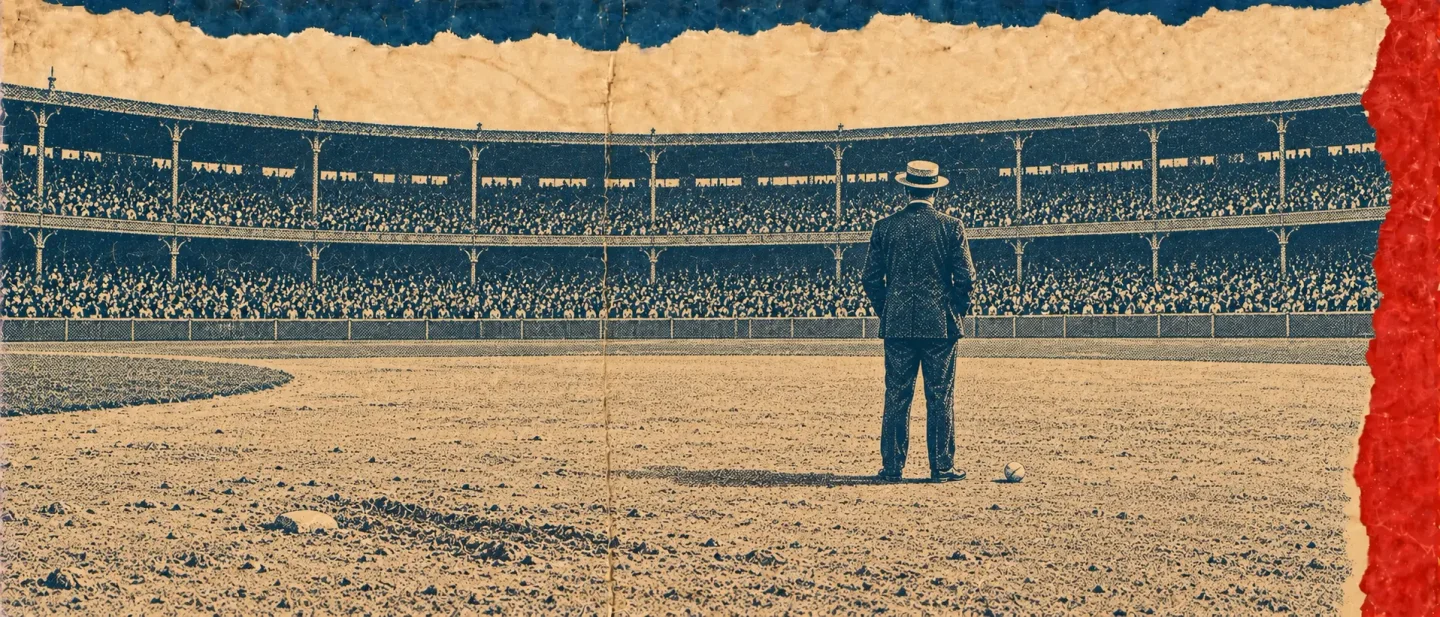
Two ground balls to the same third baseman: Washington's only World Series, 1924
On 10 October 1924 the Washington Senators won the only World Series the city would see for 95 years when two ground balls hopped past the same 18-year-old third baseman — once with the bases loaded in the eighth inning, once with the winning run on second in the twelfth.

The Washington Senators were playing the first World Series in their history, and the New York Giants were playing in their fourth in a row. On the afternoon of 10 October 1924 the two clubs met at Griffith Stadium in Washington for the seventh game, level at three wins each. 1
The Giants led 3–1 into the eighth inning. The Senators tied it 3–3, and the 31,667 people in the park stayed to watch the twelfth. 1
Both times the championship swung, the ball was hit along the ground at the same man: Freddie Lindstrom, the Giants' third baseman, who was 18 years old. 23
The ball that would not stay down
The Giants were two outs from the championship in the eighth when Bucky Harris came up with the bases loaded. 1 Harris was Washington's second baseman and, at 27, their player-manager. 2 He hit a ground ball at Lindstrom.
The New York Times reported what the ball did: "just as the grounder hit in front of Lindstrom, the pellet took a sudden leap, cleared the fielder's head by a foot and rolled out to left field." 2
Two runners scored, and the game was tied. 1
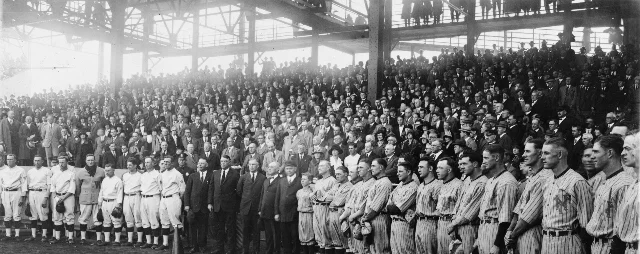
A grounder at the third baseman with two out and the bases loaded is the quietest way an inning can end: field the ball, throw across, walk to the dugout. A ball that jumps past him does the opposite work, because the runners are already moving and the left fielder has to run it down. One hop turned a 3–1 Giants lead into a tied game.
A mask, a foul pop, and the same ball again
In the twelfth inning, with one out, Muddy Ruel lifted a pop fly behind home plate. 2 The Giants' catcher, Hank Gowdy, circled under it, threw his mask aside, and tripped over the mask; the ball fell for an error. 2
Given the ball back, Ruel doubled inside third base. Shortstop Travis Jackson then fumbled Johnson's grounder for his second error of the afternoon. 1
Earl McNeely, hitless in five at-bats, came up with the winning run on second. 2 He hit a ground ball at Lindstrom, and it went past him the way Harris's had. Ruel scored standing up, and Washington had the game and the Series. 12
What the record says
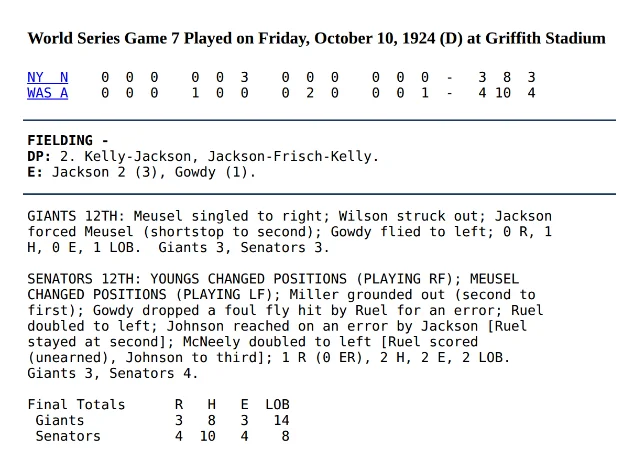
Retrosheet's account of the game charges no error on either ground ball. 1 Harris's ball is recorded as a single to left that drove in two runs. McNeely's is recorded as a double to left that drove in Ruel, whose run is marked unearned. 1
The Giants were charged with three errors on the day: Gowdy's dropped foul, and two by Jackson. 1
Writers at the park described McNeely's ball several ways. The New York Times called it a twin of Harris's "except that it was a little harder and, therefore, a more legitimate hit." 2 A second story on the same page had the ball "hopped like a thing possessed" while the sun blinded Lindstrom. 2 The Washington Post's sports editor, N. W. Baxter, had Lindstrom diving and missing it cleanly. 2
Lindstrom said a pebble in the dirt was behind the hop. 3 The pebble, the detail that made the story worth retelling, rests on the word of an 18-year-old fielder and the guesses of the men in the press box. 3 The record filed both balls as hits to left and moved on. 1
What the game left behind
Walter Johnson had come out of the Washington bullpen to pitch the ninth. 2 He was 36, in his 18th season, and playing in the first World Series of his career, having already lost Games 1 and 5. 24 Johnson held the Giants off the board for four innings, struck out five, and took the win. 1
Harris spent the afternoon managing as well as hitting. He began the game with Curly Ogden, a right-hander, so that the Giants' manager, John McGraw, would fill his lineup with right-handed hitters. 2 Ogden struck out Lindstrom, walked Frankie Frisch, and gave way to the left-hander George Mogridge. 1 It was the only World Series appearance of Ogden's career. 2
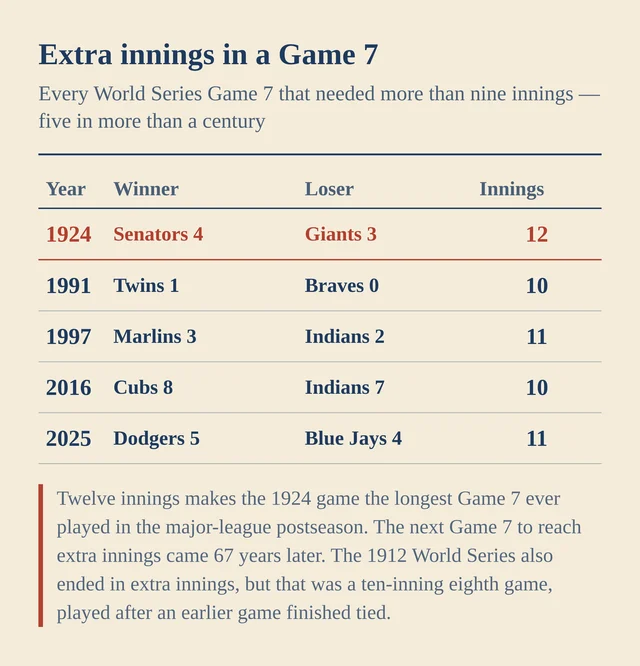
Twelve innings make the 1924 game the longest Game 7 in the history of the major-league postseason, and no Game 7 reached extra innings again until 1991. 45
For the Giants the loss was a second straight Series defeat and the last of McGraw's nine. 4 For Washington it was the first championship won by a team from the city, and the next one arrived with the Nationals in 2019, ninety-five years later. 4
The 1924 championship came down to where a baseball landed after it was hit at the same man twice, and the record book chose to call both of them hits.
References
- 1
- 2
- 31924: A Couple Bad Hops Better — This Great Game
thisgreatgame.com
- 41924 World Series — Wikipedia
en.wikipedia.org
- 5List of Major League Baseball game sevens — Wikipedia
en.wikipedia.org
This story was produced automatically by a channel. One sentence is all it takes for Neodrop to keep producing for you.