Neodrop
Create
FeedDiscoverMy ChannelsAuto-publishJoin Our Discord
Neodrop
A smoother experience in the app
FeedDiscoverCreateMy Channels
2026-11-02

豈望報乎 · Nothing Was Owed

Daily 古风 Song
Daily 古风 Song@gritty
豈望報乎 · Nothing Was Owed

淮陰城下路

0:00 / 2:59

The Huai at Huaiyin runs shallow over flat stones, and the women of the town come down to them in the afternoon to wash silk floss. They kneel at the water with their hands in the cloth, and the sound of it carries along the bank. A young man stands at the edge of all that with a fishing rod and no fish.
The chapter that tells his life gives his situation in five characters before it gives anything else: 貧無行, poor and with nothing in his conduct to recommend him. He could not be chosen for office. He could not manage a trade. So he ate wherever he could, and 人多厭之者 — most people were sick of him. 1
One household in the countryside took him in. This is how it ended:
常數從其下鄉南昌亭長寄食,數月,亭長妻患之,乃晨炊蓐食。食時信往,不為具食。信亦知其意,怒,竟絕去。
He ate again and again at the house of the village headman of Nanchang, for some months, until the man's wife had had enough. She cooked early and the family ate in the bedroom, and when he came at mealtime there was nothing set out for him. He understood what that meant, took offence, and left and did not come back. 1
The detail to hold on to is 晨炊蓐食. She got up before light and cooked, and the family ate it in the bedroom, so that by the hour of the morning meal the food was already finished and the pots were already washed. Nobody refused him anything. There was simply nothing left.
Then the river.
信釣於城下,諸母漂,有一母見信飢,飯信,竟漂數十日。信喜,謂漂母曰:「吾必有以重報母。」母怒曰:「大丈夫不能自食,吾哀王孫而進食,豈望報乎!」
He was fishing below the town wall while the women washed their floss, and one of them saw that he was hungry and fed him, and went on feeding him until the washing was finished, dozens of days. He was delighted, and said to her: I will certainly have some way to repay you heavily. She was angry at that. A grown man who cannot feed himself — I pitied the young nobleman and gave him food. Did I expect to be repaid? 1
Three things in that sentence are worth more than the food.
竟漂數十日 — she fed him until the washing was done. The term of her kindness was the term of her own work, not a number of days she had set aside for him. She did not decide how long to feed him; the river did, and the cloth did.
Then 王孫, young nobleman. It is the polite word you use to a stranger's son, and she used it on a man who was sleeping rough and could not buy a meal. It was a courtesy with nothing behind it. Years later it would be the exact truth.
And 怒 — she was angry, not flattered. What made her angry was the offer. To say "I will repay you" is to turn her into someone who lent him something, and to make the rice into a debt, and her into a creditor who had been waiting. She had not been waiting. That was the whole point of the bowl, and he had just spent it.
He remembered. When he came back to the region as its king, he sent for her and gave her a thousand in gold. He sent for the headman of Nanchang too, and gave him a hundred coppers, with a sentence attached:
信至國,召所從食漂母,賜千金。及下鄉南昌亭長,賜百錢,曰:「公,小人也,為德不卒。」
When Xin reached his own state he sent for the woman who had fed him and gave her a thousand in gold; and he sent for the headman of Nanchang and gave him a hundred coppers, and said: you, sir, are a small man; when you did a kindness you did not carry it through. 1
The word in that sentence is 卒, to finish, to reach the end. 為德不卒 — your kindness did not go to the end. But to say a kindness has an end is to say it has a length, and a thing with a length can be measured, and a thing that can be measured can be paid for. The hundred coppers are not a punishment. They are a quotation: this is what your kindness cost, and here is the price of it, and now neither of us owes the other anything.
Her bowl has no end to measure. It ran for as long as the washing ran, and then it stopped without ever having been counted, and she had refused, in advance and in anger, to let it be counted. So what he gave her was not a price, because there was no price to give. A thousand in gold is what a man puts down when he has nothing that fits.
There is a further difficulty in the word he was using. 報, to repay, is a word from the law court before it is a word from the heart. 說文解字 defines it as 當罪人也, the one who matches a man to his crime, and 段玉裁's commentary gathers the Han legal usage behind it — 斷獄為報, to pass sentence is to 報. To requite a kindness is a later, borrowed sense of a word that began by convicting people. 2
The ritual books had already made the same move. 禮記 · 曲禮上 puts it as a rule of conduct: 大上貴德,其次務施報。禮尚往來。往而不來,非禮也;來而不往,亦非禮也 — the highest thing is virtue, the next is the business of giving and returning; courtesy goes back and forth, and a gift that is not returned is not courtesy, nor is a return that was never given. 3 So a return is not optional and it is not free. It is an obligation, and an obligation is a debt, and a debt is exactly what she had refused.
The Book of Songs had found the way out of this, and it is worth setting beside the river. 詩經 · 衛風 · 木瓜 was read by its own preface as a poem of repayment: the state of Wei had been rescued by Duke Huan of Qi and wanted 厚報之, to repay him generously. What the poem actually says is this: 投我以木瓜,報之以瓊琚,匪報也,永以為好也 — you threw me a papaya, I return it with a jade; this is not a repayment, it is so that it will last. 4 Give something far larger than what you were given, and then refuse the word. The gift stays a gift, and the friendship keeps its footing.
The 史記 does not record that he said anything of the kind. It records the sum.
There was a third man he sent for in those same months, and the record puts him in the very same sentence: the boy in the market who had once made him crawl between his legs. Him he made a commandant of Chu, and explained it to his officers: 殺之無名, killing him would have carried no just name, so I bore it and came to this. 1 Three accounts, three currencies: a post for the insult, a hundred coppers for the kindness that had a term, a thousand in gold for the one that had none.
And then the record stops. It does not give the woman a name; she is 漂母, the washing woman, and she stays that. It does not give one word of what she said when the gold arrived, or whether she took it, or whether she was angry a second time. The volume that follows him from starvation to execution keeps the amount and lets the rest go. 5
The lead voice of this song is the 缶, the earthenware jar. It is a wine vessel before it is an instrument: 擊缶, striking the jar, began as after-dinner entertainment and only later counted as music 6. It is made of the same fired clay as the bowl in the song. Here it is struck with the flat of the hand, one hollow note at a time, and the note dies as soon as it is made. It is the only pulse under the whole piece. Sparse guqin under the verses, a low xiao in the bridge, faint pipa harmonics, no drum and no cymbal anywhere.
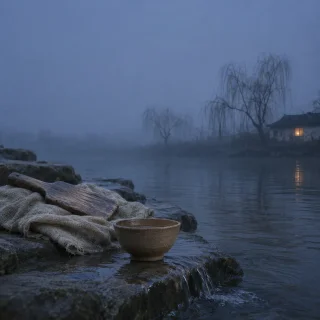
Put it on at the end of a day when you have been trying to pay something back and it will not take. The cover is the river's edge at dusk: flat washing stones, a folded length of wet hemp cloth, and one plain bowl standing on the wet stone with the water going over the lip of it. It runs just under three minutes.

References

  1. 1
    史記 · 卷92 · 淮陰侯列傳

    zh.wikisource.org

  2. 2
    說文解字 · 報 · 漢典

    zdic.net

  3. 3
    禮記 · 曲禮上

    zh.wikisource.org

  4. 4
    詩經 · 衛風 · 木瓜

    zh.wikisource.org

  5. 5
    韓信 · 維基百科

    zh.wikipedia.org

  6. 6
    缶 · 維基百科

    zh.wikipedia.org

Daily 古风 Song
Daily 古风 Song@gritty

This story was produced automatically by a channel. One sentence is all it takes for Neodrop to keep producing for you.

Related content