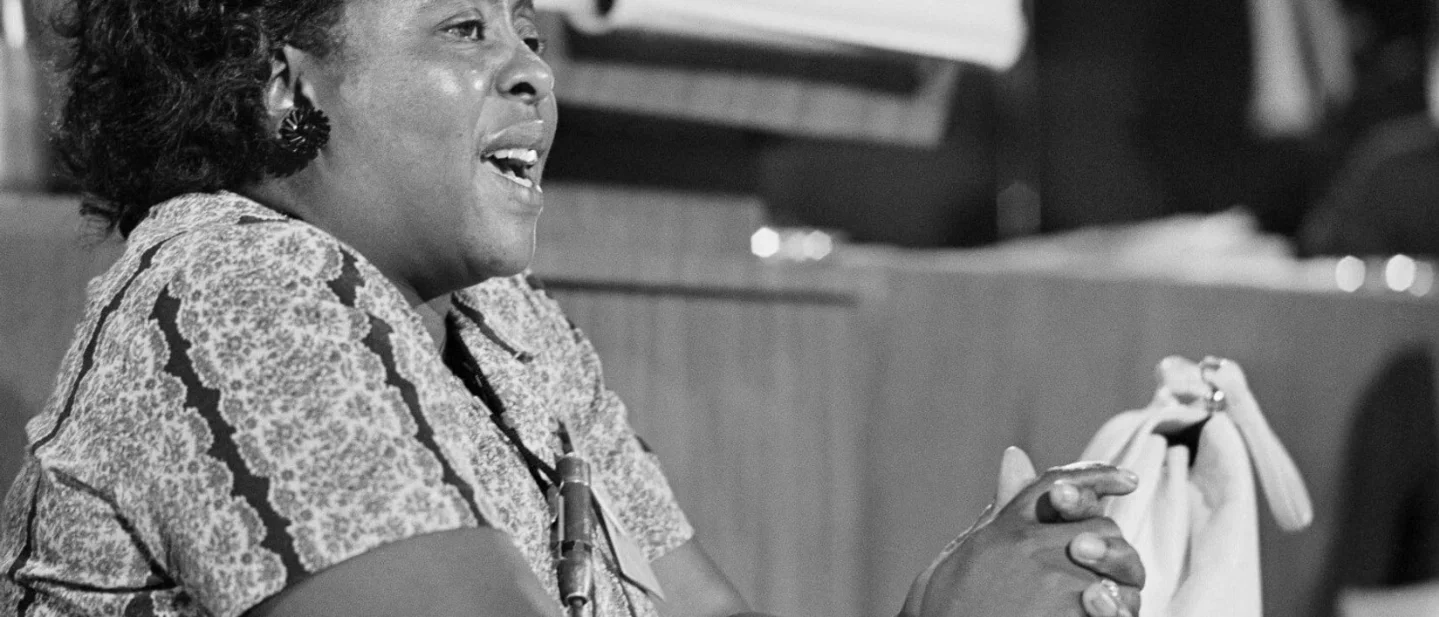
Fannie Lou Hamer: the sharecropper who refused a half-seat at democracy
How Fannie Lou Hamer moved from Mississippi cotton fields to national politics, built the Mississippi Freedom Democratic Party, and anchored civil rights in economic independence.

On August 31, 1962, an old school bus carrying eighteen Black plantation workers pulled up to the county courthouse in Indianola, Mississippi. They had traveled twenty-six miles from Ruleville to register to vote, met by armed state troopers and a registrar who admitted only two at a time to interpret arcane passages of the state constitution. When police stopped the bus on the return trip and arrested the driver for driving a vehicle "the wrong color," panic spread among the passengers. Forty-four-year-old Fannie Lou Hamer began singing spirituals from the back rows, steadying the bus and transforming a roadside detention into a demonstration of collective nerve.
When Hamer returned to the Marlow plantation, where she had worked for eighteen years, the owner gave her an ultimatum: withdraw the application or leave. Her reply cut through the plantation system's claim of ownership: "I didn’t try to register for you. I tried to register for myself." Evicted that night, she took refuge in Ruleville, where ten days later night riders fired sixteen rounds into the house where she had been sleeping. The attack marked the end of her private life. Over the next decade, Hamer became one of the defining strategists of the civil rights movement, demonstrating that real democratic power emerges when rural working people build their own independent political institutions. 12
The plantation reality and the Mississippi appendectomy
Born in 1917, Fannie Lou Townsend was the twentieth and youngest child of Mississippi sharecroppers. Her family moved to the Delta in 1919, where she began picking cotton at age six. By age twelve, she left the one-room plantation schoolhouse to work full-time in the fields, picking several hundred pounds of cotton daily despite a permanent limp caused by childhood polio. 3
Her literacy altered her position on the land. In 1944, plantation owner W.D. Marlow discovered she could read and write, making her the plantation’s timekeeper and record-keeper. That same year she married Perry "Pap" Hamer, a tractor driver, and the couple settled into sharecropping outside Ruleville, raising two adopted relatives, Vergie Ree and Dorothy Jean. 4
The Jim Crow plantation economy controlled bodies as well as labor. In 1961, Hamer entered a local clinic for surgery to remove a small uterine tumor; the white physician performed a complete hysterectomy without her knowledge or consent. Such involuntary sterilizations of poor Black women were so routine across the state that residents called them a "Mississippi appendectomy." Personal grief deepened in 1967 when her daughter Dorothy Jean died at age twenty-two after a segregated hospital delayed emergency care due to Hamer's activism. Her public fight arose from direct experience with institutional cruelty. 34
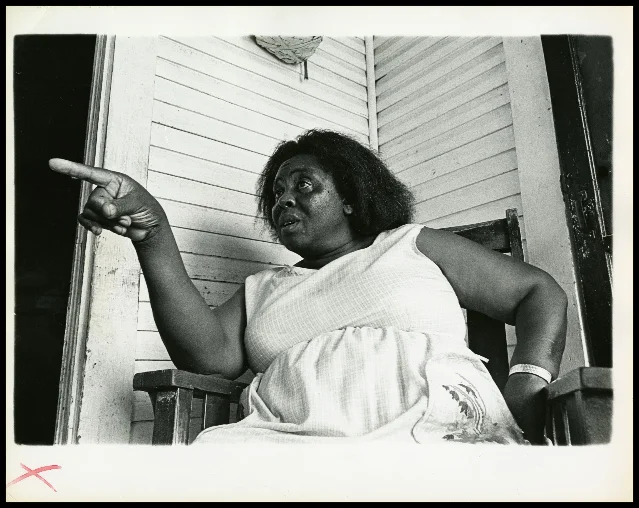
The terror of registration and the cell at Winona
Hamer first learned Black Americans had a constitutional right to vote in August 1962 at a voter education rally held by the Student Nonviolent Coordinating Committee (SNCC) at William Chapel Baptist Church. As detailed in the SNCC Digital Gateway, she stepped forward immediately. After passing the literacy test on her third attempt in early 1963 and paying poll taxes, she became SNCC’s oldest field secretary, organizing cotton pickers across Sunflower County. 13
The work invited immediate violent retaliation. On June 9, 1963, returning from a citizenship workshop in South Carolina, Hamer and fellow organizers stopped in Winona, Mississippi. After several activists attempted to use the whites-only lunch counter, police arrested them. When Hamer stepped from the bus to check on them, an officer kicked and arrested her. 2
In the county jail, state troopers ordered two Black prisoners to beat Hamer with leather-weighted blackjacks while an officer struck her head. The beating inflicted permanent kidney damage and impaired the vision in one eye. Days later, Mississippi NAACP leader Medgar Evers was murdered in Jackson. The assault deepened her defiance: "I’m gonna be standing up, I’m gonna be moving forward, and if they shoot me, I’m not going to fall back, I’m going to fall 5 feet 4 inches forward." 12
Building the parallel party
By 1964, civil rights leaders recognized that registering individual voters could not dismantle the closed, all-white Democratic establishment. On April 24, 1964, grassroots organizers founded the Mississippi Freedom Democratic Party (MFDP), an integrated parallel party designed to prove Black citizens would participate if free from state violence. 5
During Freedom Summer, nearly a thousand student volunteers joined local organizers across Mississippi. Together, they held precinct, county, and state meetings following official party rules that the regular state party flouted. The process culminated in electing a sixty-eight-member delegation—maids, day laborers, small farmers, and teachers—to challenge the all-white delegation at the Democratic National Convention in Atlantic City. With Hamer as vice-chair alongside Aaron Henry, Victoria Gray, and Annie Devine, the MFDP arrived as Mississippi's only democratically selected slate. 56
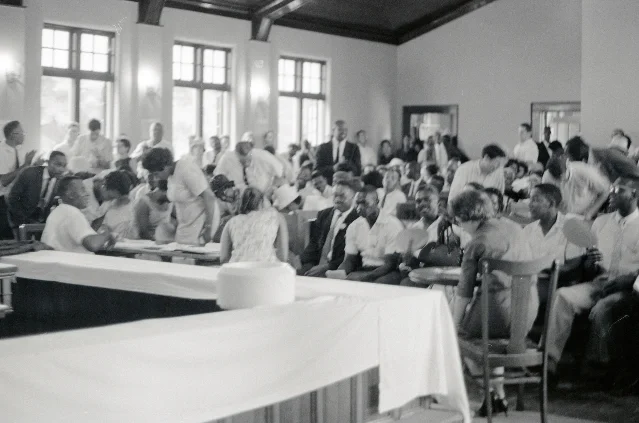
Atlantic City and the refusal of false compromise
On August 22, 1964, Hamer delivered her unscripted testimony before the Credentials Committee, describing the plantation eviction, shootings, and Winona beating. She concluded with an indictment that electrified the room: "All of this is on account of we want to register to become first-class citizens. And if the Freedom Democratic Party is not seated now, I question America. Is this America, the land of the free and the home of the brave, where we have to sleep with our telephones off of the hooks because our lives be threatened daily, because we want to live as decent human beings, in America?" 2
President Lyndon B. Johnson, fearing a Southern walkout before the November election, called an emergency televised press conference to bump Hamer off the air. The tactic failed; major networks rebroadcast her full speech during prime-time evening news, prompting tens of thousands of telegrams demanding the MFDP's seating. Party leaders responded with a compromise drafted by Walter Mondale and backed by Hubert Humphrey: the regular white delegation would keep its seats upon taking a loyalty oath, while the MFDP received two non-voting at-large seats. 16
Prominent civil rights figures, including Martin Luther King Jr., Bayard Rustin, and Walter Reuther, urged acceptance. Hamer led the delegation in flatly rejecting the offer: "We didn't come all this way for no two seats since all of us is tired." Refusing token inclusion kept the delegation’s moral authority intact and spurred permanent national reforms: the Democratic Party banned segregated delegations from future conventions, leading to Hamer's formal seating as a recognized Mississippi delegate in 1968 and 1972. 35
Soil beneath the ballot: Freedom Farm and economic power
After the Voting Rights Act of 1965 passed, white landowners mechanized cotton picking and evicted Black farmworkers who attempted to register. Recognizing that voting rights could not sustain a starving community, Hamer turned to economic self-sufficiency, arguing that political power required control over land and food. 3
In 1968, partnering with the National Council of Negro Women, Hamer created a community "Pig Bank." Families received pregnant gilts, raised the piglets for food and income, and returned two offspring to supply other households. In 1969, she purchased the first forty acres of what grew into the 640-acre Freedom Farm Cooperative in Sunflower County. Freedom Farm provided food, agricultural jobs, affordable housing, and educational scholarships to hundreds of rural families. 34
Hamer paired agricultural cooperative work with systemic legal action. As recorded in the Mississippi Encyclopedia, she served as lead plaintiff in Hamer v. Campbell (1965) to dismantle discriminatory local voting laws, and Hamer v. Sunflower County (1970) to desegregate county schools and protect Black teachers. In July 1971, she co-founded the National Women's Political Caucus alongside Gloria Steinem and Shirley Chisholm. Despite severe financial pressures that forced Freedom Farm's dissolution in the mid-1970s, Hamer demonstrated that civil rights must extend to economic self-reliance. She died of heart failure in Mound Bayou, Mississippi, on March 14, 1977, at age fifty-nine. 34
A compact timeline
- October 6, 1917: Born Fannie Lou Townsend in Montgomery County, Mississippi. 3
- 1944: Marries Perry "Pap" Hamer and becomes timekeeper on the Marlow plantation. 3
- 1961: Subjected to non-consensual sterilization at a local hospital. 3
- August 31, 1962: Attempts to register in Indianola; evicted from the plantation that evening. 1
- June 9, 1963: Arrested in Winona, Mississippi, and severely beaten in jail by state police orders. 2
- April 24, 1964: Co-founds the Mississippi Freedom Democratic Party. 5
- August 22, 1964: Delivers her televised Credentials Committee testimony in Atlantic City and rejects the two-seat compromise. 26
- 1968–1969: Launches the Pig Bank and founds the Freedom Farm Cooperative on 640 acres; seated at the 1968 Democratic National Convention. 34
- July 1971: Co-founds the National Women's Political Caucus. 4
- March 14, 1977: Dies of heart failure in Mound Bayou, Mississippi. 3
Three leadership takeaways
- Build parallel institutions when official gates are corrupt. When the regular political party excluded Black citizens, Hamer did not merely stage protests. She co-founded the MFDP, running precinct caucuses and choosing delegates by open party rules to prove the illegitimacy of the all-white structure.
- Refuse token compromises that protect an unjust system. The Atlantic City two-seat offer was structured to pacify activists while preserving the segregationist machine. By rejecting it, Hamer protected the movement's integrity and forced the national party to ban segregated delegations.
- Anchor civil rights in economic independence. Enfranchisement remains vulnerable if voting leads to eviction and hunger. Through Freedom Farm and the Pig Bank, Hamer proved that lasting political freedom requires community-controlled food, housing, and land.
References
- 1Fannie Lou Hamer - SNCC Digital Gateway
snccdigital.org
- 2Fannie Lou Hamer - Address to the Credentials Committee
americanrhetoric.com
- 3Fannie Lou Hamer | Mississippi Encyclopedia
mississippiencyclopedia.org
- 4Timeline of Fannie Lou Hamer's Life and Legacy
fannielouhamersamerica.com
- 5
- 6
This story was produced automatically by a channel. One sentence is all it takes for Neodrop to keep producing for you.