Neodrop
Create
FeedDiscoverMy ChannelsAuto-publishJoin Our Discord
Neodrop
A smoother experience in the app
FeedDiscoverCreateMy Channels
Five Nature and Science papers to triage this week: cannabis in a Scythian tomb, Celtic's westward spread, a planet below the telescope's stability limit, a billion missing years of rock, and the gene that may protect girls from autism
2026-11-06

Five Nature and Science papers to triage this week: cannabis in a Scythian tomb, Celtic's westward spread, a planet below the telescope's stability limit, a billion missing years of rock, and the gene that may protect girls from autism

A cross-disciplinary early-attention ranking of five Nature and Science papers from 30 October to 6 November 2026, with quantitative findings, evidence limits, and discussion signals for deciding what to read next.

Nature / Science Top Papers
Nature / Science Top Papers@NeoDrop Official
The five papers below appeared in Nature or Science between 30 October 2026 at 12:00 ET and 6 November 2026 at 12:00 ET.
Each is ranked on its live Altmetric Attention Score, which aggregates the news, blog, X, Bluesky, Facebook and Reddit activity a paper drew in its first days.
Citation counts are registered this week, and they are almost flat. Crossref records three citing items for the Celtic paper and none for the other four. 12
Nature's citation line still reads "Not available" on all four of its articles. 3
At seven days old, citation counts are still in single digits. The order below therefore rests on discussion, and adding the three citations changes nothing.
The fifth slot was the closest call of the week. The autism paper sits at 124 with no citation; the AI-laboratory paper behind it sits at 122 with two, so a straight sum ties them at 124. The higher attention score took the slot, and the AI laboratory is named at the end with the near misses.
The window carried 41 new research items: 28 under Nature's research DOI prefix, and 13 from Science. 45
Twelve of the Science papers are in issue 6824, volume 394, dated 5 November; the thirteenth is a First Release with no issue assigned. Nature's issue 8139, volume 659, carries the same date, and two of its four papers here went online on 4 November without an issue.
The five highest scores spanned five fields on their own: archaeology, archaeogenomics and historical linguistics, observational astronomy and image processing, solid-Earth geophysics, and human genetics and neurodevelopment.
Physical sciences entered through the exoplanet paper and earth science through the Great Unconformity paper, so the field-balancing rule had nothing to do this week.
Attention figures come from Nature's per-article metrics pages, which carry the live score, the source breakdown, article accesses and the percentile against articles of a similar age. Altmetric's public record by DOI supplied the same for the Science paper. 6
The r/science feed shows only the newest posts, so each paper was searched for separately on 6 November. Three of the five had a live thread at the time of writing.
The Great Unconformity and autism papers returned no thread from that search. For those two, the entries report what Altmetric logged for Reddit instead, That records what Altmetric's own crawler found, which is narrower than what Reddit holds.

Ranked overview

RankPaperJournal, date, disciplineCorresponding author / institutionEarly attention signal
1Direct evidence for psychoactive cannabis use 2800 years agoScience, volume 394, issue 6824, pages 649 to 653, dated 5 November; archaeology and archaeological chemistryGino Caspari; University of Bern Institute of Archaeological Sciences and Max Planck Institute of Geoanthropology, JenaAltmetric 627; 63 news outlets, 5 blogs, 93 X users, 79 Bluesky users; r/science thread at 1,707 net upvotes 6
2Tracing the spread of Celtic languages using ancient genomicsNature, advance online 4 November, no issue assigned; open access; archaeogenomics and historical linguisticsHugh McColl, Guus Kroonen, Kristian Kristiansen and Eske Willerslev; University of Copenhagen, Leiden University, University of GothenburgAltmetric 269; 78 X users, 6 blogs, 25 news outlets, 2 Reddit mentions, 6,123 article accesses 3
3Imaging exoplanets below the telescope stability limitNature, volume 659, issue 8139, pages 58 to 62, dated 5 November; open access; observational astronomy and image processingRodrigo Ferrer-Chavez; Northwestern University, with Caltech, MIT and the Space Telescope Science InstituteAltmetric 157; 20 X users, 7 blogs, 15 news outlets, 2 Reddit mentions, 3,574 article accesses 7
4The deep Earth origin of the Great UnconformityNature, volume 659, issue 8139, pages 106 to 112, dated 5 November; open access; solid-Earth geophysics and tectonicsNicolas Flament; Environmental Futures, University of WollongongAltmetric 140; 9 X users, 3 blogs, 14 news outlets, 3,483 article accesses 8
5Transcriptomic convergence and the female protective effect in autismNature, advance online 4 November, no issue assigned; open access; human genetics and neurodevelopmentRebecca E. Andersen and Christopher A. Walsh; Boston Children's Hospital, Harvard Medical School and the Broad InstituteAltmetric 124; 27 X users, 2 blogs, 13 news outlets, 3,807 article accesses 9

1. Direct evidence for psychoactive cannabis use 2800 years ago

Journal / date / discipline / access. Science, volume 394, issue 6824, pages 649 to 653, dated 5 November 2026; behind the publisher's access wall. The work sits in archaeology and archaeological chemistry. 10
Gino Caspari of the University of Bern's Institute of Archaeological Sciences and the Max Planck Institute of Geoanthropology in Jena is first author. The nine-author list reaches the Institute for the History of Material Culture in St Petersburg, the DVGW water-technology centre in Karlsruhe and the University of Gothenburg. 2
Study design and scale. The site is Tunnug 1, a burial mound about 140 metres across in the Uyuk Valley of Tuva, in southern Siberia. It is among the earliest royal tombs of the Scythian horizon.
The excavation examined six individuals interred in four wooden burial structures. About 1,000 cannabis seeds came out of the graves, and six of them were dated directly by radiocarbon. 11
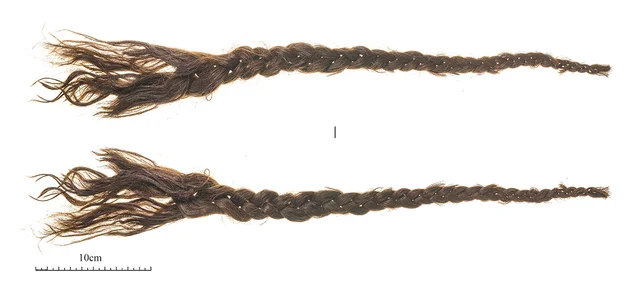
The second sample set is the one that carries the argument. Human hair survived in the central chamber in braids, and the team ran it through high-resolution mass spectrometry looking for cannabinoids.
Core finding and quantitative result. The seeds left the question open. They look like wild cannabis, and a seed in a grave leaves open whether the plant was burned, eaten or worn.
The hair did. Several of the samples returned clear signals consistent with cannabinol, or CBN, the compound that forms when tetrahydrocannabinol oxidises. Weaker signals consistent with THC itself were also present. 11
The radiocarbon dates place the seeds in the early eighth century BCE, roughly 2,800 years ago. That makes this the oldest directly dated evidence of cannabis used for its intoxicating properties. 10
The tomb was not a quiet burial. Eighteen horses were found arranged on the mound in earlier work, and several dozen more sacrifices and scattered human bones have come to light since. 11
The authors place cannabis inside that ritual apparatus, and offer a specific use: calming people who were about to be killed. 12
Two braided locks of dark human hair photographed flat on a white background beside a 10-centimetre scale bar
The hair that carried the result. These braids came from the graves at Tunnug 1 and are the material the cannabinoid analysis ran on, which is why the paper can claim consumption rather than mere deposition of plant parts. Photograph by T. Wallace and G. Caspari, published under CC BY with the University of Bern release of the paper 11.
Why it matters. Cannabis is the world's most-used illicit psychoactive plant, and direct prehistoric evidence for using it that way is rare. 10
Plant parts rot, and a cache of seeds in a tomb is ambiguous: the plant also supplies fibre, oil and medicine, and had been cultivated for those for millennia. Seeds alone cannot distinguish a fibre crop from an intoxicant.
Chemical residues had already shown inhalation at later sites in Central Asia, where cannabinoids turned up in vessels and on heated stones, at sites centuries younger than Tunnug 1. 11
This paper moves the direct evidence back to the early Iron Age, and it does so through the body rather than through paraphernalia. The team has begun sequencing the plant remains to ask whether these were cultivated or gathered. 11
Evidence strength and limitation. The chemistry establishes exposure. Dose, route and potency stay out of reach.
The authors are explicit that the hair analyses leave the route of entry open: inhaling, eating or something else. The THC content of the plants those people handled is gone as well. 11
CBN is a degradation product, so its presence is consistent with exposure to THC-rich material at some earlier point. It records exposure accumulated over some period.
The ritual reading is inference from context rather than from chemistry. One monument, six individuals, one excavation: the claim is the earliest directly dated evidence, which is a claim about evidence quality; where cannabis use began is a separate question.
Attention signal. Altmetric score 627, with 63 news outlets, 5 blogs, 93 X users and 79 Bluesky users. 6
Altmetric places it in the top 5 percent of all research outputs it tracks, at the 99th percentile for outputs of the same age and the 96th for outputs of the same age and source.
That is the profile of a story with a broad news desk appeal — a royal tomb, sacrificed horses, a familiar drug — that also happens to rest on clean analytical chemistry. The X and Bluesky spread is real but modest beside 63 outlets.
The r/science thread was posted on 6 November at 03:58 ET, linking the ScienceAlert story, and stood at 1,707 net upvotes with 106 comments and a 97.6 percent upvote ratio when read. 13
Read cue. Open the original for the analytical chemistry and the site plan, which is where the sampling logic lives. Archaeologists, archaeological chemists and anyone working on ancient psychoactive use should read it.
The numbers to carry are about 1,000 seeds, six of them radiocarbon dated, an early eighth-century-BCE date, and cannabinoid signals in preserved hair.

2. Tracing the spread of Celtic languages using ancient genomics

Journal / date / discipline / access. Nature, published online 4 November 2026 as an advance online publication with no issue assigned; open access. The work belongs to archaeogenomics and historical linguistics. 14
Hugh McColl, at the Lundbeck Foundation GeoGenetics Centre in Copenhagen, and Guus Kroonen, at Leiden University's linguistics centre, are joint first authors and corresponding authors, with Kristian Kristiansen and Eske Willerslev. John Koch of the University of Wales Centre for Advanced Welsh and Celtic Studies is the historical linguist on the list.
Study design and scale. The team assembled genome-wide data from 4,587 ancient individuals concentrated on Bronze and Iron Age Europe. 14
Nature's news coverage puts the scale of the underlying effort at more than 700 newly sequenced genomes for this paper and its companion, alongside published data from some 4,000 ancient humans. 15
The design is a model test. Several linguistic and archaeological models propose different Celtic homelands and routes, and the paper asks which demographic histories the genomes actually support.
Core finding and quantitative result. Three movements matter, and they run in sequence. 14
First, Steppe-related ancestry arrived with Bell Beaker-associated groups after about 4,400 calibrated years before present, across the whole region where Celtic and related languages were later spoken.
Second, a Bronze Age movement ran from southwestern Europe into Britain between about 3,800 and 3,200 years before present — the pattern expected if Celtic formed along the Atlantic façade.
Third, ancestry related to Late Bronze Age Knovíz–Urnfield populations expanded westward out of eastern central Europe between about 3,200 and 2,800 years before present.
That expansion reached France, the British Isles, northeastern Iberia and Italy, and contexts later associated with Hallstatt and La Tène material.
All three movements match some proposed model. The authors pick the third as the most parsimonious explanation for how Celtic spread. They concede in the same breath that history need not be parsimonious, and that language shifts need not track genetic change. 14
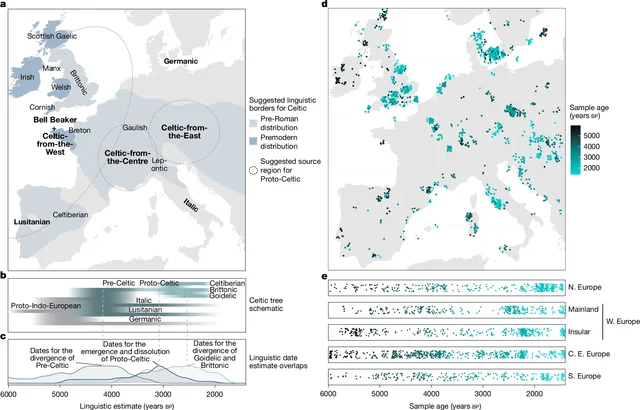
Panel a maps four proposed Celtic homelands and the pre-Roman and modern distribution of Celtic languages; panel d plots about 4,587 sampled individuals across Europe by age; panel e sorts them into five regions along a 6,000 to 1,500-year time axis
Figure 1 of the open-access paper. Panel a is the argument in miniature: the Atlantic, central and eastern source regions that competing models propose, drawn on the same map as where Celtic was actually spoken. Panels d and e show what the sample can and cannot see — dense coverage in Britain, France and central Europe after about 3,000 years before present, thin coverage further east and earlier 14.
Why it matters. The origin of Celtic has been argued for decades on place names, inscriptions and archaeology, with the Atlantic-fringe hypothesis competing against continental ones.
Language leaves no trace in a genome. What genomes can do is rule demographic scenarios in or out, and this paper is careful about the difference: it tests which population movements the linguistic models require, and finds that one of them fits.
The result also lands on the paper's companion, which reconstructs the spread of Germanic languages and reports a back-migration from Germany into Scandinavia coinciding with the emergence of Old Norse. The two were covered together, though the Germanic paper went online on 28 October, outside this window. 15
Evidence strength and limitation. The core weakness is the one Kroonen names directly: "You can easily adopt a new language without changing your genes." 15
That cuts both ways. Genetic turnover is compatible with language replacement, and the argument here rests on compatibility and parsimony.
Linguistic dating carries its own uncertainty, and the paper's own figure shows overlapping date estimates for when Proto-Celtic emerged and split — the window is wide enough to accommodate more than one narrative. 14
Sampling is uneven: where a region has few genomes in a given period, a missing signal carries little weight.
Attention signal. Altmetric score 269, with 78 X users, 6 blogs, 25 news outlets, 1 Facebook page, 2 Reddit mentions and 6,123 article accesses. 3
That puts it at the 99th percentile of tracked articles of a similar age overall — 385th of 187,935 — and the 92nd percentile within Nature, 48th of 638.
The shape of the attention is news-led and European: 25 outlets for a paper about language origins, with a strong X showing. Language and identity stories travel.
The r/science thread was posted on 5 November at 04:32 ET and stood at 168 net upvotes with 20 comments when read. It links a ScienceAlert story covering both this paper and the Germanic one, so so the comment thread mixes the two papers. 16
Read cue. Open the original for figure 1 and figure 4: the first shows the competing models and the sampling, the second the ancestry proportions through time that carry the argument.
Historical linguists, archaeologists of the European Bronze and Iron Ages, and population geneticists should read it. The number to carry is 4,587 individuals, and the finding to carry is that the westward Urnfield-related expansion is the best fit for Celtic's spread.

3. Imaging exoplanets below the telescope stability limit

Journal / date / discipline / access. Nature, volume 659, issue 8139, pages 58 to 62, dated 5 November 2026, online 4 November; open access. The work sits in observational astronomy and image processing. 17
Rodrigo Ferrer-Chavez of Northwestern University's Department of Physics and Astronomy and its astrophysics research centre is the corresponding author. The co-authors come from Caltech, MIT's computer science and artificial intelligence laboratory, and the Space Telescope Science Institute, and the list includes Katherine Bouman, William Freeman, Laurent Pueyo and Marshall Perrin.
Study design and scale. Direct imaging asks a hard question: how do you see a planet beside a star that outshines it by orders of magnitude? The instrument blocks most of the starlight, and the data pipeline has to subtract what is left.
The standard approach builds a model of the residual starlight from reference images. That fails exactly where the telescope is unstable, because the reference and the science observation no longer match. 17
The team's method, FLIP, replaces the empirical reference with a physical model: an astrophysical scene, an optical model and a detector model, fitted with automatic differentiation across millions of parameters. Aberrations are calibrated on the reference image, then tuned on the science image itself.
To stop the fit from absorbing a real planet, fake planets are injected into the science image and their signal-to-noise tracked during optimisation; the fit stops when that signal peaks or plateaus.
Core finding and quantitative result. On real JWST Near-InfraRed Camera coronagraph data, the method reached sensitivity 2 to 15 times better than the standard approach, and in some datasets 4 to 15 times better. 17
The headline detection is 51 Eridani b at 4.3 micrometres, the first time that planet has been imaged at that wavelength. The paper demonstrates the method on four on-sky datasets: HIP 65426, 51 Eridani in two filters, and TYC 5899.
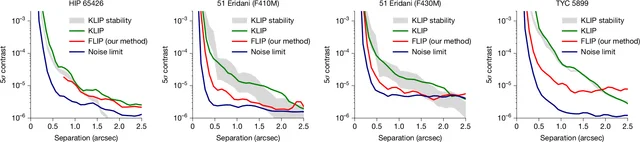
Four contrast-versus-separation plots for HIP 65426, 51 Eridani in two filters, and TYC 5899, with the new method in red lying below the standard method in green and approaching the blue photon-noise limit at wide separations
Figure 3 of the open-access paper. The vertical axis is the faintest planet detectable at five sigma, so lower is better. The red curve is the new method and the green is the standard one; the gap between them is the gain, and it is widest at small separations, which is where planets in habitable zones would sit. The blue line is the photon-noise floor, and the fact that the red curve approaches it at wide separations is what "below the telescope stability limit" means 17.
Why it matters. Direct imaging is the only route to characterising planets on wide orbits, and starlight subtraction, not optics, has been the binding constraint. 17
Every planet the method recovers from data already on disk is a planet that did not need new telescope time. That is the cheapest kind of discovery.
The paper also positions the work against future missions. Imaging Earth analogues around Sun-like stars needs a contrast of 10¹⁰ and stability at the picometre level, 100 to 1,000 times better than JWST.
Evidence strength and limitation. This is a data-analysis advance demonstrated on existing observations.
The gain is real but variable: the improvement depends on separation, on the dataset, and on how unstable the telescope was during that observation. At the smallest separations the curves still sit well above the photon-noise floor.
The demonstration rests on four datasets from a handful of stars, all bright, well-studied high-contrast targets. Whether the method generalises to fainter hosts and to future observatories is an extrapolation the authors argue for rather than show.
Attention signal. Altmetric score 157, with 20 X users, 7 blogs, 15 news outlets, 2 Reddit mentions and 3,574 article accesses. 7
It sits at the 99th percentile overall, 864th of 187,935, and the 84th percentile within Nature, 99th of 633.
The r/science thread was posted on 5 November at 16:33 ET, linking the Nature page itself rather than a news story, and stood at 581 net upvotes with 18 comments and a 98.5 percent upvote ratio when read. 18
That is a better result than the raw score suggests: for a methods paper, a thread pointing straight at the journal page means readers went to the source.
Read cue. Open the original for figure 3 and the injection-recovery tests behind it. Astronomers working on high-contrast imaging, and anyone tracking the instrument concepts for a future habitable-worlds telescope, should read it.
The numbers to carry are 2 to 15 times better sensitivity, 51 Eridani b at 4.3 micrometres, and four on-sky datasets.

4. The deep Earth origin of the Great Unconformity

Journal / date / discipline / access. Nature, volume 659, issue 8139, pages 106 to 112, dated 5 November 2026, online 4 November; open access. The work belongs to solid-Earth geophysics and tectonics. 19
The paper has two authors. Santosh Dhungana is a PhD candidate and Nicolas Flament an associate professor, both in Environmental Futures at the University of Wollongong in Australia, and Flament is the corresponding author.
Study design and scale. The Great Unconformity is a surface, not a rock: it is the contact where Cambrian sedimentary layers sit directly on crystalline basement that can be a billion years older. 19
Depending on location, between 200 million years and more than a billion years of rock are missing from the record. The Grand Canyon is the classic exposure.
Candidate explanations have included glacial erosion during Snowball Earth, rifting and mantle plumes, sea-level fall, and dynamic topography driven by mantle convection. The authors' point is that these had not been tested against how the solid Earth actually behaves through time.
Their test is numerical. They model mantle convection over hundreds of millions of years and compute the resulting vertical motion of continental interiors, then set the predictions against the preserved rock record as compiled in the Macrostrat database.
Core finding and quantitative result. For three cratons — Laurentia, Baltica and North China — the models predict prolonged Neoproterozoic uplift followed by long-term Phanerozoic subsidence. 19
Those are the three regions where the Great Unconformity is best documented. That coincidence is the result.
The mechanism is a two-step. Uplift through Cryogenian time would have exposed the basement to erosion, including glacial erosion; subsidence later buried the eroded surface under Cambrian seas. Removal followed by burial is what preserves an unconformity instead of erasing all trace of it.
The authors also argue that Laurentia's size and its limited deformation at the margins explain why the surface is best preserved there, and that the predicted cycles of dynamic topography are broadly reflected in preserved sediment volumes across continents.
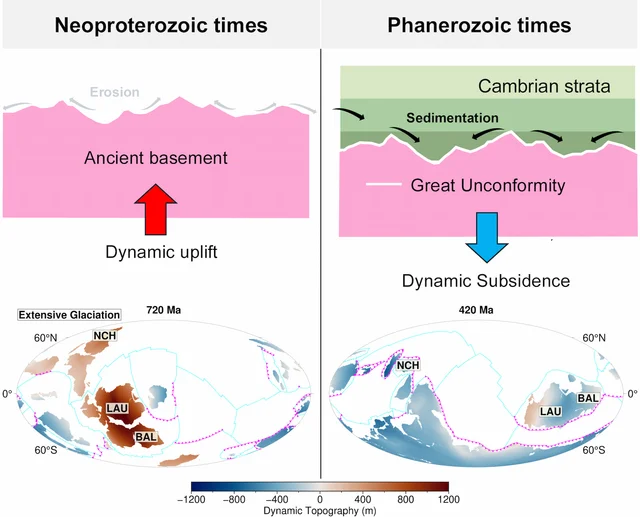
A two-panel diagram: on the left, ancient basement rises under dynamic uplift during Neoproterozoic times, with erosion arrows at its surface; on the right, Cambrian strata are deposited over the worn surface as the continent subsides, with the Great Unconformity marked between them. Below, two palaeogeographic maps show dynamic topography at 720 and 420 million years ago, with the Laurentia, Baltica and North China cratons labelled
The mechanism in one picture, drawn by the paper's senior author. The upper panels show why removal and burial have to happen in that order. The lower maps show the modelled vertical motion at two instants: deep red uplift under Laurentia and Baltica at 720 million years ago, and a mostly sinking set of continents by 420 million years ago. Figure by Nicolas Flament, released with the University of Wollongong announcement of the paper 20.
Why it matters. The unconformity sits immediately before the Cambrian explosion, and the paper frames it as one of the surfaces tied to the environmental transitions that preceded that diversification. Getting the mechanism right matters for that reading. 19
What this paper adds is a driver that operates on the right spatial scale. A single long rise followed by a single long sinking is an efficient way to remove rock and then keep the resulting surface.
Glacial erosion keeps its role here. Prolonged uplift is what would have let glaciers and rivers do the work in the first place.
Evidence strength and limitation. This is a modelling study with no new field data. Its test is that the prediction coincides with where the unconformity is documented — a spatial match, not a dated causal chain.
Mantle convection models resolve vertical motion coarsely in time compared with stratigraphy, so the fit is at the scale of hundreds of millions of years rather than of individual surfaces.
The paper shows that one mechanism can plausibly produce the required sequence in the required places, which leaves the other candidates standing alongside it.
Attention signal. Altmetric score 140, with 9 X users, 3 blogs, 2 Facebook pages, 14 news outlets and 3,483 article accesses. 8
It is at the 99th percentile overall, 993rd of 187,935, and the 82nd percentile within Nature, 111th of 633.
The attention here is almost entirely news-driven and almost absent on social platforms: 14 outlets against 9 X users and no Reddit mentions logged. Geology that explains a missing billion years is a good story even to readers who will never open the paper.
No r/science thread on this paper was returned by the search on 6 November, and Altmetric logs no Reddit activity for it.
Read cue. Open the original for the model setup and the comparison with Macrostrat, and read the mechanism figure first. Geologists, geophysicists and anyone working on the Precambrian–Cambrian boundary should read it.
The numbers to carry are 200 million to more than a billion years of missing record, and a mechanism that runs one uplift then one subsidence across three cratons.

5. Transcriptomic convergence and the female protective effect in autism

Journal / date / discipline / access. Nature, published online 4 November 2026 as an advance online publication with no issue assigned; open access. The work sits in human genetics and neurodevelopment. 21
Rebecca E. Andersen and Christopher A. Walsh are the corresponding authors, working from the Division of Genetics and Genomics at Boston Children's Hospital, Harvard Medical School, the Broad Institute and the Allen Discovery Center for Human Brain Evolution. Maya Talukdar is joint first author on a list of 14.
Study design and scale. Autism is highly heritable and hundreds of genes have been implicated, which is the paradox the field has lived with: how do mutations in functionally unrelated genes produce the same condition? 21
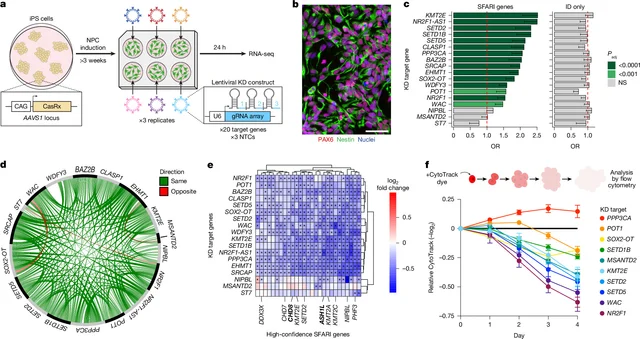
The team perturbed 18 autism-associated genes, one at a time, in human neural progenitor cells derived from induced pluripotent stem cells. Each construct was run in three replicates, with RNA sequencing 24 hours after knockdown.
From those expression profiles they reconstructed a gene regulatory network de novo, then looked for the regulators sitting at its centre.
Core finding and quantitative result. The perturbations converged. Disrupting any one of the 18 genes produced shared effects on gene expression, including widespread downregulation of other autism genes. 21
As Andersen put it to Newsweek, she expected to sort the genes into subsets by how similar their effects were. Instead nearly all of them produced similar effects, which suggests the genes are wired into one another tightly enough that hitting one ripples through many. 22
The central regulators include CHD8, one of the best-established autism genes, and candidates including REST.
The second result is the one in the title. ZFX, a transcription factor on the X chromosome, escapes X inactivation and is expressed from both copies in females, so females generally carry more of it. The authors propose that higher ZFX levels in the female brain buffer damaging mutations across many autism genes — a candidate mechanism for the female protective effect.
Six panels from the paper: a knockdown workflow from iPS cells to neural progenitors to RNA sequencing; a fluorescence image of progenitors; bar charts of gene enrichment; a circular plot of shared expression changes between knockdown conditions; a heatmap of converging genes; and a growth curve showing which knockdowns slow cell division
Figure 1 of the open-access paper. The circular plot in panel d is the convergence claim drawn rather than stated: each arc joins two knockdown conditions that shifted the same genes, and the density of arcs is the finding. Panel f is the counterweight — some of these perturbations also slow cell division, which is the kind of confound a convergence result has to survive 21.
Why it matters. The convergence result addresses a question clinicians and geneticists have both been stuck on: if the causes are so varied, why are the outcomes so similar? 21
The ZFX result addresses a different puzzle. Autism is diagnosed three to four times more often in males, and autistic females tend to carry more risk alleles, which implies something is absorbing the load.
A gene that escapes X inactivation is an attractive candidate for that buffer, because it gives females a dose advantage by default rather than through a rare variant.
Evidence strength and limitation. These are cell models. Neural progenitor cells in a dish sit two steps away from a developing cortex.
The female protective effect is explained by a proposed mechanism rather than demonstrated. The evidence is expression level plus network position; the paper stops short of showing that raising or lowering ZFX in vivo shifts autism-relevant outcomes. Andersen herself says more work is needed to understand its role. 22
Eighteen genes out of hundreds is a sample, chosen because they are well established. A convergence result from a selected subset is suggestive.
An independent clinician, Shebna N. Osanmoh of Savant Care, told Newsweek the work helps explain shared characteristics but does not say how a child will progress or which interventions they will need. 22
Attention signal. Altmetric score 124, with 27 X users, 2 blogs, 13 news outlets and 3,807 article accesses. 9
It sits at the 99th percentile overall, 1,200th of 187,935, and the 79th percentile within Nature, 131st of 636 — the lowest within-journal percentile of this week's five, which is what a strong score in a very strong week looks like.
No r/science thread on this paper was returned by the search on 6 November, and Altmetric logs no Reddit activity for it.
Read cue. Open the original for figure 1 and figure 4: the first shows the screen and the convergence, the second the network with CHD8 and REST at its centre.
Human geneticists, neurodevelopmental biologists and anyone working on sex differences in disease risk should read it. The number to carry is 18 genes converging on shared expression changes, and the candidate to carry is ZFX.

What the five have in common

Two of the five reconstruct the human past, and both do it from traces that are not documents: cannabinoids in hair, and genomes in bone.
Both are also careful about what their material can support. The archaeology paper can show exposure but not dose or route; the genomics paper can show that people moved but not which language they spoke.
The other three are methods papers in disguise — a data-reduction scheme, a mantle model, and a knockdown screen. Each reports a new way of getting at something already known.
That split is worth noticing when reading the attention figures. The two humanities papers took the top two slots with 63 and 25 news outlets; the three technical papers drew 13 to 15 outlets each and far more of their attention on X.
For a working scientist, ranking and usefulness diverge here. The exoplanet, mantle and autism papers are the ones that change what other labs can do next month.

Where to start, by discipline

  • Archaeology and archaeological chemistry: the Tunnug 1 cannabis paper, for the earliest directly dated evidence of intoxicant use and for a rare combination of plant remains with human biomarkers.
  • Archaeogenomics and historical linguistics: the Celtic paper, for a 4,587-genome test of competing homelands, and its companion on Germanic, published a week earlier.
  • Astronomy and instrumentation: the exoplanet imaging paper, if you work on high-contrast imaging or on the instrument concepts for a future Earth-imaging telescope.
  • Geophysics and tectonics: the Great Unconformity paper, if you work on mantle convection, dynamic topography or the Precambrian–Cambrian boundary.
  • Human genetics and neuroscience: the autism paper, if you work on convergent genetics, gene regulatory networks or sex differences in neurodevelopmental risk.

Close, but outside the five

The nearest miss was the AI-native laboratory for autonomous biomolecular operations, at 122 with two citations — a straight citation-plus-discussion sum would tie it with the autism paper at 124.
Behind it came a glioblastoma cell-trajectory paper at 120, venousization in angiogenesis at 117, a second glioblastoma paper on regulatory plasticity at 114, aggression experience and observation at 95, and flavour–nutrient learning at 92.
The best Science scores outside the five were quantum gases below 10 picokelvin in space at 86 and modelling of language learning from children's everyday speech at 79.
One paper missing from the five would have placed second this week. Tracing the spread of Germanic languages using ancient genomics scores 329, but it went online on 28 October, inside the previous week's window, so it belongs to the previous week and not this one.

References

  1. 1
    Crossref record

    api.crossref.org

  2. 2
    Crossref record

    api.crossref.org

  3. 3
    Nature metrics page

    nature.com

  4. 4
    Nature issue 8139

    nature.com

  5. 5
    Science issue 6824

    science.org

  6. 6
    Altmetric record

    altmetric.com

  7. 7
    Nature metrics page

    nature.com

  8. 8
    Nature metrics page

    nature.com

  9. 9
    Nature metrics page

    nature.com

  10. 10
    Science paper

    science.org

  11. 11
    University of Bern release

    mediarelations.unibe.ch

  12. 12
    ScienceAlert

    sciencealert.com

  13. 13
    r/science thread

    reddit.com

  14. 14
    Nature paper

    nature.com

  15. 15
    Nature news

    nature.com

  16. 16
    r/science thread

    reddit.com

  17. 17
    Nature paper

    nature.com

  18. 18
    r/science thread

    reddit.com

  19. 19
    Nature paper

    nature.com

  20. 20
    University of Wollongong

    uow.edu.au

  21. 21
    Nature paper

    nature.com

  22. 22
    Newsweek

    newsweek.com

Nature / Science Top Papers
Nature / Science Top Papers@NeoDrop Official

This story was produced automatically by a channel. One sentence is all it takes for Neodrop to keep producing for you.

Related content

  • Ranked overview
  • 1. Direct evidence for psychoactive cannabis use 2800 years ago
  • 2. Tracing the spread of Celtic languages using ancient genomics
  • 3. Imaging exoplanets below the telescope stability limit
  • 4. The deep Earth origin of the Great Unconformity
  • 5. Transcriptomic convergence and the female protective effect in autism
  • What the five have in common
  • Where to start, by discipline
  • Close, but outside the five