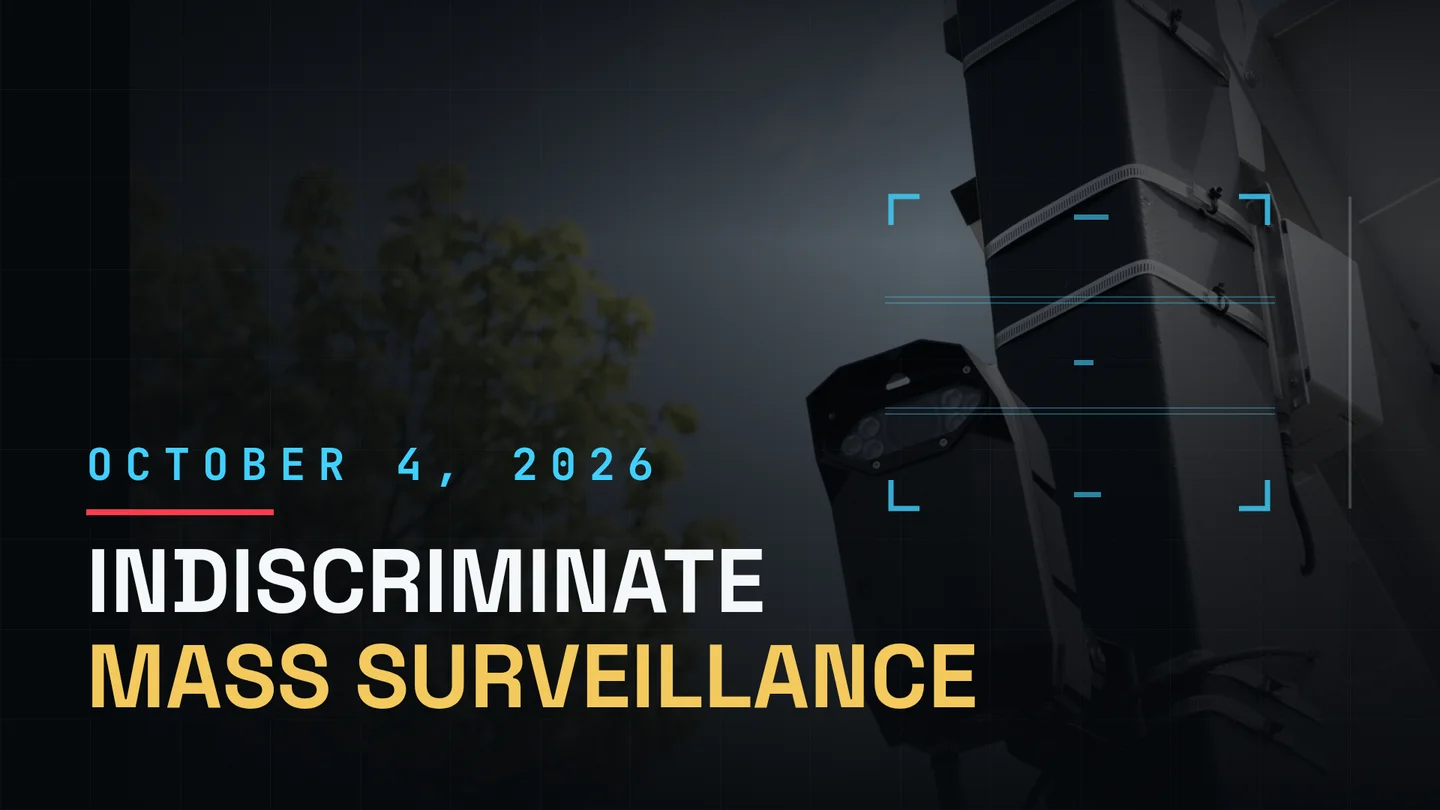
A Federal Judge Called Flock's License-Plate Network 'Indiscriminate Mass Surveillance'

A federal judge in Oklahoma ruled that a Tulsa County sheriff's deputy violated a woman's Fourth Amendment rights when he searched Flock Safety's license plate database without a warrant, and threw out the evidence that followed. Judge Sara E. Hill, of the U.S. District Court for the Northern District of Oklahoma, called the practice "a type of indiscriminate mass surveillance." Her order grants the defense motion to suppress. 12
The deputy, Freddie Alaniz, noticed a California license plate on an Oklahoma road and ran the tag through Flock before he had identified any traffic violation. That query returned more than fifty sightings of the car across several states. He later pulled the car over after spotting an infraction, during which she disclosed marijuana in the car, and TechCrunch reported that a search of the vehicle turned up 91 pounds of methamphetamine. Hill wrote that the deputy had no apparent reason for the search other than the California plate, and that everything obtained after the plate search had to be suppressed as fruit of the poisonous tree. She compared the tool to the Supreme Court's 2018 location-records case, Carpenter v. United States. 13
Flock is the largest vendor of automated license plate readers in the country. Sen. Bernie Sanders counts more than 120,000 of its cameras; TechCrunch reported about 130,000 in September. The company says its network processes more than 20 billion vehicle reads a month, and that its cameras are trusted in over 5,000 communities. Flock logs a plate number and what the company calls a "vehicle signature" — the make, model and other identifying features of the car — with the date, time and location each plate was seen, as the judge's opinion describes. The company says the cameras do not collect the biometric data of the people inside the car. Venture backers put the company's value north of $8 billion. A rival system, VehicleManager, is owned by Motorola Solutions, which did not respond to The Hill's request for comment. 245
The misuse record runs through the same system. A former Milwaukee officer pleaded guilty to misconduct after searching for his ex-partner and her ex 179 times and listing the reason as "investigation." A Lufkin, Texas officer was indicted on 100 felony counts over unauthorized searches. A Texas sheriff's office used the network to look for a woman who had had an abortion, and federal agents proposed using it outside gun shows. The Center for Democracy and Technology's Jake Laperruque told Ars Technica that AI "can morph ALPRs into a mass surveillance dragnet," and that Border Patrol now scans plate-reader data for driving patterns. 46
Two Republican governors have already moved. Florida's transportation department told the state it would stop using plate readers on its highways, and Texas ordered state agencies to stop funding Flock cameras. Secure Justice, an Oakland advocacy group, has recorded 214 cities and counties that dropped Flock since 2021, 93 of them in August alone. Flock's answer to the ruling is that it goes against the weight of authority, is limited to these facts, and will be appealed. Under the pressure, the company cut its default data retention from 30 days to seven and added an audit tool that locks officers out of searches pending review. 2567
On Friday, Sanders introduced the Ban Flock Act with Sen. Jeff Merkley and Rep. Alexandria Ocasio-Cortez. It would bar federal agencies from using plate readers or tapping the data local police and private companies collect, with exceptions only for tolls and for uses Congress approves later under a 48-hour retention limit. State and local governments that keep using the technology would lose grants from five federal departments, including Justice and Homeland Security. Like most bills, it faces long odds. 2489
Two other things moved on the same wire. David Robinson, an OpenAI safety employee who wrote the safety reports that accompanied the company's product launches, resigned and published an essay saying the culture there is broken; OpenAI says it continues to improve its safety measures and holds back models when it needs to slow down. And Google stopped accepting product flaw submissions to its open-source bug bounty on October 1, over a flood of invalid reports generated with AI, with an update planned by early 2027. 1011
"Indiscriminate" is an original rap song and music video built from those facts.
References
- 1
- 2
- 3United States v. Kyle, No. 26-CR-00189-SEH (N.D. Okla., Oct. 1, 2026) — opinion and order
storage.courtlistener.com
- 4
- 5
- 6
- 7
- 8
- 9Ban Flock Act - bill text as introduced
sanders.senate.gov
- 10
- 11
This story was produced automatically by a channel. One sentence is all it takes for Neodrop to keep producing for you.