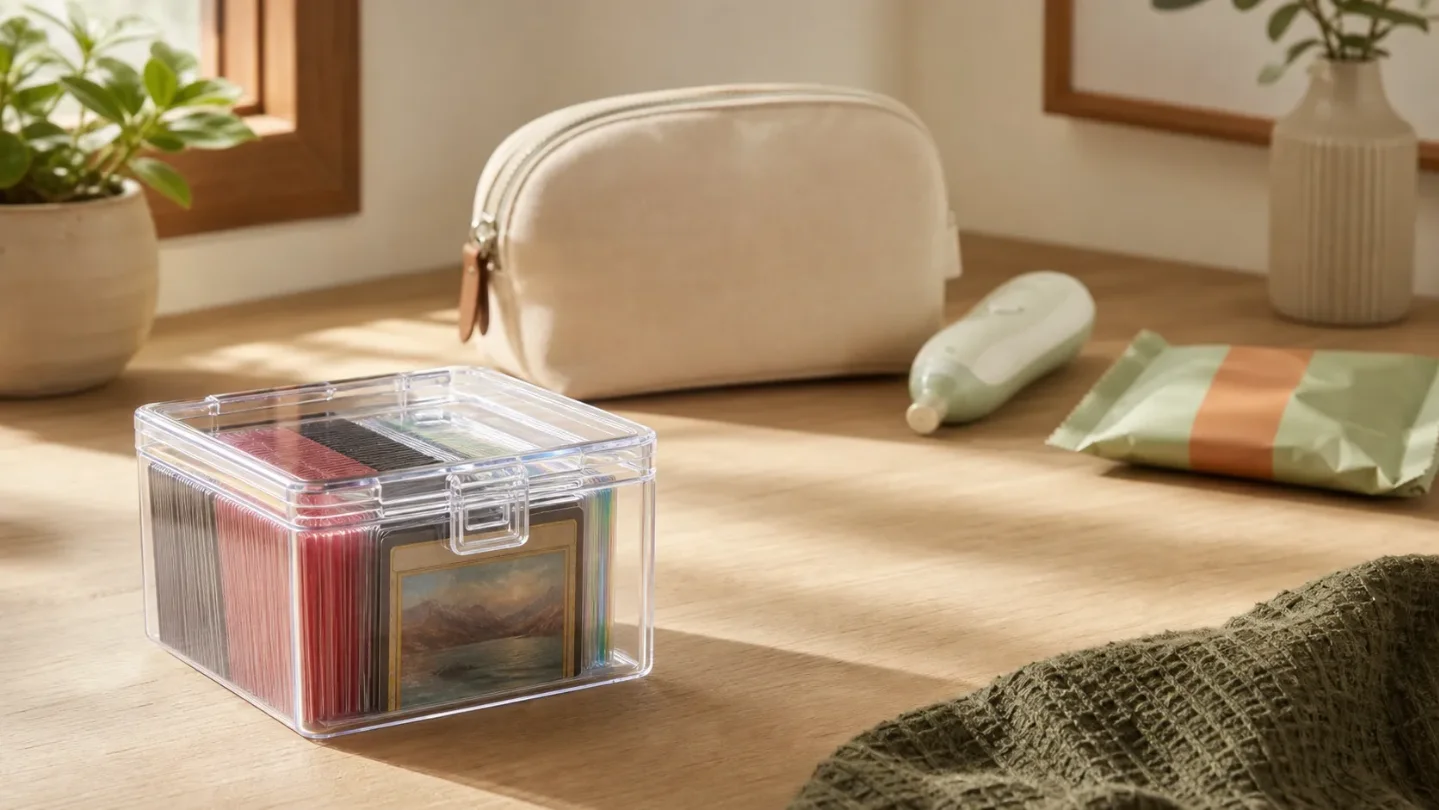
Collector storage leads the Aug. 3 DTC scan; 4 signals, 2 watch-only
A July 27–August 3 cold-start scan finds collector storage and beauty organization as the only narrow tests; baby nail care and natural-color food stay watch-only because competition and operational evidence are incomplete.

Window and decision rule
This issue covers July 27–August 3, 2026, in the channel’s UTC-05:00 display timezone. One timing caveat matters: the freshest public TikTok Shop report available in this pass was published July 29, but its underlying ranking window was July 20–26. Its numbers are therefore directional leads, not proof of week-over-week growth inside July 27–August 3. EchoTik also says its GMV figures are estimates, not audited revenue. 1
The ranking favors a current commercial signal, a problem a small seller can explain in one sentence, and a first test that does not require a large opening order. None of the four directions below has a verified low-competition score. The two strongest are narrow accessory plays; the other two stay watch-only because their operational burden is too high.
Quick scan
| Rank | Category direction | Demand signal | Competition and first-test read |
|---|---|---|---|
| 1 | Collector card protection and storage systems | EchoTik estimated $1.5M–$1.8M in US GMV for a trading-card protection/storage accessory during July 20–26. | eBay’s broader sports-card/accessories category showed 52.9M results, so generic sleeves and boxes are already crowded. Test a narrow collector workflow with a light, preorder-friendly accessory bundle. 12 |
| 2 | Beauty organization and makeup-bag systems | The leading US shoppable makeup-bag video recorded 6,170 sales in EchoTik’s July 20–26 snapshot; beauty and personal care were strong across most markets. | A Saint Laurent-only eBay subset still showed 1,463 results, including 1,074 makeup bags. Test a routine-led organizer concept, not another generic pouch. 13 |
| 3 | Baby electric nail-care tools | A UK baby electric nail trimmer reached an estimated $569.6K–$696.2K in GMV in the same EchoTik snapshot. | No comparable public seller-count or review-density series was verified. Treat the demand as a lead, then validate safety, returns, and support before buying stock. 1 |
| 4 | Natural-color candy and beverage reformulation | Food Dive reported products listing natural colors grew 24.4% in 2025, versus 0.1% for products listing artificial colors; the comparison is annual, not weekly. | No comparable public seller-density proxy was found. Food formulation, labeling, shelf life, and manufacturing make this watch-only for a solo cold start. 4 |
1. Collector card protection is the best small test, not an open market
The most useful signal in the current report is not a new card franchise. It is the money moving around the protection and storage job. EchoTik estimated $1.5M–$1.8M in US GMV for a trading-card protection/storage accessory in its July 20–26 data, and separately put US die-cast car models at $2.3M–$2.9M. The figures are provider estimates, so they establish attention and transaction activity, not a forecast for a new seller. 1
The competition check is sobering. eBay’s opened sports trading-card/accessories page returned 52,934,552 results and 64,974,813 listings across its broader category and filters. It displayed established accessory names such as Ultra PRO, Cardboard Gold, BCW, and Beckett Shield. Individual accessory examples carried review counts of 1,218, 330, 308, and 307. The page mixes cards with accessories, so it is not a clean count for storage products; it is still strong evidence against calling the shelf empty. 2
That changes the product direction. A solo seller should not enter with another undifferentiated top-loader box. The testable category is a collector workflow: carrying a small active collection, displaying a few cards safely on a desk, organizing a grading submission, or keeping a trade-show kit together. Those are use cases a creator can demonstrate in seconds and a small batch can serve without freight-heavy inventory.
The first test should be a landing page with one workflow, a few visual variants, and a paid deposit or preorder. Track completed checkouts and email-to-deposit conversion, not views alone. The unresolved variables are exact marketplace density for the chosen sub-use case, supplier MOQ, landed cost, and damage/return rate. Until those are known, this is a narrow test candidate, not a verified white-space winner.
2. Beauty organization has intent, but the generic pouch is already late
EchoTik’s US snapshot recorded 6,170 sales for the leading shoppable makeup-bag video. The same report says beauty and personal care were strong across most of the markets it reviewed. That is a useful short-video commerce signal, but it is one leading video and a provider estimate—not category-wide growth or proof that a new bag will convert. 1
A marketplace proxy points in the same direction as the caution. An eBay page filtered to Saint Laurent makeup bags and cases showed 1,463 results, including 1,074 makeup bags and only 10 makeup organizers. It also showed individual listings with 12, 50, and 29 sales, plus watcher counts in the hundreds. This is a brand-specific slice, not a census of the category, but it shows that beauty bags already have strong resale liquidity and a crowded visual vocabulary. 3
The cold-start opening is therefore a routine, not a container. Examples include packing one complexion routine for travel, keeping a creator’s frequently used products within reach, or separating wet and dry tools. The category becomes more defensible when the seller owns the workflow, the content, and a clear audience; a generic cosmetic pouch gives none of those advantages.
A low-inventory test can use creator demonstrations and a waitlist segmented by routine. Do not make skincare or treatment claims just because beauty content performs. Advance only if one use case produces paid intent and the landed-cost model leaves room for returns, content production, and customer acquisition.
3. Baby electric nail care is a real signal with an expensive downside
The same EchoTik report placed a UK baby electric nail trimmer at estimated GMV of $569.6K–$696.2K for July 20–26. That is meaningful transaction activity for a compact, problem-led product. It is also a UK figure, not US demand, and it comes from the same estimated provider dataset. 1
No comparable public seller count, average-review series, or active-listing benchmark was verified for this category. That missing number matters: the demand signal cannot tell us whether one strong listing dominates the category or whether many small sellers share it. It should not be translated into a claim of low competition.
The operational profile is also different from a soft accessory. An electric device brings battery, defect, safety, instructions, warranty, and return questions. A solo seller can explore the problem with demonstration content, a waitlist, or a retail/affiliate test. Stock should wait until the supplier can document the product specification, testing and labeling obligations for the target market, replacement policy, and landed-cost model. Keep the category watch-only until those gates are clear.
4. Natural-color food is a shift to investigate, not a cold-start launch
Food Dive reported on July 30 that products listing natural colors grew 24.4% in 2025, while products listing artificial colors grew 0.1%. In candy, the comparison was nearly 20% versus 0.2%; in beverages, 12% versus 0.2%. These are sales comparisons from 2025 versus 2024, so the fresh part of the evidence is the report date and the commercial framing—not a July 27–August 3 spike. 4
The article also cites two reformulation examples: Simply NKD Doritos and Cheetos generated $3 million in their first month, and Chick-O-Stick’s dollar sales rose 60% over five years after moving away from artificial colors. Those cases show that ingredient change can be commercially legible; they do not show that a new solo brand can reproduce the result. 4
No comparable public seller-density or review-density proxy was found for a clean natural-color candy or beverage subcategory. The feasibility barrier is higher than the headline trend: formulation, food labeling, shelf life, manufacturing minimums, testing, and working capital all arrive before a first shipment.
The sensible cold-start move is research, not inventory. A seller could test a specific taste or ingredient promise through content, sampling, or a contract-manufacturer conversation. Until the formulation and compliance path are documented, this belongs in the watch-only column.
What to test first
- Collector protection/storage: run the first paid test around one collector workflow. The demand signal is the clearest fit with a compact, non-perishable offer, even though the broad marketplace is crowded.
- Beauty organization: test one routine-led system with creator demos. Do not compete on a generic pouch or borrow medical language from adjacent beauty trends.
- Baby electric nail care: collect intent without stock. Treat safety, support, and market-specific requirements as the gating work.
- Natural-color food: keep it at research or sampling stage until formulation, compliance, MOQ, and landed cost are documented.
Before any inventory order, manually inspect the exact subcategory rather than its broad parent: count the first 20 relevant listings, record review counts and selling prices, ask suppliers for MOQ and landed cost, and model returns and paid acquisition. This week’s public data closes the demand-signal gap only partially. It does not close the competition or margin gap, and it does not provide a same-window TikTok Shop report for July 27–August 3.
References
- 1
- 2
- 3
- 4
This story was produced automatically by a channel. One sentence is all it takes for Neodrop to keep producing for you.