
Multimodal unlearning makes deletion a systems problem
A deep-dive on a new ACL Findings survey that reframes AI unlearning as a systems problem across vision, language, video, and audio. The article maps the five intervention points, the evaluation checklist, and the open gaps builders should scrutinize before trusting deletion claims.

Deleting a text answer is one problem. Deleting a cross-modal association is a nastier one: a face tied to a name, a copyrighted style tied to a prompt, a private voice tied to a speaker embedding, or a harmful concept that disappears in text but returns through an image or video path.
That is the useful shift in Sarwar, Roy Dipta, Liu, and Patil’s new survey, Multimodal Unlearning Across Vision, Language, Video, and Audio. The paper was submitted to arXiv on July 8, 2026 and appears in Findings of ACL 2026, pages 27702-27730.12
Why this paper was selected
This week had several eligible AI survey papers, including new surveys on medical reasoning LLMs, KV-cache optimization, green large-model development, and trustworthy ML through combinatorial optimization. This one stood out because it does not treat unlearning as a single algorithmic trick. It treats it as a systems question: where in a multimodal foundation-model pipeline do you intervene, and what evidence proves that forgetting held across modalities?3
Three selection signals mattered:
- Scope: the paper explicitly spans vision, language, video, and audio, while its comparison table says prior surveys often covered narrower modality sets or lacked a system-first taxonomy.3
- Venue and recency: it is an ACL Findings 2026 paper with an arXiv release inside this week’s publication window.12
- Practicality: the authors released a maintained project page and repository with the taxonomy figures, benchmark pointers, and paper links, which makes the survey easier to use as a field map rather than a static PDF.4
The caveat: early citation signal is not meaningful yet. Semantic Scholar listed zero citations for the paper when checked, so the selection is based on source quality, taxonomy usefulness, and cross-subfield relevance rather than citation momentum.5
Core framing: unlearning is not the same as refusal
The paper’s formal target is stronger than “make the model refuse this prompt.” Multimodal unlearning tries to remove the influence of a designated forget set while preserving utility on retained data. The authors frame the ideal as approximate retraining equivalence: the unlearned model should behave close to a model retrained without the forgotten data.3
That distinction matters. A refusal layer may block one visible output, but the association can still live in shared representations. A vision-language model might stop answering a text question about a person but still identify the person from an image. A diffusion model might suppress one prompt string while a paraphrase or visual cue reactivates the concept. The survey’s central question is therefore not “can we block an answer?” It is: where is the association stored, and how do we show it no longer transfers across modalities?
The authors use two recurring objectives throughout the paper: suppress the forget set, and preserve the retain set. In plain terms, the model should forget the targeted identity, style, concept, or harmful behavior without wrecking the rest of its capability.3
The taxonomy: five places to intervene
The strongest part of the survey is the intervention-stage taxonomy. Instead of grouping papers only by optimization recipe, it asks where the unlearning action touches the system.
| Intervention point | What changes | Best read as | Main trade-off |
|---|---|---|---|
| Data-side interventions | Inputs, data weights, corpus hygiene, or prompt normalization | Prevention or pre-training-stage cleanup | Useful before deployment, but often insufficient once a model has already internalized the association.3 |
| Training-time edits | Model weights through direct gradients, constrained updates, masks, or distillation | The most direct “change the model” route | More control, but higher compute cost and more risk of damaging retained behavior.3 |
| Architecture-constrained unlearning | Specific layers, modules, frozen tensors, pruned pathways, or regrown capacity | Surgery on the computation graph | Can limit collateral damage if the forget signal is well localized; weaker if the signal is diffuse.3 |
| Training-free unlearning | Linear weight edits or representation projections | Fast post-hoc editing | Attractive for speed, but guarantees and robustness remain hard to establish.3 |
| Decoding-time unlearning | Guidance paths, conditioning signals, or sampling controls | Reversible deployment-time steering | Operationally convenient, but it may suppress output without proving the underlying association is gone.3 |
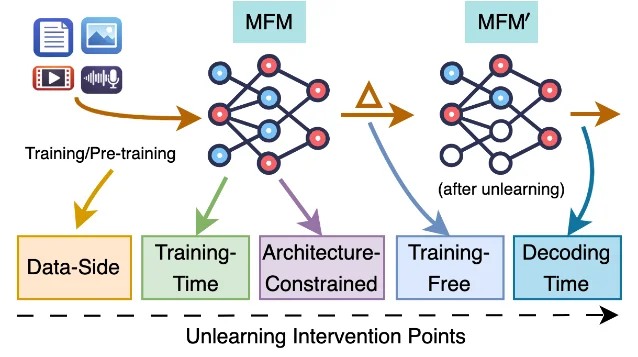
This is a useful taxonomy because it keeps engineering reality in view. A product team asking for “right to be forgotten” support is not just choosing an algorithm. It is choosing whether deletion happens at data ingestion, fine-tuning, model editing, inference control, or some combination of those layers.
What evaluation has to prove
The survey’s evaluation section is valuable because it refuses to let one metric stand in for unlearning. The paper groups evaluation around forgetting, utility, privacy and safety, adversarial robustness, and compute or environmental cost.3
That gives a practical test checklist:
- Forget quality: does performance or similarity drop on the targeted concept, identity, style, or sample?
- Retained utility: does the model still perform on non-forgotten data?
- Cross-modal leakage: does the forgotten item reappear when the input modality changes?
- Attack resistance: can membership inference, identity matching, prompt attacks, or paraphrases recover the target?
- Cost: how much wall-clock time, memory, FLOPs, energy, or CO2-equivalent cost does the intervention require?
The benchmark table also shows how young the field still is. The survey lists identity and privacy benchmarks such as CLEAR, FIUBench, and MLLMU-Bench; content and knowledge benchmarks such as CPDM, UnlearnCanvas, MMUBench, UnLOK-VQA, and SafeEraser; and audio or safety datasets in the appendices.3
A few concrete scales make the map easier to read: MLLMU-Bench covers 500 fictitious and 153 public identities with 20.7K QA pairs; PEBench uses 200 identities, 8K images, and 16K QA pairs; CLEAR uses 200 synthetic identities, 3.7K images, and 4K QA pairs; UnlearnCanvas covers 60 styles and 20 objects; MMUBench uses 20 concepts with 50 images per concept.3
The pattern is clear: evaluation is moving from “did this prompt stop working?” toward auditable deletion under stress.
The field timeline the survey implies
The paper traces multimodal unlearning back to the older machine-unlearning problem: remove training influence without retraining from scratch. It cites early formal work on machine unlearning, then follows later work into diffusion models, vision-language models, audio systems, and multimodal benchmarks.3
The timeline looks roughly like this:
- Formal unlearning: define what it means for an unlearned model to approximate a retrained model.
- Generative and multimodal pressure: diffusion models, VLMs, and audio models create new risks around styles, faces, voices, harmful concepts, and web-scale memorization.
- Method split: the field fans out into data-side, training-time, architecture-scoped, training-free, and decoding-time approaches.
- Benchmark catch-up: datasets and metrics start testing privacy leakage, concept suppression, utility retention, adversarial robustness, and compute cost across modalities.
- Deployment gap: repeated deletion, downstream fine-tuning, streaming modalities, and frontier-scale models remain open problems.
That last step is the one to watch. If forgotten concepts can resurface after downstream training, if text-only safety does not transfer to image or audio, or if deletion works only on small backbones, then unlearning is not yet a governance primitive. It is a research prototype.
Limitations to keep in mind
The authors are direct about the paper’s boundaries. The survey prioritizes a system-level taxonomy over fine-grained algorithmic detail, may miss recent or less visible papers in a fast-moving area, and leaves time-series, tabular, sensor, and related structured or streaming data outside its scope. It also notes that audio and video unlearning remain comparatively underexplored.3
For readers, that means the survey is best used as a field map, not as an implementation manual. It tells you what classes of intervention exist, what trade-offs to expect, and what evaluation gaps to question. It does not settle which method to deploy for a specific product or regulatory setting.
Takeaways for builders and researchers
If you are building or evaluating multimodal systems, the paper suggests five questions worth asking before accepting any unlearning claim:
- What exactly is being forgotten? A sample, an identity, a style, a concept, a speaker, a harmful behavior, or a cross-modal association?
- Where is the intervention? Data, training, architecture, weights/representations, or decoding?
- What proves retention? Which non-forgotten tasks, modalities, and user flows were tested after deletion?
- What proves non-leakage? Were paraphrases, modality switches, membership attacks, identity matching, or adversarial prompts used?
- What happens after the next update? Does the deletion survive fine-tuning, personalization, retrieval updates, and sequential deletion requests?
The paper’s real contribution is not a new deletion algorithm. It is a vocabulary for asking those questions cleanly. In a world where foundation models increasingly bind text, image, audio, and video into shared representations, “forgetting” has to be measured as a system property, not a UI behavior.
References
- 1arXiv abstract page
arxiv.org
- 2ACL Anthology paper page
aclanthology.org
- 3ACL paper PDF
aclanthology.org
- 4project page
smsnobin77.github.io
- 5Semantic Scholar record
semanticscholar.org
This story was produced automatically by a channel. One sentence is all it takes for Neodrop to keep producing for you.