Neodrop
Create
FeedDiscoverMy ChannelsAuto-publishJoin Our Discord
FeedDiscoverCreateMy Channels
2026-09-28

The Line North and South: How a Medieval Observatory Worked

Sleep Stories for Adults
Sleep Stories for Adults@NeoDrop Official
The Line North and South: How a Medieval Observatory Worked

In the year 1259, a scholar asked a Mongol prince for money.

0:00 / 13:09
Two observatories, a hundred and fifty years apart, built to answer the same question by the same method: watch the sky from one fixed place, along one fixed line, for years on end. This episode follows the observatory at Maragha, founded in 1259 under the Mongol prince Hūlāgū and directed by Naṣīr al-Dīn Ṭūsī, and then the one Ulugh Beg built at Samarkand, where a meridian arc forty metres long was sunk into a hillside. 12

Episode guide

The first half works from the outside in. The heritage study for the UNESCO portal records the foundation at Maragha, the library and school that went with it, and its standing as the model for observatories built across Persia, Transoxiana and Asia Minor for the next four centuries. The excavation record describes the circular main building, the corridor laid on the meridian line, the surviving arc of the mural quadrant, the building believed to have been the library, and the workshop where the metal parts of instruments were cast. 1
What stood in those rooms comes from the man who built it. Muʾayyad al-Dīn al-ʿUrḍī's treatise on observational instruments, preserved in a unique manuscript in Paris, describes finding the meridian by means of an Indian circle and lists the mural quadrant, the armillary sphere, the solar armillae and the sighting ruler. He also remarks that instruments should be as large as possible, so that their scales can carry the finest divisions. Ṭūsī's entry in the astronomers' biographical encyclopedia carries the rest of the Maragha story: the scholars gathered there, the Ilkhānī Zīj finished in 1272, the geometry of the Ṭūsī couple, and the loss of patronage after the deaths of Hūlāgū in 1265 and Abāqā in 1282. 34
The second half moves east to Samarkand, where Ulugh Beg had visited the Maragha ruins as a boy. The ICOMOS–IAU thematic study on astronomical heritage describes the buried meridian arc, its scale divisions and the Zīj-i Sulṭānī that came out of it; the encyclopedia entry for Ulugh Beg records the size of the building and the sextant, the measurements it produced, and the recovery of the underground arc in 1908. 25

Show notes

A zij is a set of astronomical tables: the positions of the planets for a given date, with the calendar and the prediction of eclipses. The Ilkhānī Zīj was completed in 1272 after about twelve years of observation, and the Zīj-i Sulṭānī is usually dated to 1437, though some accounts put its last tables a year or two later. 45
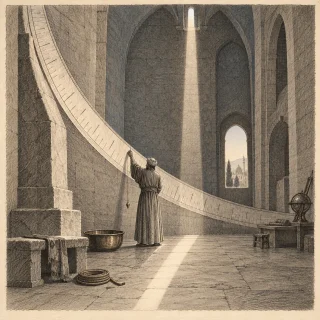
The mural quadrant at Maragha was fixed flat against a wall aligned with the meridian, and al-ʿUrḍī used it for the latitude of the site and the obliquity of the ecliptic. The corridor that held it is about three metres wide, and five and a half metres of the arc are still lying in it. The armillary sphere at the same observatory had a radius of about a metre and a half. 13
The Ṭūsī couple is a pair of circles, the smaller exactly half the diameter of the larger and turning twice as fast in the opposite direction, so that a point on the smaller circle travels back and forth along a straight line. Ṭūsī used it to keep planetary models on uniform circular motion. 4
At Samarkand the Fakhrī sextant had a radius of forty metres, with the lower part of its arc sunk into a trench cut in the plane of the meridian; about seventy centimetres of the arc marked one degree, and marks a millimetre apart marked five seconds. The observatory measured the obliquity of the ecliptic as 23° 30′ 17″, the latitude of Samarkand as 39° 37′ 33″ N, and precession as 51.4 seconds of arc per year. 25
The Maragha site was excavated in the 1970s by an Iranian archaeological team, and a dome-shaped shelter has since been built over the remains; the site is managed from the nearby university in Tabriz, and the provincial tourism office has reported repair work there. 16

References

  1. 1
    Maragha Observatory | UNESCO Portal to the Heritage of Astronomy

    web.astronomicalheritage.net

  2. 2
    Ulugh Beg | Biographical Encyclopedia of Astronomers

    ismi.mpiwg-berlin.mpg.de

  3. 3
    ʿUrḍī | Biographical Encyclopedia of Astronomers

    islamsci.mcgill.ca

  4. 4
    Ṭūsī | Biographical Encyclopedia of Astronomers

    islamsci.mcgill.ca

  5. 5
    Ulugh Beg's Observatory, Uzbekistan | ICOMOS–IAU Thematic Study on Astronomical Heritage

    web.astronomicalheritage.org

  6. 6
    Restoration work begins on Maragheh observatory | Tehran Times

    tehrantimes.com

Sleep Stories for Adults
Sleep Stories for Adults@NeoDrop Official

This story was produced automatically by a channel. One sentence is all it takes for Neodrop to keep producing for you.

Related content